




Latest Insights
AI Medical Scribe Benefits Beyond Time Savings: Accuracy, Burnout, and Revenue
- Oct 27, 2026
- Sajid M.
- AI medical scribe benefits
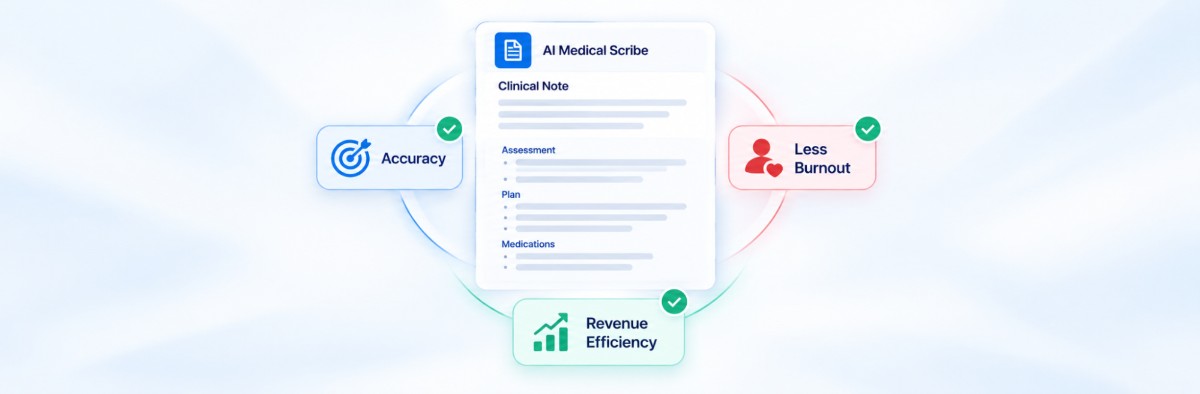
AI medical scribes are often introduced with a simple promise: spend less time documenting and more time with patients. That benefit matters, but it barely scratches the surface of what effective AI-assisted clinical documentation can change. When implemented correctly, medical scribe technology can influence documentation accuracy, clinician workload, patient experience, coding quality, revenue capture, and even the operational resilience of a healthcare organization.
From our perspective at Testiva, the more interesting question is not whether an AI medical scribe can generate a note quickly. It is whether the system can generate consistently accurate, clinically appropriate, secure, and usable documentation under real-world conditions. That is where rigorous software and AI quality assurance becomes essential. In healthcare, shaving minutes from documentation is useful; producing unreliable information faster is not.
As healthcare organizations evaluate AI scribes, the conversation therefore needs to move beyond productivity. The real business case rests on how the technology affects quality across the entire clinical and financial workflow.
What Does an AI Medical Scribe Actually Do?
An AI medical scribe uses technologies such as speech recognition, natural language processing, and generative AI to convert clinician-patient conversations into structured clinical documentation. Depending on the product, it may identify symptoms, medical history, diagnoses, treatment plans, medications, follow-up instructions, and other information before preparing a draft note for clinician review.
The important word here is “draft.” AI medical scribes are not simply digital replacements for keyboards, nor should their output automatically be treated as unquestionable clinical truth. They operate inside complex environments involving different accents, specialties, terminology, speaking styles, background noise, workflows, and electronic health record systems.
A useful AI scribe must therefore do more than recognize words. It needs to understand enough context to organize information correctly while giving clinicians an efficient way to verify, modify, and approve what ultimately becomes part of the medical record.
Better Documentation Accuracy Can Improve the Entire Workflow
Accuracy is one of the most consequential benefits and risks of AI-assisted documentation. Traditional documentation can contain mistakes caused by rushed data entry, copy-and-paste habits, memory gaps, interruptions, or notes completed hours after an encounter. An AI scribe can reduce some of those problems by capturing information during the conversation and organizing it immediately.
That does not make AI inherently accurate. A system can misinterpret medical terminology, confuse speakers, omit clinically significant details, or confidently generate information that was never discussed. These failure modes make accuracy testing especially important before an AI scribe is trusted at scale.
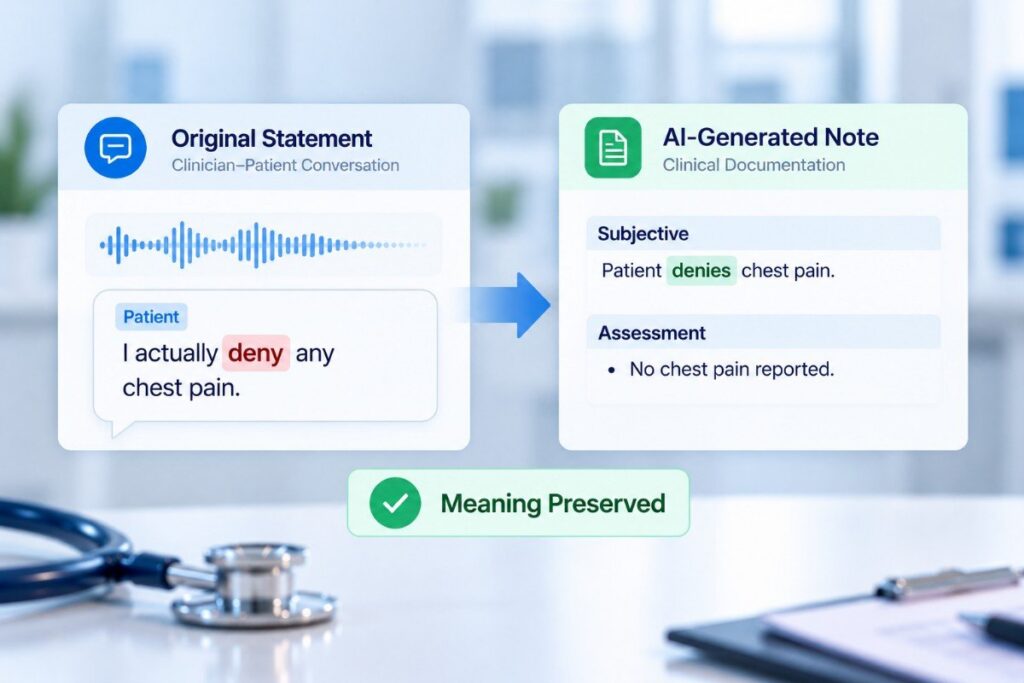
Healthcare organizations should evaluate more than transcription accuracy. Testing should examine whether the system preserves clinical meaning, assigns information to the correct patient or encounter context, handles negation correctly, distinguishes current conditions from historical ones, and avoids inventing unsupported details.
Consider the difference between “patient has chest pain” and “patient denies chest pain.” A tiny linguistic error creates an enormous clinical difference. Medical AI quality lives in details like these.
AI Scribes Can Help Reduce Documentation-Driven Burnout
Clinical documentation is necessary, but the way it fits into modern healthcare workflows can create significant administrative pressure. When clinicians spend substantial portions of their day entering information into an EHR, documentation competes directly with patient interaction, recovery time, and personal life.
AI scribes can change that equation by moving documentation closer to the natural clinical conversation. Instead of constantly switching attention between the patient and a computer, a clinician can potentially remain more engaged while the system captures information in the background.
The benefit is not simply “fewer minutes typing.” Reducing repetitive cognitive work can decrease context switching and the mental burden of remembering details for documentation later. It can also reduce the familiar end-of-day backlog in which clinicians finish notes after appointments are complete.
However, poorly designed AI can create a different type of burnout. If clinicians must repeatedly correct inaccurate drafts, navigate awkward interfaces, or double-check unpredictable outputs, the technology simply moves the workload somewhere else. The best AI scribe is not the one that generates notes fastest; it is the one clinicians can reliably review with minimal friction.
Better Documentation Can Strengthen Patient Engagement
There is another benefit that does not appear neatly on a productivity dashboard: attention. During an appointment, patients generally want to feel that their clinician is listening rather than managing a computer.
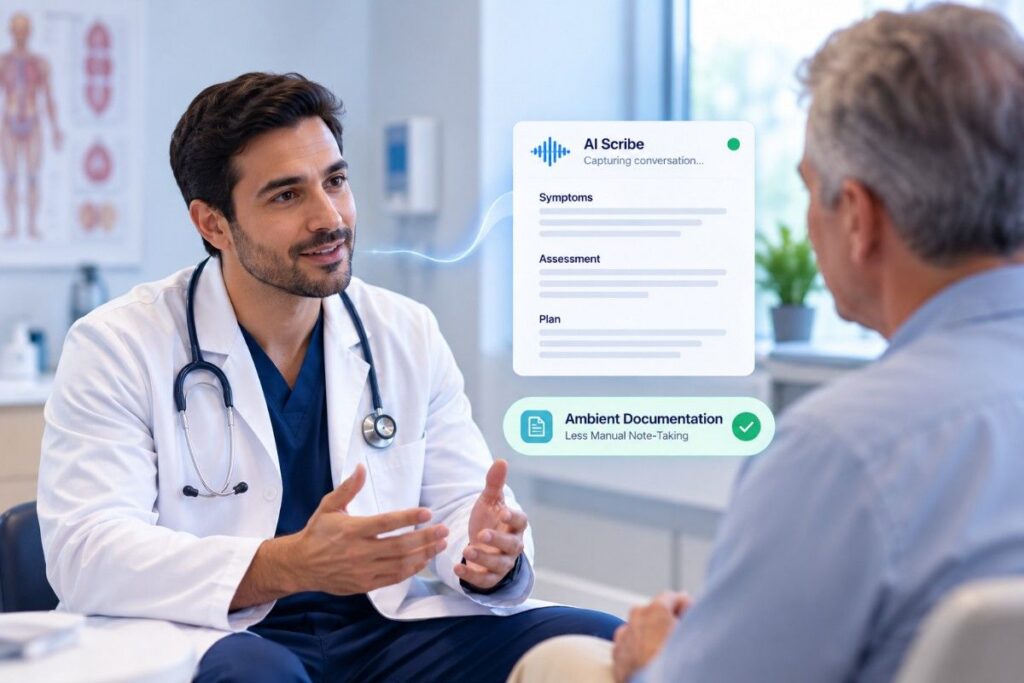
When documentation requires constant keyboard interaction, eye contact and conversational flow can suffer. An effective ambient AI scribe can reduce the need for continuous manual note-taking, allowing the clinician to focus more naturally on the patient.
That can make consultations feel less transactional. Clinicians may have more freedom to listen for subtle details, ask follow-up questions, and communicate treatment decisions clearly rather than mentally dividing their attention between medicine and documentation.
Of course, healthcare organizations must also consider patient consent, privacy, security, and transparency when conversations are processed by AI systems. Convenience cannot outrank trust. Successful implementations need technical safeguards and workflows that make responsible use part of the product rather than an afterthought.
The Revenue Impact Starts With Documentation Quality
AI medical scribes can also influence financial performance, although the connection is more nuanced than “AI equals more revenue.” Healthcare reimbursement depends heavily on documentation. When services, complexity, procedures, and clinical decision-making are documented incompletely, organizations may struggle to support appropriate coding and billing.
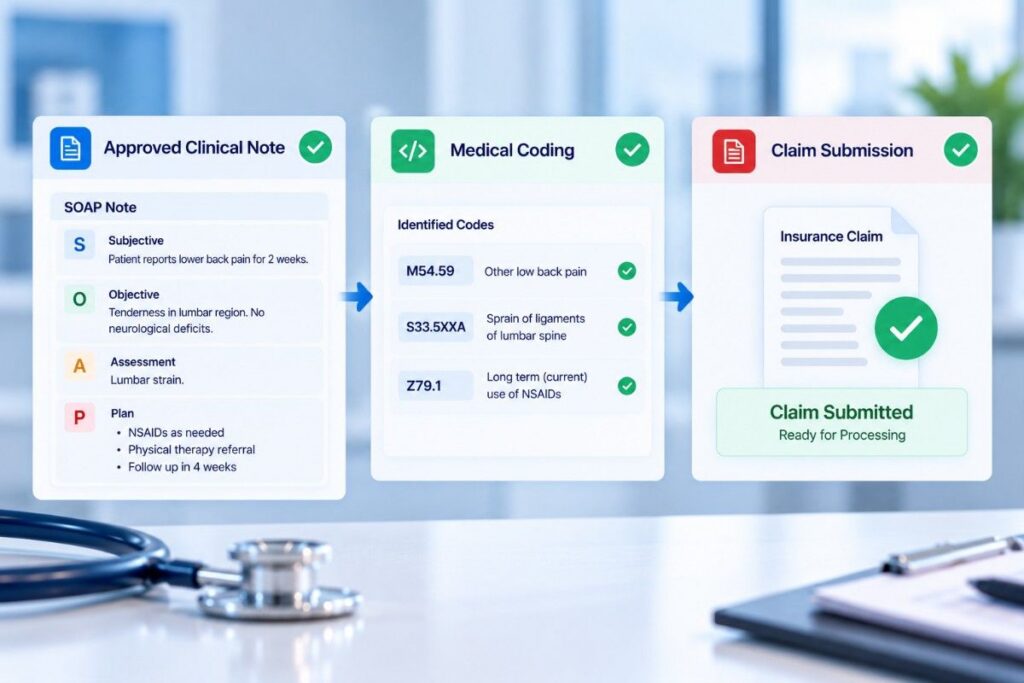
More complete documentation can help ensure that the clinical record accurately reflects what occurred during the encounter. That may give coding and billing teams better source information, reduce ambiguity, and lower the amount of manual clarification required downstream.
There is also an operational capacity angle. If physicians spend less time finishing notes, organizations may be able to improve scheduling efficiency or increase patient capacity without asking clinicians to extend their working day. Even modest improvements become meaningful when multiplied across hundreds or thousands of encounters.
The key is accuracy. An AI scribe that introduces unsupported details can create compliance and billing risks rather than financial benefits. Revenue improvement must come from capturing legitimate clinical work more consistently not from artificially increasing documentation complexity.
Faster Documentation Can Improve Revenue Cycle Efficiency
Clinical documentation sits near the beginning of the revenue cycle. Delays at that stage can cascade into coding delays, claim submission delays, and additional administrative work. If AI-assisted documentation enables clinicians to complete and approve notes sooner, downstream teams can potentially begin their work earlier.
Better structured notes can also reduce unnecessary back-and-forth between clinicians and coding teams. When relevant information is clear and complete, fewer encounters may require clarification before coding or billing can proceed.
Organizations should measure these outcomes rather than assuming them. Useful indicators include time to note completion, clinician correction rates, coding queries, claim processing time, denial patterns, and documentation-related revenue leakage.
This is where the geeky part gets interesting: the value of an AI scribe is measurable across a chain of connected systems. Optimizing note generation alone misses most of the picture.
Reliability Matters More Than a Great Demo
AI medical scribes frequently look impressive in controlled demonstrations. Real clinics are considerably messier. People interrupt each other. Patients speak quietly. Medical terminology overlaps with ordinary language. Microphones vary. Network connections fail. Multiple speakers may enter a room.
Quality assurance therefore needs to replicate realistic conditions. Testing should include different accents, speech speeds, specialties, terminology, device configurations, background noise levels, interruptions, long encounters, and unusual conversational structures.
Integration testing matters just as much. A perfectly generated note is not useful if information is truncated when transferred into the EHR, formatting breaks, the wrong fields are populated, or a workflow failure associates content with an incorrect context.
At Testiva, this is where our QA testing perspective becomes particularly relevant. AI-enabled healthcare software needs functional testing, integration validation, performance testing, usability evaluation, and carefully designed edge cases. The objective is not to prove that the software works once. It is to discover where it stops working before clinicians and patients discover those limits themselves.
Human Oversight Remains a Critical Safety Layer
AI medical scribes should support clinical judgment rather than replace it. Even sophisticated models can produce outputs that sound convincing while being incomplete or incorrect. Healthcare documentation demands a higher standard than linguistic fluency.
Clinician review should therefore remain a meaningful part of the workflow. Interfaces should make generated notes easy to inspect, edit, and approve without turning verification into another exhausting administrative process.
Organizations should also monitor performance after deployment. Models, integrations, workflows, and user behavior can change over time. Production monitoring and regression testing help identify whether software updates introduce new documentation errors or degrade previously reliable functionality.
The goal is calibrated trust. Clinicians should understand where the technology performs well, where additional attention is required, and what happens when confidence is low or the system encounters an unexpected situation.
Measuring AI Medical Scribe ROI Beyond Minutes Saved
Time saved per encounter is an attractive metric because it is simple. It is not sufficient. Healthcare leaders evaluating AI scribes should examine outcomes across clinical, operational, human, and financial dimensions.
A mature evaluation might consider documentation correction rates, note completion times, clinician satisfaction, after-hours documentation, patient throughput, coding queries, claim denials, revenue-cycle speed, system reliability, and user adoption. These measurements reveal whether the technology is actually improving operations rather than merely producing impressive productivity statistics.
Organizations should establish baselines before deployment and continue measuring after implementation. They should also segment results by specialty, workflow, location, and user type because aggregate numbers can conceal important weaknesses.
Ultimately, ROI emerges from a combination of saved time, reduced administrative friction, better documentation quality, improved clinician experience, and more efficient financial operations.
AI Medical Scribes Are Ultimately a Quality Challenge
The future of AI medical scribes will not be determined solely by how quickly models can generate clinical notes. Speed is rapidly becoming table stakes. The differentiators will be accuracy, reliability, usability, security, interoperability, and the ability to perform consistently in complicated real-world environments.
For healthcare organizations, that changes the implementation question from “How much time can this save?” to “Can we trust this system throughout the clinical workflow?” That is a much tougher question and a much more valuable one.
AI medical scribes can help clinicians reclaim attention, reduce documentation burden, strengthen the quality of medical records, and improve revenue-cycle efficiency. But those benefits depend on software that behaves predictably when conditions are anything but predictable.
That is why serious AI adoption requires equally serious quality assurance. If your organization is building or scaling AI-powered healthcare software, Testiva can help validate the functionality, reliability, performance, and user experience behind it. Start your QA journey today and unlock flawless delivery where software quality matters most.