




Latest Insights
Testing AI Medical Scribes Across EHRs, FHIR, and HL7 Integrations
- Oct 25, 2026
- Sajid M.
- AI Medical Scribe and Integrations
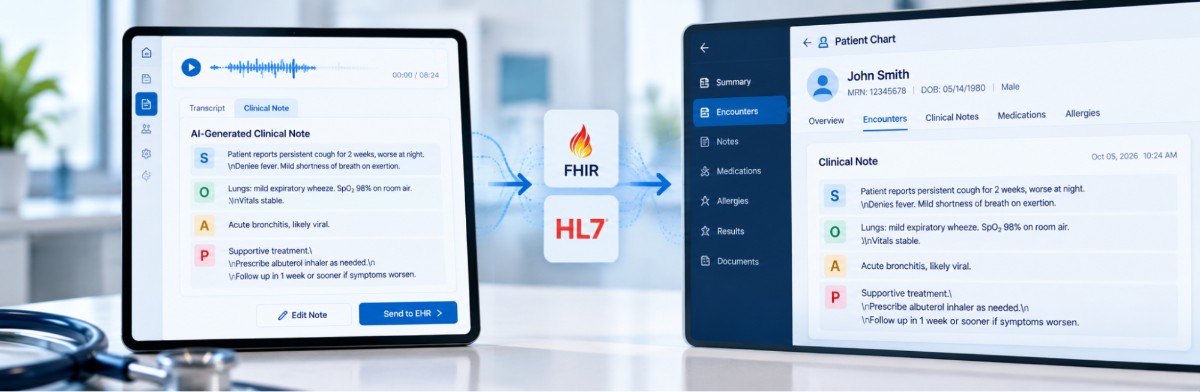
An AI medical scribe can capture a flawless clinical conversation and still fail spectacularly five seconds later. The note might reach the wrong encounter, lose critical context during data mapping, duplicate information, or break when an EHR interprets a FHIR resource differently than expected. In healthcare, “the AI got it right” is only half the story. The integration has to get it right, too.
That is where testing gets interesting. At Testiva, our QA and integration testing work looks beyond transcription accuracy to the entire clinical data journey from spoken words and AI-generated notes to EHR workflows, FHIR APIs, and HL7 messages. When patient information crosses this many boundaries, every handoff becomes a potential failure point, making interoperability testing fundamental to trustworthy AI-powered documentation.
Why AI Medical Scribe Testing Is an Integration Problem
Traditional application testing often begins with deterministic expectations: provide input A and verify output B. AI medical scribes are different. The same clinical conversation can be summarized in slightly different language while remaining clinically equivalent. Consequently, QA teams need to evaluate meaning and downstream behavior rather than relying exclusively on exact text matching.
The scribe also rarely operates independently. It may retrieve patient demographics and encounter context from an EHR, process a conversation, generate a SOAP note or another documentation format, associate diagnoses or medications with the encounter, and return approved documentation to the clinical system. Each transition creates another opportunity for information to become incomplete, duplicated, incorrectly mapped, or attached to the wrong context.
This makes end-to-end testing essential. A perfectly generated note is still a failed outcome if it lands in the wrong encounter, loses attribution metadata, creates duplicate records, or cannot be opened by the clinician.
Testing Across Different EHR Environments
EHR interoperability is rarely as universal as architecture diagrams make it appear. Two platforms may both advertise FHIR support while exposing different resource profiles, extensions, authorization requirements, workflow assumptions, or supported operations. Even deployments of the same EHR can differ because organizations configure templates, fields, permissions, departments, and integration rules differently.
Testing should therefore use a representative matrix of EHR configurations rather than a single “happy path” environment. Teams should verify patient selection, encounter identification, practitioner context, note creation, updates, signatures, error handling, and synchronization behavior. Tests should also cover unusual but realistic conditions such as merged patient records, canceled appointments, multiple open encounters, delayed synchronization, and clinicians switching patients rapidly.
The objective is not merely proving that the scribe can connect to an EHR. QA must establish that the integration preserves clinical context under normal, exceptional, and messy real-world conditions.
Validating FHIR Integrations Beyond Successful API Calls
FHIR provides a standardized framework for healthcare information exchange, but receiving an HTTP 200 response does not prove interoperability. FHIR validation includes considerations such as resource structure, cardinality, value domains, terminology bindings, invariants, profiles, and additional business rules. HL7 also notes that automated validation cannot prove every aspect of conformance, meaning human and workflow-level verification remain important.
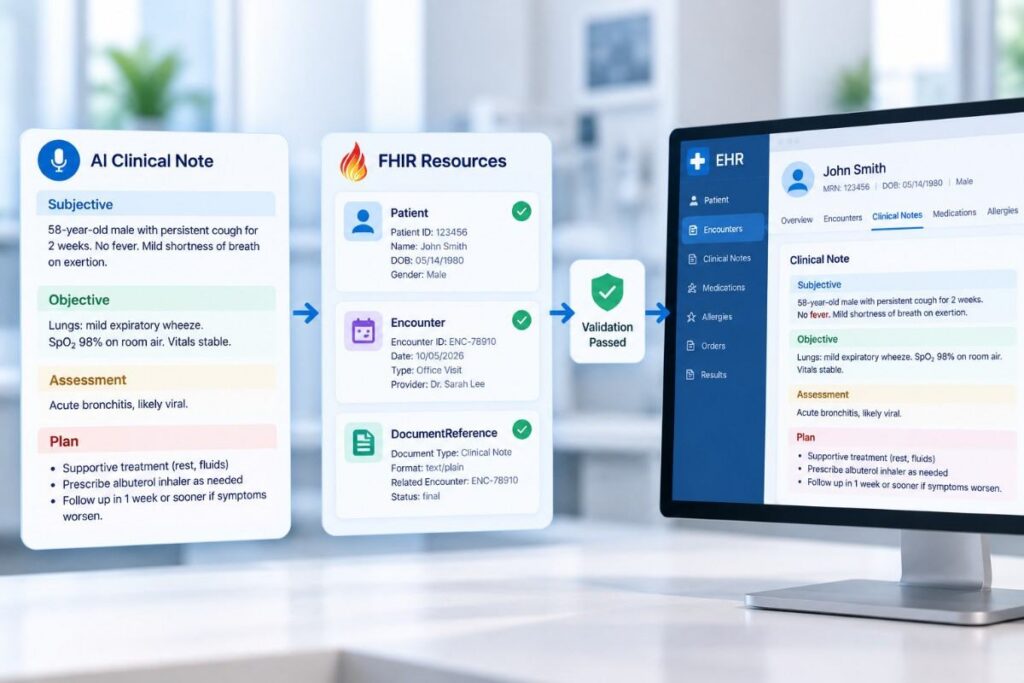
For medical scribes, QA teams should validate every resource involved in the workflow against the expected FHIR version and implementation guide. Depending on the architecture, that could include Patient, Practitioner, Encounter, Condition, Observation, MedicationRequest, Composition, or DocumentReference resources.
Clinical notes deserve particular attention. US Core guidance supports DocumentReference and DiagnosticReport for exchanging clinical notes, with their suitability depending on the nature of the documentation. Tests must therefore confirm not only syntactic validity but also that the chosen resource representation matches the intended workflow.
Profile conformance should be automated wherever possible. Current Inferno tooling, for example, provides test kits capable of validating client and server implementations against multiple US Core versions. However, conformance testing should complement rather than replace application-level QA.
Testing HL7 Interfaces and Legacy Workflows
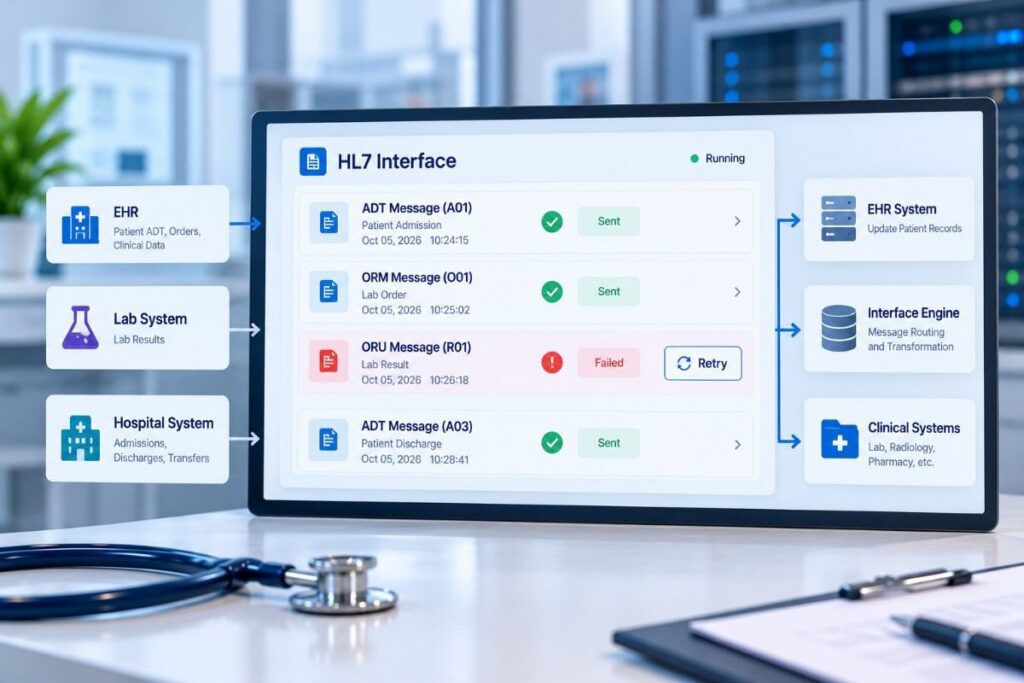
Many healthcare environments still depend heavily on HL7 v2 messaging. An AI scribe entering an established hospital ecosystem may therefore encounter architectures where FHIR handles one portion of the workflow while HL7 messages drive admissions, discharges, transfers, orders, results, or downstream synchronization.
Testing these interfaces requires more than confirming that messages are transmitted. QA engineers should verify segment mapping, identifiers, timestamps, optional fields, code sets, acknowledgments, retries, message ordering, and downstream interpretation. A malformed field may be obvious; a technically valid field containing the wrong encounter identifier is considerably more dangerous.
Resilience testing is equally important. What happens when the receiving interface engine is temporarily unavailable? Does the scribe retry safely? Can retries create duplicate notes? What happens when acknowledgments are delayed or messages arrive out of sequence? Integration testing should deliberately create these conditions because production healthcare systems eventually will.
Clinical Accuracy Must Survive the Entire Data Pipeline
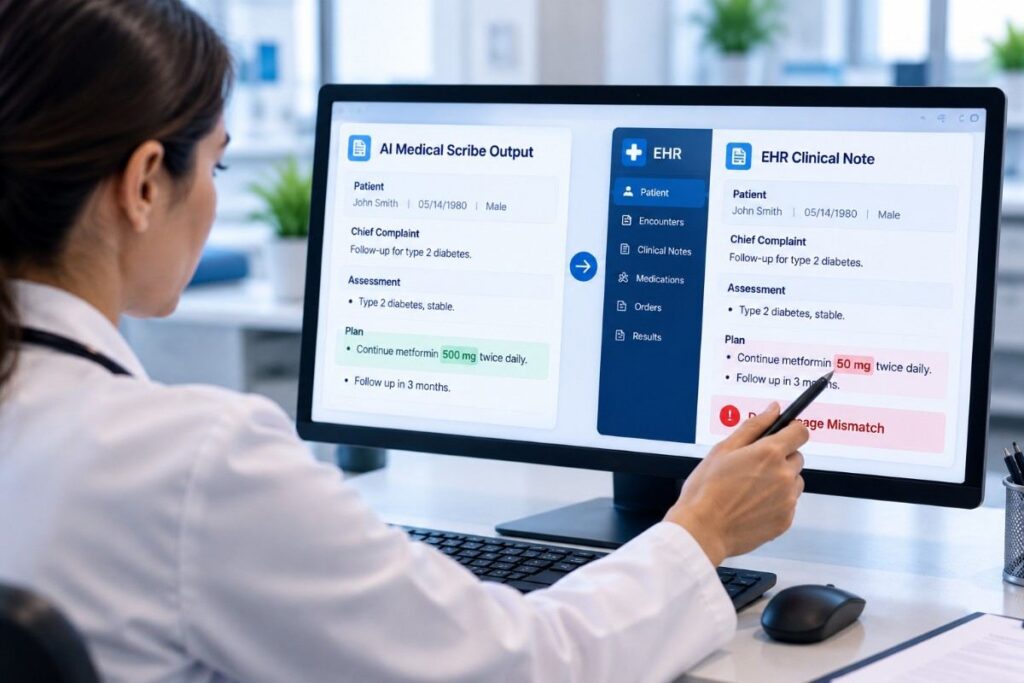
AI accuracy testing usually focuses on whether the model captured what the clinician and patient said. That is necessary, but it represents only the beginning of the verification chain. QA should trace critical facts from spoken conversation through transcription, generated documentation, structured extraction, interoperability payloads, and final EHR presentation.
Consider a dosage such as “5 milligrams twice daily.” The transcript could be correct while the structured medication mapping is wrong. Alternatively, the FHIR payload could contain the correct value while the EHR renders or stores it incorrectly. Without end-to-end assertions, teams may incorrectly classify the model as accurate even though clinicians receive faulty information.
Test datasets should include medications, allergies, negations, family history, symptoms, measurements, abbreviations, similar drug names, interruptions, corrections, and contradictory statements. Specialty-specific scenarios matter too. Cardiology, behavioral health, pediatrics, and orthopedics do not generate identical documentation challenges.
The key principle is traceability: clinically significant information should remain semantically consistent across every transformation.
Testing Hallucinations, Omissions, and Context Leakage
Generative AI introduces failure modes conventional healthcare software does not. A medical scribe may generate plausible information that was never stated, omit a clinically important detail, resolve ambiguity incorrectly, or carry information from an inappropriate context into the current note.
QA teams need evaluation frameworks that classify these failures by clinical significance rather than treating every textual difference equally. Adding an unstated diagnosis deserves greater scrutiny than changing harmless phrasing. Similarly, omitting an allergy, medication change, or negative finding can have a different risk profile from omitting conversational filler.
Context isolation is especially critical. Tests should determine whether information from previous encounters, another patient session, cached prompts, or interrupted workflows can contaminate current documentation. Multi-patient and rapid-switching scenarios are particularly valuable because they stress session boundaries that clean laboratory demonstrations rarely expose.
Security and Authorization Belong in Functional Testing
Medical scribe integrations handle highly sensitive clinical information, so security cannot be relegated to a final penetration-testing phase. Authentication, authorization, session management, auditability, and minimum-necessary access should be tested alongside ordinary functionality.
Where SMART-based authorization is involved, teams should verify scopes, launch context, token expiration, refresh behavior, revoked permissions, and unauthorized resource requests. Current interoperability tooling includes dedicated SMART App Launch conformance testing for supported framework versions.
Negative tests are particularly important. A clinician should not be able to retrieve another patient’s information merely by manipulating an identifier. Expired credentials should fail predictably. Logs should provide enough information for investigation without unnecessarily exposing protected data. Security controls must remain effective during retries, failures, background processing, and recovery, not only during the cleanest successful workflow.
Build a Test Architecture That Reflects Production Reality
The strongest QA strategy combines several testing layers. Component tests can validate transformation logic quickly, contract tests can detect API incompatibilities, conformance suites can evaluate standards implementation, and end-to-end tests can prove that complete clinical workflows behave correctly. Performance, security, resilience, and AI evaluation should then stress those workflows from different angles.
Test data management deserves equal attention. Teams need realistic but appropriately protected datasets representing different demographics, specialties, encounter types, terminology variations, and clinical complexity. Synthetic data can support automation, while carefully governed validation processes may be required for higher-fidelity clinical evaluation.
Automation should prioritize repeatability without pretending every judgment can be reduced to a binary assertion. FHIR schemas and required fields are excellent automation targets. Clinical equivalence and subtle hallucinations may require expert review or carefully designed evaluation models.
Reliable AI Scribes Require More Than a Good Model
An AI medical scribe succeeds only when the entire clinical documentation chain succeeds. Speech recognition, reasoning, note generation, patient context, EHR behavior, FHIR resources, HL7 messages, authorization, and user workflows collectively determine whether clinicians can trust the final result.
That is why interoperability testing should be designed around clinical outcomes rather than isolated interfaces. Teams need to ask whether the right information reaches the right record, in the right structure, for the right user, at the right time and whether the system behaves safely when something goes wrong.
For healthcare software companies building the next generation of AI-assisted documentation, rigorous QA is ultimately a trust mechanism. Test the model, certainly, but test every boundary around it even harder. When AI, EHRs, FHIR, and HL7 behave as one dependable system, clinicians can focus less on documentation mechanics and more on patient care. That is the standard worth engineering for and the foundation for truly flawless delivery.