




Latest Insights
How to Test AI Medical Scribes for Reliability in Clinical Workflows
- Oct 26, 2026
- Sajid M.
- AI Medical Scribe Reliability Testing
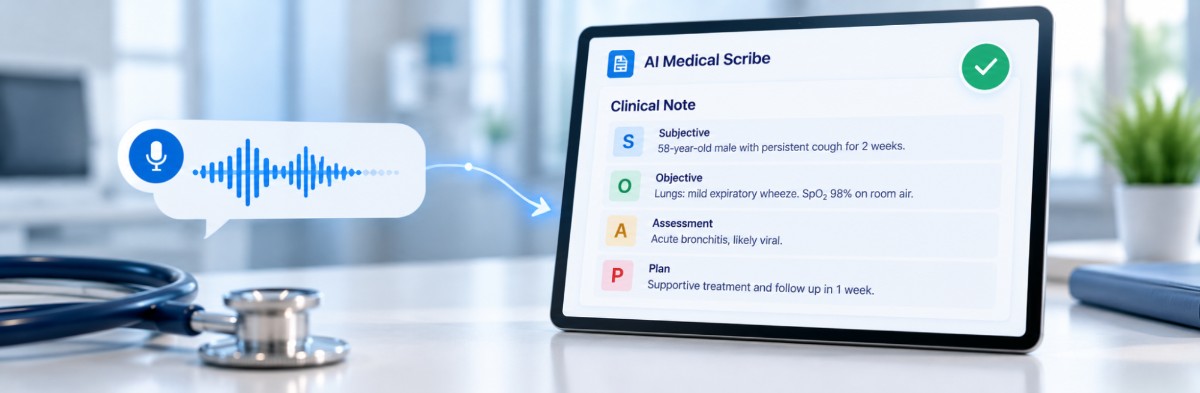
AI medical scribes are quickly becoming part of modern clinical workflows, helping clinicians capture conversations, generate documentation, and reduce time spent on administrative tasks. But healthcare leaves little room for “almost accurate.” A missed medication, incorrect symptom, confused speaker, or fabricated detail can turn a convenient AI feature into a serious reliability risk.
Testing these systems requires more than checking transcription accuracy. Teams must validate clinical context, hallucinations, integrations, performance, security, and real-world workflow behavior. At Testiva, our software QA and functional testing approach focuses on these interconnected risks, helping ensure AI medical scribes remain dependable when clinicians rely on them during everyday patient care.
Start by Defining What Reliability Actually Means
Reliability for an AI medical scribe has several dimensions. A system can achieve impressive transcription accuracy while still generating clinically unreliable documentation. For example, it might correctly hear that a patient previously took a medication but incorrectly place that medication in the current treatment plan. Every word could be recognizable while the resulting clinical meaning is wrong.
Testing should therefore begin with explicit reliability criteria. Teams need measurable expectations for factual accuracy, completeness, attribution, chronology, clinical context, system availability, latency, and workflow consistency. These requirements should reflect the intended use of the product rather than generic AI benchmarks.
The acceptable behavior must also include what the system should do when uncertain. A reliable scribe should not confidently manufacture information simply because audio is incomplete or ambiguous. In healthcare software, graceful uncertainty can be a feature. Flagging unclear information for clinician review is often safer than producing beautifully written fiction.
Test Clinical Meaning, Not Just Transcription Accuracy
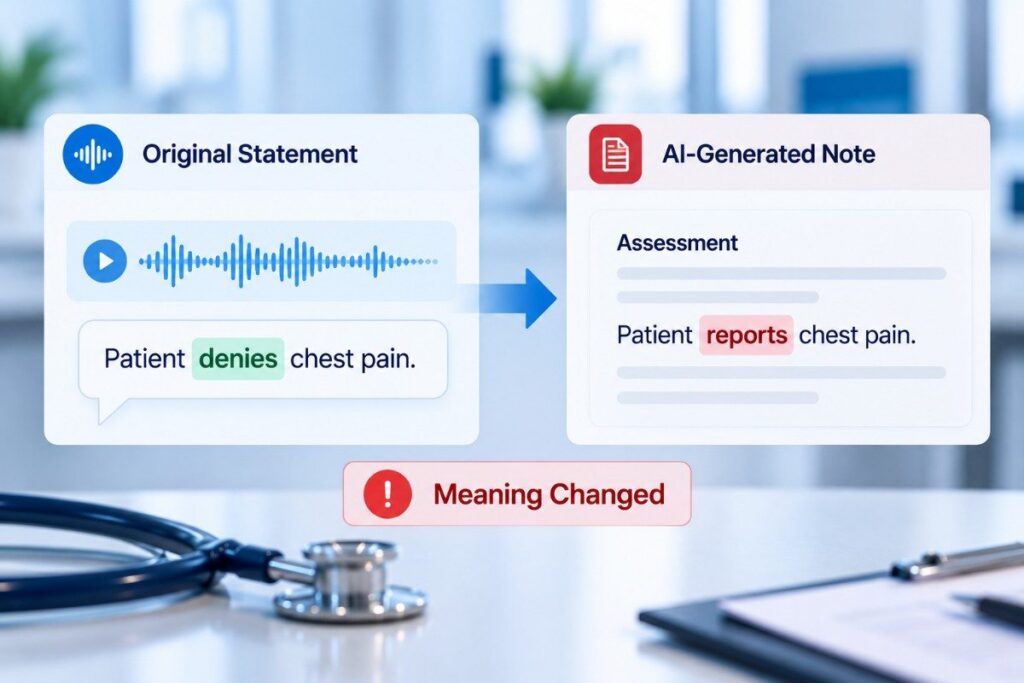
Word error rate can be useful when evaluating speech recognition, but it does not tell the whole clinical story. Consider the difference between “patient denies chest pain” and “patient reports chest pain.” One incorrect word can completely reverse the meaning while leaving the transcript statistically very accurate.
Test cases should therefore evaluate medically significant entities and relationships. Medication names, dosages, frequencies, allergies, symptoms, anatomical locations, diagnoses, test results, procedures, and follow-up instructions deserve particular attention. QA teams should also verify whether negation and uncertainty survive the transition from conversation to generated note.
Chronology is equally important. A patient may describe a medication used five years ago, a procedure performed last month, and symptoms occurring today. The AI needs to distinguish historical information from current clinical status. Testing should deliberately include conversations where similar medical concepts appear across different time periods to expose temporal reasoning failures.
Build Test Data Around Real Clinical Conversations
Perfect studio recordings make poor stress tests. Real consultations include interruptions, accents, incomplete sentences, background noise, medical abbreviations, overlapping speech, family members, nurses entering the room, and clinicians switching rapidly between medical and conversational language.
A strong test dataset should reproduce that diversity without exposing inappropriate patient information. Synthetic conversations, appropriately governed datasets, and carefully anonymized scenarios can be used to create controlled test conditions. The important part is knowing what the expected clinical documentation should contain before the AI processes the encounter.
Scenarios should also vary systematically. Test quiet rooms against noisy environments, short appointments against long consultations, straightforward cases against complex histories, and common terminology against unusual drug or disease names. This turns testing from a collection of demos into an evidence-based reliability program.
Challenge Speaker Attribution and Context
Speaker attribution is one of those features that looks simple until several people start talking. An AI scribe must distinguish what the clinician says from what the patient reports, while potentially handling caregivers, interpreters, trainees, or other staff.
Misattribution can create clinically significant errors. If a physician says, “We should rule out pneumonia,” the generated note should not state that the patient has pneumonia. Similarly, a family member describing their own medical history should not accidentally contribute conditions to the patient’s record.
QA scenarios should intentionally introduce ambiguous speakers, interruptions, corrections, and conversational references such as “she had the same problem.” The goal is to discover whether the system preserves the source and context of information instead of merely extracting medical terminology.
Test Hallucinations as a Dedicated Failure Category
Generative AI creates a testing problem traditional software teams rarely encounter: output can be grammatically excellent, structurally correct, and factually invented. That combination makes hallucinations particularly dangerous because incorrect information may not look incorrect.
Testing should compare generated documentation against a trusted ground truth and identify unsupported additions. If blood pressure was never discussed, the note should not invent a reading. If no medication dose was provided, the system should not infer one because it commonly accompanies that drug.
Teams should measure hallucination severity as well as frequency. An unnecessary descriptive phrase and an invented medication allergy are not equivalent defects. Risk-based classification helps engineering teams prioritize failures according to potential clinical impact rather than treating every textual discrepancy identically.
Validate the Entire Clinical Workflow
An accurate note is still not useful if it arrives in the wrong patient record, loses formatting during transfer, or forces clinicians through an unreliable review process. AI scribe testing must extend beyond the model and into the surrounding product ecosystem.
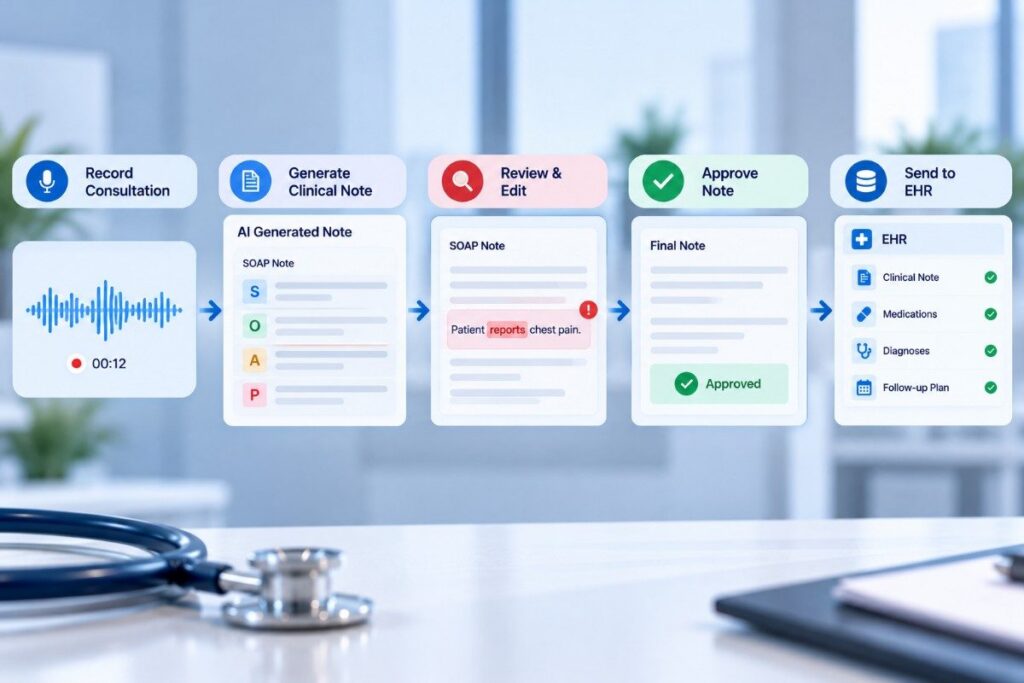
End-to-end scenarios should cover authentication, encounter selection, recording, processing, note generation, clinician review, editing, approval, and transfer into downstream systems. Integrations with electronic health records deserve careful attention because mapping errors can transform correct AI output into incorrect structured data.
Teams should also test recovery paths. What happens when connectivity disappears halfway through an encounter? What if processing times out, the clinician closes the application, an integration endpoint becomes unavailable, or the same encounter is submitted twice? Reliable healthcare software must behave predictably when dependencies fail.
Measure Performance Under Realistic Load
Speed matters because AI scribes operate inside time-sensitive workflows. A note that takes seconds during a controlled demonstration but several minutes during peak clinical hours can disrupt adoption even when its content is accurate.
Performance testing should simulate realistic concurrency, encounter lengths, audio sizes, and processing patterns. Teams should monitor upload time, processing latency, resource utilization, error rates, and downstream integration performance. Testing averages alone is insufficient; tail latency often reveals the experiences that frustrate actual users.
Scalability tests should also investigate whether accuracy or stability changes under load. A platform should not begin dropping recordings, producing incomplete outputs, or creating duplicate records simply because many clinicians finish appointments around the same time.
Treat Privacy and Security as Reliability Requirements
Medical conversations contain highly sensitive information, so security cannot be separated from product quality. Reliability includes ensuring that the correct authorized person can access the correct data while unauthorized users cannot.
Testing should examine authentication, authorization, session handling, encryption behavior, audit logging, data retention workflows, and tenant isolation where applicable. APIs and third-party integrations need equivalent scrutiny because sensitive information frequently moves across system boundaries.
Teams should additionally verify operational behaviors such as deletion requests, expired sessions, revoked permissions, and accidental cross-account access attempts. Security testing should be aligned with the product’s regulatory obligations and deployment environment rather than reduced to a generic checklist.
Test Human Review as Part of the Product
AI medical scribes are often designed to support clinicians rather than replace their judgment. That means the review interface itself becomes a safety mechanism and deserves serious QA attention.
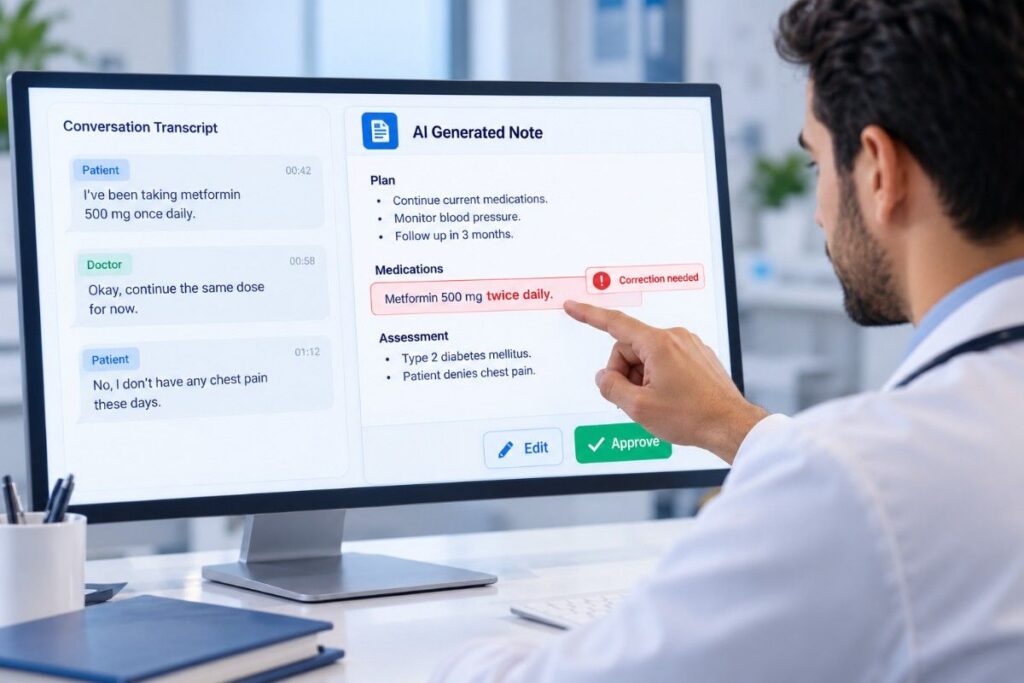
Clinicians should be able to identify, understand, and correct questionable output efficiently. Testing should determine whether important information is easy to verify, whether edits persist correctly, whether generated content can be traced to relevant encounter information where supported, and whether warnings are understandable.
Usability matters here because review fatigue creates risk. If clinicians must inspect every sentence with equal effort, the efficiency promised by the AI can disappear. Good testing therefore evaluates not only whether review controls technically function, but whether they support realistic human decision-making.
Make Regression Testing Continuous
AI systems evolve differently from deterministic applications. A new model, revised prompt, updated speech-recognition component, terminology dictionary, or post-processing rule can improve one class of encounters while quietly degrading another.
Every meaningful change should therefore run against a representative regression suite. The suite should contain routine encounters, known edge cases, historically problematic examples, safety-critical scenarios, different speakers, noisy recordings, and integration workflows. Results should be compared against established baselines instead of judged subjectively.
Production monitoring should feed this process. When clinicians identify recurring corrections or unusual failures, those cases can become future regression tests after appropriate privacy handling. The test suite then evolves alongside the product and its real-world usage.
Use Risk-Based Metrics Instead of a Single Accuracy Score
One percentage cannot adequately describe an AI medical scribe. A 97% accuracy score sounds excellent until the missing 3% contains allergies, medication doses, or critical follow-up instructions.
A more useful quality framework separates errors by type, severity, and workflow impact. Teams can track clinically significant omission rates, unsupported statement rates, medication accuracy, speaker attribution errors, processing failures, latency percentiles, integration defects, and clinician correction frequency. These measurements create a more honest picture of reliability.
Thresholds should also reflect risk. Formatting imperfections may tolerate relatively generous limits, while patient identity errors or fabricated clinical facts should trigger much stricter acceptance criteria. This is where thoughtful QA becomes more valuable than chasing an impressive headline metric.
Reliability Has to Survive the Real World
AI medical scribes can meaningfully reduce documentation burden, but clinical reliability cannot be demonstrated by a polished demo or a handful of successful transcripts. It has to survive noisy conversations, unusual terminology, ambiguous statements, integrations, network failures, peak traffic, security boundaries, and continuous model changes.
The strongest testing strategies combine clinical-context validation with functional, integration, performance, security, usability, and regression testing. They also treat AI uncertainty and hallucination as explicit quality risks rather than unexpected anomalies.
For teams building medical AI, the objective is not to prove that the model is intelligent. It is to establish evidence that the complete system behaves safely, consistently, and predictably when clinicians depend on it. That is the standard modern healthcare software deserves and the standard a rigorous QA strategy should be designed to verify. Start your QA journey today by testing the workflow, not merely the algorithm.
omission rates, unsupported statement rates, medication accuracy, speaker attribution errors, processing failures, latency percentiles, integration defects, and clinician correction frequency. These measurements create a more honest picture of reliability.
Thresholds should also reflect risk. Formatting imperfections may tolerate relatively generous limits, while patient identity errors or fabricated clinical facts should trigger much stricter acceptance criteria. This is where thoughtful QA becomes more valuable than chasing an impressive headline metric.