




Latest Insights
Top QA Firms for AI-Powered Clinical Documentation Tools
- Oct 28, 2026
- Sajid M.
- Clinical documentation QA companies
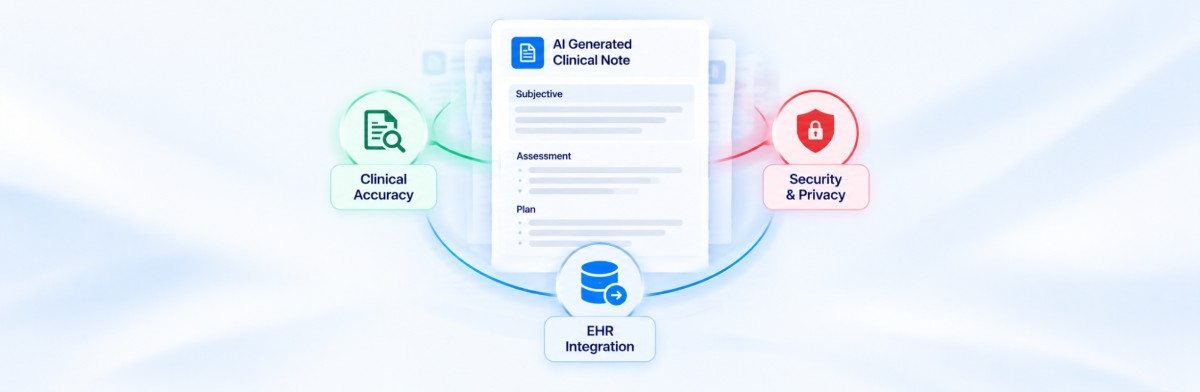
Clinical documentation has always demanded precision. Even a small error in a patient note can create confusion, disrupt workflows, or affect downstream clinical decisions. As healthcare organizations adopt smarter documentation systems to reduce administrative work, ensuring that these tools remain accurate and reliable has become increasingly important.
This is where specialized quality assurance matters. At Testiva, our healthcare AI testing services help evaluate everything from clinical accuracy and hallucinations to EHR integrations, security, and real-world performance. Choosing the right QA firm can help healthcare technology companies identify subtle failures before they reach clinicians or patients.
What Makes Clinical Documentation QA Different?
Traditional software is largely deterministic. Give a function the same valid input and engineers generally expect the same defined result. Generative AI changes that equation because outputs can vary while remaining linguistically convincing.
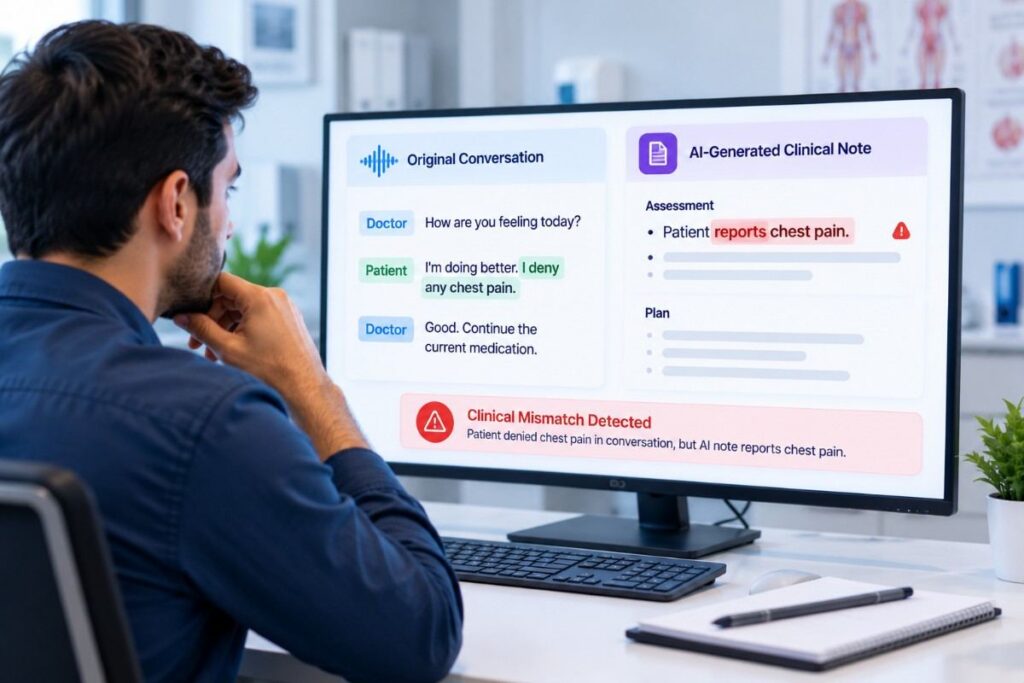
That matters enormously in medicine. A beautifully formatted clinical note is useless if the underlying facts are inaccurate. QA teams must evaluate factual consistency, omissions, hallucinations, medication information, speaker attribution, clinical context, specialty terminology, and whether generated documentation remains grounded in the actual encounter.
Audio introduces another layer. Ambient documentation systems encounter accents, interruptions, overlapping speech, background noise, abbreviations, incomplete sentences, and conversations that jump between medical and non-medical subjects. Testing only pristine recordings gives engineering teams a dangerously optimistic picture of production performance.
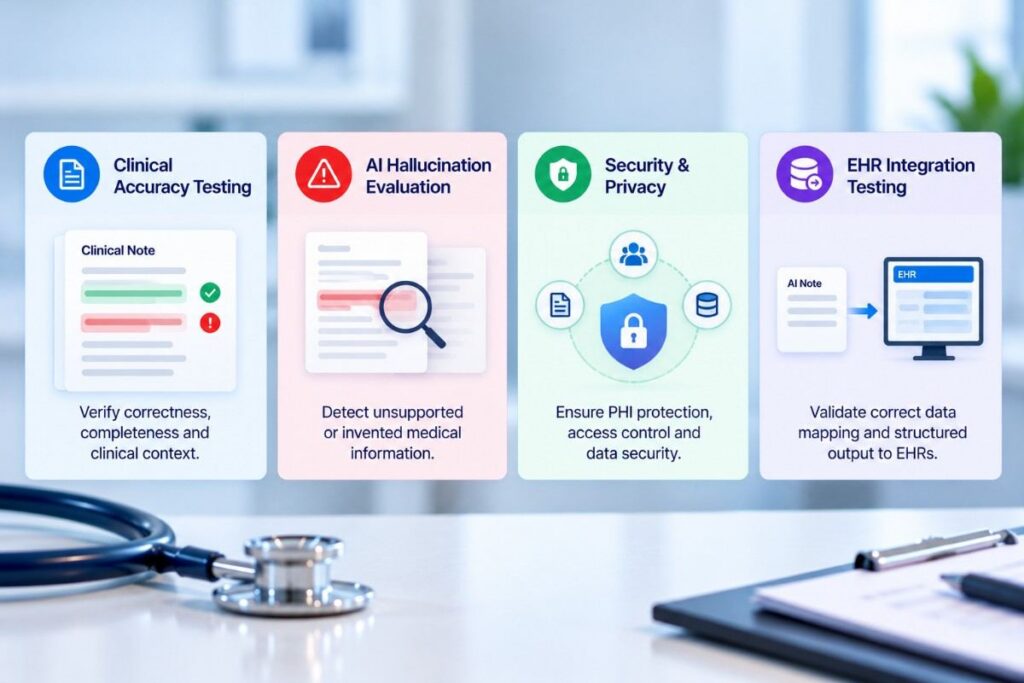
The surrounding application still requires conventional healthcare QA too. Authentication, role permissions, EHR write-back, APIs, audit trails, PHI handling, performance, and interoperability cannot become secondary concerns simply because an LLM sits in the architecture. In 2026, healthcare AI QA is fundamentally a multidimensional engineering discipline.
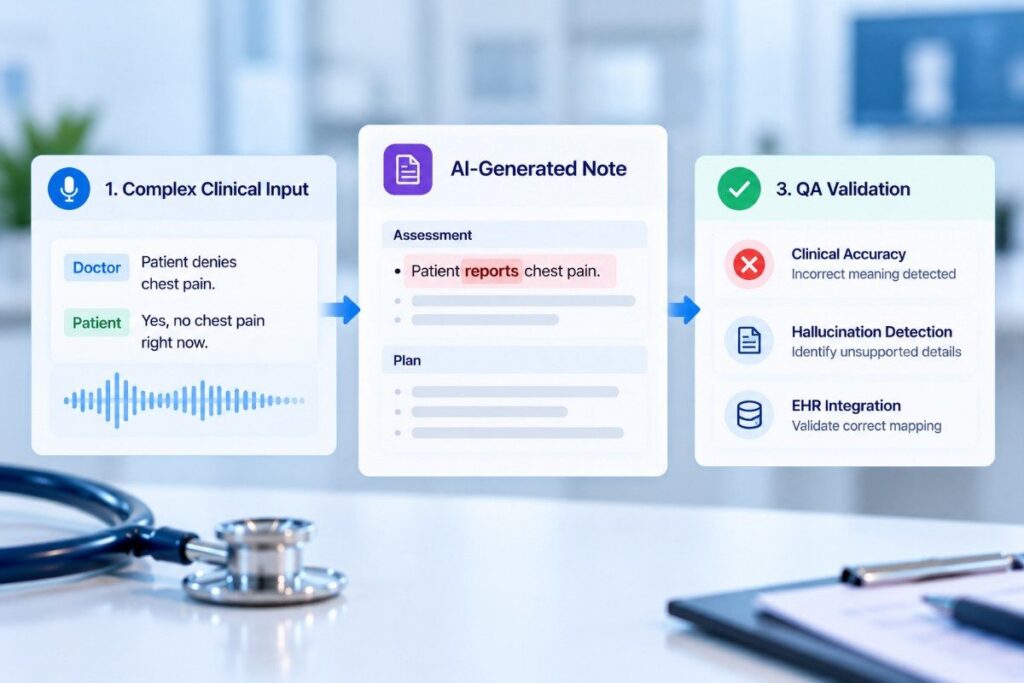
1. Testiva — Best for Specialized AI Medical Scribe and Healthcare AI Testing
For teams specifically building AI-powered clinical documentation, Testiva is purpose-built around the intersection of healthcare QA and AI evaluation. Rather than treating clinical AI as another vertical inside a generic software-testing portfolio, our approach focuses on the failure modes unique to medical AI systems.
Our AI medical scribe testing covers ambient audio and clinical transcription, speaker attribution, SOAP note accuracy, medication and dosage verification, clinical context retention, hallucination detection, EHR integration, PHI security, and performance. Generated notes can be evaluated against clinical ground truth so teams can measure whether information has been correctly captured rather than relying on superficial text similarity.
This distinction becomes especially important after model or prompt changes. An updated LLM may improve note readability while quietly reducing medication accuracy or increasing omissions. Testiva establishes clinical accuracy baselines and applies regression testing to detect these shifts across subsequent releases.
Testiva is therefore particularly relevant to medical-scribe startups, clinical voice AI companies, healthcare RAG developers, and teams that need specialist AI evaluation without building an entire clinical QA capability internally.
2. QualityAI — Strong for Large Regulated Healthcare Programs
QualityAI is a substantial quality-engineering provider with capabilities spanning healthcare and life sciences. Its healthcare practice emphasizes regulated workflows, compliance, data integrity, large-scale transformation, and AI-powered quality engineering.
Its scale makes it especially relevant to enterprises where an AI documentation component exists inside a much larger healthcare technology ecosystem. Think hospital networks, insurers, pharmaceutical organizations, or major digital transformation programs involving numerous systems and stakeholder groups.
For clinical documentation vendors, the question during evaluation should be how deeply the proposed team will test generative output itself. Enterprise quality engineering and clinical AI evaluation overlap, but they are not identical. Buyers should explicitly establish how hallucinations, note completeness, encounter-grounded factuality, and specialty-specific clinical language will be benchmarked.
QualityAI is consequently a compelling option when enterprise delivery capacity, governance, and regulated healthcare experience are major procurement requirements.
3. TestingXperts — Strong for Enterprise Healthcare Quality Engineering
TestingXperts combines healthcare quality engineering with a growing focus on AI testing. Its healthcare capabilities cover connected healthcare ecosystems, EHR/EMR environments, data quality, security, compliance, performance, and AI-enabled workflows.
The company also offers AI testing around probabilistic behavior, model bias, hallucinations, data quality, and drift. That combination makes TestingXperts relevant to organizations requiring both conventional healthcare validation and broader AI assurance.
Its strongest fit may be larger healthcare platforms with extensive integration surfaces and mature engineering organizations. Clinical documentation products rarely operate independently; they interact with identity systems, EHRs, APIs, analytics platforms, and multiple clinical workflows. A QA provider comfortable testing the complete ecosystem can expose failures that model-only evaluation misses.
Prospective clients should still request a documentation-specific evaluation plan. Ask how transcription fidelity, unsupported clinical statements, omissions, medication errors, speaker attribution, and model regression will be scored not simply whether “AI testing” appears in the proposal.
4. QASource — Strong for Independent AI Assurance and Healthcare QA
QASource brings longstanding software-testing experience together with dedicated healthcare testing and a distinct AI Assurance practice. Its healthcare capabilities include PHI and HIPAA-related validation, security, automation, API testing, compliance testing, and support around healthcare software validation.
Its AI Assurance model is particularly interesting for clinical AI buyers because it emphasizes independent evaluation rather than simply helping build the system being assessed. QASource describes validation around realistic behavior, regression over time, ground-truth datasets, human judgment, evaluation harnesses, and bounded production monitoring.
That philosophy aligns well with an important principle in clinical documentation testing: evaluation cannot be reduced to automated pass/fail assertions. Human judgment remains valuable when deciding whether a generated note preserves meaning, communicates appropriately, or creates unacceptable clinical ambiguity.
QASource deserves consideration from organizations wanting an established QA operation with independent AI-assurance methodology, especially where repeatable evaluation evidence is an important deliverable.
5. Kualitatem — Strong for Healthcare Automation and Interoperability
Kualitatem offers healthcare-focused QA automation covering clinical workflows, security, interoperability, EHR/EMR environments, performance, and continuous testing. Its healthcare services specifically address HL7 and FHIR interfaces, PHI protection, regression testing, and CI/CD integration.
That makes Kualitatem worth evaluating when the documentation product has a particularly complex surrounding application architecture. AI scribes do not stop being software applications at the boundary of the model; generated notes still need to move accurately between services, users, and clinical systems.
The company also uses AI-assisted approaches for test generation and automation. However, buyers developing generative clinical documentation should distinguish between using AI to accelerate QA and actually testing the clinical behavior of AI. Those are separate capabilities.
Kualitatem can be a strong candidate for teams prioritizing mature healthcare automation, interoperability, and regression coverage, provided the engagement is paired with sufficiently rigorous clinical-output evaluation.
How to Evaluate a QA Firm Before Signing
The best vendor is not necessarily the largest company or the one promising the highest number of automated tests. Clinical AI teams should begin with a much more revealing question: “Show us exactly how you would determine whether this generated clinical note is correct.”
A credible answer should define ground truth, evaluation rubrics, severity classifications, and measurable thresholds. The firm should understand that transcription accuracy alone cannot establish documentation accuracy. A transcript can be correct while the generated note introduces an unsupported diagnosis, loses an important negative finding, or changes a medication frequency.
Next, ask how regression is handled. Models, prompts, retrieval pipelines, transcription engines, and post-processing logic evolve constantly. The QA strategy should preserve benchmark datasets and rerun meaningful clinical scenarios so teams can identify where a new release became worse rather than merely different.
Finally, inspect the surrounding healthcare expertise. The provider should be comfortable discussing PHI handling, role-based access, auditability, EHR integration, APIs, interoperability, performance, and real clinical workflows. AI evaluation without healthcare engineering is incomplete; healthcare QA without AI evaluation is equally incomplete.
The Bottom Line
AI-powered clinical documentation tools sit in an unusually demanding quality environment. They combine voice technology, generative AI, healthcare data, clinical workflows, third-party integrations, and sensitive information in a single product. A failure can look perfectly fluent while being factually wrong—which is exactly what makes these systems so interesting to test and so risky to test superficially.
Testiva, QualityAI, TestingXperts, QASource, and Kualitatem each bring useful strengths to this market. Large enterprises may prioritize global delivery and broad quality-engineering capacity, while specialized clinical AI companies may place greater weight on medical-scribe evaluation, hallucination detection, ground-truth validation, and rapid AI regression testing.
From our perspective at Testiva, the deciding factor should always be evidence. Your QA partner should be able to demonstrate what was tested, how clinical correctness was measured, which failure modes were discovered, and whether every model change preserves an acceptable safety and accuracy baseline.
Clinical documentation AI does not need more generic test cases. It needs QA designed around the strange, probabilistic, context-sensitive ways AI actually fails. Choose a partner that understands those failures before clinicians and patients encounter them in production. When you are ready to establish that level of assurance, start your QA journey today.