




Latest Insights
How to Test AI Medical Scribe Software Accuracy
- Aug 29, 2026
- Sajid M.
- AI Medical Scribe Accuracy
Accurate clinical documentation is the foundation of quality healthcare, and AI medical scribes are rapidly changing how that documentation is created. While these tools can reduce administrative burden and improve efficiency, their value depends on one critical factor: accuracy. A missed symptom, incorrect medication, or fabricated detail can compromise patient care and erode trust in the technology.
As healthcare organizations adopt AI-powered documentation solutions, testing has become just as important as development. At Testiva, we know that validating AI medical scribes requires far more than checking transcription quality. Through comprehensive AI software testing, organizations can evaluate whether these systems accurately capture clinical conversations, understand medical context, and generate reliable documentation that clinicians can trust. In this guide, we’ll explore the key areas to test when assessing AI medical scribe software accuracy.
Why Accuracy Matters More Than Features
Healthcare software operates in one of the most demanding industries in the world. Every clinical note becomes part of a patient’s permanent medical record, influences treatment decisions, supports insurance claims, and may even serve as legal documentation.
Unlike consumer AI applications where an occasional mistake may simply be inconvenient, errors in medical documentation can have meaningful consequences. A missed allergy, incorrect dosage, omitted symptom, or inaccurate diagnosis can create downstream issues affecting clinicians, administrative staff, and ultimately patients.
This is why evaluating AI medical scribe software goes well beyond measuring transcription quality. The software must demonstrate that it consistently captures clinical intent while preserving context throughout complex conversations involving multiple speakers, interruptions, background noise, medical terminology, abbreviations, and specialty-specific vocabulary.
Testing should therefore focus on understanding how the AI performs in realistic healthcare environments instead of ideal laboratory conditions.
Understanding What "Accuracy" Actually Means
Many organizations define accuracy too narrowly by comparing transcripts word-for-word against recordings. While transcription quality certainly matters, AI medical scribes perform multiple intelligent tasks beyond speech recognition.
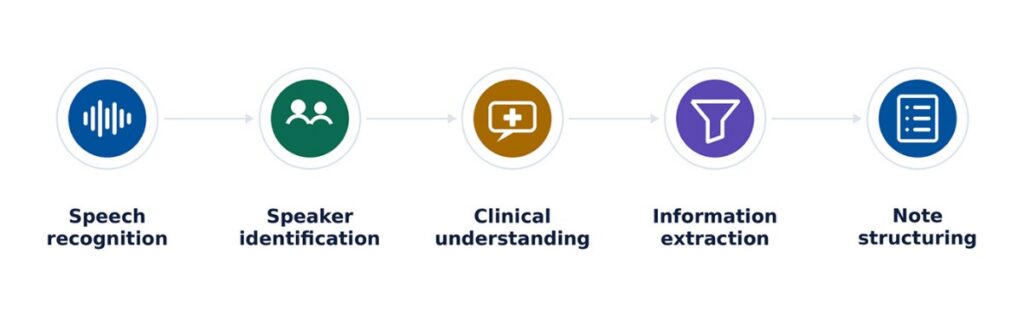
The software must first recognize spoken language accurately. It then needs to identify speakers correctly, distinguish physicians from patients, understand clinical terminology, extract meaningful medical information, organize findings into structured documentation, and produce notes that align with accepted clinical documentation standards.
Each stage introduces opportunities for errors.
For example, speech recognition may correctly capture every spoken word while the summarization model incorrectly omits an important symptom discussed earlier in the consultation. Likewise, the software might perfectly identify medications but assign them to the wrong patient complaint.
Testing should therefore measure overall documentation quality rather than isolated AI capabilities.
Building a Realistic Testing Strategy
One of the biggest mistakes organizations make is evaluating AI medical scribes using clean, scripted conversations. Real clinical encounters are rarely perfect.
Patients hesitate, interrupt themselves, change topics unexpectedly, speak with different accents, use non-medical language, or forget important details before remembering them later in the appointment. Physicians frequently multitask, dictate findings while examining patients, speak rapidly, and reference previous medical history without repeating full context.
A comprehensive testing strategy should replicate these realities.
Test datasets should include conversations involving different medical specialties, varying appointment lengths, diverse patient demographics, multiple languages where applicable, varying recording quality, telehealth sessions, in-person consultations, emergency scenarios, routine follow-ups, and complex multi-condition visits.
The broader the dataset, the better the organization can evaluate whether the AI performs consistently across different clinical environments instead of only succeeding under ideal circumstances.
Measuring Speech Recognition Performance
Speech recognition serves as the foundation of every AI medical scribe. If transcription quality suffers, downstream summarization and documentation inevitably become less reliable.
Testing speech recognition involves much more than calculating word error rates.
Quality assurance teams should evaluate whether the system correctly identifies medical terminology, drug names, laboratory values, anatomical references, abbreviations, procedural terminology, and specialty-specific language. They should also examine how well the AI handles overlapping speech, interrupted sentences, background conversations, equipment noise, masks, and varying microphone quality.
Healthcare environments are noisy by nature, and testing should intentionally introduce these variables rather than eliminating them.
Another important consideration involves accented speech. Hospitals and clinics employ physicians from diverse linguistic backgrounds while serving patients with varying dialects and pronunciation patterns. An AI model that performs exceptionally well on standard English may struggle significantly when exposed to real-world diversity.
Testing across representative speech samples helps uncover these weaknesses before deployment.
Evaluating Clinical Information Extraction
Transcribing words correctly does not necessarily mean the AI understands what matters clinically.
Medical scribes must identify symptoms, diagnoses, medications, allergies, laboratory findings, treatment plans, follow-up instructions, family history, social history, and physician assessments from lengthy conversations.
Each extracted element should be compared against manually reviewed ground truth documentation created by experienced clinical reviewers.
Testing should answer important questions.
Did the AI identify every medication?
Were medication dosages captured correctly?
Did it confuse current symptoms with historical conditions?
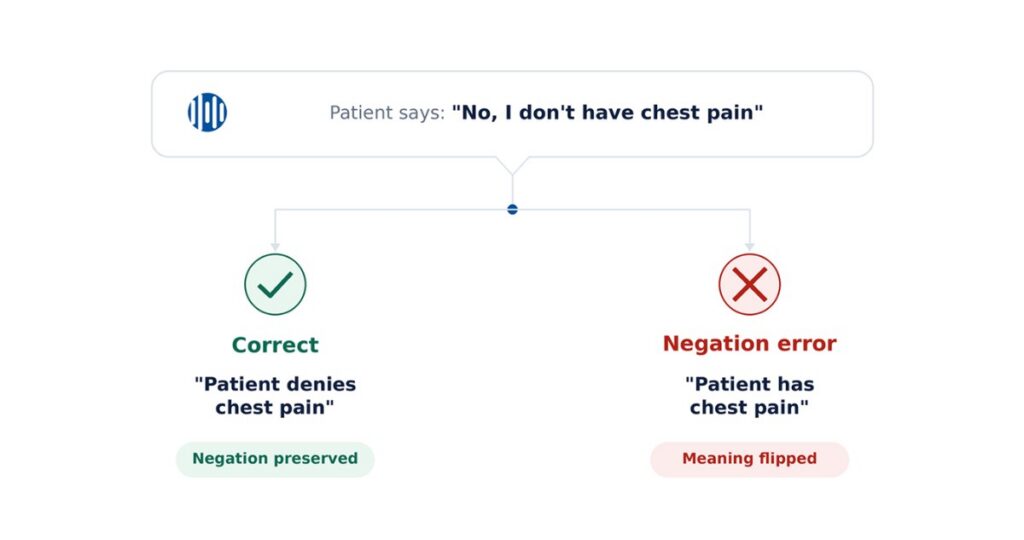
Did it correctly recognize negative findings such as “the patient denies chest pain”?
Was family history separated from personal medical history?
Negation detection deserves special attention because misunderstanding statements like “no evidence of infection” or “patient denies dizziness” fundamentally changes clinical meaning.
Testing Medical Note Generation
Perhaps the most valuable capability of modern AI medical scribes is their ability to generate structured clinical notes automatically.
These notes should not merely summarize conversations—they should accurately represent the clinical encounter while following documentation standards used by healthcare organizations.
Quality reviewers should examine whether generated SOAP notes, progress notes, consultation notes, or specialty-specific documentation include all essential information without introducing hallucinated facts.
AI hallucinations remain one of the biggest concerns in generative healthcare applications.
Even if hallucinations occur infrequently, fabricated diagnoses, medications, examination findings, or treatment recommendations are unacceptable in medical documentation.
Testing should include systematic verification that every statement appearing in the final note is supported by information actually present in the recorded consultation.
Nothing should be invented.
Nothing clinically relevant should be omitted.
Assessing Consistency Across Similar Cases
AI systems occasionally produce different outputs when presented with highly similar inputs.
This variability can become problematic in healthcare environments where documentation consistency affects compliance, billing, and physician confidence.
Quality assurance should therefore include repeatability testing.
The same consultation should be processed multiple times under identical conditions to determine whether documentation remains stable.
Similarly, multiple conversations covering similar clinical scenarios should produce notes with comparable structure, terminology, and completeness.
Unexpected inconsistency may indicate underlying instability within large language model workflows or prompt engineering strategies.
Validating Specialty-Specific Performance
General-purpose testing rarely reflects real clinical practice.
Medical specialties use unique terminology, workflows, examination methods, and documentation requirements.
Cardiology consultations differ significantly from dermatology appointments.
Orthopedic evaluations differ from psychiatric assessments.
Pediatric visits differ from oncology consultations.
Each specialty introduces vocabulary, abbreviations, examination techniques, and documentation expectations that AI models must understand accurately.
Organizations should therefore conduct specialty-specific validation rather than assuming strong performance in one clinical area automatically translates to another.
This approach frequently uncovers weaknesses that broad benchmark testing overlooks.
Testing Edge Cases and Difficult Conversations
Robust AI systems perform well not only during routine appointments but also during unusual or stressful clinical situations.
Testing should intentionally include difficult scenarios.
Patients may become emotional, speak unclearly, interrupt physicians repeatedly, discuss multiple unrelated concerns, reference previous visits, use slang, or rapidly switch between languages.
Clinicians may dictate findings while moving between examination rooms, conduct virtual appointments with unstable internet connections, or speak while wearing masks.
The AI should demonstrate resilience across these situations without significant deterioration in documentation quality.
Edge case testing often reveals limitations that only emerge after deployment if they are not identified during quality assurance.
Evaluating Human Review Workflows
Few healthcare organizations rely entirely on autonomous documentation generation.
Most AI medical scribes operate within human-in-the-loop workflows where physicians review, edit, and approve generated notes before final submission.
Testing should therefore evaluate more than AI accuracy alone.
Reviewers should measure how much editing physicians perform after receiving AI-generated documentation.
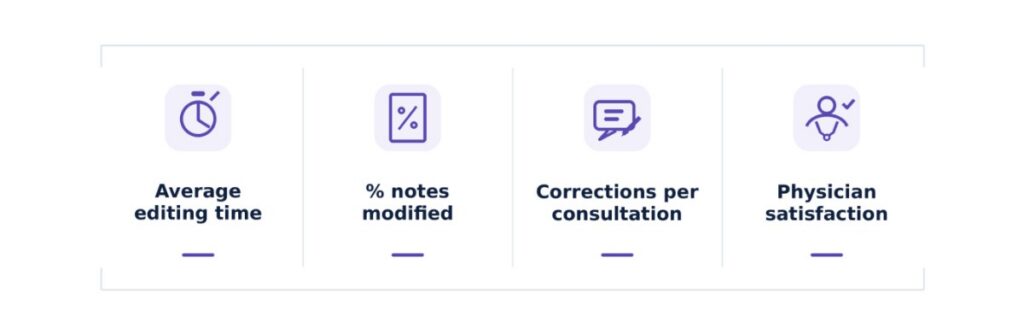
Common quality metrics include average editing time, percentage of modified notes, number of corrections per consultation, and physician satisfaction scores.
These measurements provide practical insight into whether the AI genuinely reduces documentation burden or simply shifts effort from writing notes to correcting them.
Security and Compliance Validation
Healthcare data requires exceptional protection.
AI medical scribe software processes highly sensitive patient information, making security testing an essential part of overall quality assurance.
Testing should verify secure authentication mechanisms, encrypted data transmission, protected storage, audit logging, role-based access controls, session management, and secure API communications.
Organizations should also validate compliance with applicable healthcare privacy regulations such as HIPAA or regional healthcare data protection requirements depending on deployment location.
Security testing should examine whether AI processing pipelines expose sensitive information during transcription, summarization, model inference, or third-party integrations.
Measuring Long-Term Reliability
Accuracy should remain stable over time.
AI models may evolve through updates, prompt changes, infrastructure modifications, or model replacements.
Without continuous validation, previously reliable documentation quality may gradually decline.
Regression testing should compare outputs generated by updated models against established benchmarks to ensure performance remains consistent after every release.
Automated testing pipelines can continuously monitor transcription quality, extraction accuracy, note completeness, hallucination frequency, and physician editing rates throughout the software lifecycle.
Continuous monitoring transforms quality assurance from a one-time activity into an ongoing process that protects long-term reliability.
The Importance of Human Expertise in AI Testing
Although AI evaluation increasingly relies on automated metrics, healthcare software still requires experienced human reviewers.
Clinical experts provide context that automated scoring systems cannot capture.
They recognize subtle documentation issues, inappropriate clinical wording, missing contextual information, ambiguous phrasing, and medically significant omissions that statistical evaluation may overlook.
Combining automated validation with expert clinical review creates a more comprehensive assessment than relying exclusively on either approach.
The goal is not simply to determine whether the AI generated a note, but whether the note accurately represents the clinical encounter in a way healthcare professionals can confidently trust.
Conclusion
AI medical scribe software is only as valuable as the accuracy of the documentation it produces. Thorough testing ensures these systems can reliably capture clinical conversations, interpret medical context, and generate precise, consistent notes that healthcare professionals can trust.
As AI continues to transform clinical documentation, comprehensive quality assurance is essential for ensuring reliability, safety, and long-term performance. By validating accuracy across real-world scenarios, organizations can deploy AI medical scribes with greater confidence while supporting better clinical outcomes and more efficient healthcare workflows.