




Latest Insights
Evaluating Accuracy of AI-Generated SOAP Notes
- Sep 05, 2026
- Sajid M.
- AI-Generated Note Testing

Artificial intelligence has rapidly found its way into healthcare documentation, and one of its most impactful applications is the generation of SOAP notes. By automating clinical documentation, AI promises to reduce physician burnout, improve efficiency, and allow healthcare professionals to spend more time focusing on patient care instead of paperwork. Yet with this promise comes an equally important question: How accurate are AI-generated SOAP notes, and can healthcare organizations trust them?
Accuracy in medical documentation is not simply about producing grammatically correct text. Every generated note becomes part of a patient’s permanent medical record, influences treatment decisions, supports insurance claims, and may even serve as legal documentation. That makes quality assurance an essential part of adopting AI documentation tools. At Testiva, we’ve seen firsthand how rigorous software QA and AI validation help organizations confidently deploy intelligent healthcare solutions without compromising reliability or patient safety.
As healthcare providers increasingly integrate AI into their clinical workflows, evaluating the accuracy of generated SOAP notes has become more than a technical exercise. It is a multidisciplinary process involving software testing, clinical validation, note compliance testing, usability assessment, and continuous monitoring. Understanding what “accuracy” truly means is the first step toward building trustworthy AI-assisted documentation systems.
Understanding AI-Generated SOAP Notes
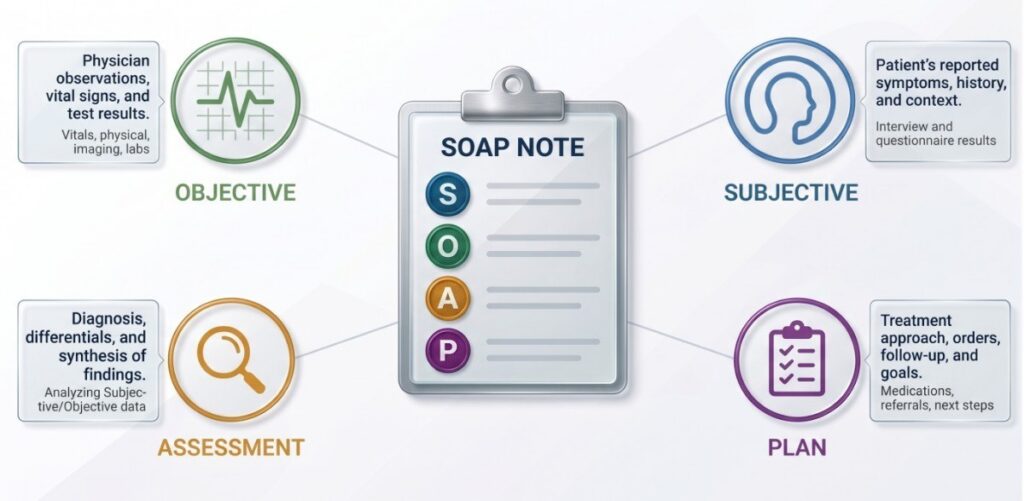
SOAP stands for Subjective, Objective, Assessment, and Plan. This structured documentation format has become the standard for recording patient encounters because it organizes information in a logical and clinically meaningful way.
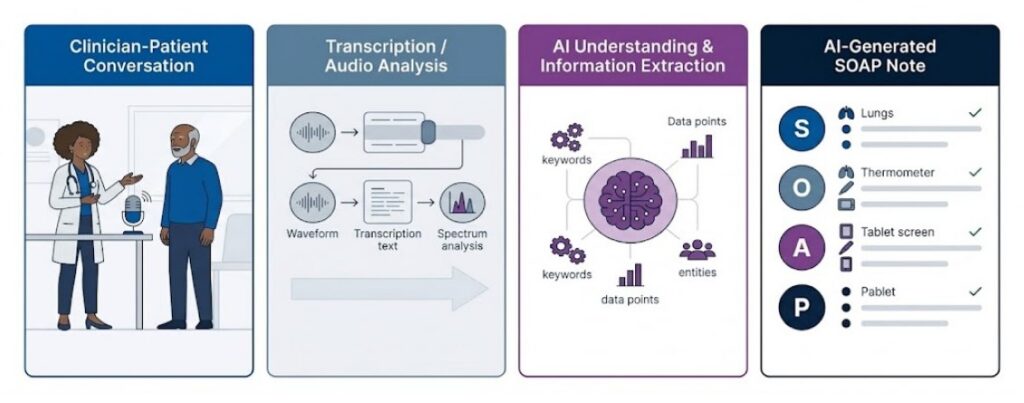
Modern AI-powered documentation systems typically generate SOAP notes by analyzing clinician-patient conversations, dictated summaries, electronic health records, or a combination of multiple data sources. Advances in speech recognition and large language models have significantly improved the quality of these generated notes, making them appear remarkably natural and comprehensive.
However, natural language fluency should never be mistaken for clinical accuracy. An AI model may produce a note that reads perfectly while introducing subtle factual errors, omitting critical symptoms, confusing medications, or inferring diagnoses that were never discussed. These issues may not be immediately obvious during a quick review, making systematic evaluation essential.
Unlike traditional software features that either work or fail, AI outputs exist on a spectrum of quality. This makes validation considerably more complex than conventional functional testing.
Defining Accuracy Beyond Correct Grammar
Many organizations initially evaluate AI-generated SOAP notes by asking clinicians whether they “look good.” While clinician feedback is valuable, it represents only one dimension of accuracy.
True evaluation involves determining whether every section faithfully represents the patient encounter.
The Subjective section should accurately capture the patient’s reported symptoms, concerns, history, and experiences without introducing assumptions or omitting relevant information. The Objective section must correctly document measurable observations, examination findings, laboratory values, and vital signs. The Assessment should appropriately summarize the clinician’s diagnostic reasoning without fabricating conclusions. Finally, the Plan must accurately reflect medications, follow-up instructions, referrals, tests, and treatment recommendations.
A high-quality AI system maintains consistency across all four sections while preserving clinical intent. Even small inconsistencies can create confusion for future providers or introduce unnecessary clinical risk.
Common Accuracy Challenges in AI-Generated SOAP Notes
Although AI has demonstrated impressive language generation capabilities, several recurring challenges continue to appear across healthcare documentation systems.
Hallucinated Clinical Information
Perhaps the most well-known AI failure is hallucination. In healthcare documentation, hallucinations occur when the model confidently generates information that never appeared in the original conversation or medical record.
Examples include inventing symptoms that were never mentioned, documenting medications the patient does not take, or adding examination findings that were never performed.
These hallucinations are particularly dangerous because they often appear plausible, making them difficult to detect during routine reviews.
Missing Critical Information
AI models may also omit clinically significant details.
For example, a patient may mention chest pain occurring during exercise, but the generated note only records generalized discomfort. Likewise, allergies, medication changes, family history, or important follow-up instructions may disappear entirely from the final document.
Missing information is often more dangerous than obvious mistakes because healthcare providers may assume the documentation is complete.
Incorrect Medical Terminology
Healthcare language is nuanced. Similar terms often carry entirely different meanings.
Confusing “hyperglycemia” with “hypoglycemia,” incorrectly expanding abbreviations, or selecting the wrong anatomical location can dramatically alter clinical interpretation.
Accurate terminology requires not only strong language models but also specialized medical knowledge embedded within the AI system.
Context Drift
Long patient conversations introduce another challenge known as context drift.
As conversations become longer, AI models may lose track of earlier information or incorrectly associate later statements with previous discussions. The resulting SOAP note may contain internally inconsistent timelines or contradictory assessments.
Evaluating how well an AI system maintains context throughout extended consultations is an important aspect of validation.
Measuring Accuracy Using Clinical Evaluation Metrics
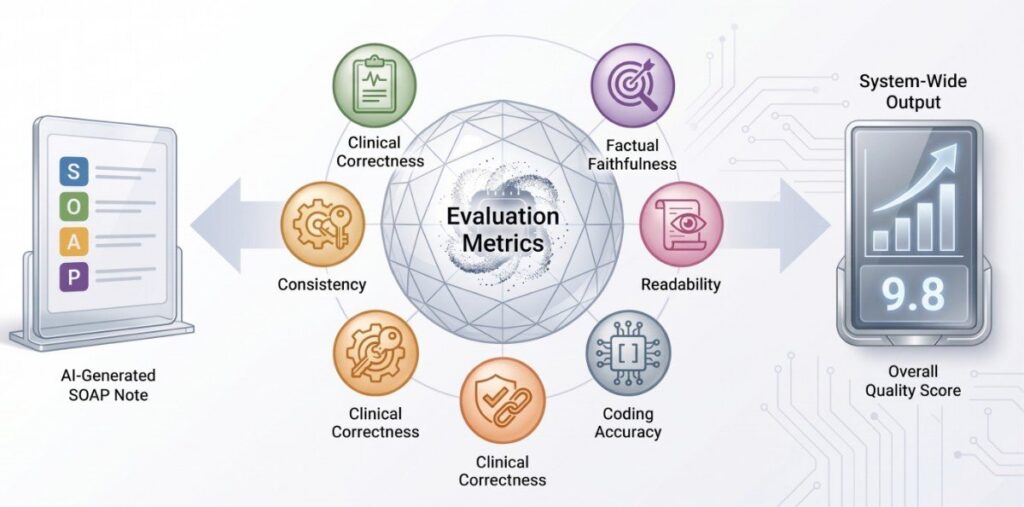
Evaluating AI-generated SOAP notes requires more than assigning an overall quality score. Multiple complementary metrics provide a much clearer understanding of system performance.
Clinical correctness measures whether documented information accurately reflects the encounter. Completeness evaluates whether all relevant information has been captured. Consistency examines whether different sections of the note align logically without contradiction.
Another important metric is factual faithfulness. Every generated statement should be traceable to information actually provided during the consultation or contained within verified medical records. AI systems should never fill knowledge gaps with educated guesses.
Medical coding accuracy is also increasingly relevant. Since SOAP notes often support ICD and CPT coding, inaccuracies can directly impact billing, reimbursement, and compliance.
Readability should not be overlooked either. Clinicians need documentation that is concise, well-structured, and easy to review quickly during busy clinical workflows.
Combining these metrics provides a much more reliable picture than relying solely on clinician satisfaction surveys.
Why Human Review Still Matters
Despite remarkable advances in generative AI, human oversight remains indispensable.
Healthcare professionals possess contextual understanding, clinical reasoning, and ethical judgment that AI systems currently cannot replicate consistently. They recognize subtle inconsistencies, identify clinically inappropriate wording, and understand nuances that extend beyond literal transcription.
Rather than replacing clinicians, AI should function as an intelligent documentation assistant.
The most successful implementations position clinicians as final reviewers who verify generated notes before they become part of the official medical record. This collaborative approach balances efficiency with patient safety.
Organizations that remove human review too early often discover hidden quality issues only after documentation errors accumulate across thousands of patient encounters.
The Role of Software QA in AI Documentation Systems
Traditional software testing remains just as important for AI-powered healthcare platforms as it is for conventional applications.
Beyond evaluating the AI model itself, the surrounding software ecosystem must be validated to ensure accurate data flow, secure storage, reliable integrations, and predictable user interactions.
For example, transcription accuracy may be excellent, but an integration bug could incorrectly assign notes to the wrong patient record. Likewise, synchronization issues between electronic health record systems and AI services could introduce outdated medication lists into newly generated documentation.
This is where comprehensive QA testing becomes especially valuable. Functional testing, integration testing, regression testing, usability testing, performance testing, and security testing collectively ensure that the entire documentation workflow performs reliably not just the language model at its core.
From our experience testing intelligent software systems, the strongest AI products are rarely distinguished solely by better models. They excel because every surrounding workflow has been thoroughly validated under realistic clinical conditions.
Regulatory and Compliance Considerations
Healthcare documentation exists within one of the world’s most heavily regulated industries.
Organizations deploying AI-generated SOAP notes must comply with regulations governing patient privacy, security, auditability, and clinical documentation standards. Depending on the jurisdiction, these may include HIPAA, GDPR, regional healthcare regulations, and emerging AI governance frameworks.
Evaluating accuracy therefore extends beyond clinical correctness.
Organizations should verify that AI systems maintain audit trails showing how notes were generated, preserve source data where appropriate, protect sensitive patient information during processing, and support transparent human review workflows.
Regulatory expectations surrounding AI continue to evolve, making continuous validation more important than one-time certification.
Continuous Testing Is More Important Than One-Time Validation
AI systems change over time.
Language models receive updates, prompts evolve, training data improves, and surrounding software components are regularly modified. Each change introduces the possibility of unexpected regressions.
A documentation system that performed exceptionally well six months ago may produce different outputs after a seemingly minor model update.
Continuous evaluation helps organizations detect performance degradation before it impacts clinical operations.
Modern QA strategies increasingly include automated benchmark datasets, regression testing against representative clinical scenarios, periodic human review, and real-world monitoring of production outputs.
Treating AI validation as an ongoing process rather than a one-time project significantly reduces long-term risk.
Building Trustworthy AI Documentation
Trust in AI-generated SOAP notes is earned through evidence rather than assumptions.
Healthcare organizations should establish clear evaluation criteria before deployment, validate outputs using diverse clinical scenarios, involve practicing clinicians throughout testing, monitor production performance continuously, and maintain transparent review processes.
Equally important is recognizing that accuracy is not a fixed number. Performance varies across specialties, patient populations, accents, conversation complexity, and clinical workflows. Robust evaluation accounts for these variations rather than relying on idealized testing environments.
As generative AI continues reshaping healthcare documentation, organizations that invest in comprehensive quality assurance will be best positioned to realize its benefits while minimizing risk.
Conclusion
AI-generated SOAP notes represent one of healthcare’s most promising applications of generative AI. They have the potential to dramatically reduce documentation burdens, improve operational efficiency, and give clinicians more time to focus on patient care. However, these benefits depend entirely on one critical factor: accuracy.
Evaluating AI-generated SOAP notes requires a holistic approach that combines clinical expertise, rigorous software testing, regulatory awareness, and continuous performance monitoring. Looking only at linguistic quality or user satisfaction is not enough. Organizations must verify factual correctness, completeness, consistency, workflow reliability, and long-term stability before placing trust in automated documentation.
As AI becomes increasingly embedded in healthcare systems, quality assurance will remain a cornerstone of responsible adoption. Thorough validation doesn’t slow innovation it enables it. By ensuring every generated note accurately reflects clinical reality, healthcare organizations can embrace AI with confidence while safeguarding patient outcomes, regulatory compliance, and the integrity of the medical record.