


Testiva

Live webinar

How to test your AI Medical Scribe before clinical deployment

A practical session for teams building AI Medical Scribe applications. Learn what to test beyond traditional QA before your product reaches clinicians.

23 Sep 2026
Date
12:00 PM EST
Start time
30 minutes
Duration
Online
Format
00 Days
00 Hours
00 Minutes
00 Seconds

Building an AI Scribe is hard.
Testing one is harder.

Traditional QA can verify that the application works, but it may not catch AI-specific failures in how a conversation is understood and documented.

Real-world conversations

Interruptions, corrections, multiple speakers, overlapping speech, and complex encounters can make results less predictable.

Speech and speaker errors

Accents, noise, medical terminology, or incorrect speaker attribution can affect what the system captures.

Clinical inaccuracies

The generated note may misinterpret or incorrectly represent information from the conversation.

Missing information

Important symptoms, medications, decisions, or other details may be left out of the final note.

Hallucinations

The AI may add information that was never stated or supported by the conversation.

Test data is hard to build

Real conversations are hard to reproduce at scale. Synthetic data and scripted scenarios help build meaningful coverage.

What we will cover

Practical areas to consider when building a testing strategy for AI Medical Scribes. The session closes with a live walkthrough of Testiva's in-house AI Scribe testing tool, showing how it evaluates clinical accuracy, hallucination rates, and transcription quality.

Building a practical QA and evaluation strategy

Understanding the speech/ASR and note-generation layers

Testing note accuracy, completeness, and structure

Synthetic test data and realistic test scenarios

Live demo of Testiva's in-house AI Scribe testing tool

AI Medical Scribe testing fundamentals

Testing transcription and speaker diarization

Hallucination, omission, and factuality testing

Real-world edge cases and adversarial testing

Q&A with the Testiva team

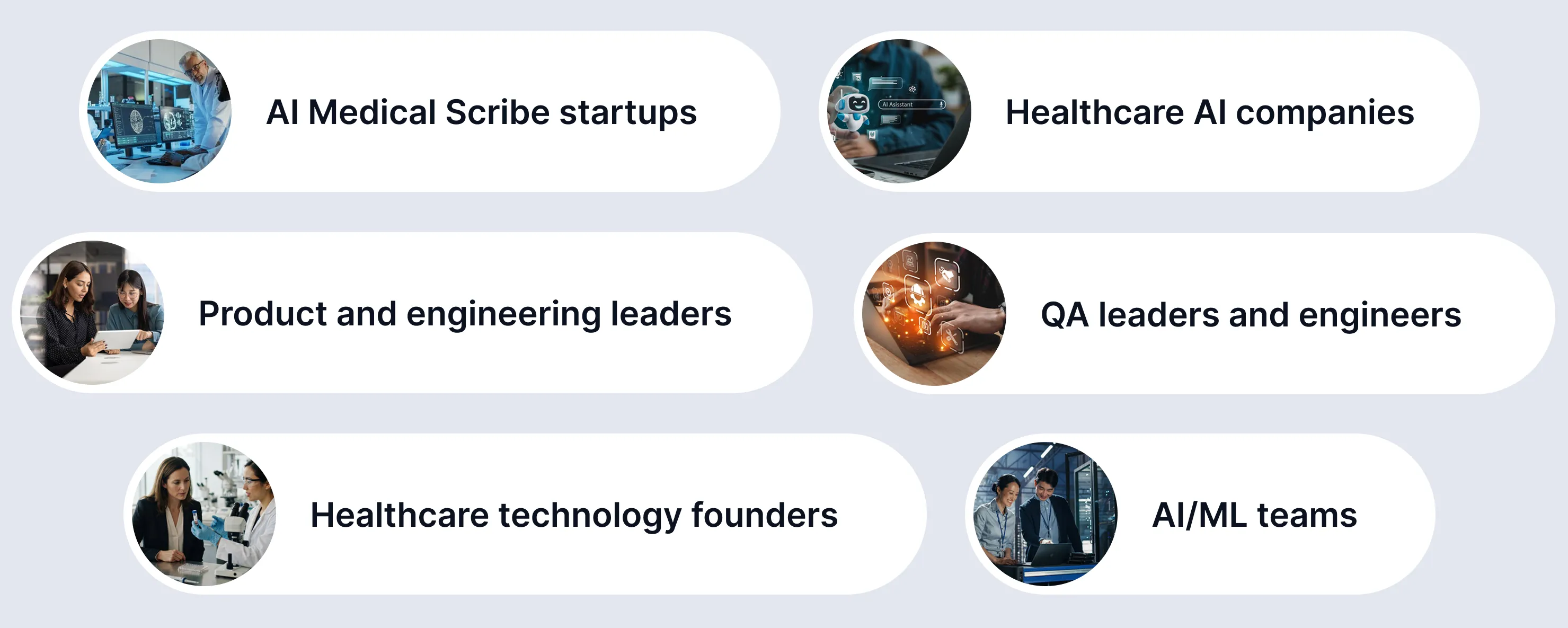
Who should attend

Built for teams shipping or preparing to deploy AI Medical Scribe products.

Join the webinar

Reserve your spot and learn how to build a stronger testing strategy for your AI Medical Scribe.
After registration, Testiva team will contact you and will share the webinar link via email

    We will use your email only for webinar registration and related updates.

    Common questions

    Traditional QA checks whether the application functions correctly but cannot evaluate whether the generated clinical note is accurate, complete, or faithful to the conversation. AI-specific failures like hallucinations, missed information, and speaker misattribution require a different evaluation approach.
    Hallucination testing involves comparing the generated note against the original conversation transcript to identify any clinical claims, medications, or decisions that were added by the AI but never stated. This requires structured evaluation criteria and is difficult to scale without synthetic test data and automated comparison tools.
    Speaker diarization is the process of identifying who said what in a multi-speaker conversation. In a clinical setting, misattributing physician statements to the patient or vice versa can produce notes with serious clinical inaccuracies. Testing diarization accuracy across different voices, accents, and conversation dynamics is a core part of AI Scribe evaluation.
    Synthetic test data generated from clinical scenarios, scripted conversations, and simulated encounters allows teams to build large, diverse test sets without using protected health information. Synthetic data can be designed to cover specific edge cases, specialties, accents, and noise conditions that would be difficult to collect from real recordings.
    Testing should begin as early as possible, ideally before clinical deployment. Early-stage evaluation of the transcription layer, note structure, and hallucination rate gives teams time to address issues before they reach clinicians. Waiting until late-stage or post-launch testing makes problems significantly more expensive to fix.
    No. The webinar will cover anything related to AI Scribe with special focus on AI Medical Scribe.