




Latest Insights
Testing Medical Transcription AI for Healthcare Applications
- Sep 18, 2026
- Sajid M.
- Medical Transcription AI Testing

There is a dangerous kind of software error: the one that looks completely correct.
A beautifully formatted clinical note can contain the right terminology, sensible punctuation, and perfectly structured sentences and still misrepresent what happened in the consultation. A barely audible dosage, a misplaced negation, or a sentence attributed to the wrong speaker can quietly transform accurate conversation into inaccurate clinical documentation. Because the output looks credible, these mistakes can be much harder to notice than an obvious system failure.
That is what makes medical transcription AI such an interesting QA challenge. At Testiva, our AI testing and quality assurance services examine more than whether a system successfully converts speech into text. We test whether meaning survives the journey from spoken conversation and AI interpretation to structured documentation and downstream healthcare workflows.
For healthcare applications, “mostly accurate” is not a particularly useful finish line. Testing has to uncover the subtle failures hiding behind fluent output, determine which errors carry genuine clinical significance, and verify how the technology behaves when real-world audio gets noisy, ambiguous, fast, and wonderfully human.
Why Medical Transcription AI Is Harder to Test Than Ordinary Speech-to-Text
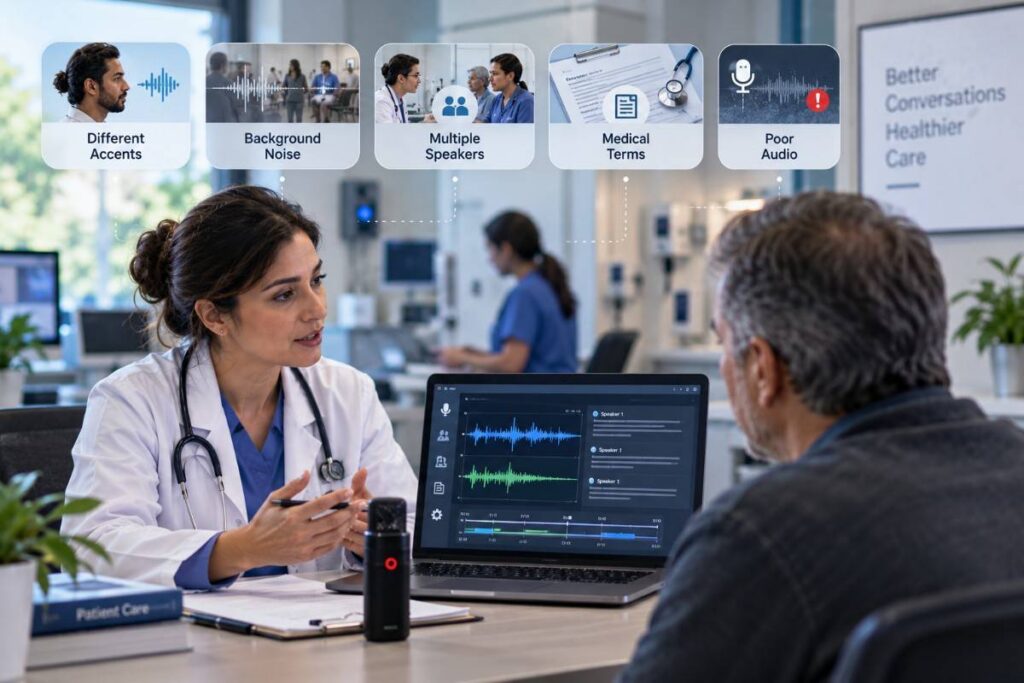
Clinical speech is wonderfully unfriendly to machines. Doctors dictate quickly, abbreviate aggressively, switch between everyday language and specialist terminology, mention similar-sounding medications, interrupt themselves, and sometimes revise a statement halfway through speaking. Add background noise, different accents, multiple speakers, telehealth audio, and imperfect microphones, and a seemingly simple transcription task becomes a serious QA challenge.
More importantly, not every transcription error has equal consequences. Confusing “fifteen” with “fifty” is potentially more important than missing a harmless filler word. Dropping a negation from “no evidence of pneumonia” is considerably more serious than incorrect punctuation. That means testing cannot rely exclusively on a single aggregate accuracy score.
A strong QA strategy evaluates the clinical significance of errors, not merely their quantity. The goal is to discover where the AI changes meaning, introduces ambiguity, or creates information that was never present in the original conversation.
Build Test Data Around Real Clinical Complexity
Medical transcription AI needs a test dataset that resembles the messy reality of healthcare environments. Testing primarily with clean recordings, carefully pronounced terminology, and one speaker in a silent room creates reassuring results that may collapse as soon as the application reaches actual users.
Datasets should cover different specialties, clinical scenarios, accents, speaking speeds, recording devices, audio quality levels, and conversation structures. A cardiology consultation presents different vocabulary from dermatology, psychiatry, oncology, or emergency medicine. Test coverage should also include abbreviations, acronyms, numbers, dates, measurements, anatomical terminology, medication names, and similar-sounding clinical terms.
The dataset should deliberately contain difficult conditions too: overlapping speakers, background conversations, coughing, equipment noise, weak connectivity, unfinished sentences, self-corrections, and rapid changes between speakers. These are not obscure edge cases in healthcare. They are normal operating conditions.
Where real clinical data is involved, privacy and governance must be built into the testing process. De-identified or appropriately generated synthetic datasets can help teams expand coverage without casually exposing protected health information.
Test Meaning, Not Just Word Error Rate
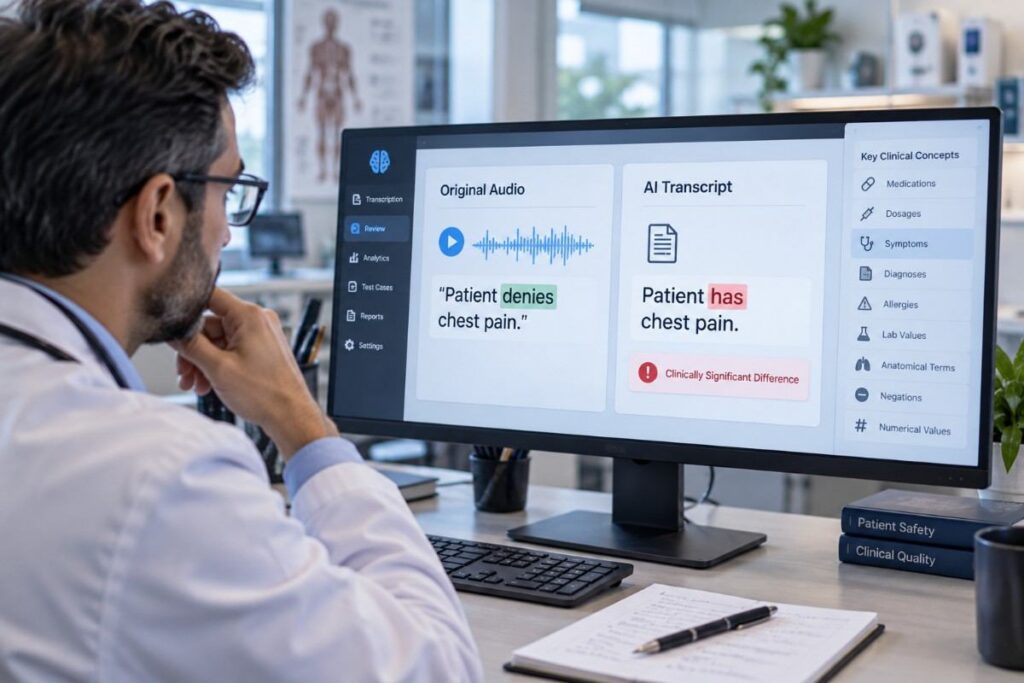
Word Error Rate (WER) is useful, but healthcare teams should resist turning it into the supreme judge of transcription quality. Two transcripts can have similar WER scores while presenting dramatically different levels of clinical risk.
Suppose the source audio says, “Patient denies chest pain,” and the transcription says, “Patient has chest pain.” The sentence is structurally excellent and catastrophically wrong. Likewise, incorrectly transcribing a dosage, frequency, allergy, lab value, or laterality can matter far more than several harmless formatting mistakes.
Testing should therefore classify errors by clinical importance. Critical concepts deserve dedicated validation, including medications, dosages, units, symptoms, diagnoses, allergies, procedures, anatomical locations, numerical values, and negations. QA teams can then measure not only how often the system fails but where its failures become dangerous or operationally disruptive.
This risk-weighted view produces a much more useful picture of AI quality than a headline accuracy percentage.
Challenge the AI With Clinical Language Ambiguity
Healthcare vocabulary creates an enormous playground for ambiguity. Drug names can sound alike. Abbreviations can mean different things depending on specialty or context. Numbers may refer to dosages, vital signs, dates, measurements, ages, or test results.
Testing should deliberately introduce phonetic ambiguity and contextual traps. Can the system distinguish similar terms when surrounding information provides the clue? Does it preserve “mg” versus “mcg”? Can it correctly capture “left” versus “right”? Does it understand when a clinician corrects an earlier statement?
Negation deserves particularly aggressive testing. Phrases such as “no history of,” “denies,” “negative for,” and “without evidence of” carry enormous semantic weight. The QA suite should verify that negations remain attached to the correct clinical concepts throughout transcription and downstream processing.
Test Hallucinations and Unsupported Additions
Generative AI can create a problem traditional transcription systems rarely had: producing plausible information that was never actually spoken.
A medical transcription application may clean up language, summarize conversations, generate structured notes, or map dialogue into predefined clinical sections. Those capabilities are useful, but they also create opportunities for unsupported additions. A polished sentence can look perfectly reasonable while quietly inserting a diagnosis, symptom, medication, or interpretation absent from the audio.
QA should therefore include source-grounding tests. Important statements in generated documentation should be traceable to the original conversation or an explicitly permitted source. Test cases should include unclear audio, contradictory statements, incomplete information, and conversations where the model simply does not have enough evidence to reach a conclusion.
Sometimes the correct AI behavior is uncertainty. A safe system should be able to flag unclear content rather than confidently inventing the missing pieces.
Validate Speaker Identification and Conversation Structure
Modern medical transcription applications increasingly process conversations rather than straightforward dictation. That makes speaker diarisation determining who said what part of the quality problem.
Consider a patient saying, “My father had a heart attack at 52.” If the system incorrectly attributes that statement to the patient’s own medical history, the transcription may be linguistically accurate while the resulting record is clinically misleading. Similar problems arise when clinicians, patients, caregivers, interpreters, and nurses participate in the same conversation.
Testing should verify speaker separation across interruptions, overlapping dialogue, long pauses, changing microphone distance, and participants with similar voices. It should also confirm that information remains associated with the correct person when transcription is transformed into structured clinical documentation.
This is a useful reminder that AI quality cannot be evaluated one component at a time. The entire information pipeline matters.

Verify EHR Integration and End-to-End Data Integrity
A flawless transcript that breaks during integration is still a failed healthcare application. Medical transcription systems often send information into electronic health records (EHRs), clinical note templates, billing systems, mobile applications, or other healthcare platforms.
Integration testing should verify that text, identifiers, timestamps, formatting, structured fields, and metadata survive those transitions correctly. Special attention is needed for Unicode characters, units, punctuation, lengthy notes, network interruptions, duplicate submissions, retries, and partial failures.
QA teams should also test what happens when an external service becomes slow or unavailable. Does the application queue data safely? Does it accidentally create duplicate records? Can users tell whether synchronization succeeded? Reliable recovery behavior is every bit as important as the happy path.
Test Privacy, Security, and Access Controls
Medical conversations can contain highly sensitive information, making security testing inseparable from functional testing. Audio recordings, transcripts, temporary processing files, logs, and generated notes can all become exposure points if handled incorrectly.
Testing should examine authentication, authorization, session management, encryption, data retention behavior, audit trails, and access boundaries between different user roles. QA should also inspect whether sensitive information unexpectedly appears in logs, analytics events, error messages, debugging tools, or exported files.
Regulatory requirements will depend on where and how the product operates, so compliance should not be reduced to a checkbox. The practical QA question is broader: Can sensitive healthcare information travel through this system without appearing somewhere it should not?
That question needs to be tested continuously as architectures, AI providers, integrations, and product features evolve.
Measure Performance Under Real Healthcare Workloads
Speed matters because transcription often sits directly inside a clinician’s workflow. Even highly accurate AI becomes frustrating if users repeatedly wait for notes to process or if performance deteriorates during busy periods.
Performance testing should measure transcription latency across different recording lengths, concurrent user volumes, audio qualities, and processing workloads. For streaming transcription, teams should evaluate partial-result latency, correction behavior, and how smoothly the transcript updates as speech continues.
Load and stress tests can expose queue bottlenecks, API limits, memory problems, timeout behavior, and downstream service dependencies. Recovery testing is equally valuable. When connectivity disappears halfway through a consultation, the application should fail predictably and recover without losing or corrupting clinical information.
Keep Humans in the QA Loop
Automation can execute enormous test suites, compare transcripts, measure latency, and detect regressions. But healthcare language contains context and nuance that make expert human review extremely valuable.
Clinical reviewers can identify errors that appear minor statistically but substantially alter meaning. QA engineers can then convert those findings into reusable regression scenarios. This creates a powerful feedback cycle: expert review discovers meaningful failure patterns, and automation ensures those failures stay fixed.
Human review is especially important after model updates. AI systems may improve overall while becoming worse for a particular specialty, accent, terminology group, or acoustic environment. Aggregate metrics can hide those regressions unless the test strategy actively searches for them.
Treat AI Testing as Continuous Quality Engineering
Medical transcription AI does not become “tested” once and remain trustworthy forever. Models change, clinical terminology evolves, integrations are updated, user behavior shifts, and new environments introduce new audio conditions.
Teams need baseline datasets, risk-based regression suites, production monitoring, and clear thresholds for acceptable performance. Model or prompt changes should trigger targeted testing of clinically sensitive scenarios, not just generic smoke tests. Comparing versions across identical datasets can reveal subtle regressions before they reach healthcare users.
The most mature teams also turn production discoveries into future test cases. When an unusual accent, medication name, workflow, or integration condition exposes a weakness, that scenario should become part of the permanent quality suite.
Quality Is the Feature Users Ultimately Trust
Medical transcription AI can reduce documentation effort and make clinical workflows significantly more efficient. But its real value depends on whether healthcare professionals can trust what appears on the screen.
That trust is built through disciplined testing: realistic clinical data, risk-weighted accuracy measurement, hallucination detection, speaker validation, security testing, integration verification, performance engineering, and continuous regression coverage. The objective is not to prove that an AI model works under ideal conditions. It is to understand exactly how the application behaves when conditions are difficult, ambiguous, or unexpected.
At Testiva, we believe that is where serious QA earns its place. Healthcare AI needs testing strategies that look beyond impressive demos and headline accuracy numbers to evaluate the complete experience users actually depend on.
Building or scaling an AI-powered healthcare application? Start your QA journey today and make quality part of the system before the system becomes part of critical clinical workflows.