




Latest Insights
Red Teaming AI Medical Scribes: A Guide for Healthcare QA Teams
- Sep 24, 2026
- Sajid M.
- AI Red Teaming in Healthcare

A clinician opens an automatically generated note after a packed morning. It looks polished, structured, and professional but one detail is wrong. A medication the patient stopped taking is listed as current. Nothing crashes or triggers an alert. The AI has produced something far trickier for QA teams to catch: an error that looks completely believable.
That is the real challenge of testing AI-powered clinical documentation. Failures can hide behind fluent language a missing “not,” a tentative diagnosis presented as confirmed, or a family member’s condition attributed to the patient. At Testiva, our AI and software QA testing services focus on uncovering these subtle risks, not simply checking whether the system produces a clean-looking note.
Healthcare conversations are naturally messy: interruptions, corrections, accents, background noise, and shifting context are normal. Red teaming turns that messiness into a testing advantage, deliberately pushing AI medical scribes into difficult scenarios to uncover weaknesses in accuracy, reasoning, privacy, and reliability.
What Red Teaming Means for an AI Medical Scribe
Red teaming originated in security, where one group deliberately attacks a system to uncover weaknesses that ordinary testing may miss. Applied to AI medical scribes, the concept becomes broader. The goal is not simply to “hack” the model. It is to systematically create situations that expose unsafe assumptions, hallucinations, context failures, privacy weaknesses, and unpredictable model behavior.
A traditional QA scenario might verify that the scribe correctly records a medication mentioned during a clear consultation. A red-team scenario asks what happens when the clinician mentions two medications, corrects themselves halfway through, discusses a drug the patient has stopped taking, and is interrupted by another speaker.
The distinction is important. Normal testing demonstrates that expected workflows function correctly. Red teaming searches for the conditions under which confidence in those workflows breaks down.
For healthcare AI, that mindset is essential because the most consequential defects may exist in unusual combinations of perfectly ordinary events.
Why Medical Scribes Need a Different QA Mindset
Deterministic software generally gives testers a familiar relationship between input and output. When the same button is clicked under the same conditions, QA expects substantially the same result. Generative AI complicates that model because acceptable outputs can vary linguistically while still needing to remain clinically faithful to the source conversation.
This creates a difficult question: what exactly counts as “correct”?
A medical note does not need to reproduce a conversation word for word. Summarization is part of the product’s value. Yet compression creates risk. The system must distinguish important clinical details from conversational noise without inventing connections or removing qualifiers that change meaning.
Consider the difference between “patient denies chest pain” and “patient has chest pain.” One missing word radically changes the clinical meaning. Similarly, “possible allergy to penicillin” is not equivalent to “penicillin allergy confirmed.” QA teams must evaluate semantic fidelity, not merely grammatical quality.
That means testing must operate at multiple levels: technical functionality, clinical meaning, model behavior, data handling, usability, and resilience.
Build Red-Team Scenarios Around Real Clinical Complexity
Useful red teaming starts with realistic failure conditions rather than exotic prompts created solely to confuse an AI model. Healthcare conversations already contain enough complexity to stress a system naturally.
Start with linguistic variation. Test different accents, speech speeds, regional terminology, medical abbreviations, incomplete sentences, overlapping speakers, code-switching, and mispronounced drug names. Add environmental complications such as background conversations, ringing phones, coughing, medical equipment, and intermittent audio.
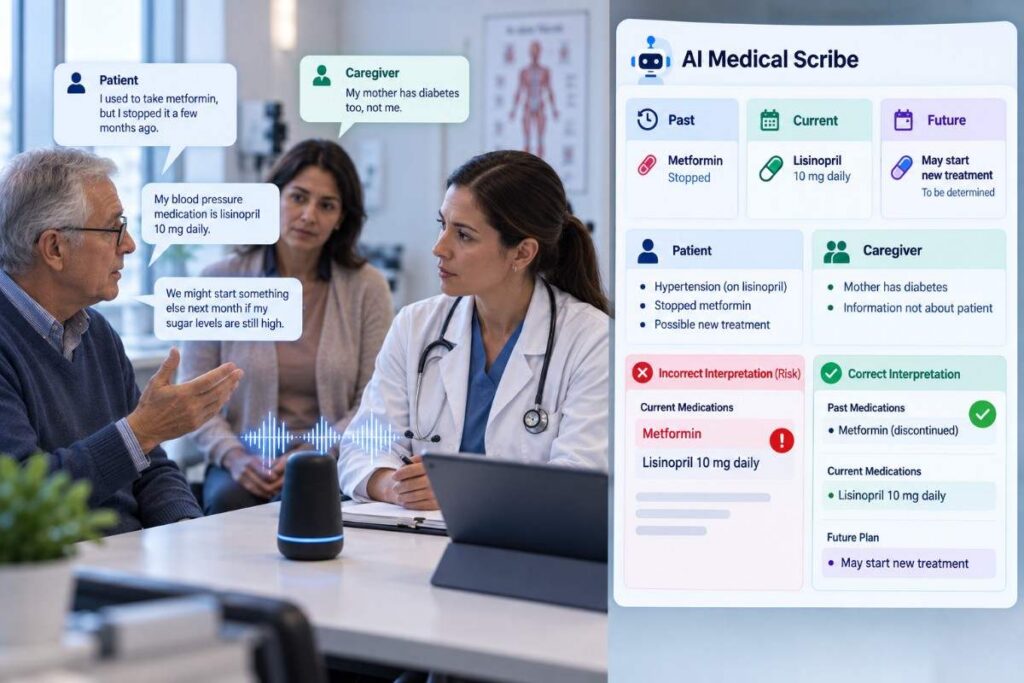
Then introduce conversational ambiguity. A clinician may say, “We considered increasing it to 20, but keep her on 10 for now.” A weak system may capture the proposed dosage rather than the final decision. Another encounter might include a patient discussing a family member’s diabetes, creating an attribution challenge: can the scribe distinguish family history from the patient’s diagnosis?
Corrections deserve particularly aggressive testing. Clinicians frequently revise statements while speaking. QA should verify that the final note reflects the correction rather than preserving both statements or selecting the first one arbitrarily.
The geeky rule here is simple: ambiguity is not an edge case. In human conversation, ambiguity is production traffic.

Test Hallucination as a First-Class Failure Mode
Hallucination becomes especially serious when generated content resembles plausible medical documentation. A fabricated detail may look completely natural inside an otherwise accurate note, making it harder for a busy clinician to detect.
Red-team cases should therefore contain deliberate information gaps. If no dosage is stated, does the scribe leave it unspecified or manufacture one? If the clinician discusses ordering a test but never confirms the decision, does the note convert consideration into an order? If symptoms are discussed without a diagnosis, does the system infer one?
QA teams should also test whether the model introduces standard-sounding clinical language that was never supported by the encounter. A polished sentence is not automatically an accurate sentence.
Metrics should reflect this distinction. Overall transcription accuracy can hide dangerous errors. Teams should separately measure unsupported additions, omissions, incorrect attribution, negation errors, temporal mistakes, and changes in clinical certainty.
Attack Context, Attribution, and Temporal Reasoning
Many medical-scribe failures are not failures to recognize words. They are failures to understand relationships between words.
Speaker attribution is one example. A consultation may involve a clinician, patient, caregiver, nurse, or interpreter. Red-team tests should deliberately create conversations in which multiple people describe symptoms or medical histories. The resulting note must consistently assign information to the correct person.
Time creates another challenge. “I used to take metformin,” “I started metformin yesterday,” and “I may start metformin next week” contain the same medication name but describe entirely different clinical states. QA should construct conversations containing past treatments, current medications, discontinued drugs, proposed therapies, and future plans within the same encounter.
Long conversations should also test memory boundaries. Important information may appear early and be corrected much later. The scribe must maintain sufficient context to reconcile those statements rather than treating every sentence independently.
These tests reveal whether the system understands an encounter as a coherent clinical narrative rather than simply transforming nearby words into professional-looking prose.
Red Team Privacy and Data Boundaries Too
Accuracy is only one dimension of medical AI quality. Scribes process highly sensitive information, so red-team planning should also examine privacy, access controls, retention behavior, integrations, and unintended data exposure.
QA teams can test whether one user’s information can appear in another session, whether cached content survives where it should not, and whether sensitive information is unnecessarily exposed in logs or downstream workflows. Testing should also examine failure states. What happens to recorded or transcribed information when connectivity disappears, an integration fails, or processing stops halfway through?
Prompt-based attacks deserve attention as well. If spoken content includes phrases that resemble instructions to the AI, the system should not unexpectedly change its behavior or reveal protected information. Treating untrusted encounter content as authoritative system instructions creates an entirely different class of risk.
These scenarios should be developed alongside the organization’s security, privacy, clinical, and compliance stakeholders. QA should verify technical behavior against established requirements rather than assuming that passing functional tests automatically demonstrates appropriate healthcare data handling.
Make Clinical Experts Part of the QA Loop
Healthcare AI cannot be evaluated exclusively through generic software-quality metrics. A note can be technically complete and linguistically excellent while still being clinically misleading.
Clinical reviewers can help QA teams classify errors according to consequence. A punctuation issue and an incorrect medication dosage should not contribute equally to a quality score. Likewise, omitting casual conversation is desirable; omitting a reported adverse reaction is potentially significant.
This collaboration enables risk-weighted testing. QA engineers bring systematic scenario design, reproducibility, automation, defect analysis, and adversarial thinking. Clinical experts contribute domain interpretation and an understanding of how documentation errors could influence downstream decisions.
The strongest programs combine both disciplines instead of expecting either group to evaluate the entire system alone.
Turn Red-Team Discoveries Into Regression Tests
Finding an impressive failure once is not enough. The real engineering value appears when every meaningful discovery strengthens the permanent QA suite.
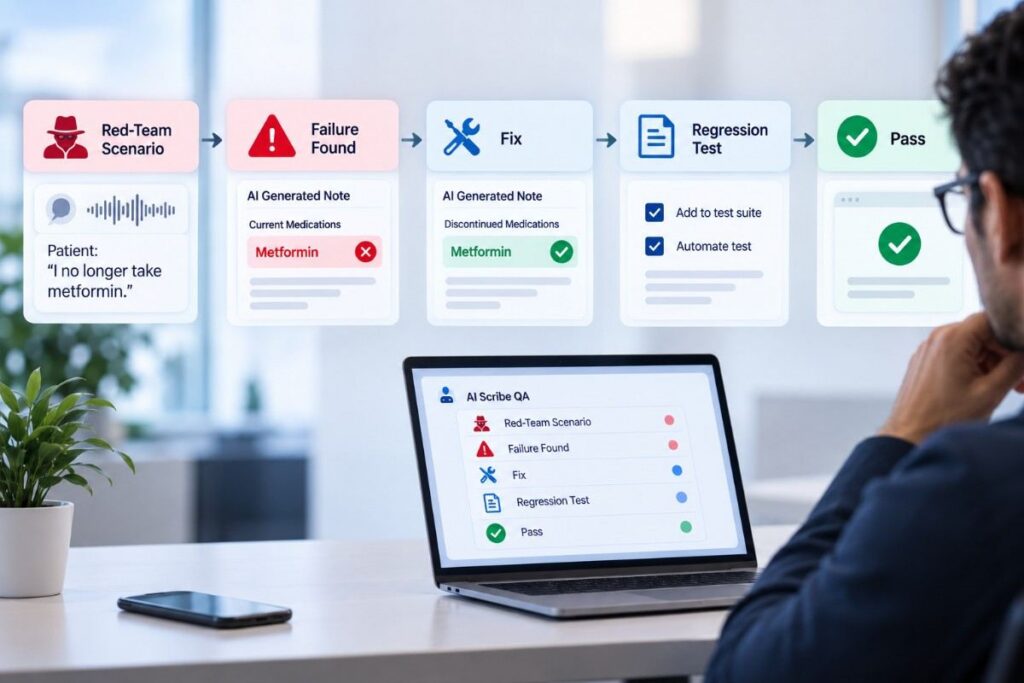
When red teaming exposes a failure, preserve the triggering input, expected clinical meaning, actual output, severity classification, model configuration, and relevant environment details. After the defect is addressed, convert the scenario into a repeatable regression test wherever practical.
Over time, this produces a library based on observed weaknesses rather than hypothetical requirements alone. It also becomes especially valuable when models, prompts, transcription components, summarization logic, or integrations change.
AI systems evolve quickly. A new model version may improve general note quality while unexpectedly degrading speaker attribution or negation handling. A mature regression suite makes those trade-offs visible before deployment.
Automation can handle repeatable checks and large scenario sets, while human review remains valuable for nuanced semantic and clinical judgments. The objective is not to automate every evaluation; it is to apply automation where it produces reliable evidence.
Red Teaming Should Be Continuous, Not a Launch Gate
AI medical scribes operate in a world that refuses to stay neatly inside predefined test cases. New accents appear. Clinical workflows change. Models are updated. Integrations evolve. Users discover behaviors that product teams never anticipated.
Red teaming should therefore become part of the ongoing QA lifecycle rather than a dramatic exercise performed just before launch. Run targeted adversarial testing after meaningful model changes, prompt modifications, workflow updates, and integration releases. Feed production findings back into scenario design, while handling real-world data according to appropriate privacy controls.
Most importantly, track failure categories over time. Knowing that “accuracy improved” is less useful than knowing that unsupported clinical additions fell while temporal errors increased. Granular quality signals help teams understand what each release actually changes.
For an AI medical scribe, trust is not created by flawless-looking text. It is created by repeatedly demonstrating that the system preserves meaning when conversations become noisy, contradictory, ambiguous, multilingual, interrupted, or simply human.
Build AI That Has Earned Clinical Confidence
Red teaming changes the central QA question from “Does the medical scribe work?” to “Under what conditions does it stop being trustworthy?” That second question is harder and far more valuable.
Healthcare QA teams should deliberately challenge hallucination, negation, attribution, temporal reasoning, corrections, noisy audio, privacy boundaries, and clinical ambiguity. They should measure failures according to risk, involve domain experts, and turn every important discovery into future regression coverage.
AI medical scribes do not need QA that merely confirms the happy path. They need QA designed to find the uncomfortable paths before real users do.
At Testiva, we help teams build rigorous testing strategies for complex digital products where reliability and user trust cannot be afterthoughts. Unlock flawless delivery and start your QA journey today.