




Latest Insights
How to Conduct Automation Testing for AI Medical Scribes in Clinical Workflows
- Sep 26, 2026
- Sajid M.
- ai medical scribe automation testing

AI medical scribes are changing one of healthcare’s most time-consuming workflows: clinical documentation. Instead of requiring clinicians to manually capture every relevant detail during or after an encounter, these systems can listen to conversations, identify medically significant information, and generate structured clinical notes. The workflow looks effortless when it works. Testing it properly is anything but effortless.
An AI medical scribe sits at the intersection of speech recognition, generative AI, clinical software, integrations, and sensitive patient data. A defect can therefore be more consequential than an ordinary UI bug. At Testiva, our automation testing services approach systems like these as complete workflows rather than isolated AI features. The goal is not simply to prove that the application produces output, but to determine whether it produces dependable output under realistic clinical conditions.
Automation provides the repeatability and coverage required to make that determination continuously. The challenge is designing tests that evaluate both traditional software behavior and the less deterministic behavior of AI.
Why AI Medical Scribe Testing Requires a Different Strategy
Traditional application testing usually starts with deterministic expectations. Enter a known value, perform an action, and verify that a predictable result appears. AI medical scribes complicate this model because two semantically equivalent outputs may use different wording while still being clinically correct.
A generated note cannot always be validated with an exact string comparison. Testing must instead examine meaning, completeness, attribution, formatting, workflow behavior, and whether unsupported information has been introduced.
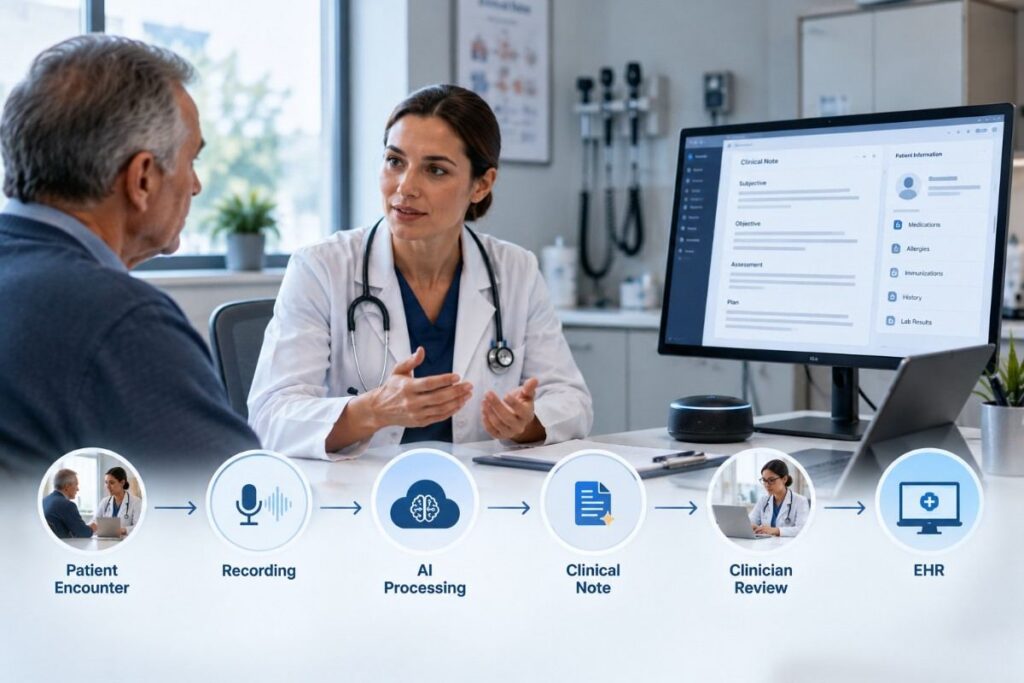
There is also considerably more happening behind the interface. A typical scribe workflow may involve audio capture, speech-to-text processing, speaker identification, medical terminology extraction, note generation, EHR integration, clinician review, and final submission. Automation therefore needs to validate the chain, not merely the shiny AI component in the middle.
Map the Clinical Workflow Before Automating It
Good automation begins with understanding how clinicians actually use the product. A test suite built around technical components alone can report excellent pass rates while missing failures that disrupt real clinical work.
Map the journey from the beginning of an encounter through documentation completion. That includes starting and stopping recording, interruptions, long conversations, multiple speakers, reviewing generated notes, editing content, approving documentation, and transferring information into the electronic health record.
From that map, identify critical checkpoints. Did recording begin successfully? Was the complete encounter processed? Did the correct patient context remain associated with the session? Was the generated note saved? Did edits persist? Was the approved version transferred to the intended record?
This workflow-first approach also helps prioritize automation. Functions that influence clinical documentation, data integrity, or downstream systems deserve deeper automated coverage than low-risk cosmetic behavior.
Build a Controlled Test Dataset
Automation becomes unreliable when every test depends on unpredictable live conversations. Teams need a controlled library of synthetic or appropriately de-identified encounter data representing realistic clinical scenarios while respecting applicable privacy and security requirements.
The dataset should include variations in speaking speed, accents, terminology, conversation length, background noise, interruptions, and speaker count. It should also cover different specialties and encounter types because a primary-care consultation and a cardiology follow-up can produce very different vocabulary and documentation structures.
Each scenario needs a reference expectation. That does not necessarily mean prescribing one perfect note word for word. Instead, define the clinical facts that must appear, information that must not appear, expected note sections, speaker attribution requirements, and acceptable terminology variations.
Version these datasets alongside the test suite. When prompts, models, transcription engines, or note-generation logic change, the same scenarios can be replayed to detect regressions.
Automate the End-to-End Scribe Pipeline
Component tests are valuable, but AI medical scribes need end-to-end automation because many serious failures occur between components.
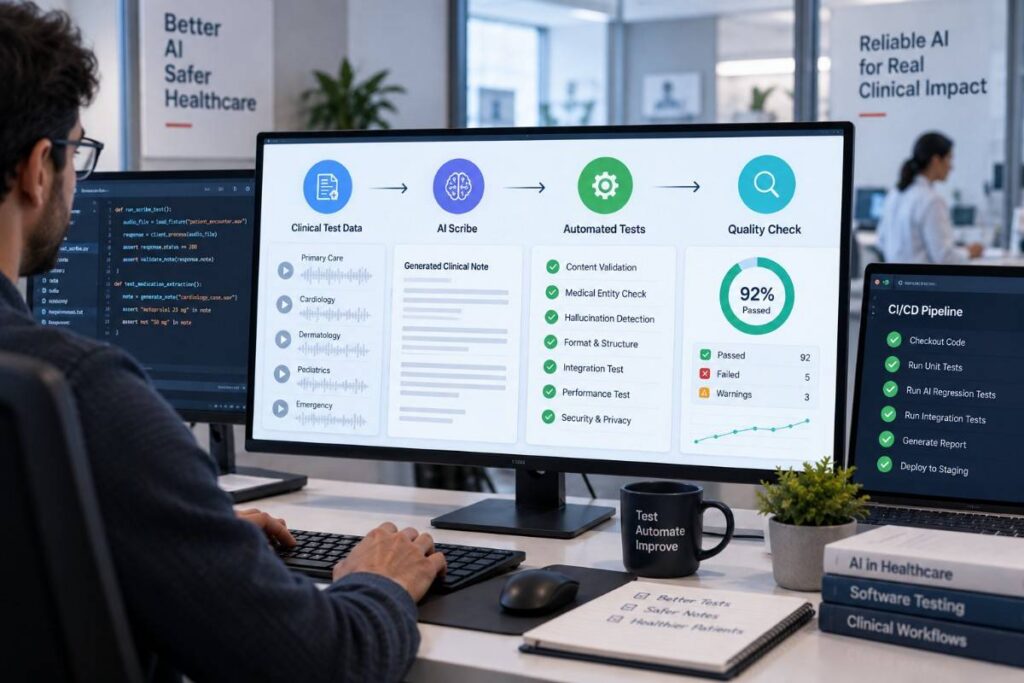
An automated scenario can feed a known audio fixture into the application, wait for transcription and note generation, retrieve the resulting document, and validate its content and metadata. The test can then simulate clinician edits, approval, and any permitted downstream EHR interaction in a controlled test environment.
These tests should verify more than whether the workflow returns HTTP 200 responses. Automation should detect incomplete recordings, truncated transcripts, duplicate note sections, incorrect patient associations, failed saves, integration timeouts, and state inconsistencies.
Failure recovery deserves equal attention. If connectivity disappears during an encounter or an AI service temporarily fails, what happens next? The application should recover predictably without silently losing documentation or creating duplicate records.
Test Clinical Meaning Instead of Exact Wording
One of the biggest automation mistakes with generative AI is expecting identical text on every execution. AI output can change wording without changing meaning, making exact-match assertions unnecessarily brittle.
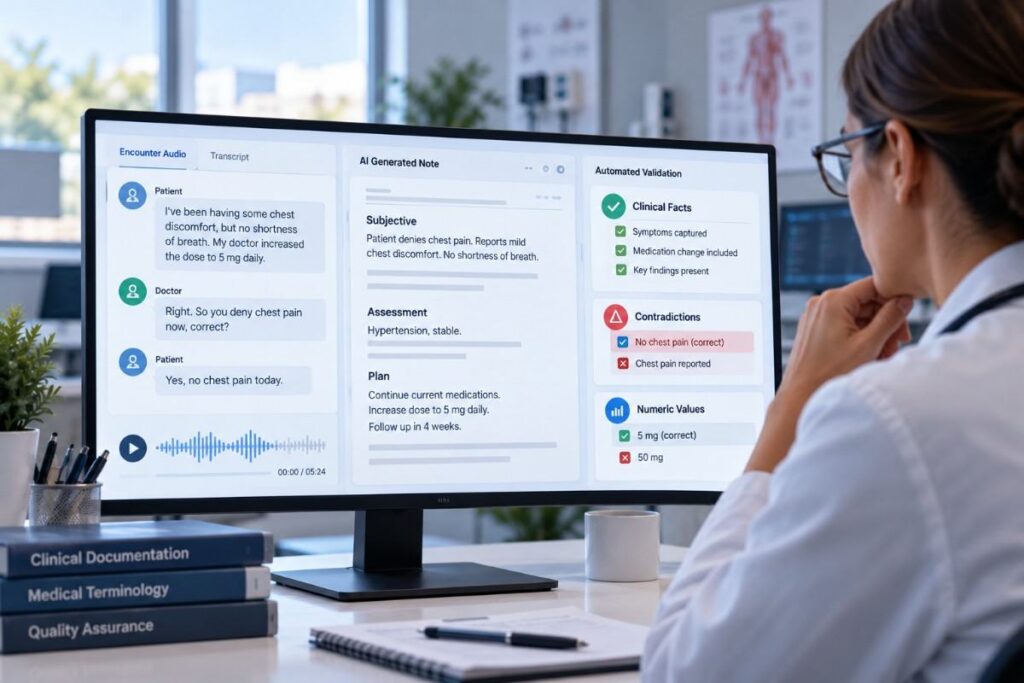
A stronger framework combines deterministic rules with semantic evaluation. Deterministic assertions can verify required sections, patient identifiers, timestamps, field formats, medication names, numerical values, and other structured information. Semantic checks can evaluate whether important clinical concepts from the source encounter remain represented in the generated note.
Testing should also detect contradictions. If the conversation says the patient denies chest pain, a note stating that the patient reports chest pain represents a meaningful failure even though both phrases contain the same medical concept.
Numeric information deserves especially strict validation. Dosages, frequencies, measurements, dates, and quantities should be extracted from controlled source material and compared against the generated documentation. A beautifully formatted note is still defective if “5 mg” becomes “50 mg.”
Automate Hallucination and Omission Detection
For medical scribes, what the AI invents can matter just as much as what it misses. Automated tests should therefore evaluate both unsupported additions and clinically relevant omissions.
Create scenarios containing deliberately limited information. If an encounter never mentions allergies, for example, the system should not confidently invent an allergy history. Likewise, a test fixture containing an explicit medication change should verify that the change survives transcription and note generation.
Negative assertions are particularly useful here. Maintain lists of facts that are intentionally absent from specific fixtures and flag generated documentation when those concepts unexpectedly appear.
No automated mechanism can guarantee clinical correctness in every circumstance. Human clinical review remains important, particularly when evaluating nuanced documentation quality. Automation is most useful for continuously catching repeatable failure patterns before they reach that review stage.
Validate Integrations, Privacy, and Access Controls
A medical scribe rarely operates alone. It may communicate with identity systems, scheduling platforms, EHRs, APIs, storage services, and third-party AI infrastructure. Every connection creates additional failure paths.
Automated integration tests should verify field mapping, authentication, retries, duplicate prevention, error handling, and record association. Contract testing can also detect when an upstream or downstream API changes in a way that could break the scribe workflow.
Security-oriented automation should validate role-based access and session behavior. A clinician should see only information permitted by the product’s authorization model, while unauthorized users must be prevented from accessing recordings, transcripts, notes, and related patient information.
Teams should additionally verify logging behavior. Diagnostic logs are useful for troubleshooting, but sensitive information should not accidentally appear in places where it is unnecessary or insufficiently protected.
Measure Performance Under Realistic Clinical Conditions
Performance testing for an AI medical scribe is not simply about page-load speed. The meaningful question is whether the system remains responsive while processing the workloads expected in real clinical environments.
Test concurrent encounters, large audio files, extended consultations, bursts of note-generation requests, and slow downstream services. Measure transcription latency, generation time, API response behavior, queue depth, failure rates, and resource utilization.
Define thresholds around user experience rather than arbitrary infrastructure numbers. If clinicians routinely wait several minutes for documentation after every encounter, technically successful processing may still create a poor workflow.
Soak testing is valuable too. Running sustained workloads can uncover memory leaks, queue accumulation, token or rate-limit issues, and degradation that short performance tests never expose.
Make AI Regression Testing Part of CI/CD
AI systems evolve frequently. A model upgrade, prompt modification, transcription-engine update, terminology rule, or integration change can improve one scenario while unexpectedly degrading another.
A regression suite should replay representative clinical fixtures whenever important components change. Results can be compared against established quality thresholds for factual coverage, omissions, unsupported content, latency, formatting, and workflow success.
Not every AI test belongs on every commit. Fast deterministic tests can run continuously, while expensive audio-processing and semantic regression suites can run at controlled pipeline stages, nightly, or before releases. This layered strategy keeps feedback fast without sacrificing deeper validation.
Most importantly, keep historical results. Trends often reveal degradation more effectively than individual pass/fail results. A slow decline in transcription accuracy or increasing generation latency deserves attention even if neither has crossed a hard failure threshold yet.
Build Automation Around Clinical Confidence
Automation testing an AI medical scribe requires more than UI scripts and API checks. Teams need a framework that understands clinical workflows, exercises the complete processing pipeline, evaluates variable AI output intelligently, tests failure recovery, and continuously watches for regressions.
The strongest strategy combines deterministic software testing with controlled clinical scenarios and semantic quality evaluation. It treats transcription, generation, integrations, security, performance, and clinician interactions as parts of one quality problem rather than separate testing projects.
That is ultimately what effective QA should provide: evidence that the product behaves reliably where users actually depend on it. For teams building AI-driven healthcare software, investing in that evidence early makes releases safer, regressions easier to identify, and rapid iteration far more sustainable.