




Latest Insights
AI Medical Scribe Productivity Metrics: What Healthcare Teams Should Track
- Sep 29, 2026
- Sajid M.
- AI Medical Scribe Productivity

Documentation should support patient care, not compete with it. Yet for many clinicians, the work continues long after an appointment ends finishing notes, correcting details, and updating the EHR. That is exactly where medical scribe technology is expected to make a measurable difference.
But “faster documentation” alone does not prove better productivity. At Testiva, we see this same principle in our QA testing services: real performance is measured across the complete workflow, including accuracy, reliability, usability, and the time users actually save.
So, which metrics reveal whether an AI medical scribe is genuinely improving clinical productivity? Let’s look at the numbers healthcare teams should be tracking.
Why AI Medical Scribe Productivity Needs to Be Measured
Healthcare productivity is unusually sensitive to workflow friction. Saving two minutes during transcription means little if the clinician then spends four minutes correcting the generated note. Similarly, fast note generation loses much of its value when integration failures force staff to copy information manually into an electronic health record (EHR).
That is why healthcare organizations should establish baseline measurements before introducing an AI scribe. How long does documentation currently take? How much work happens after the patient visit? How frequently are notes reopened or corrected? Without baseline data, teams may see impressive AI performance statistics without knowing whether day-to-day clinical work actually improved.
The strongest measurement programs combine efficiency metrics with quality indicators. This helps teams distinguish genuine productivity gains from situations where work has simply moved elsewhere in the workflow.
Documentation Time per Encounter
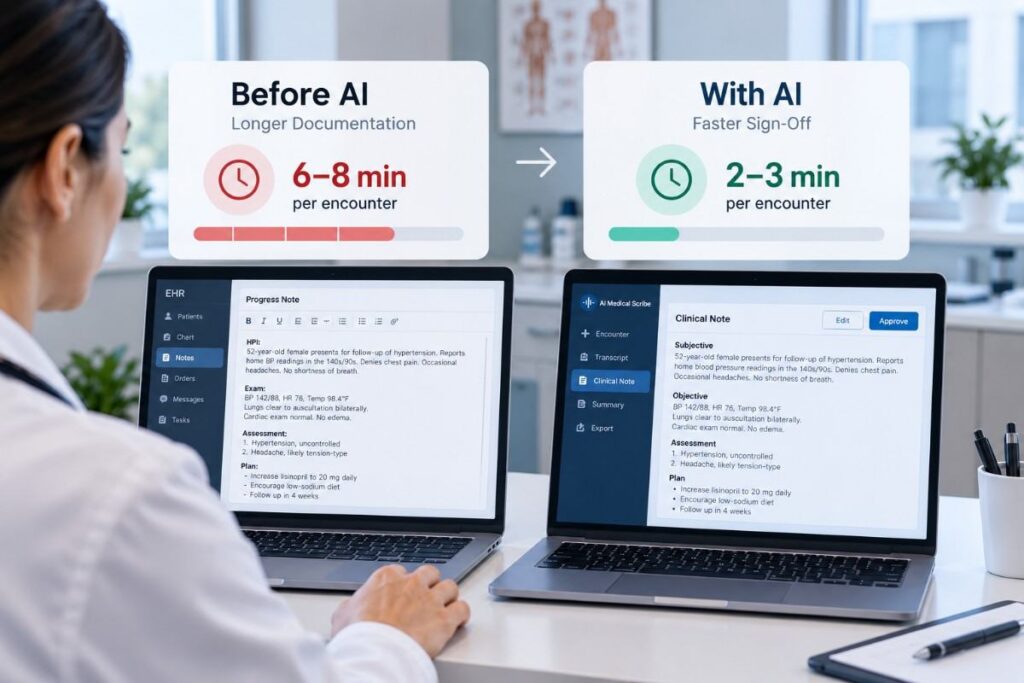
Documentation time per encounter is one of the clearest indicators of AI scribe productivity. Teams should compare the average time clinicians spend documenting an encounter before and after implementation, ideally segmented by specialty, visit type, and clinician.
However, measuring only AI generation time creates an incomplete picture. A system might produce a draft note in seconds, but clinicians could still spend several minutes reviewing, editing, formatting, and approving it. The more meaningful metric is total documentation time, from the point documentation activity begins until the note is ready for sign-off.
Teams should also examine the distribution rather than relying exclusively on averages. A medical scribe that performs extremely well for routine follow-ups but poorly for complex consultations may appear productive at the organizational level while creating significant friction for specific clinical workflows.
Time to Note Completion and Sign-Off
Another valuable metric is the elapsed time between the clinical encounter and finalized documentation. AI scribes are particularly valuable when they reduce the backlog of unfinished notes that clinicians must address later.
Healthcare teams can measure median time to note completion, the percentage of notes signed within a defined period, and the number of notes remaining incomplete at the end of a shift. These metrics reveal whether the technology is improving workflow velocity rather than merely accelerating one technical step.
This matters because delayed documentation has operational consequences. Notes that remain unfinished can slow downstream processes, create additional administrative work, and increase the cognitive burden on clinicians who must reconstruct encounter details hours later.
After-Hours Documentation Time
One of the most important productivity metrics is also one of the most human: how much documentation work happens after scheduled clinical hours?
AI medical scribes are often introduced partly to reduce the administrative workload clinicians carry beyond patient-facing hours. Healthcare organizations should therefore compare after-hours EHR activity before and after deployment. Useful measures include average minutes spent documenting after shifts and the percentage of clinicians regularly completing notes outside scheduled hours.
A meaningful decline can indicate that the system is doing more than making individual tasks faster. It may be changing when documentation work happens and reducing the amount of administrative work clinicians carry into their personal time.
Note Editing and Correction Rate
Speed becomes misleading when AI-generated documentation requires extensive correction. That makes editing rate one of the most important counterbalances to raw productivity metrics.
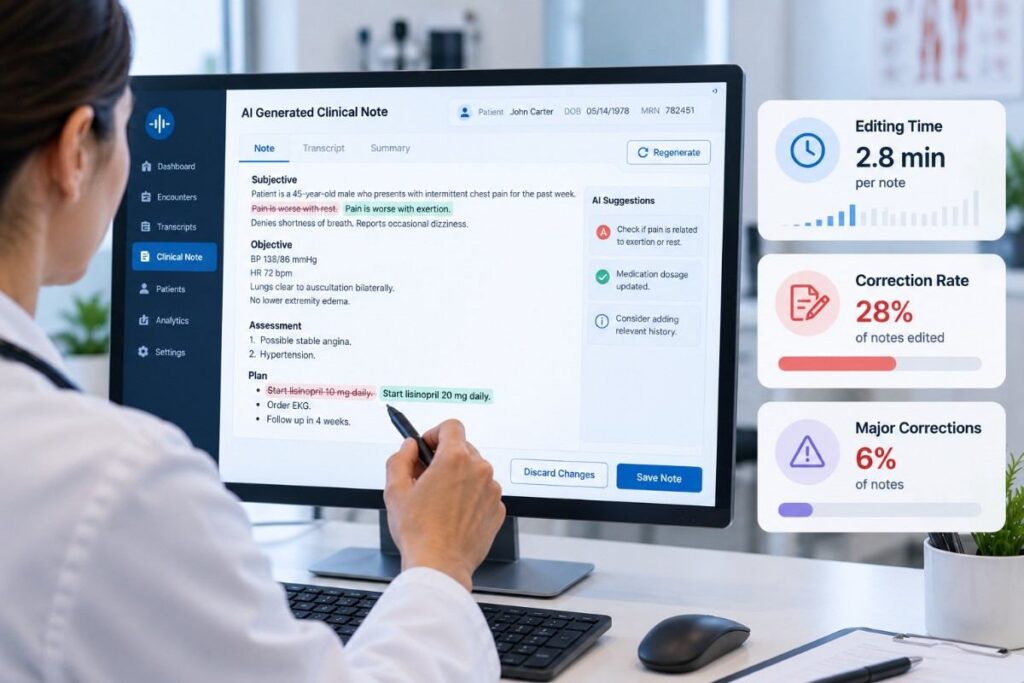
Teams can measure the percentage of generated text modified before sign-off, average editing time, frequency of major corrections, and categories of recurring changes. Minor formatting adjustments are fundamentally different from corrections involving medications, diagnoses, clinical history, or assessment details.
Tracking patterns is especially useful. If clinicians repeatedly correct the same terminology or note sections, the problem may indicate a model limitation, configuration issue, specialty-specific weakness, or integration defect. Productivity monitoring can therefore double as an early-warning system for software quality.
Clinician Acceptance and Adoption Rate
AI medical scribe cannot generate meaningful productivity gains if clinicians routinely avoid it. Adoption metrics provide important context for interpreting every other KPI.
Healthcare teams should monitor the percentage of eligible encounters using the scribe, active users over time, abandonment rates, and differences in adoption between specialties or locations. A gradual decline after an enthusiastic launch is particularly worth investigating.
Low adoption does not automatically mean clinicians are resistant to new technology. It may signal slow interfaces, unreliable recording, cumbersome review workflows, inconsistent outputs, or poor integration with existing systems. In other words, adoption is often a practical usability metric disguised as a business KPI.
Encounters per Clinician
If an AI medical scribe meaningfully reduces administrative effort, organizations may eventually see changes in clinical capacity. Encounters per clinician per shift, day, or week can help measure this effect.
This metric requires careful interpretation. Increasing patient volume should not be treated as the only definition of success, nor should teams assume every minute saved must become another appointment. Recovered time might instead improve patient interaction, reduce delays, support more complex cases, or decrease overtime.
The important question is whether documentation is consuming fewer resources while clinical quality remains stable. Productivity should represent increased capacity and reduced friction, not simply pressure to squeeze more appointments into the schedule.
Note Accuracy and Quality Must Sit Beside Productivity
Productivity metrics should never be evaluated in isolation from documentation quality. An AI scribe that saves substantial time but regularly produces clinically significant errors is not truly productive.
Healthcare teams should track factual accuracy, omission rates, inappropriate additions, terminology errors, and discrepancies in critical information. Quality review can also examine whether generated notes follow required structures and accurately distinguish between patient statements, clinician assessments, and treatment plans.
This is where rigorous QA becomes essential. Healthcare AI applications should be tested across realistic scenarios, including noisy environments, different speakers, specialty terminology, interruptions, unusual workflows, and integration failures. The objective is to understand not only how the system performs under ideal conditions, but how reliably it behaves when clinical reality gets messy.
System Latency, Availability, and Failure Rate
Clinical productivity depends heavily on technical performance. Even an accurate AI scribe becomes disruptive when clinicians regularly wait for processing, experience synchronization failures, or lose recordings.
Teams should monitor transcription latency, note-generation latency, uptime, error rates, failed uploads, synchronization failures, and recovery time after incidents. Performance should also be examined during peak usage rather than only under controlled conditions.
Percentile measurements can reveal problems averages hide. For example, an acceptable average response time can coexist with frustratingly slow experiences for a meaningful percentage of encounters. In clinical workflows, those outliers matter because one delayed or failed note can interrupt an otherwise efficient session.
EHR Integration Efficiency
The productivity value of an AI scribe depends heavily on what happens after the note is generated. If clinicians must repeatedly copy, paste, reformat, or reconcile information manually, automation has only solved part of the problem.
Healthcare teams should measure successful note transfers, integration error rates, manual steps required per encounter, duplicate-entry frequency, and time spent resolving synchronization problems. These metrics reveal the “hidden clicks” that often disappear from executive-level productivity reports.
Integration testing is equally important when EHRs, APIs, authentication services, mobile applications, and AI components operate together. Each individual system can function correctly while the end-to-end workflow still fails at the handoff points.
Build a Balanced AI Scribe Productivity Scorecard
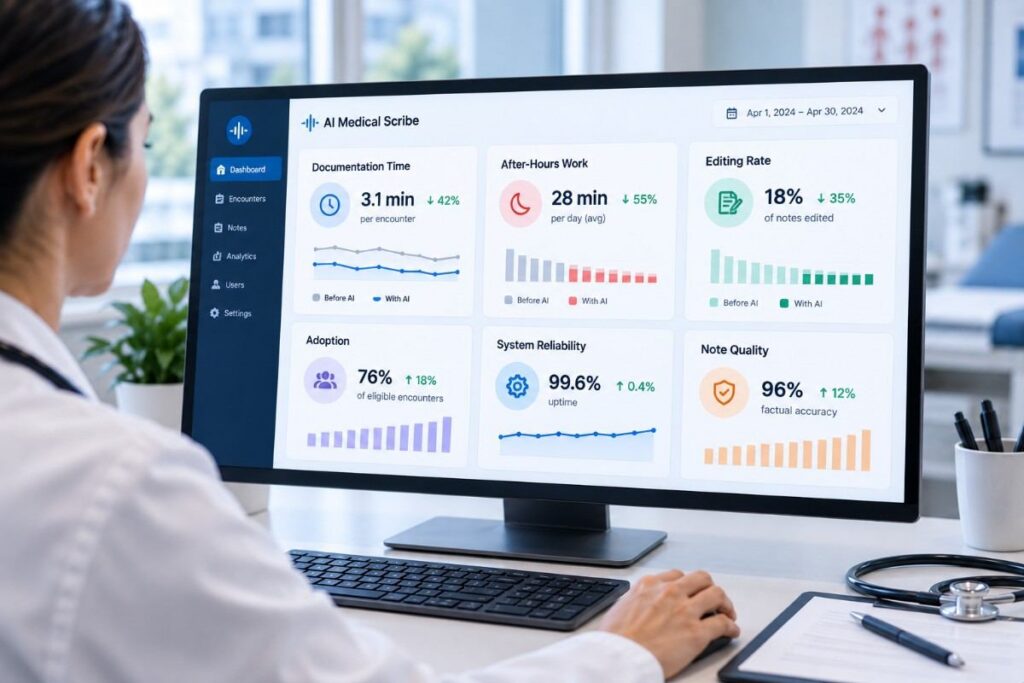
No single KPI can determine whether an AI medical scribe is successful. A practical scorecard should combine time savings, workflow completion, adoption, technical reliability, and documentation quality.
For example, a team might track total documentation minutes per encounter, time to sign-off, after-hours documentation, editing rate, scribe utilization, system latency, integration failures, and clinically significant correction rates. Those measurements should then be segmented where possible by specialty, location, clinician cohort, and encounter type.
Most importantly, teams should monitor trends over time. AI systems, software releases, integrations, clinical workflows, and user behavior evolve. A productivity improvement measured during an initial pilot does not guarantee identical performance six months later.
Measure the Workflow, Not Just the AI
The best AI medical scribe metric is not simply “How fast did the model generate a note?” It is “How much easier, faster, and more reliable did the entire documentation workflow become?”
Healthcare teams that measure only generation speed risk optimizing the smallest part of the problem. Teams that monitor documentation time, corrections, after-hours work, adoption, clinical quality, system reliability, and integration performance gain a much more realistic picture of value.
AI medical scribes have enormous potential to remove repetitive administrative work from healthcare, but that potential depends on measurable performance in real clinical environments. Treat productivity as an end-to-end quality outcome, validate it continuously, and the numbers become more than dashboard decorations they become evidence that the technology is genuinely helping clinicians work better.