




Latest Insights
Which Is Better for Your Practice: AI Medical Scribe or Virtual Scribe?
- Sep 30, 2026
- Sajid M.
- Scribe Differences

Clinical documentation has always been necessary. The amount of clinician time it consumes, however, does not have to be. As healthcare practices look for ways to reduce administrative workload and give providers more attention back to patients, two solutions increasingly enter the conversation: AI medical scribes and virtual scribes.
Both approaches can reduce the burden of creating clinical notes, but they solve the problem differently. AI medical scribes rely on speech recognition, natural language processing, and increasingly sophisticated generative AI to turn clinical conversations into structured documentation. Virtual scribes bring a human into the workflow remotely, listening to encounters or reviewing recorded information and documenting on the provider’s behalf. From our perspective as a quality assurance team, this distinction matters because healthcare software must be evaluated not only for whether it works, but for accuracy, reliability, privacy, workflow compatibility, and the consequences when something goes wrong.
The better option therefore isn’t automatically the one with more AI or more humans. It is the one that produces dependable documentation while fitting the clinical, operational, and technical realities of your practice.
What Is an AI Medical Scribe?
An AI medical scribe is software designed to capture information from a patient-provider interaction and convert it into clinical documentation. Modern systems may identify speakers, recognize medical terminology, summarize conversations, organize information into predefined note structures, and integrate the resulting documentation with an electronic health record (EHR).
The major attraction is automation. Once properly configured, an AI scribe can work alongside the clinician with relatively little human involvement. Notes may be generated shortly after an encounter, allowing providers to review, correct, and approve documentation instead of writing it from scratch.
But the word “AI” should never be mistaken for “infallible.” Medical conversations are messy data. Accents, background noise, interruptions, abbreviations, specialty terminology, overlapping speech, and ambiguous statements can all affect output. An AI scribe must therefore be judged by what happens under realistic clinical conditions, not just by how impressive its demo looks.
What Is a Virtual Medical Scribe?
A virtual medical scribe is a trained human professional who supports documentation remotely. Depending on the operating model, the scribe may join an encounter in real time or work asynchronously from recordings and clinical information. The scribe then creates or updates documentation for clinician review.
The human element gives virtual scribes an important advantage: contextual reasoning. A trained scribe can often recognize nuances, interpret conversational detours, distinguish relevant clinical information from small talk, and adapt to an individual provider’s documentation habits.
Virtual scribes are not immune to mistakes, of course. Human performance varies, and quality depends heavily on training, experience, workload, supervision, and standardized processes. Practices also need to consider secure access, confidentiality, staffing availability, and how remote personnel interact with existing systems.
AI Medical Scribe vs. Virtual Scribe: The Core Differences
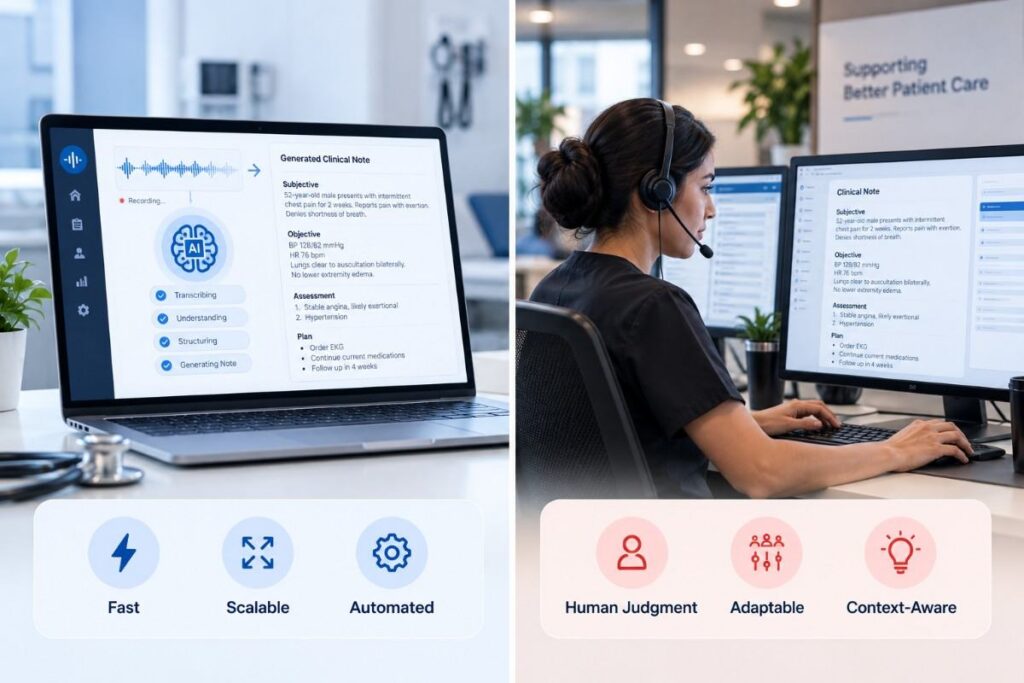
The most obvious difference is who or what does the documentation work. An AI scribe primarily automates interpretation and note generation, while a virtual scribe relies on a person to understand and document the encounter.
That difference creates several downstream tradeoffs. AI can offer speed, consistency, and scalability. A software system does not need to schedule another employee for every additional clinic session, making the model attractive to rapidly growing organizations. Virtual scribes, meanwhile, offer human judgment and adaptability, which can be particularly valuable when encounters are complex or documentation conventions vary considerably.
Neither advantage should be considered in isolation. A note produced in seconds is not valuable if a clinician spends several minutes correcting it. Similarly, excellent human-generated documentation may become operationally difficult if staffing limitations repeatedly leave providers without coverage. The meaningful comparison is the complete workflow.
Accuracy and Clinical Context Matter More Than Raw Speed
AI medical scribes have improved significantly, particularly in understanding natural speech and generating coherent summaries. Yet coherent language is not necessarily clinically accurate language. A note can read beautifully while containing an incorrect medication, missing a negative finding, assigning information to the wrong speaker, or turning an uncertain statement into an apparently definitive fact.
That is why quality testing becomes particularly important for AI-enabled healthcare products. Testing should include different accents, specialties, encounter lengths, audio conditions, terminology, interruptions, multi-speaker scenarios, and unusual workflows. Functional QA testing can also help validate whether generated notes move correctly through the broader application and EHR workflow rather than evaluating transcription accuracy alone.
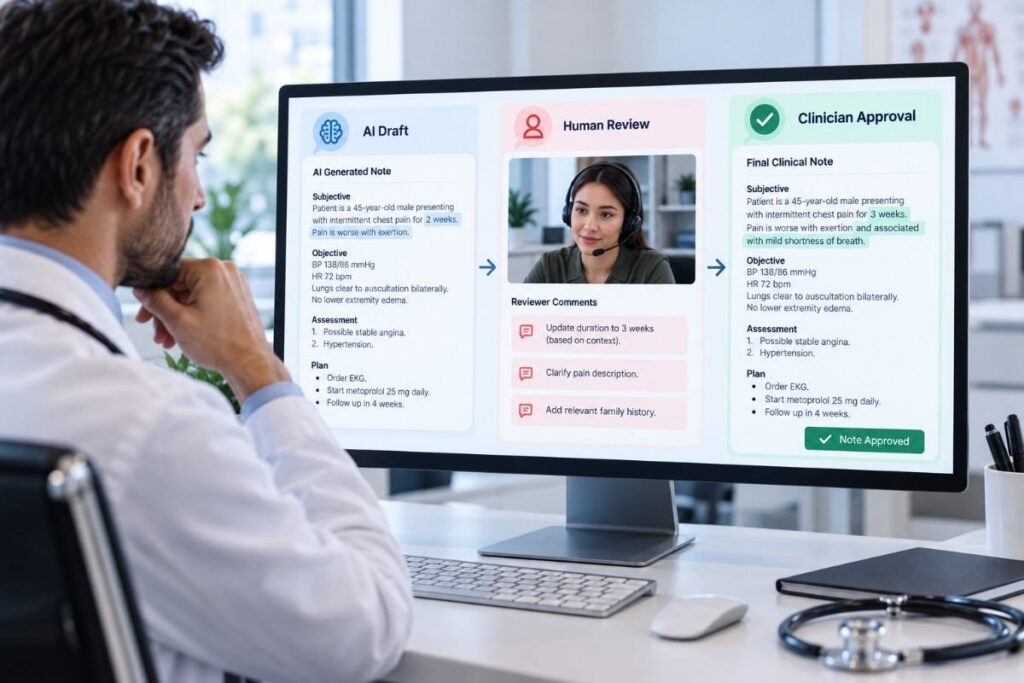
Virtual scribes have a different accuracy profile. Humans can use context to resolve ambiguities and recognize when information needs clarification. However, fatigue, insufficient training, unfamiliar terminology, or excessive workload can introduce errors. In either model, clinician review remains an important safeguard rather than an inconvenient final step.
Which Option Delivers Better Scalability?
For practices expecting substantial growth, AI generally has the stronger scalability story. Once the technical infrastructure is established, software can potentially support more encounters without requiring staffing to increase at exactly the same rate.
This can be particularly useful for multi-location practices, telehealth providers, and healthcare platforms handling variable encounter volumes. AI systems can also offer greater availability across extended hours, assuming the surrounding infrastructure remains operational.
Virtual scribing scales differently because capacity is tied to people. More encounters usually require additional trained scribes, scheduling, onboarding, and quality management. That does not make virtual scribes unsuitable for growth, but practices should understand that their operational scaling requirements can be more substantial.
Workflow Integration Can Decide the Winner
A documentation tool that creates extra friction has missed the point, regardless of how sophisticated its underlying technology is. Providers should not have to jump between multiple applications, repeatedly correct formatting, manually transfer information, or redesign their entire clinical routine just to accommodate a scribe solution.
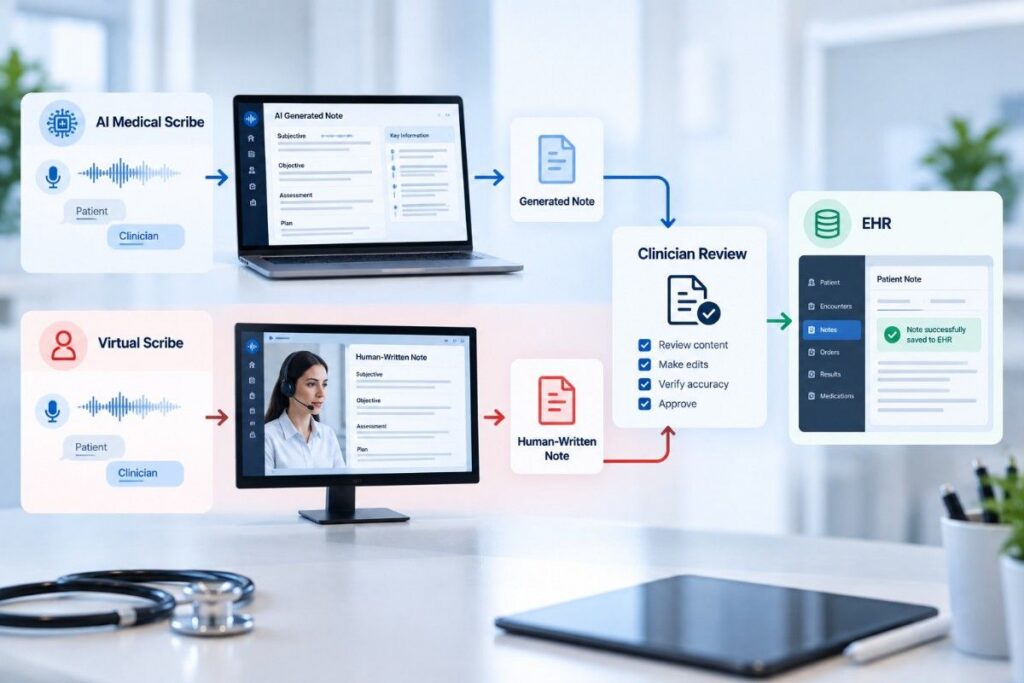
AI scribes can be highly effective when they integrate smoothly with EHRs and existing workflows. The experience should be tested end to end: encounter capture, processing, note generation, review, editing, synchronization, and final submission. Edge cases such as connectivity loss, incomplete encounters, duplicate sessions, and failed synchronization deserve equal attention.
Virtual scribes can sometimes adapt more naturally to established workflows because humans can learn provider preferences and adjust their documentation accordingly. The tradeoff is increased dependency on training and operational consistency. Practices should therefore assess workflow fit rather than comparing features on a checklist.
Privacy and Security Cannot Be Secondary Considerations
Both models involve highly sensitive patient information. The relevant questions simply appear in different forms.
With an AI medical scribe, practices should understand how audio and transcripts are transmitted, processed, stored, retained, and deleted. They should also evaluate access controls, encryption, auditability, third-party dependencies, applicable regulatory obligations, and whether data may be used for purposes beyond providing the service.
Virtual scribing requires equally serious scrutiny. Remote access must be controlled, scribe environments should meet organizational security requirements, and permissions should follow least-privilege principles. A human-based service is not inherently safer than an AI system, just as an automated system is not inherently more secure. Security depends on architecture, implementation, processes, and continuous verification.
Cost Is More Complicated Than the Subscription Price
AI medical scribes can appear economically attractive because automation reduces the need for dedicated human labor. At sufficient scale, the cost per encounter may become compelling. But practices should calculate total cost rather than looking only at software fees.
Consider clinician review time, corrections, integration work, onboarding, support, downtime, and the consequences of recurring documentation errors. An inexpensive AI system that requires substantial cleanup can quietly move the administrative burden rather than eliminate it.
Virtual scribes typically carry greater labor costs, but strong scribes may reduce correction time and accommodate complex documentation more effectively. The right financial comparison is therefore cost per reliably completed encounter not simply monthly AI subscription versus scribe salary.
When an AI Medical Scribe Makes More Sense
AI medical scribes are particularly attractive when a practice handles high encounter volumes, needs fast documentation turnaround, wants around-the-clock availability, or plans to scale without proportionally expanding administrative staffing. They may also suit relatively standardized workflows where clinicians are comfortable reviewing AI-generated notes before finalizing them.
The technology is strongest when it removes repetitive documentation work without demanding excessive supervision. Practices considering AI should run controlled pilots using realistic scenarios and measure more than transcription accuracy. Review time, correction frequency, workflow failures, provider satisfaction, latency, and note completeness can reveal whether the technology actually saves time.
A successful pilot should feel almost boring from a QA perspective. The system should consistently perform the expected actions, handle odd situations gracefully, and avoid surprising users. In healthcare software, predictable is a feature.
When a Virtual Scribe May Be the Better Choice
Virtual scribes can be a stronger option for providers handling complex conversations or highly specialized documentation. They may also benefit clinicians who want greater customization without repeatedly correcting an automated system.
Human scribes can learn individual preferences over time. One physician may prefer highly concise notes, while another expects more extensive detail. A capable virtual scribe can adapt to these patterns and use contextual judgment when an encounter does not follow a neat template.
The approach can also make sense for organizations that are not ready to rely heavily on generative AI in clinical documentation. Instead of forcing automation into the workflow, they can gain many of the time-saving benefits of scribing while maintaining human interpretation throughout the process.
A Hybrid Model May Offer the Best of Both
The AI-versus-human framing is becoming less useful as scribing technology evolves. In many practices, the strongest model may combine both.
AI can perform the first pass by capturing conversations, extracting relevant information, and generating structured notes. A human can then review exceptions, resolve ambiguity, or handle encounters requiring additional judgment. Clinicians retain final oversight while spending less time creating documentation manually.
This model also reflects an important principle in software quality: automation works best when teams know where human judgment still adds value. The goal should not be to automate every possible action. It should be to create a workflow that is faster and more reliable than what came before it.
How Should Your Practice Choose?
Start with the problems you are actually trying to solve. If documentation delays, high encounter volumes, and scalability are the primary concerns, AI may offer the stronger fit. If clinical complexity, personalization, and contextual interpretation dominate, virtual scribing may provide greater value.
Then test the workflow using your real environment rather than idealized demonstrations. Evaluate documentation accuracy, correction time, EHR integration, reliability, privacy controls, provider experience, and behavior when conditions are less than perfect. A polished demo tells you what a product can do; disciplined QA helps reveal what it will do repeatedly.
Ultimately, the better scribe is the one clinicians can trust without giving it unnecessary attention. Whether intelligence comes from an algorithm, a trained professional, or a combination of both, successful clinical documentation should fade quietly into the workflow.
The Bottom Line
AI medical scribes offer compelling speed, availability, and scalability, while virtual scribes provide human judgment, flexibility, and contextual understanding. There is no universal winner because different practices have different specialties, patient populations, workflows, technology stacks, and risk tolerances.
What should be universal is the standard applied to whichever solution you choose. Clinical documentation technology needs rigorous validation under realistic conditions, especially when AI, sensitive data, integrations, and healthcare workflows intersect.
At Testiva, we approach these systems from the quality side of the equation: does the technology perform accurately, consistently, securely, and smoothly when real users put it under pressure? Before adopting or scaling a scribe solution, make sure those questions have convincing answers. When you’re ready to validate the experience behind your healthcare software, start your QA journey today.