




Latest Insights
Validating Data Extraction in AI Patient Intake Systems
- Oct 16, 2026
- Sajid M.
- AI Patient Intake Validation

AI is remarkably good at turning patient paperwork into structured data until the paperwork stops behaving nicely. A slightly blurry insurance card, an oddly formatted date, a handwritten medication, or one unexpected abbreviation can turn a smooth extraction pipeline into a guessing game.
And healthcare data is a terrible place for guessing games. The real challenge is not getting AI to read patient information; it is proving that what it reads is accurate, complete, correctly mapped, and safe to use downstream. That is where our AI testing and QA services dig deeper, testing extraction against the messy inputs and awkward edge cases that polished demos tend to avoid.
Because an AI intake system can process a thousand forms quickly and still get the details that matter wrong. Good validation asks the tougher question: when the data gets messy, does the AI stay trustworthy?
Why Data Extraction Accuracy Matters in Patient Intake
A traditional digital intake form is relatively deterministic. A patient enters a date of birth into a date-of-birth field, selects an option from a predefined menu, and submits the form. Validation rules can catch obvious problems before the information reaches another system.
AI-driven intake introduces another layer. The system may need to read scanned forms, identify handwriting, interpret uploaded PDFs, extract information from insurance cards, classify medical information, or convert natural-language responses into structured fields. Each step introduces opportunities for uncertainty.
Consider a patient writing “metformin 500 mg twice daily” in a medication section. The extraction system must correctly identify the medication, dosage, unit, and frequency and then map those elements to the appropriate destination fields. A system that extracts “metformin” correctly but records the dosage as 50 mg has technically completed the extraction while still producing an unacceptable result.
That distinction is fundamental to AI QA. Successful processing does not equal correct processing.
Start With the Data, Not Just the AI Model
One of the biggest mistakes teams can make is focusing exclusively on model accuracy. The AI model is only one component of the intake pipeline. Before testing begins, we need to understand the complete journey of the information.
A typical workflow might begin with an uploaded document or patient-entered information. The system processes the input, identifies relevant entities, normalizes the extracted values, maps them to predefined fields, applies business rules, and sends the resulting data to another healthcare platform.
Errors can occur at every stage.
The OCR layer might read a character incorrectly. An extraction model might correctly identify a value but assign it to the wrong category. A transformation function might convert a date into the wrong format. An integration could truncate a field. The destination system might reject the information without clearly notifying the intake application.
Good validation therefore follows the data end to end. We want to know whether the information that entered the system remains accurate, complete, appropriately structured, and traceable when it reaches its destination.
Build a Representative Ground-Truth Dataset
Reliable extraction testing requires something against which the AI output can be compared. That means creating a ground-truth dataset containing inputs alongside verified expected results.
The key word here is representative.
A test dataset containing twenty perfectly scanned forms is unlikely to reveal how the system behaves in production. Real patient data arrives in a delightful variety of formats delightful, at least, if you are the kind of QA geek who enjoys breaking extraction pipelines.
Forms may be scanned sideways. Images can be blurry. Insurance cards may contain glare. PDFs can have multiple pages. Patients can use abbreviations, leave fields blank, cross out answers, provide information in unexpected places, or upload the wrong document entirely.
The dataset should therefore represent normal cases, edge cases, and degraded inputs. It should include different document layouts, image qualities, field lengths, date formats, names, addresses, medical terminology, and combinations of structured and unstructured information.
Ground truth must also be carefully reviewed. If the expected dataset itself contains errors, accuracy metrics become misleading. In healthcare AI testing, the quality of the test oracle is just as important as the sophistication of the system being evaluated.
Measure More Than Overall Extraction Accuracy
A single accuracy percentage can look reassuring while hiding serious problems.
Imagine that an intake system extracts 98% of fields correctly. That sounds excellent. But suppose nearly all of the errors occur in medication dosage, allergy information, or patient identifiers. The aggregate metric suddenly becomes much less comforting.
Validation should therefore measure performance at multiple levels.
Field-level accuracy tells us whether individual values were extracted correctly. Completeness measures whether required information was captured at all. Classification accuracy evaluates whether extracted information was assigned to the correct category. Exact-match testing can determine whether identifiers and codes were reproduced precisely, while normalized comparisons can account for acceptable formatting differences.
Precision and recall can also become useful when evaluating extracted entities. High precision means the system rarely produces incorrect entities, while high recall indicates that it successfully captures most of the relevant information that exists in the source.
The appropriate metrics depend on the field. A phone-number formatting difference may be harmless after normalization. A one-digit difference in a member ID, date of birth, or medication dosage may not be.
That is why field criticality should influence both testing depth and acceptance thresholds.
Validate Field Mapping and Semantic Meaning
Extraction is only half the problem. The system also needs to understand what the extracted information represents.
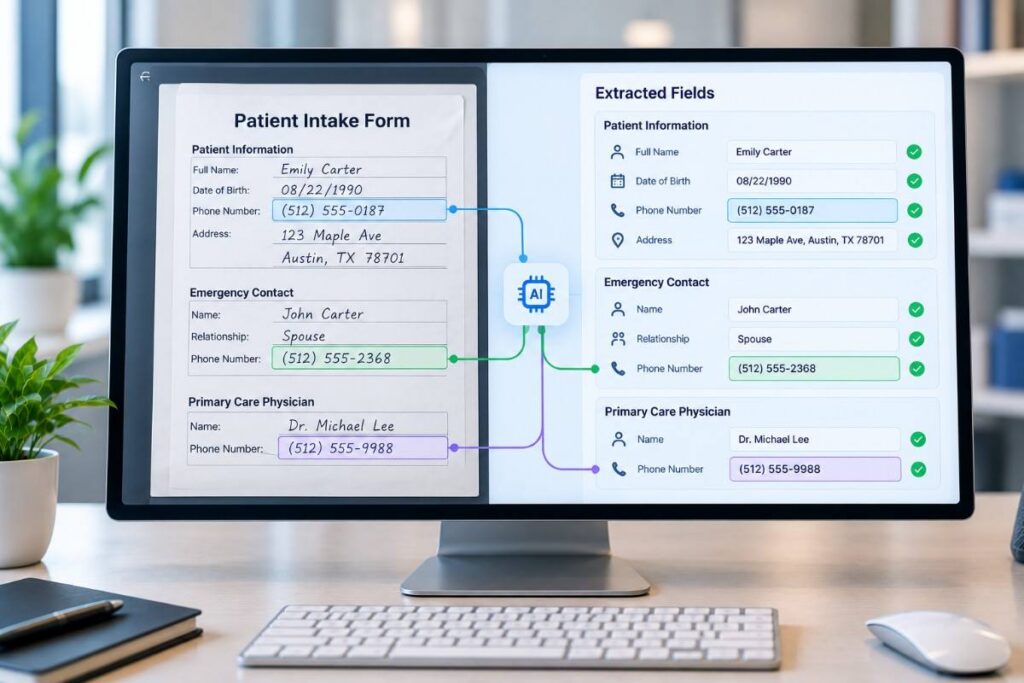
Suppose a form contains the patient’s phone number, an emergency contact number, and a physician’s office number. An AI model may successfully recognize all three numbers while still mapping one to the wrong field. Character-level extraction accuracy would look excellent, but the resulting patient record would be incorrect.
Semantic validation examines whether information has been interpreted and categorized properly. Names should be associated with the correct people. Dates should represent the correct events. Insurance information should map to the correct payer and member fields. Medical history should not accidentally become current medication information.
This becomes especially important with free-text responses. Patients rarely write information in perfectly standardized clinical language. They might write “high BP,” “blood pressure meds,” or “had appendix removed when I was a kid.” The system needs to extract useful structured meaning without inventing details that were never supplied.
QA scenarios should intentionally challenge these relationships rather than merely verifying individual strings.
Test Missing, Ambiguous, and Contradictory Information
AI systems often look impressive when inputs are clean. Their true quality becomes visible when the input is incomplete or confusing.
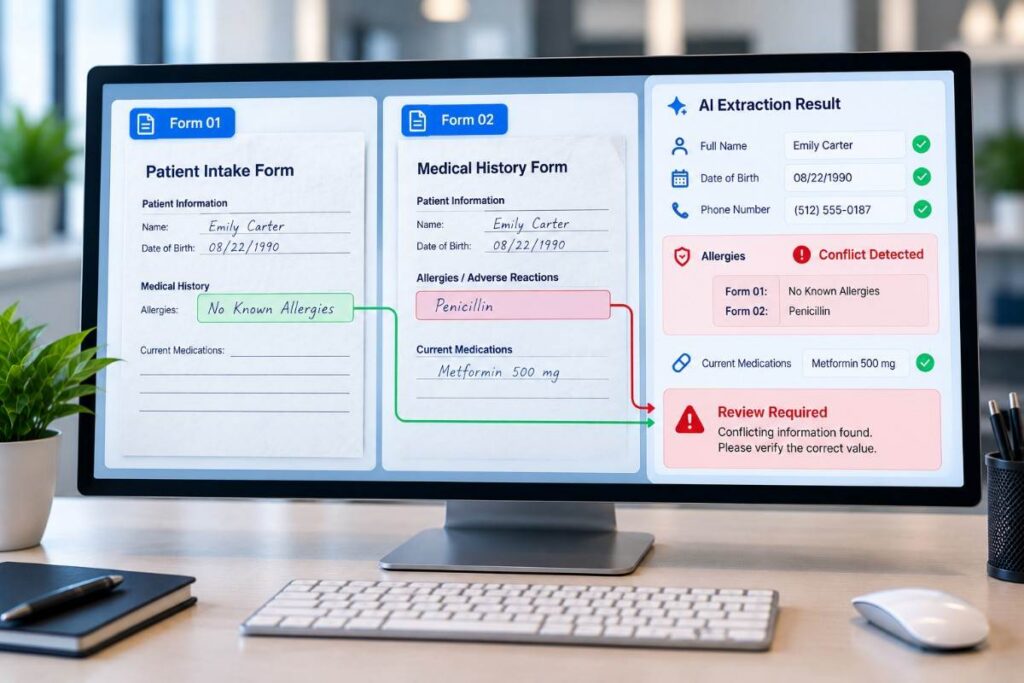
What happens if a patient enters a medication name without a dosage? What if two uploaded documents show different addresses? What if the handwriting could reasonably represent two different numbers? What if a required field appears blank?
A safe system should not convert uncertainty into unjustified certainty.
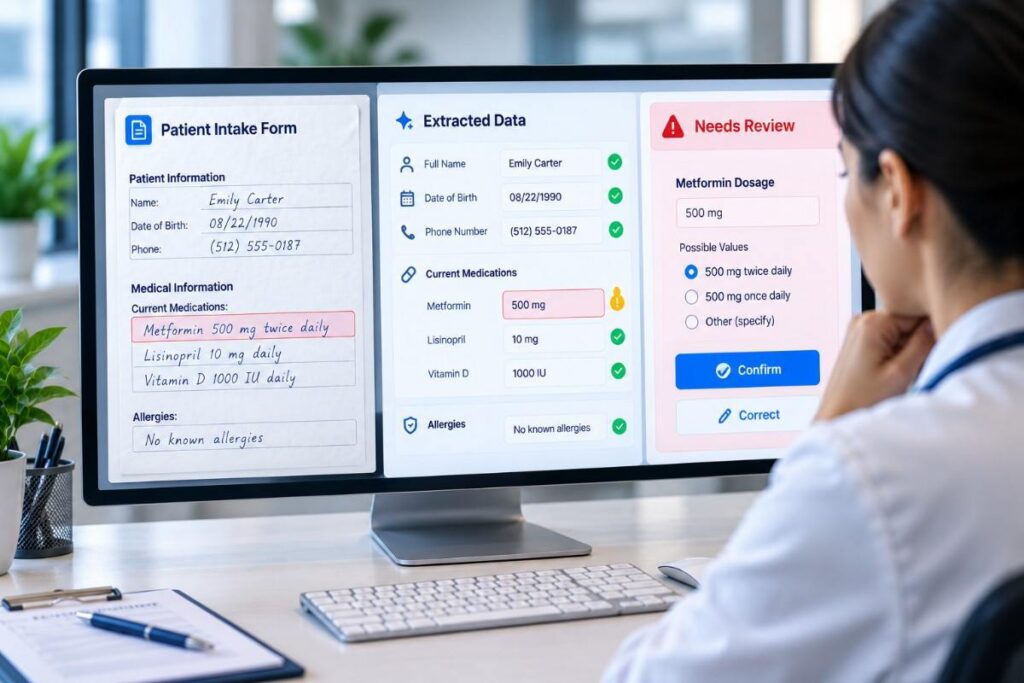
Testing should verify that ambiguous information triggers the appropriate workflow. Depending on the product design, that might mean lowering a confidence score, requesting patient confirmation, sending the case for human review, or marking the field as unresolved.
Contradictions deserve similar attention. If the patient selects “no known allergies” on one page but lists penicillin elsewhere, the system should not silently choose whichever value happened to be processed first.
These scenarios are particularly valuable because they test the intelligence surrounding the AI model, not simply the model itself.
Put Confidence Scores Under the Microscope
Many extraction systems attach confidence scores to predictions. These scores can be useful, but only if they are calibrated and used intelligently.
A confidence score of 0.97 looks reassuring. The important question is whether predictions assigned approximately that level of confidence are actually correct at a comparable rate in realistic data.
QA teams should examine false positives with high confidence because these are particularly dangerous. Low-confidence mistakes may be routed to manual review. High-confidence mistakes can pass through automation unnoticed.
Threshold testing can help determine where automatic acceptance should stop and human verification should begin. Critical fields may require stricter thresholds than administrative information. The objective is not necessarily to maximize automation at all costs; it is to automate safely while making uncertainty visible.
Test the Entire Downstream Workflow
An extraction engine can perform perfectly while the overall intake experience still fails.
After extraction, data may move through APIs, databases, integration layers, electronic health record workflows, scheduling systems, insurance verification tools, or internal dashboards. QA needs to verify that extracted information survives these transitions without unexpected transformation.
Data types deserve particular attention. Dates, Boolean values, identifiers with leading zeros, special characters, multiline text, and unusually long values can behave differently across systems. Something as simple as converting a string to a number can turn an identifier such as “001245” into “1245.”
We also test failure behavior. If an external service becomes unavailable, does the intake system retry safely? Could retries create duplicate patient records? Is partially processed information clearly identified? Can staff determine which records require intervention?
Data integrity is an end-to-end property. Testing should reflect that reality.
Protect Privacy While Testing Healthcare AI
Patient intake systems process highly sensitive information, which makes test-data management a core QA concern.
Production patient records should not casually become convenient test fixtures. Teams need controlled approaches to synthetic data, anonymized datasets, access restrictions, logging, environment separation, and retention policies. Test environments deserve serious security consideration because they frequently contain integrations and realistic data structures even when production data is intentionally excluded.
Logging also requires scrutiny. An application might correctly protect information in the interface while accidentally writing sensitive extracted content into debug logs, error traces, analytics platforms, or monitoring systems.
QA should therefore examine not only whether the system extracts data correctly, but also where that information travels, where it is stored, who can access it, and what appears when something fails.
Regression Testing Is Essential for AI Extraction Systems
AI systems evolve. Models are updated, prompts change, preprocessing logic improves, extraction rules are adjusted, and integrations are modified. A change that improves one document type can unexpectedly reduce accuracy somewhere else.
A strong regression suite provides a stable benchmark.
Representative test cases should be rerun whenever meaningful components change. Results can then be compared across versions to identify field-level improvements and regressions. High-risk cases deserve permanent places in the suite, particularly examples associated with previous production defects.
This approach also makes AI development more measurable. Instead of saying that a new model “seems better,” teams can determine precisely where it improved, where performance stayed stable, and where accuracy declined.
That is much closer to engineering than optimism and healthcare software deserves engineering.
Human Review Is Part of the Quality Strategy
The goal of AI patient intake should not be to pretend uncertainty has disappeared. The goal should be to automate confidently where appropriate and escalate intelligently where it has not.
Human-in-the-loop workflows are therefore something we test, not merely a fallback we assume will work. Reviewers need to see the original source, extracted value, relevant context, and reason the case was flagged. Corrections should propagate reliably to downstream systems, and the workflow should maintain appropriate traceability.
We also examine the opposite problem: excessive escalation. If harmless formatting variations constantly trigger manual review, automation loses much of its operational value.
The best system is not necessarily the one with the highest automation rate. It is the one that finds the right balance between speed, accuracy, transparency, and human oversight
Reliable AI Intake Requires Relentless Validation
AI can remove enormous amounts of repetitive work from patient intake, but automation magnifies both efficiency and error. A mistake made once by a staff member affects one record. A systematic extraction flaw can affect thousands before anyone notices the pattern.
That is why validating AI patient intake requires more than checking whether text can be extracted from documents. Teams need representative ground truth, field-specific metrics, semantic validation, uncertainty testing, confidence-score analysis, downstream integration checks, privacy controls, regression suites, and reliable human-review workflows.
At Testiva, this is how we approach AI quality: challenge the entire system, including the uncomfortable edge cases that polished demos rarely show. Healthcare AI should not merely work when the input is clean and predictable. It should behave safely, transparently, and reliably when real humans inevitably make the data messy.
If your patient intake platform is moving from promising prototype to production-ready product, start your QA journey today and make validation part of the architecture not the cleanup operation after something goes wrong.