




Latest Insights
Synthetic Patient Data for Testing AI Medical Scribe Applications
- Oct 17, 2026
- Sajid M.
- Synthetic Healthcare Data Testing

AI medical scribes promise something clinicians have wanted for years: less time documenting care and more time delivering it. By listening to clinical conversations and transforming them into structured notes, summaries, and other documentation, these systems can significantly reduce administrative workload. But there is a catch. A medical scribe cannot merely sound intelligent. It has to be accurate when conversations are messy, terminology is ambiguous, speakers interrupt each other, and clinically important details appear only once.
Testing these applications with real patient information introduces privacy, security, compliance, and data-access complications. That is why synthetic patient data has become such an important part of the testing strategy. At Testiva, our AI application testing and QA services approach these systems as more than language models with a healthcare interface. We test the complete behavior of the product, including transcription, information extraction, clinical context handling, integrations, reliability, and the user experience surrounding the AI.
Synthetic data gives QA teams a controlled way to challenge those behaviors without unnecessarily exposing protected health information. Done correctly, it can simulate complex clinical encounters while giving testers something particularly valuable: knowledge of what the system should have understood.
What Synthetic Patient Data Actually Means
Synthetic patient data is artificially created healthcare information designed to reproduce characteristics of real clinical data without directly representing an actual patient. For medical scribe testing, this can include demographics, medical histories, symptoms, medications, allergies, diagnoses, laboratory results, encounter transcripts, clinician observations, and expected clinical notes.
The important word is realistic. Generating a fictional patient named Alex with a cough and asking an AI to summarize the conversation is technically synthetic testing, but it tells us very little about production readiness.
Useful synthetic data needs relationships between information. A patient taking warfarin, for example, may also have a relevant diagnosis, monitoring history, medication interactions, and discussion points during an encounter. If those relationships are unrealistic, the test might evaluate language generation while failing to reproduce the reasoning and contextual challenges found in actual clinical workflows.
For QA teams, synthetic data is therefore not simply fake data. It is engineered test material.
Why AI Medical Scribes Create an Unusual QA Problem
Traditional software usually operates against relatively explicit inputs. Enter an invalid date, and the application should reject it. Submit a correctly formatted request, and an API should produce a defined response.
Medical conversations are much less cooperative.
Consider a patient saying, “I stopped taking the little white pill a couple of weeks ago because it made me dizzy.” A clinician may understand which medication the patient means based on previous conversation and medical history. An AI scribe has to connect those clues correctly without inventing certainty that does not exist.
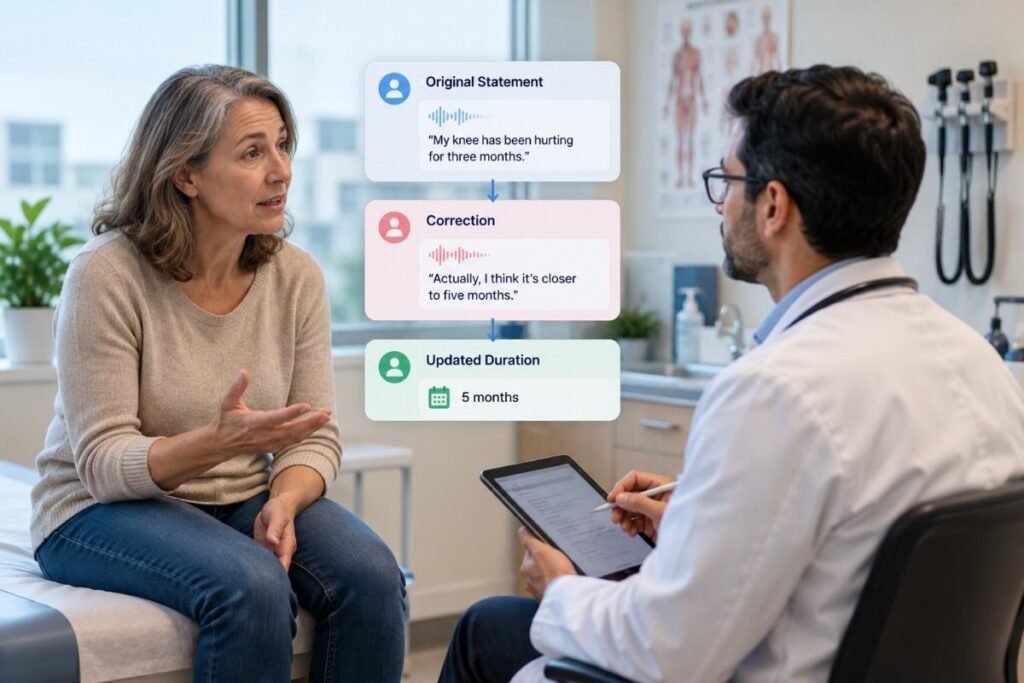
The conversation may also contain corrections:
“My knee has been hurting for three months—actually, closer to five.”
A useful scribe should preserve the corrected duration rather than documenting both statements or choosing the first one.
Then there is negation. “No history of stroke” and “history of stroke” differ by only one word but carry dramatically different clinical meaning. Testing must therefore go beyond whether generated notes are grammatically polished. QA needs to determine whether clinically significant information survives the transformation from conversation to documentation.
Synthetic Data Gives Testers a Known Ground Truth
One of the biggest advantages of synthetic testing is control.
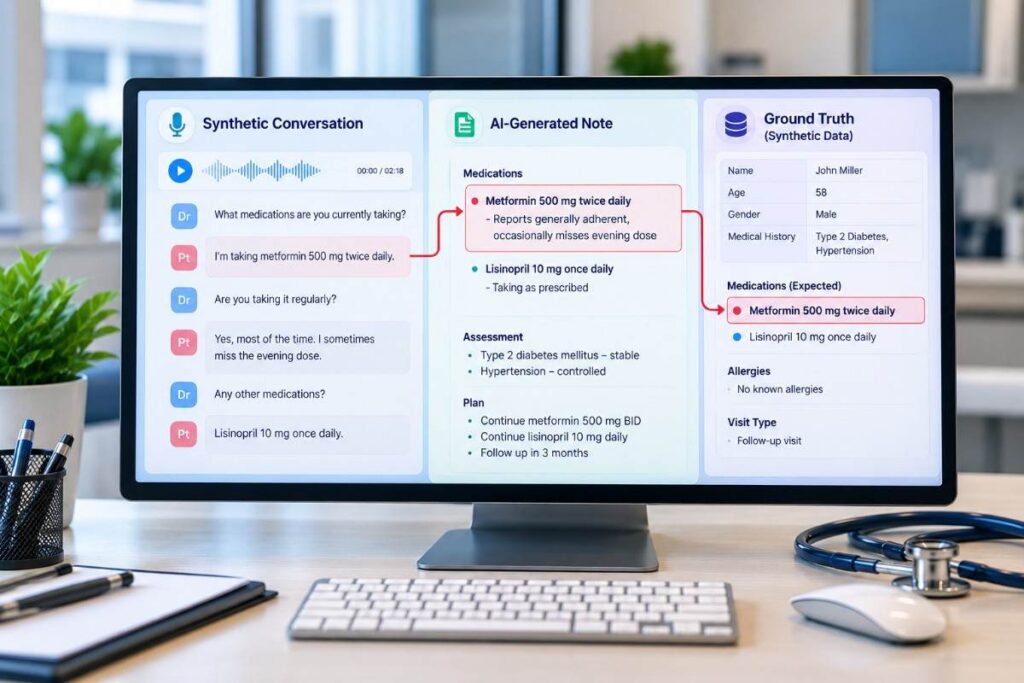
When we construct a synthetic encounter, we can define exactly what happened. We know the patient’s medications, symptoms, history, allergies, and statements. We can intentionally introduce corrections, uncertainty, irrelevant conversation, abbreviations, interruptions, or conflicting details.
That provides a reference against which the AI output can be evaluated.
Suppose a synthetic encounter specifies that a patient takes metformin 500 mg twice daily. During the conversation, the clinician asks about adherence and the patient confirms occasionally missing the evening dose. The generated note can then be checked for several behaviors: Was the medication identified correctly? Was the dosage preserved? Did the scribe capture the adherence issue? Did it fabricate an explanation that was never discussed?
This is much more informative than asking whether a note “looks good.”
Building Clinically Realistic Test Scenarios
Good synthetic datasets should reflect the diversity and unpredictability of clinical encounters rather than repeatedly testing clean textbook conversations.
A useful scenario library might include routine follow-ups, medication reviews, acute complaints, chronic disease management, multi-condition patients, post-operative visits, specialist consultations, and encounters where the final assessment differs from the patient’s initial assumption.
Complexity should increase deliberately.
Early tests can use clear statements and straightforward terminology to establish baseline behavior. Later scenarios can introduce overlapping symptoms, multiple medications, ambiguous references, background conversation, unusual phrasing, rapid topic changes, and corrections.
Testing different speaking patterns matters too. Patients do not communicate like structured datasets. They hesitate, forget names, jump between topics, use non-medical descriptions, and sometimes contradict themselves. Clinicians may dictate observations, ask rapid questions, or use specialty-specific shorthand.
If every synthetic transcript is perfectly organized, the QA environment becomes cleaner than the product’s real operating environment. That creates comforting metrics and unpleasant surprises after release.
Hallucination Testing Deserves Special Attention
A medical scribe should document what was communicated, not produce the most statistically plausible version of the encounter.
Synthetic scenarios are particularly effective for testing hallucinations because we know precisely which facts were never provided. QA teams can deliberately omit expected information and see whether the system resists filling the gaps.
Imagine an encounter discussing fever and sore throat without mentioning a temperature measurement. If the generated note confidently records “temperature 101.2°F,” the output may look clinically plausible while being factually fabricated.
That distinction is critical. Fluency can disguise errors.
We therefore evaluate not only missing information but unsupported additions. Testing should examine invented diagnoses, medications, dosages, examination findings, measurements, symptoms, timelines, and treatment recommendations. The more polished the generated note appears, the more important systematic factual verification becomes.
Test the Conversation-to-Note Pipeline, Not Just the Model
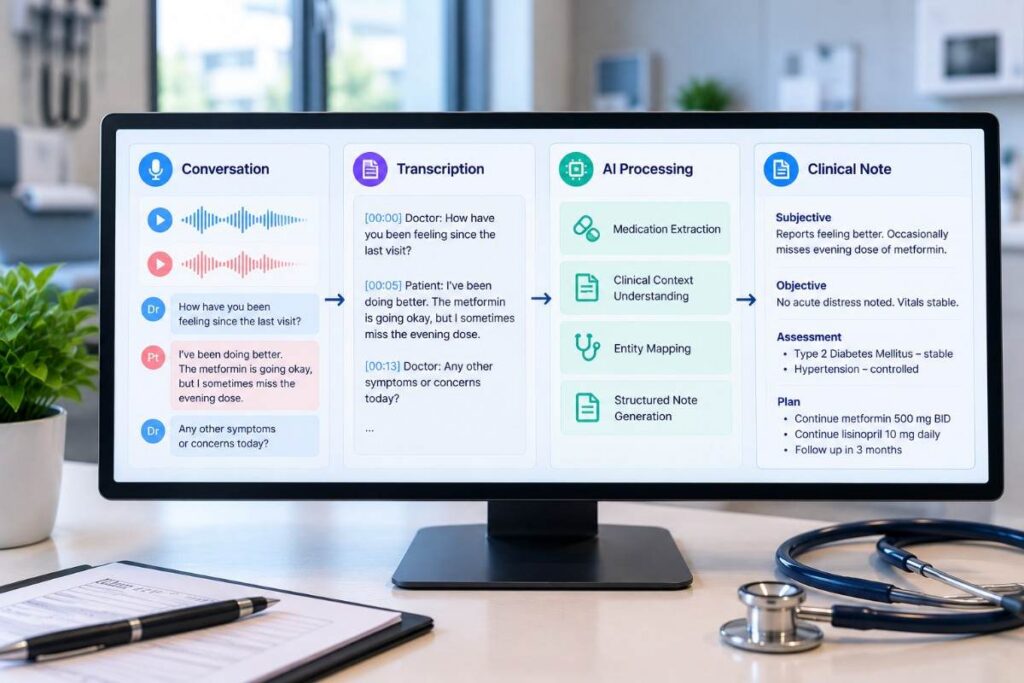
An AI medical scribe is usually a system of systems. Audio capture feeds speech recognition. Transcribed text may be processed by language models, mapped into structured fields, displayed in an application, edited by clinicians, and potentially transferred into an electronic health record.
Each transition creates another opportunity for failure.
A transcription engine might convert a drug name into a similar-sounding everyday word. The language model might then interpret that transcription confidently and produce an incorrect medication entry. Alternatively, the AI output might be correct while an integration maps it into the wrong field.
End-to-end QA should therefore trace information throughout the pipeline.
Synthetic data makes this easier because identifiable markers can be deliberately inserted into scenarios and followed through each processing stage. Testers can determine where information was lost, altered, duplicated, or incorrectly normalized rather than treating every bad final note as simply an “AI problem.”
Measure Clinical Meaning, Not Just Text Similarity
Exact text matching is a poor primary metric for medical scribe quality because several differently worded notes can all be correct.
Testing should focus on preservation of meaning. Important dimensions include factual accuracy, completeness, negation handling, medication accuracy, temporal relationships, attribution to the correct speaker, section placement, unsupported claims, and consistency across the note.
Consider the reference statement “patient denies chest pain.” A generated note saying “no chest pain reported” is semantically correct despite using different words. A simplistic text comparison may penalize it, while a clinically informed evaluation recognizes equivalence.
The reverse problem is more dangerous. A generated paragraph may share most of its vocabulary with the expected output while reversing one clinically significant fact.
This is why AI QA requires layered evaluation rather than one magic accuracy score.
Synthetic Data Should Also Test Bias and Edge Cases
Production users rarely resemble an idealized “average patient.” Medical scribe systems may encounter different accents, speech speeds, age groups, languages, code-switching, communication styles, and levels of health literacy.
Synthetic test design should intentionally broaden coverage.
The goal is not merely demographic variety on a spreadsheet. Test cases should investigate whether different communication patterns influence transcription accuracy, extraction quality, or documentation completeness.
Rare but consequential cases deserve attention as well. An application might perform extremely well across thousands of routine encounters while struggling with uncommon medication names or complicated multi-condition discussions. Average accuracy can hide these weaknesses.
Risk-based QA gives higher weight to failures whose consequences are disproportionately serious, even when the underlying scenario occurs less frequently.
Synthetic Data Is Powerful, but It Is Not the Entire Testing Strategy
Synthetic patient data reduces dependence on sensitive production information and gives QA teams exceptional control over scenarios. However, it should not be mistaken for a perfect substitute for reality.
Synthetic datasets inherit assumptions from whoever creates them. If test designers fail to anticipate a communication pattern or workflow, the generated dataset may never expose the corresponding weakness.
That means synthetic testing should be continuously refined using legitimate product learnings, observed failure categories, clinician feedback, changing workflows, and production insights handled under appropriate privacy and governance controls.
Every discovered failure should make the test library smarter. A useful synthetic dataset is not a static fixture created before launch. It becomes a growing representation of everything the team has learned about how the product can fail.
Building Confidence Before the Scribe Enters the Exam Room
AI medical scribes operate in an environment where impressive demos are easy and dependable behavior is considerably harder. The real engineering challenge begins when conversations become ambiguous, noisy, incomplete, contradictory, and clinically complex.
Synthetic patient data gives QA teams a practical way to reproduce those conditions safely and repeatedly. More importantly, it turns vague questions such as “Does the AI produce good notes?” into testable questions about factual accuracy, missing information, hallucinations, context preservation, integrations, and resilience.
At Testiva, we believe AI quality comes from challenging systems before users have to. A medical scribe should not earn trust because its output sounds convincing. It should earn trust because it has been systematically tested against realistic scenarios designed to expose exactly where it can go wrong.
Building an AI healthcare product where accuracy and user experience cannot be left to chance? Start your QA journey today and unlock flawless delivery.