




Latest Insights
Evaluating Bias in AI Medical Documentation Systems
- Sep 22, 2026
- Sajid M.
- AI Bias Testing in Healthcare

Artificial intelligence can turn a clinician’s conversation into structured medical documentation before the coffee on their desk has gone cold. That is impressive. It is also exactly why bias in AI medical documentation deserves more scrutiny than a routine “the output looks right” check.
When an AI system listens to clinical conversations, summarizes encounters, suggests codes, or organizes patient histories, it does more than process words. It makes decisions about what information matters, what can be compressed, and what should appear prominently in the medical record. At Testiva, we approach systems like these through rigorous AI and software testing, because an application can be technically stable while still producing systematically unreliable outcomes for particular patient populations.
Bias testing therefore cannot be treated as an optional ethics exercise performed after functional QA. For medical documentation systems, it is part of determining whether the product actually works as intended.
What Bias Looks Like in AI Medical Documentation
Bias does not always appear as an obviously discriminatory statement. More often, it hides inside subtle differences in transcription quality, summarization, terminology selection, omission rates, or the way clinical details are prioritized.
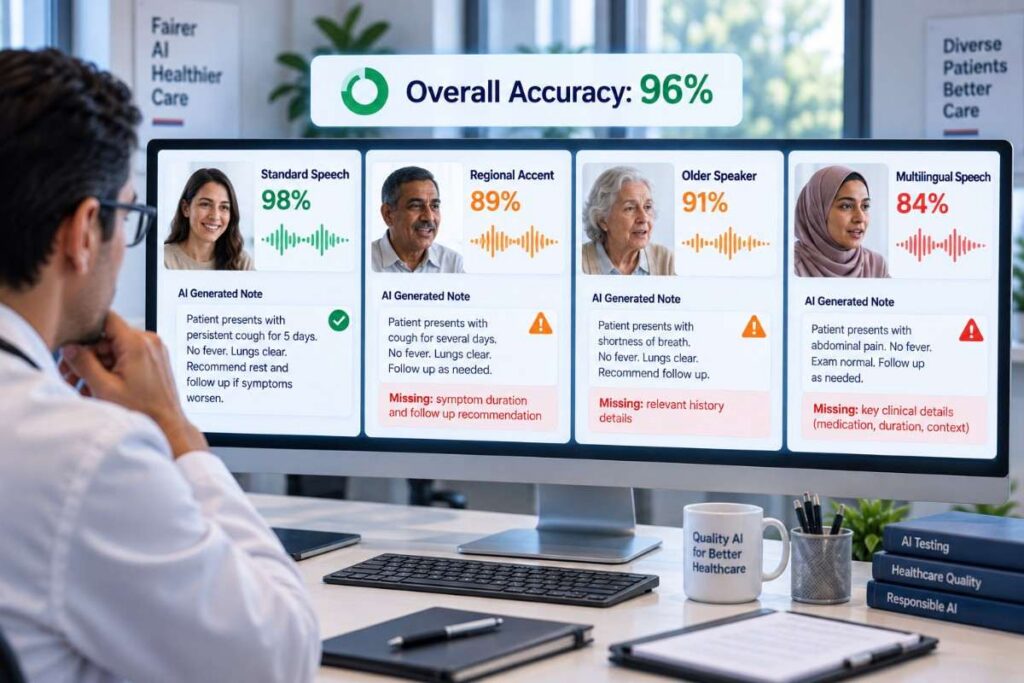
Imagine an AI documentation assistant that performs exceptionally well when processing clear speech in a controlled environment. Introduce regional accents, older speakers, multilingual patients, speech impairments, background noise, or rapid clinician-patient exchanges, and its accuracy may change considerably. If those changes consistently affect particular groups, an impressive overall accuracy score can conceal a serious product-quality problem.
Documentation systems also inherit risks from their training data. Historical medical records may contain demographic imbalances, inconsistent terminology, underdiagnosis, stereotypes, or outdated clinical assumptions. A model trained on those records can reproduce patterns embedded in the source data even when nobody intentionally programmed them into the system.
This is why evaluating bias requires looking beyond whether the AI generated a grammatically correct note. QA teams need to ask whether equivalent clinical information receives equivalent treatment across different patient contexts.
Why Conventional Accuracy Metrics Are Not Enough
A single aggregate accuracy percentage is comforting because it gives teams a clean number to put on a dashboard. Unfortunately, averages can be remarkably good at hiding inconvenient details.
Suppose a medical documentation model achieves 96% accuracy overall. That result appears excellent until testing reveals substantially higher error rates for a particular accent, age group, or clinical specialty. The overall metric remains strong because the better-represented cases dominate the dataset.
Bias evaluation requires disaggregated testing. Performance should be examined across relevant demographic, linguistic, clinical, and environmental dimensions rather than evaluated only as one large population.
The same principle applies to different error types. A misplaced comma and an omitted medication dosage should not carry equal significance simply because both count as errors. Medical AI testing needs risk-sensitive metrics that distinguish cosmetic imperfections from errors capable of changing the clinical meaning of a record.
Build Representative Test Data, Not Convenient Test Data
Bias testing is only as credible as the test dataset behind it. A dataset composed primarily of ideal recordings, common conditions, standardized vocabulary, and highly represented patient populations can produce reassuring results that collapse in real clinical environments.
Representative testing should account for variation in age, gender where relevant, language patterns, accents, speech characteristics, specialties, clinical conditions, and interaction styles. Environmental conditions matter too. Real healthcare environments contain interruptions, overlapping speech, equipment noise, incomplete sentences, abbreviations, and conversations that refuse to behave like laboratory samples.
Representation, however, is not simply a matter of adding a few examples from each demographic group. Test teams need enough meaningful cases to identify patterns. Tiny sample sizes can create misleading conclusions in either direction.
Synthetic data can help expand coverage, particularly where real patient data creates privacy or availability constraints. But synthetic cases should complement carefully governed real-world evaluation rather than becoming a convenient substitute for it. If generated test data fails to reproduce real linguistic and clinical complexity, it may simply create a cleaner version of the same blind spot.
Test the Entire Documentation Pipeline
AI medical documentation rarely consists of one isolated model. The final note may depend on speech recognition, speaker identification, natural-language processing, summarization, structured field extraction, clinical terminology mapping, and integrations with electronic health record systems.
Bias can enter at any stage.
A speech recognition component might incorrectly transcribe an accented phrase. The summarization model may then confidently transform that incorrect transcription into polished clinical prose. Because the final sentence reads naturally, the original error becomes harder for a reviewer to detect. In other words, downstream fluency can disguise upstream failure.
Testing should therefore trace information through the complete workflow. Teams need to compare the original clinical input, intermediate transformations, final documentation, and data transferred to connected systems. This makes it possible to identify not only that an error occurred but where the system introduced or amplified it.
End-to-end QA is especially important when several individually “accurate” components interact. Small errors can compound, producing a final result that none of the component-level metrics predicted.

Measure Omissions and Distortions, Not Just Wrong Words
One of the most dangerous documentation failures is something that never appears in the output.
A generated note may contain no obvious factual errors while omitting an allergy, symptom severity, medication change, family-history detail, or patient concern. Bias evaluation should therefore examine what the system leaves out and whether omission patterns differ between patient groups or communication styles.
Testers should also look for semantic distortion. Does “occasional discomfort” become “chronic pain”? Does uncertainty expressed by a clinician become a definitive diagnosis? Does a patient’s description receive less emphasis than a clinician’s interpretation? These transformations may preserve individual words while altering their clinical meaning.
A useful evaluation framework compares factual completeness, clinical significance, attribution, certainty, and prioritization across comparable scenarios. The central question is not merely, “Did the AI capture the conversation?” It is, “Did it represent the important clinical information faithfully and consistently?”
Use Counterfactual Testing to Expose Hidden Bias
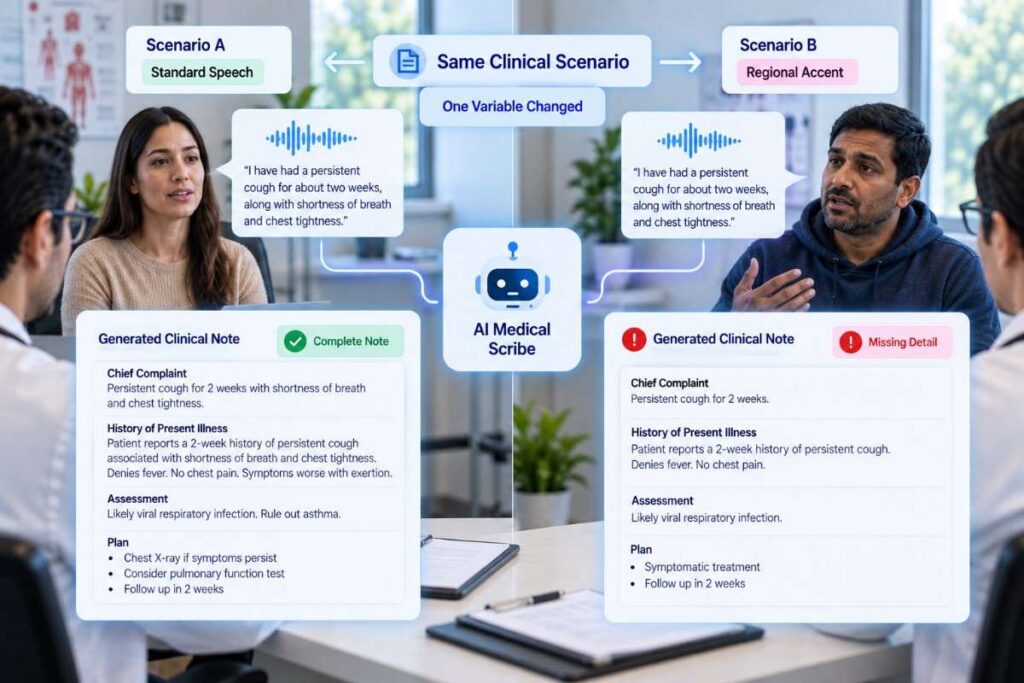
Counterfactual testing is particularly useful for AI systems because it changes one relevant characteristic while keeping the underlying clinical scenario as consistent as possible.
For example, testers might evaluate comparable encounters while varying an accent, demographic reference, patient name, communication style, or another carefully selected characteristic. Significant changes in documentation quality can indicate that the model is responding to information that should not materially affect the output.
This technique is powerful because real-world datasets contain many interacting variables. When ten characteristics change simultaneously, determining why performance changed becomes difficult. Controlled counterfactual scenarios allow QA teams to isolate specific factors.
However, these tests need thoughtful design. Human communication is complex, and demographic characteristics cannot always be reduced to interchangeable variables. Results should be interpreted alongside broader statistical testing and expert review rather than treated as standalone proof of bias.
Keep Humans in the Evaluation Loop
Automated evaluation is essential when thousands of AI outputs must be compared, but medical documentation cannot be validated entirely by another algorithm.
Clinical experts can identify failures that generic similarity metrics miss. Two notes may appear linguistically similar while differing significantly in clinical meaning. Conversely, two differently worded notes can communicate essentially identical medical information.
Human review is particularly valuable for borderline cases, high-risk specialties, ambiguous conversations, and discrepancies discovered during subgroup testing. Reviewers should use standardized evaluation criteria so that human judgment itself does not introduce uncontrolled inconsistency.
The strongest approach combines automated measurements with structured expert review. Machines provide scale and repeatability; qualified reviewers provide context and clinical interpretation. Bias evaluation needs both.
Treat Bias Testing as Continuous QA
AI systems are not static software components. Models change, training datasets evolve, prompts are adjusted, integrations are updated, and user behavior shifts after deployment. A system that passed a bias evaluation six months ago cannot automatically be assumed to behave identically today.
Bias-related scenarios should become part of regression testing. When teams release a new model version, they should compare subgroup performance against established baselines and investigate meaningful changes rather than checking only whether overall accuracy improved.
Production monitoring matters as well. Real-world error reports, clinician corrections, overridden documentation, and user feedback can reveal patterns that pre-release datasets missed. Those findings should feed directly back into future test suites.
The objective is not to perform one giant bias audit and declare the product “unbiased.” No realistic AI system earns that permanent label. The more defensible goal is to establish a repeatable process for detecting disparities, understanding their impact, mitigating them, and verifying that fixes do not introduce new problems elsewhere.
Bias Is a Software Quality Problem
In medical documentation systems, bias is fundamentally a quality issue. If an AI system performs less accurately for certain patient groups, accents, communication styles, or clinical contexts, its behavior is inconsistent and that inconsistency deserves the same attention as any other critical software defect.
Effective QA should therefore make bias evaluation part of requirements, regression testing, release criteria, and ongoing monitoring. Testing subgroup performance, realistic edge cases, omissions, and model changes helps teams identify disparities before they become embedded in everyday clinical workflows.
AI can reduce the burden of medical documentation, but speed alone is not the benchmark for success. The real measure is whether the system produces consistently accurate, clinically meaningful, and dependable documentation for the diverse people it is designed to serve.