




Latest Insights
How to Quality Test an AI Doctor’s Note Generator: A Complete QA Guide
- Oct 21, 2026
- Sajid M.
- AI Doctor's Note Generator Testing
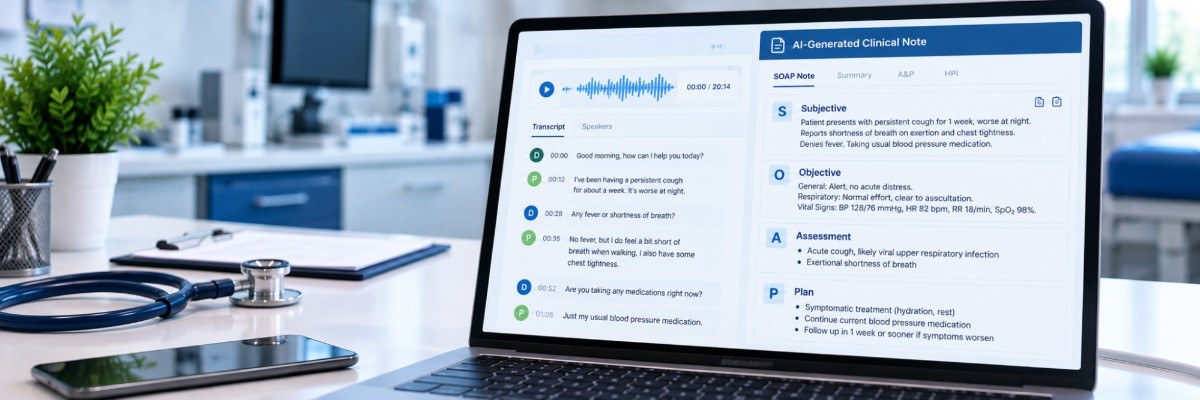
An AI doctor’s note generator can turn a 20-minute patient consultation into a structured clinical note in seconds. Impressive, right? But what happens when the AI misses a critical symptom, invents a diagnosis, or confuses “no known allergies” with “known allergies”? In healthcare, these aren’t minor software glitches. They’re potential patient safety risks. That’s why testing an AI doctor’s note generator demands far more than verifying whether it produces readable, well-formatted documentation.
From catching AI hallucinations to validating medical terminology and protecting sensitive patient data, every detail matters. At Testiva, our AI testing and software QA services help uncover the hidden weaknesses that conventional testing might miss. In this guide, we’ll explore how to quality test an AI doctor’s note generator, what can go wrong behind the scenes, and which testing strategies help ensure every generated note is accurate, secure, and clinically reliable.
Understanding How an AI Doctor’s Note Generator Works
An AI doctor’s note generator converts clinical information into organized medical documentation using natural language processing (NLP), large language models (LLMs), and predefined documentation templates.
Depending on the application, the system may process typed clinical observations, patient histories, structured electronic health record (EHR) data, or transcribed conversations between physicians and patients.
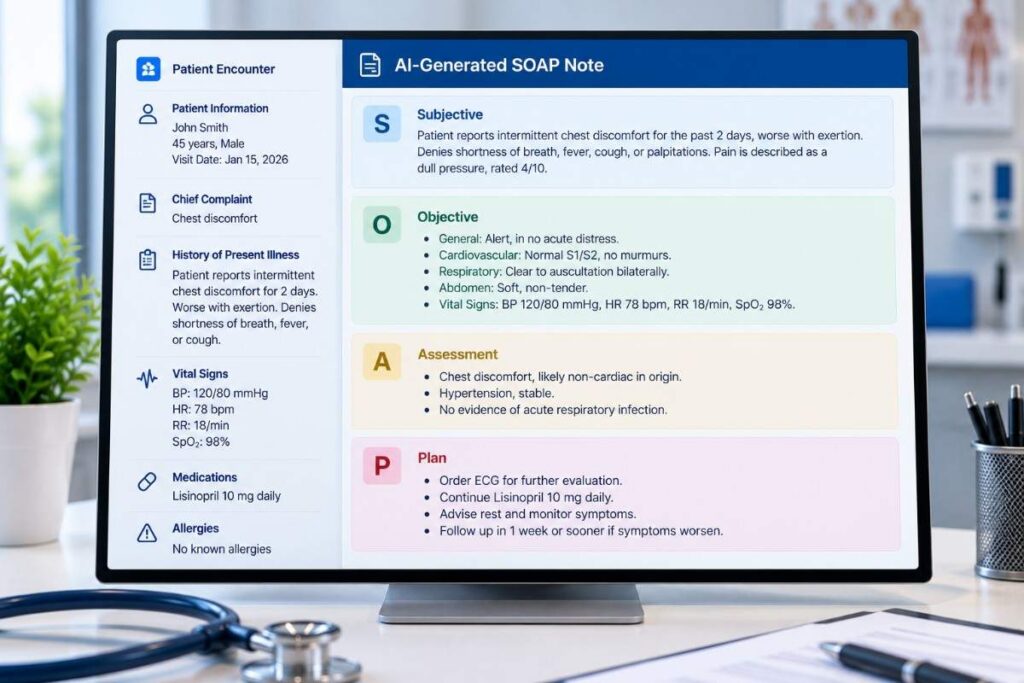
The generated output typically follows established medical documentation formats, such as SOAP notes, which organize information into Subjective, Objective, Assessment, and Plan sections.
Although the workflow appears straightforward, multiple components influence the final result. Speech recognition can misinterpret medical terminology, language models can invent unsupported details, and formatting engines can place accurate information in incorrect sections.
Effective QA must therefore evaluate the entire documentation pipeline rather than simply checking whether the generated note looks professional.
1. Validate Clinical Accuracy and Medical Information Integrity
Clinical accuracy is the foundation of testing any AI doctor’s note generator. A grammatically perfect note becomes dangerous if it misrepresents the patient’s condition or introduces information that the clinician never provided.
QA engineers should develop representative clinical test datasets containing documented symptoms, diagnoses, medications, allergies, vital signs, and treatment plans. Each generated note should then be compared against a clinician-approved reference.
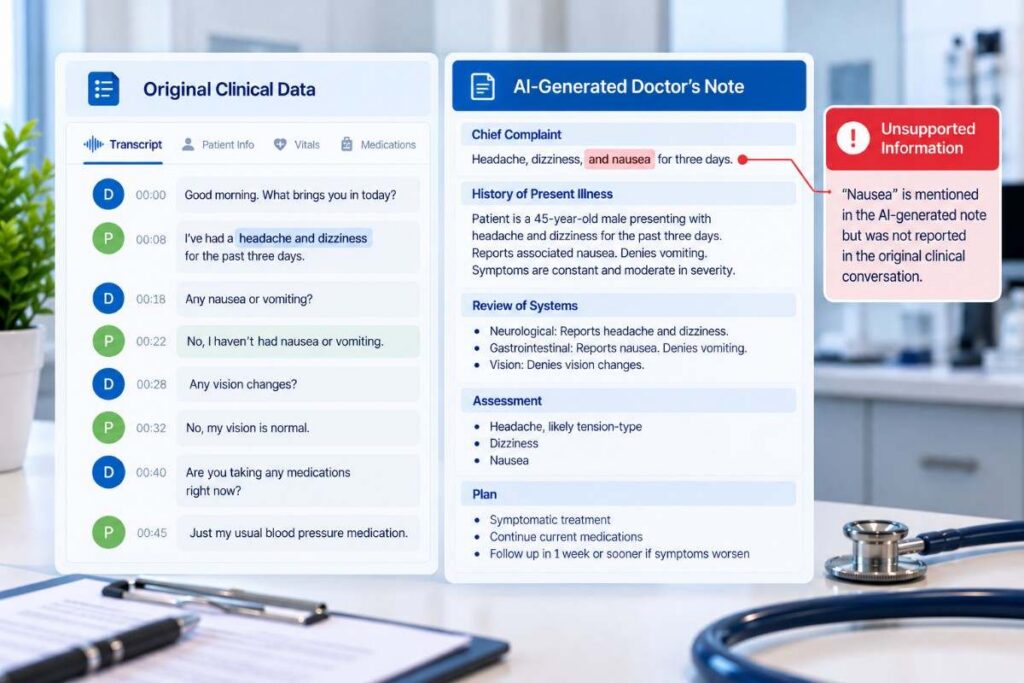
Detect Hallucinations and Unsupported Clinical Statements
AI hallucinations occur when a model generates plausible information without supporting evidence.
For example, a physician might document that a patient reports headaches and dizziness. The AI could incorrectly add nausea, migraine history, or neurological abnormalities despite those details never appearing in the source material.
Testing must identify every unsupported clinical assertion, especially those involving diagnoses, medications, examination findings, and treatment recommendations.
A robust evaluation process should classify hallucinations by severity and prioritize errors that could influence patient care.
Verify Medical Terminology and Context
Medical terminology frequently contains abbreviations, similar-sounding conditions, and context-dependent meanings.
Consider abbreviations such as “MS,” which could refer to multiple sclerosis or mitral stenosis depending on clinical context. An AI system must not expand ambiguous terminology into a definitive diagnosis without sufficient evidence.
QA teams should test specialty-specific vocabulary, abbreviations, negations, and complex clinical descriptions.
Importantly, the system must preserve distinctions between confirmed diagnoses, suspected conditions, historical illnesses, and ruled-out findings.
2. Test Completeness and SOAP Note Structure
An accurate note can still be clinically inadequate if important information is missing. Completeness testing verifies that the AI captures all relevant details from the source encounter without introducing unnecessary content.
For SOAP-based documentation, testers should examine whether subjective symptoms, objective findings, clinical assessments, and treatment plans appear in their appropriate sections.
For example, patient-reported chest discomfort belongs under subjective information, while measured blood pressure belongs under objective findings. Mixing these categories can confuse clinicians reviewing the record.
QA teams should also verify whether the generator consistently includes clinically relevant negative findings, medication changes, follow-up instructions, and documented patient concerns.
The objective is not to maximize note length. It is to preserve meaningful clinical information while eliminating duplication and irrelevant text.
3. Evaluate AI Output Consistency and Reproducibility
Generative AI systems are probabilistic, meaning identical inputs may produce different outputs across repeated executions.
Some variation in wording is acceptable. However, clinical facts, medication dosages, diagnoses, and treatment instructions must remain consistent with the source documentation.
QA engineers should execute identical clinical scenarios multiple times and compare generated notes for factual discrepancies.
Testing should also examine how small input changes affect output. Adding an unrelated demographic detail, for example, should not unexpectedly alter a documented diagnosis or medication instruction.
We recommend separating acceptable linguistic variation from clinically significant inconsistency. This distinction prevents teams from incorrectly treating stylistic differences as defects while overlooking meaningful medical errors.
4. Perform Functional Testing Across the Complete Workflow
An AI doctor’s note generator is still a software application, and conventional functionality must work reliably alongside its AI capabilities.
Functional testing should cover patient selection, encounter creation, data entry, transcription uploads, note generation, editing, approval, saving, exporting, and EHR synchronization.
Each workflow should be tested under normal conditions and deliberate failure scenarios.
For instance, what happens when a clinician loses connectivity while saving a generated note? Does the application preserve edits, display an accurate error message, or silently discard information?
Testers should also verify that regenerated notes do not overwrite clinician-approved changes without explicit authorization.
Reliable healthcare software must maintain predictable application behavior even when the underlying AI produces variable responses.
5. Test Speech Recognition and Clinical Transcription Accuracy
Many AI doctor’s note generators rely on ambient listening or speech-to-text technology to capture clinical conversations.
This introduces additional failure points involving background noise, overlapping speakers, accents, pronunciation, and medical vocabulary.
QA teams should evaluate transcription accuracy using realistic recordings from diverse clinical environments, including busy examination rooms and remote consultations.
Particular attention should be given to medication names, numerical values, negations, and speaker attribution.
Confusing “no history of seizures” with “history of seizures” demonstrates how one transcription error can reverse clinical meaning.
Word error rate provides a useful baseline, but clinical testing should also measure whether transcription mistakes alter medically significant facts.
6. Verify Patient Data Security and Regulatory Compliance
Healthcare AI applications frequently process protected health information, making privacy and security testing essential.
In the United States, relevant systems may need to satisfy HIPAA requirements. Applications operating in other jurisdictions may also face GDPR or applicable national healthcare data protection obligations.
Compliance requirements depend on the product’s intended use, deployment model, contractual relationships, and regulatory classification.
QA teams should verify authentication, role-based access controls, encryption, session management, audit logging, and secure data transmission.
Security testing must also investigate prompt injection, unauthorized record access, data leakage between patient sessions, and sensitive information appearing in application logs.
When third-party AI models process clinical data, organizations must validate retention policies, contractual safeguards, and permitted data usage.
7. Measure Performance, Scalability, and Reliability
Clinical documentation tools must remain responsive during demanding healthcare workflows.
Performance testing should measure note-generation latency, API response times, system availability, and resource consumption under realistic workloads.
Load testing can simulate multiple clinicians generating notes simultaneously, while stress testing identifies the system’s behavior beyond expected capacity.
QA engineers should also examine timeout handling, interrupted model responses, retry mechanisms, and recovery after infrastructure failures.
A particularly important scenario involves partial generation. The application must never present an incomplete note as finalized without clearly communicating its status.
Performance targets should reflect actual clinical workflows rather than arbitrary technical benchmarks.
8. Conduct Bias, Robustness, and Edge-Case Testing
AI models may perform differently across patient populations, medical specialties, communication styles, and documentation formats.
Testing should therefore include diverse ages, accents, language patterns, and clinically relevant demographic contexts using appropriately authorized datasets.
Robustness testing should introduce misspellings, fragmented sentences, conflicting information, missing values, and unusually long consultations.
For example, if a patient reports taking two medications with potentially conflicting instructions, the AI should preserve the documented facts and flag uncertainty rather than inventing a resolution.
Edge-case testing should also examine emergency presentations, rare conditions, pediatric documentation, and encounters involving multiple diagnoses.
The goal is to determine whether the system handles uncertainty safely instead of disguising uncertainty behind confident language.
9. Establish Human-in-the-Loop Clinical Validation
Automated evaluation is valuable, but it cannot independently establish the clinical safety of generated documentation.
Qualified healthcare professionals should review representative outputs, assess clinical significance, and help define acceptable error thresholds.
A structured review process can score factual correctness, completeness, terminology, clarity, and potential patient safety impact.
High-risk errors should trigger investigation and remediation before deployment.
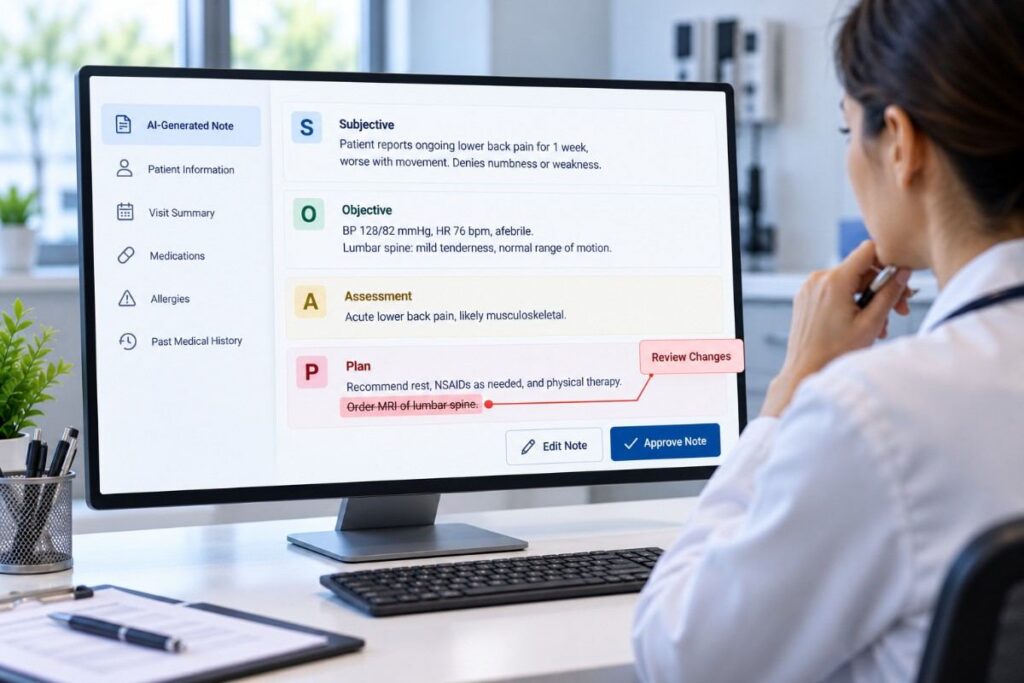
Human oversight should also remain embedded in production workflows, allowing authorized clinicians to review, correct, and approve notes before they enter the official medical record.
AI should accelerate clinical documentation, not replace professional accountability.
10. Build a Continuous AI Quality Assurance Framework
Testing an AI doctor’s note generator is not a one-time certification exercise. Model updates, prompt modifications, integration changes, and evolving clinical workflows can introduce unexpected regressions.
A sustainable QA framework combines automated regression suites, clinician-reviewed benchmark datasets, security assessments, and production monitoring.
Teams should track metrics such as clinical factual accuracy, omission rates, hallucination frequency, critical error rates, generation latency, and clinician correction frequency.
Every model or prompt update should undergo risk-based validation against previously approved clinical scenarios.
Production monitoring should identify emerging failure patterns without exposing unnecessary patient information.
At Testiva, we believe continuous QA is essential for maintaining dependable AI-driven healthcare applications as their capabilities evolve.
Final Thoughts: Quality Testing Makes Healthcare AI Trustworthy
One frequent mistake is evaluating multilingual functionality using translated English test scripts exclusively. Such datasets rarely capture authentic language switching, cultural expressions, or spontaneous clinical speech.
Another is relying entirely on aggregate accuracy scores. Strong overall performance can conceal serious failures affecting particular languages or patient groups.
Developers should also avoid treating successful transcription as proof of accurate clinical documentation. Transcription, interpretation, summarization, and EHR integration each introduce distinct failure opportunities.
Finally, launching multilingual features without clearly defined acceptance criteria makes it difficult to determine whether the system is genuinely ready for clinical use.
A risk-based testing strategy should establish measurable quality thresholds, prioritize patient safety, and require additional review for high-impact errors.