




Latest Insights
User Acceptance Testing (UAT) for AI Medical Scribe Software: A Complete Guide
- Oct 22, 2026
- Sajid M.
- AI Medical Scribe Acceptance Testing

Imagine an AI medical scribe capturing an entire patient consultation in minutes only to misinterpret a medication, miss a critical symptom, or place important information in the wrong section. In healthcare, an AI tool that simply “works” isn’t enough. It must produce reliable results while fitting naturally into real clinical workflows.
That’s where User Acceptance Testing (UAT) becomes essential. At Testiva, our QA testing services help teams evaluate software through realistic user scenarios before release. For AI medical scribes, UAT provides the reality check needed to uncover usability gaps, documentation issues, workflow friction, and unexpected behavior before clinicians encounter them.
What Is UAT for AI Medical Scribe Software?
User Acceptance Testing evaluates whether software satisfies business requirements and supports users in realistic operating scenarios. It typically occurs after core functional, integration, and system testing have established that the application behaves according to its technical specifications.
With an AI medical scribe, however, acceptance is more nuanced. The software may technically capture audio, generate a transcript, create a SOAP note, and sync information successfully, yet still fail from a clinician’s perspective. Perhaps important details are placed in the wrong section. Maybe medical terminology is interpreted incorrectly. The generated note might require so much editing that the promised productivity benefit disappears.
UAT therefore asks a practical question: can intended users successfully and confidently use this product in the environments for which it was designed? That distinction is critical. Traditional testing verifies expected behavior against requirements; UAT validates whether those requirements translate into something genuinely usable and valuable.
Why AI Medical Scribes Require Rigorous Acceptance Testing
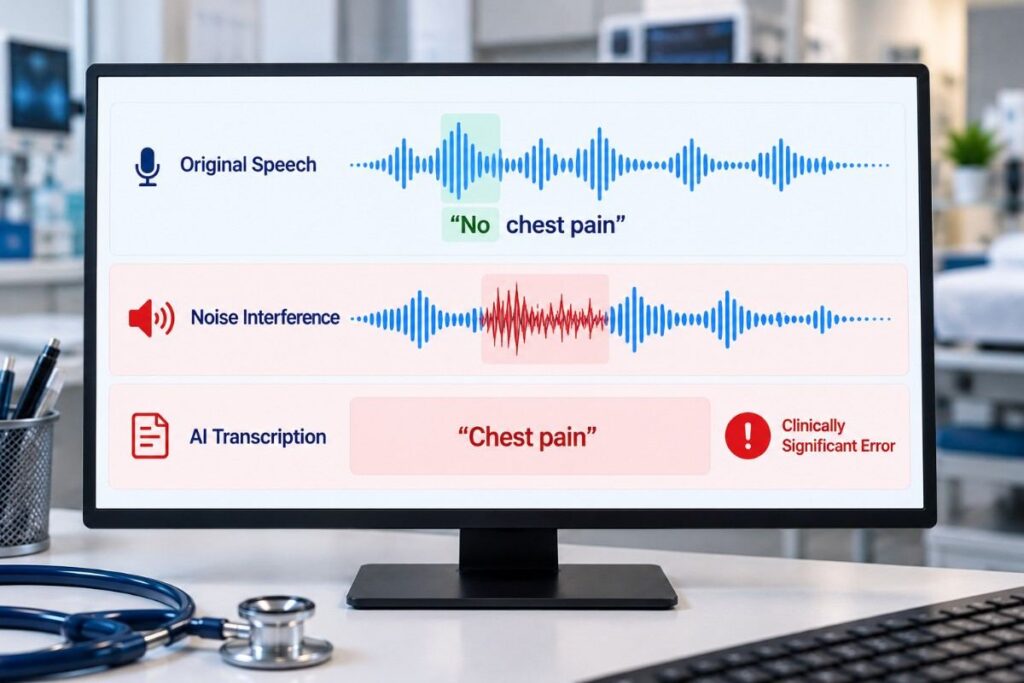
Healthcare documentation contains ambiguity that ordinary business applications rarely encounter. Clinicians speak quickly, patients interrupt, medications have similar names, background noise varies, and conversations routinely include corrections, uncertainty, historical information, and hypothetical statements. AI must navigate all of this without quietly transforming ambiguity into incorrect documentation.
Generative AI introduces another challenge: outputs are probabilistic rather than perfectly deterministic. Two clinically similar encounters may produce notes with slightly different structures or wording. Consequently, UAT cannot depend exclusively on rigid expected-output comparisons. Reviewers need acceptance criteria covering clinical meaning, completeness, consistency, usability, and the level of editing required.
There is also a human-factor dimension. A physician working between appointments will interact with software differently from a tester following a controlled script. UAT should reproduce realistic pressures, devices, workflows, interruptions, and encounter types whenever possible. Otherwise, teams risk validating an idealized product rather than the one clinicians will actually experience.
Build UAT Around Real Clinical Workflows
Effective UAT starts with representative workflows instead of isolated features. Testing “Generate Note” confirms a function. Testing an end-to-end patient encounter validates whether that function works as part of an actual clinical process.
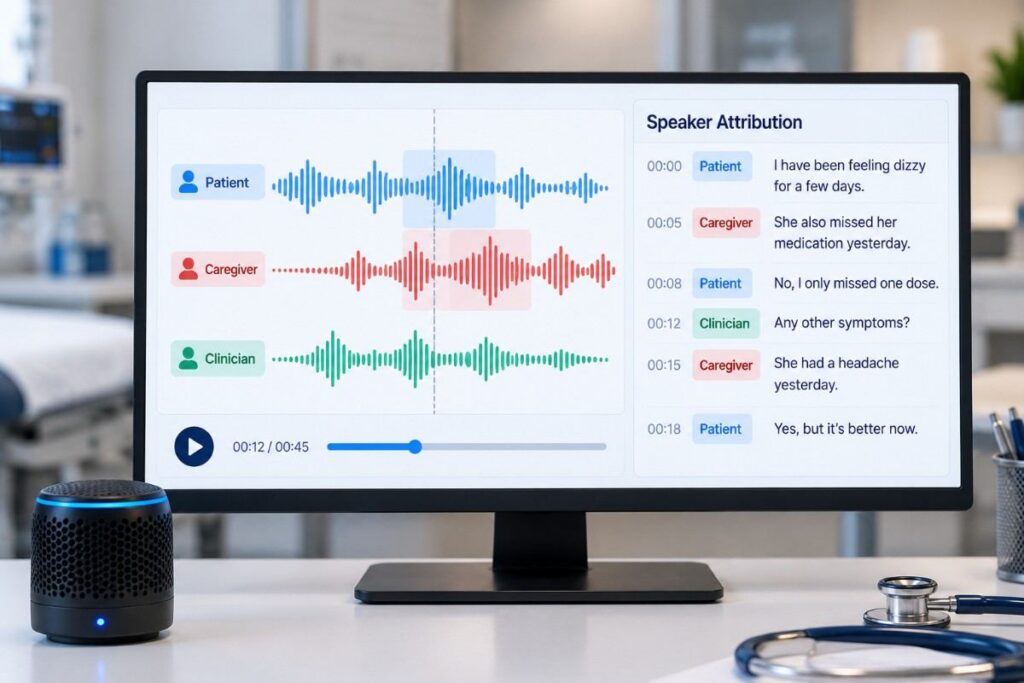
A scenario might begin when a clinician starts an encounter, records a conversation, pauses or resumes capture, reviews the transcript, generates documentation, edits the note, approves it, and transfers it to the appropriate downstream system. Every transition creates potential failure points. Recording may stop unexpectedly, speaker attribution may become confused, edits may not persist, or synchronization could create duplicate information.
Different specialties also require different scenarios. Primary care conversations differ considerably from psychiatry, cardiology, orthopedics, or emergency medicine encounters. Teams should select workflows reflecting the product’s actual target users, supported specialties, documentation styles, and deployment environments rather than assuming one generic consultation adequately represents clinical usage.

Define Acceptance Criteria Before UAT Begins
Good UAT is measurable. “The AI should generate accurate notes” sounds reasonable but provides little guidance when reviewers disagree about whether a particular output is acceptable. Teams should establish acceptance criteria before execution and connect those criteria to business and clinical requirements.
For example, criteria can address whether clinically important statements are represented correctly, unsupported information is avoided, required note sections are populated appropriately, edits are saved reliably, and clinicians can complete core workflows without unnecessary friction. Teams can also measure correction burden by tracking how much generated documentation requires modification before approval.
Acceptance criteria should distinguish severity. A formatting preference and an invented medication are not equivalent defects. Categorizing issues according to potential clinical impact, workflow disruption, data integrity, and usability helps stakeholders make rational release decisions instead of treating every UAT observation as equally important.
Test Clinical Accuracy Without Treating AI Like Traditional Software
Testing AI-generated documentation requires a different mindset from validating deterministic application logic. Exact text matching is usually inappropriate because multiple formulations can communicate the same clinically correct information. What matters is whether the output preserves the meaning of the encounter.
Reviewers should examine omissions, incorrect assertions, negation errors, temporal confusion, speaker attribution, medications, dosages, symptoms, diagnoses, and other clinically significant details. A particularly important category is unsupported content: information appearing in the generated note even though it was never established during the encounter.
Test data should intentionally contain difficult language patterns. Consider abbreviations, accents, overlapping speakers, self-corrections, similar drug names, numerical measurements, uncertain statements, and conversations that move rapidly between current symptoms and medical history. These cases reveal weaknesses that polished demonstration conversations often hide.
Include Integrations and Data Flow in UAT
AI medical scribes rarely operate as completely isolated products. They may exchange information with electronic health records, identity systems, scheduling platforms, APIs, mobile applications, or other healthcare technology. These integration points deserve explicit UAT coverage.
Teams should verify that the correct patient context follows the encounter, generated documentation reaches its intended destination, updates behave predictably, and duplicate or stale records are not introduced. Permission differences between user roles should also be validated using realistic accounts rather than administrator access alone.
Integration failures can be deceptive because individual components may work perfectly in isolation. UAT provides an opportunity to validate the complete chain from user action through AI processing to final documentation. That end-to-end perspective frequently uncovers issues missed by component-level testing.
Choose the Right UAT Participants
The strongest UAT participants resemble actual users. For medical scribe software, that typically means involving clinicians and relevant operational stakeholders who understand both documentation requirements and everyday workflow realities.
Participants should receive realistic objectives without being coached through every click. If testers can succeed only because the product team explains where controls are located or how unusual behavior should be interpreted, the exercise is no longer representative of genuine adoption.
Product, engineering, QA, and clinical stakeholders should also agree on how feedback will be recorded and evaluated. Structured defect reporting makes observations actionable by capturing the scenario, expected behavior, actual result, severity, environment, and supporting evidence. This prevents valuable clinical feedback from disappearing into vague comments such as “the note doesn’t feel right.”
Treat Privacy, Permissions, and Failure States as Acceptance Concerns
Medical software handles sensitive information, making privacy-related behavior part of the user experience rather than merely a backend security concern. UAT should verify that users can access only the information and actions appropriate to their roles and that sensitive data is not unintentionally exposed through screens, notifications, exports, or workflow transitions.
Teams should also test failure states deliberately. What happens when transcription fails? Can users retry safely? Does the interface clearly communicate whether processing is still underway? Could repeated actions accidentally create duplicate documentation?
Reliable software is not software that never encounters an error. It is software that behaves predictably when errors occur. For clinicians working under time pressure, understandable recovery behavior can be as important as the happy path.
Turn UAT Results Into a Release Decision
UAT should conclude with evidence, not intuition. Teams need visibility into completed scenarios, pass rates, unresolved defects, clinical-impact findings, workflow blockers, and outstanding risks. Critical issues should have clearly defined ownership and retesting requirements.
Regression testing becomes important after fixes are introduced. Correcting one problem can unintentionally affect another workflow, particularly in complex applications combining AI services, interfaces, integrations, and conventional application logic. Relevant scenarios should therefore be rerun before final acceptance.
Teams should also recognize that launch is not the end of AI quality assurance. Models, prompts, integrations, workflows, and user expectations evolve. Production feedback can reveal new edge cases that should become future regression and acceptance scenarios, creating a continuously improving quality baseline.
Build Confidence Before the AI Enters the Consultation Room
AI medical scribes can remove meaningful administrative burden from healthcare professionals, but their value depends on more than impressive transcription or generation capabilities. Clinicians need software that behaves reliably, fits naturally into their workflows, preserves clinical meaning, and helps them document encounters without creating new sources of friction.
Well-designed UAT makes those expectations testable. By combining representative clinical scenarios, measurable acceptance criteria, human review, integration validation, usability assessment, and disciplined defect management, teams can identify the difference between software that merely works and software users are prepared to trust.
At Testiva, that distinction sits at the heart of effective quality assurance. For teams building AI-powered healthcare products, UAT should never be a ceremonial checkbox immediately before release. It should be the final reality check that proves the product can deliver what was promised when real users encounter real-world complexity. When your medical AI is approaching that milestone, get in touch with our experts and start your QA journey today.