




Latest Insights
Benchmarking AI Medical Scribes: Metrics That Matter
- Sep 23, 2026
- Sajid M.
- AI Medical Scribe Benchmarking

AI medical scribes have a deceptively simple job description: listen to a clinical conversation and turn it into useful documentation. But anyone who has tested one knows that “produced a note” and “produced a clinically reliable note” are very different outcomes. A transcript can look polished while quietly dropping a medication change, confusing negation, assigning symptoms to the wrong person, or adding a detail nobody actually said.
That makes benchmarking AI scribes less like grading an essay and more like validating a safety-sensitive software system. At Testiva, our QA testing approach emphasizes the same principle we apply to complex AI-enabled products: measure what affects real users, workflows, and outcomes not just what produces an impressive demo. For medical scribes, that means evaluating clinical fidelity, usability, consistency, latency, integration behavior, and failure patterns together.
The challenge is choosing metrics that reveal those qualities rather than hiding them behind one convenient accuracy score.
Why AI Medical Scribe Benchmarking Is Harder Than It Looks
Traditional software testing usually starts with deterministic expectations. Provide an input, perform an action, and compare the resulting output with a known result. Generative AI complicates that model because two different notes can both be acceptable summaries of the same encounter.
Medical documentation adds another layer. Not every error carries equal weight. Missing an inconsequential conversational detail is fundamentally different from recording “no chest pain” as “chest pain” or generating an incorrect medication dosage. A benchmark that counts every mismatch equally can therefore produce a mathematically tidy but clinically misleading score.
The evaluation dataset matters just as much. A scribe performing well on clean, short, single-speaker recordings tells us little about its behavior during noisy consultations, overlapping dialogue, specialist terminology, accents, interruptions, telehealth audio, or complicated multi-condition encounters. Serious benchmarking must represent the messy reality in which the product will operate.
Clinical Fidelity Should Be the Core Metric
The first question is not whether the generated note resembles a reference note word for word. It is whether the clinical meaning remains correct.
A strong benchmark should evaluate whether diagnoses, symptoms, medications, allergies, procedures, measurements, timelines, and treatment plans are captured accurately. It should also test attribution. If a caregiver describes their own medical history during a pediatric consultation, for example, the model must not quietly attach that history to the patient.
Negation deserves particular attention. Phrases such as “denies fever,” “no known allergies,” and “has not started the medication” contain small linguistic signals with significant clinical consequences. A system that captures the entities but reverses their meaning cannot reasonably be considered accurate.
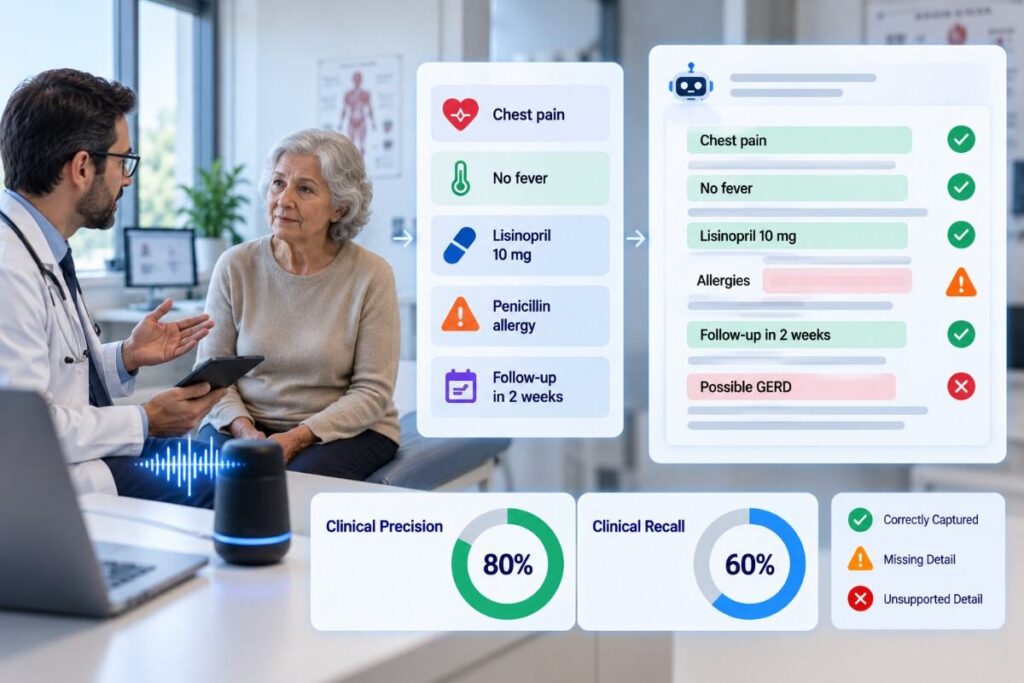
This is why clinical concept precision and recall are more useful than generic text similarity alone. Precision asks how much of the clinical information generated by the scribe is actually supported. Recall asks how much important information from the encounter successfully reaches the note. Both matter: high recall with poor precision may indicate hallucination, while high precision with weak recall can conceal dangerous omissions.
Hallucination and Omission Rates Need Separate Measurement
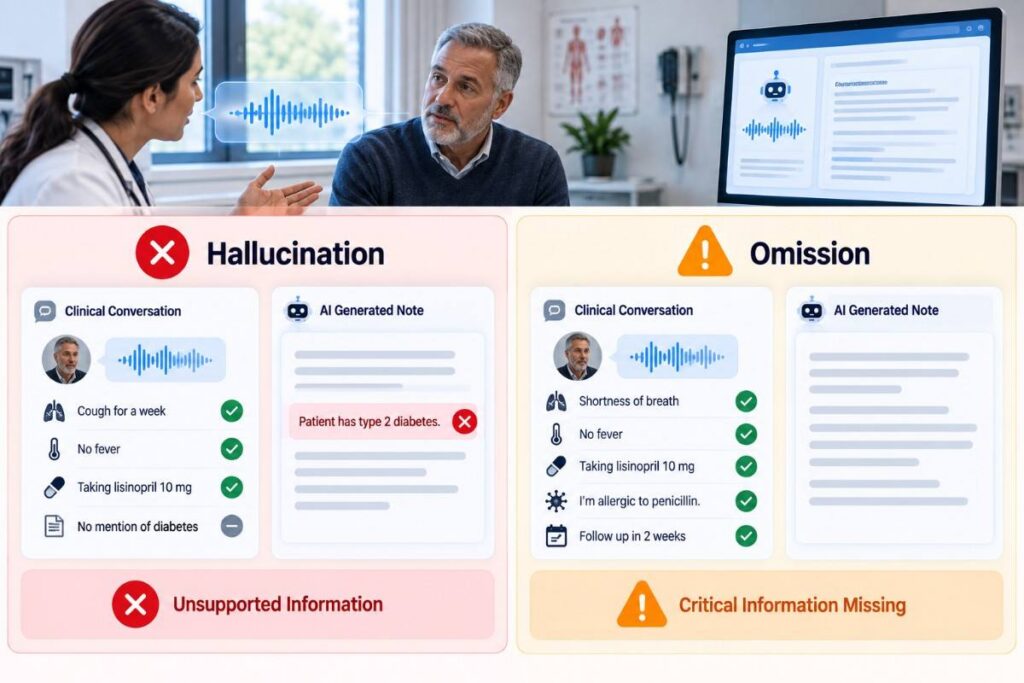
Generative systems can fail in opposite directions. They can invent information that was never present, or they can leave out information that was.
A hallucination benchmark should identify unsupported clinical claims and classify them by severity. Fabricating a medication, diagnosis, allergy, dosage, or follow-up instruction deserves substantially more attention than generating an unnecessary descriptive phrase. Severity-weighted measurement prevents a collection of trivial errors from statistically overshadowing one potentially serious failure.
Omission testing should follow the same logic. Benchmarkers can define critical clinical facts for each encounter and calculate the percentage successfully represented in the final documentation. Particular attention should go to treatment changes, contraindications, abnormal findings, medication instructions, referrals, and follow-up requirements.
Tracking the two rates independently also improves debugging. A model that frequently hallucinates requires a different remediation strategy from one that is overly conservative and routinely drops information.
Measure Note Quality Through Clinician Effort
An AI-generated note can be technically accurate and still create work. If clinicians repeatedly reorganize sections, delete irrelevant material, correct terminology, or rewrite assessments, the product is transferring documentation effort rather than eliminating it.
Edit distance can provide a starting signal by comparing generated notes with clinician-approved final versions. More meaningful operational metrics include correction count, percentage of notes requiring substantive edits, average editing time, and time from encounter completion to signed documentation. These measurements connect model performance directly to workflow value.
Acceptance rate is useful too, but it needs careful interpretation. A high percentage of notes accepted without modification may suggest strong performance, yet acceptance behavior varies between clinicians. Some users edit aggressively for style while others accept adequate notes with minimal changes.
Benchmarking should therefore combine automated comparisons with structured clinician review. The objective is not merely to produce text clinicians tolerate. It is to reduce cognitive and administrative load while preserving documentation quality.
Latency Is Part of Quality
A clinically excellent system that takes too long to generate documentation can still fail in production. Performance expectations should therefore include the entire pipeline rather than only model inference time.
Useful measurements include transcription latency, note-generation latency, time to first usable draft, and end-to-end processing time. Testing should also examine percentile performance particularly p95 and p99 latency because averages have an irritating habit of making painful outliers disappear.
Concurrency matters as well. A system that performs beautifully with ten encounters may behave differently when hundreds of sessions are processed simultaneously. Load testing can reveal queue buildup, timeouts, degraded transcription, API throttling, or downstream integration bottlenecks.
For real-time or near-real-time scribes, responsiveness becomes part of the user experience. Benchmarking should recreate realistic workloads rather than relying exclusively on isolated laboratory runs.
Reliability Must Be Tested Across Real Clinical Conditions
An overall accuracy score can hide weak spots. A model might achieve excellent aggregate performance while struggling disproportionately with certain specialties, accents, recording environments, or encounter types.
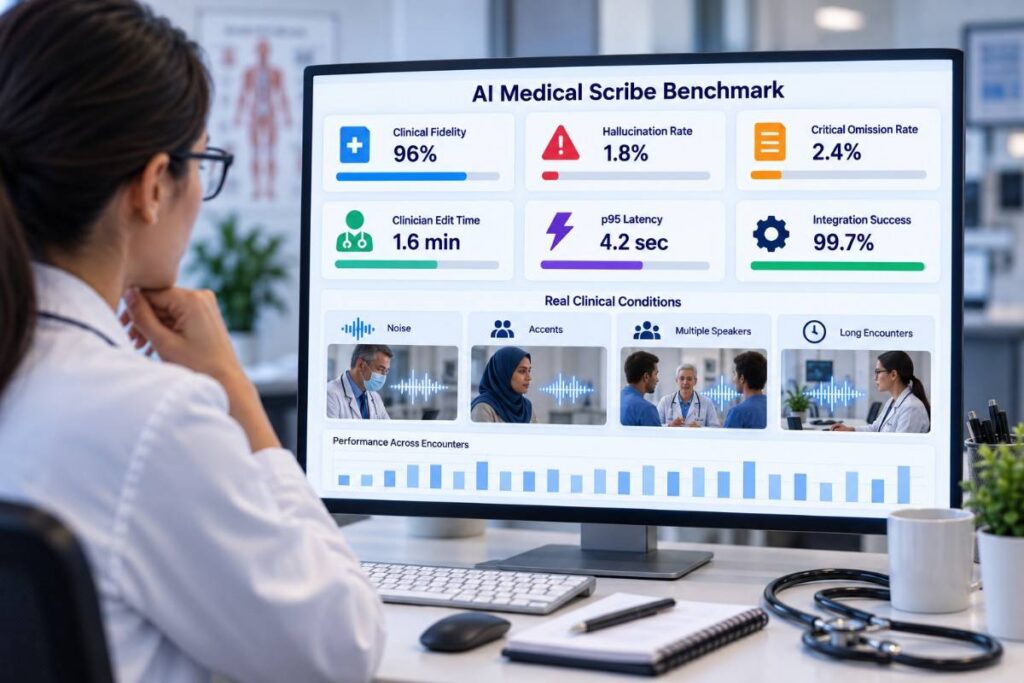
Benchmark datasets should therefore be segmented. Compare results across specialties, encounter duration, speaker count, audio quality, terminology complexity, demographic and linguistic variation, and device or microphone conditions. The goal is not simply to calculate a global score but to discover where performance changes.
Stress cases are especially valuable. Test interrupted speech, overlapping speakers, background noise, rapidly dictated medication names, corrections made mid-sentence, contradictory statements, long pauses, and unusually long encounters. These scenarios expose assumptions that carefully curated recordings rarely challenge.
Consistency should also be measured through repeated runs where model configuration permits variation. If identical or equivalent inputs produce materially different clinical facts, that instability deserves investigation even when each individual note appears plausible.
Integration and Workflow Metrics Cannot Be Ignored
Medical scribes do not operate in isolation. They interact with recording systems, identity services, EHR workflows, APIs, templates, storage layers, and clinician-facing interfaces. Model accuracy is only one component of production quality.
Integration benchmarks should measure successful note delivery, correct patient and encounter association, template mapping, API failure rates, retry behavior, duplicate creation, synchronization delays, and recovery from interrupted workflows. A perfectly generated note attached to the wrong encounter is still a failed system.
Usability metrics belong here as well. Track how easily clinicians can review, edit, approve, and navigate generated documentation. Additional clicks, confusing status indicators, lost edits, or poorly surfaced errors can erase gains created by strong AI performance.
This broader perspective is important because users experience the product as one system. They do not care which microservice technically caused the problem and neither should the benchmark.
Build a Benchmark That Reflects Risk, Not Vanity
The most useful AI medical scribe benchmark is multidimensional. Clinical fidelity should carry substantial weight, with hallucinations, critical omissions, negation errors, and incorrect attribution explicitly measured. Workflow efficiency, latency, reliability, integration success, and clinician effort then reveal whether that accuracy translates into a usable product.
Thresholds should also be defined before testing whenever possible. Establish what constitutes an unacceptable critical-error rate, reasonable generation latency, sufficient note completeness, or successful integration rate. Otherwise, teams risk adjusting their interpretation after seeing the results a classic way to turn benchmarking into scorekeeping.
Regression testing is equally important. AI systems evolve through model updates, prompt changes, infrastructure modifications, and new integrations. A release that improves average note quality may unexpectedly reduce medication recall or degrade performance for noisy encounters. Maintaining a stable benchmark suite makes those trade-offs visible before production users discover them.
From “Looks Good” to Evidence-Based Quality
AI medical scribes should not be judged by how convincing a handful of generated notes appear on screen. The meaningful question is whether the system remains clinically faithful, fast, stable, usable, and predictable across thousands of realistic situations including the inconvenient edge cases that never make it into the product demo.
Good benchmarking turns those qualities into measurable evidence. It distinguishes cosmetic improvements from meaningful ones, identifies where risk concentrates, and gives engineering and clinical teams a shared language for deciding whether a system is ready to scale.
For teams building or refining AI-driven healthcare software, rigorous QA provides the framework needed to test that evidence continuously rather than relying on intuition. When the benchmark measures what clinicians and patients actually depend on, better scores can finally mean something: better software.
Ready to put your AI healthcare product through meaningful, real-world QA? Get in touch with our experts and start your QA journey today.