




Latest Insights
AI Medical Scribe Data Security: A Buyer’s Guide for Clinics (Encryption, Access Controls, Vendor Due Diligence)
- Oct 23, 2026
- Sajid M.
- AI medical scribe data security
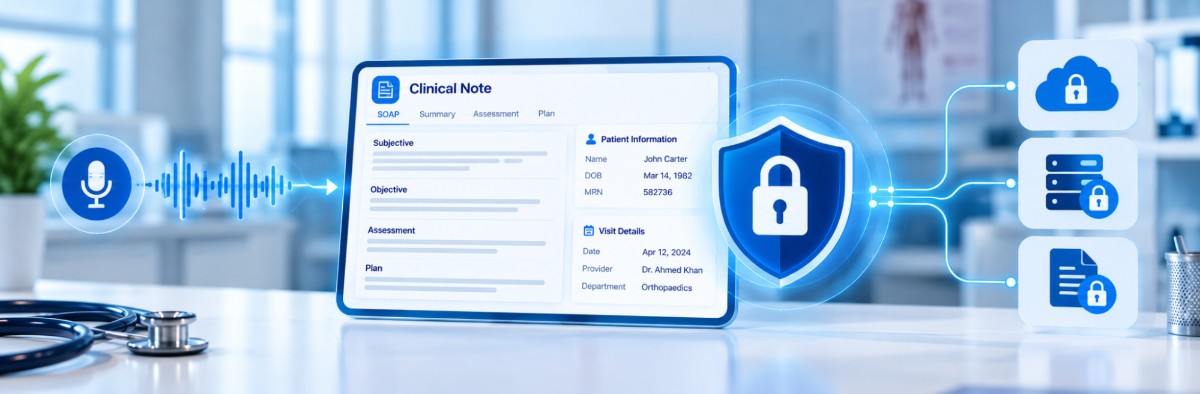
AI medical scribes can document patient visits in seconds, but what happens to the sensitive conversations they capture? Every recording, transcript, and EHR connection creates another potential entry point for cybercriminals. For clinics, AI medical scribe data security isn’t just an IT concern; it’s a patient safety and business priority.
A vendor claiming HIPAA compliance sounds reassuring, but can they prove their encryption works, access permissions are airtight, and patient data stays protected? At Testiva, our security testing and QA services help uncover vulnerabilities that security promises alone cannot address.
Before investing in an AI scribe, clinics need answers, not marketing claims. This guide breaks down the encryption standards, access controls, and vendor security checks that actually matter.
Why AI Medical Scribe Data Security Matters
Traditional clinical documentation generally stays within established EHR environments. AI medical scribes introduce additional processing layers involving microphones, speech recognition, cloud infrastructure, large language models, and third-party integrations.
Each component expands the potential attack surface. Audio recordings may contain identifiable patient information, while generated notes can reveal sensitive medical conditions. Improper storage configurations, compromised credentials, or insecure APIs could expose this information.
Security failures also create operational consequences. Clinics may face regulatory investigations, breach notification obligations, financial losses, disrupted workflows, and damaged patient relationships.
Importantly, security must cover the entire data lifecycle, from recording and transmission to processing, retention, deletion, and backup management. A secure application interface means little if underlying transcripts remain accessible through poorly configured cloud storage.
Encryption: Protecting Patient Data Throughout Its Lifecycle
Encryption is one of the most important technical safeguards clinics should examine when comparing AI medical scribe vendors. It converts readable information into protected ciphertext, reducing exposure when data is intercepted or improperly accessed.
However, encryption effectiveness depends on implementation, key management, and coverage across the system.
Encryption in Transit
AI medical scribes continuously transfer information between recording devices, application servers, transcription engines, and EHR platforms. These connections should use modern Transport Layer Security, preferably TLS 1.3, with TLS 1.2 supported where appropriately configured.
Clinics should verify that encryption protects every transmission pathway, including third-party AI processing services and EHR integrations. HTTPS on a vendor’s website does not establish that internal service communications are secure.
Buyers should also ask whether vendors enforce certificate validation, prevent insecure protocol downgrades, and securely authenticate service-to-service connections.
Encryption at Rest
Stored audio, transcripts, clinical notes, and backups require encryption at rest. AES-256 is a widely adopted encryption standard suitable for protecting sensitive healthcare information when implemented correctly.
Clinics should determine whether encryption covers production databases, temporary processing files, diagnostic logs, and disaster recovery backups.
Equally important is encryption key management. Vendors should explain how keys are generated, stored, rotated, and restricted, ideally using dedicated key management services or hardware security modules.
Encryption cannot prevent every breach. If attackers obtain authorized application credentials, they may still access decrypted information. Therefore, encryption must operate alongside strong identity controls and monitoring.

Access Controls: Ensuring Only Authorized Users See Patient Information
Strong access controls determine who can view, modify, export, or delete information within an AI medical scribe platform. Clinics should reject solutions that provide broad permissions without meaningful restrictions.
Role-Based Access Control and Least Privilege
Role-based access control (RBAC) assigns permissions according to professional responsibilities. Physicians may need access to clinical notes, while administrators may require billing or configuration access without unrestricted visibility into patient conversations.
The principle of least privilege ensures users receive only the permissions necessary for their duties.
Clinics should evaluate whether vendors support granular permissions, separation between administrative and clinical roles, and immediate access revocation when employees leave.
For larger healthcare organizations, patient-level or department-level access restrictions may also be necessary.
Multi-Factor Authentication and Session Security
Passwords alone provide insufficient protection for systems handling protected health information (PHI). Multi-factor authentication (MFA) adds another verification layer, reducing risks associated with stolen credentials.
Prefer vendors supporting phishing-resistant authentication methods, such as FIDO2 security keys or passkeys, particularly for privileged accounts.
Additional safeguards should include configurable session timeouts, suspicious-login detection, account lockout protections, and secure recovery procedures.
Single sign-on integration can simplify centralized identity management, provided authentication policies are consistently enforced.
Audit Logging and Accountability
A trustworthy AI medical scribe should maintain detailed audit trails covering access to patient records, exports, modifications, administrative actions, and security-sensitive events.
Logs should identify the user, action, timestamp, and relevant resource without unnecessarily exposing PHI.
Clinics should ask whether logs are tamper-resistant, retained according to applicable requirements, and accessible for security investigations.
Audit logs become particularly valuable when investigating unauthorized access or determining the scope of a potential breach.

Vendor Due Diligence: Looking Beyond Security Marketing
A vendor’s security page is a starting point, not sufficient evidence of protection. Clinics need a structured due diligence process that examines security architecture, independent assessments, operational practices, and contractual commitments.
HIPAA Compliance and Business Associate Agreements
For US healthcare organizations subject to HIPAA, vendors processing PHI on their behalf generally qualify as business associates. A properly executed Business Associate Agreement (BAA) is therefore essential before sharing patient information.
The agreement should define permitted data uses, safeguards, breach reporting obligations, subcontractor responsibilities, and data handling upon termination.
According to the US Department of Health and Human Services, cloud providers handling electronic PHI can qualify as business associates even when they cannot decrypt the information.
Clinics should remember that HIPAA does not provide an official certification for AI scribe products. Vendor compliance statements cannot replace the clinic’s own security risk assessment.
Independent Audits and Security Certifications
Independent assessments provide stronger assurance than unsupported vendor declarations. SOC 2 Type II reports can demonstrate how security controls operated over an assessment period.
ISO/IEC 27001 certification can also indicate an established information security management system.
However, neither automatically guarantees HIPAA compliance or complete application security.
Buyers should examine assessment scope, identified exceptions, remediation activities, and whether critical AI processing components were included.
Subprocessors and Third-Party AI Models
Many medical scribes depend on external speech recognition engines, language models, hosting providers, and analytics services.
Clinics must understand which organizations receive patient information and why.
Ask vendors whether PHI is used for model training, whether training is disabled by contractual agreement, and whether subprocessors retain prompts or responses.
Data residency, cross-border transfers, subcontractor agreements, and changes to subprocessors deserve particular attention.
A vendor cannot meaningfully guarantee privacy without understanding its complete processing ecosystem.
Data Retention, Deletion, and Incident Response
Not every clinical recording needs indefinite storage. Data minimization reduces exposure by limiting the information collected and retained.
Clinics should favor configurable retention periods for recordings, transcripts, and intermediate processing artifacts.
Deletion policies must explain how information is removed from primary storage, backups, caches, and third-party systems.
Incident response capabilities are equally important. Vendors should maintain documented procedures for detecting breaches, containing threats, investigating incidents, and notifying affected customers.
Contracts should establish clear notification timelines and cooperation requirements. Clinics should also evaluate backup restoration capabilities and disaster recovery testing results.
Security Testing Before Deployment
Documentation alone cannot establish whether a medical scribe behaves securely under realistic conditions.
At Testiva, we recognize the importance of combining security assessments with functional testing to identify weaknesses that conventional compliance reviews may overlook.
Testing should examine authentication bypasses, privilege escalation, insecure APIs, session management, and unauthorized access between patient records.
AI-specific assessments should also investigate prompt injection, unintended disclosure of sensitive information, and unsafe interactions between generated content and connected systems.
EHR integration testing deserves particular attention. Incorrect patient mapping, excessive API permissions, or synchronization failures can compromise confidentiality and clinical integrity simultaneously.
Testing should use synthetic or appropriately de-identified patient information wherever practical.

How Clinics Should Make the Final Purchasing Decision
Choosing a secure AI medical scribe requires balancing clinical usability, documentation accuracy, integration reliability, and measurable security safeguards.
Start by identifying non-negotiable requirements: appropriate encryption, enforceable access restrictions, a satisfactory BAA where applicable, transparent subprocessors, and documented incident response procedures.
Next, request technical evidence rather than accepting generic assurances. Review security reports, conduct controlled demonstrations, and evaluate how the platform handles unusual or unauthorized activities.
Finally, assess operational ownership. Determine who manages user permissions, monitors security alerts, reviews vendor changes, and coordinates incidents after deployment.
The strongest solution is not necessarily the platform advertising the most security features. It is the one whose protections can be demonstrated, maintained, and independently evaluated.
Conclusion: Secure Clinical AI Starts With Verification
AI medical scribes can deliver meaningful efficiency improvements, but protecting patient information requires disciplined procurement and continuous oversight.
Encryption protects information, access controls restrict exposure, and vendor due diligence reveals risks hidden behind polished product demonstrations. Together, these safeguards create a stronger foundation for trustworthy clinical automation.
For clinics, the purchasing principle is simple: never confuse promised security with verified security.
At Testiva, we help organizations strengthen software reliability through rigorous quality assurance and testing practices. When your healthcare technology needs dependable functionality and carefully evaluated security controls, get in touch with our experts and start your QA journey today.