




Latest Insights
Does an AI Medical Scribe Improve Efficiency? A Practical Testing Framework for Clinics
- Oct 24, 2026
- Sajid M.
- AI medical scribe efficiency testing
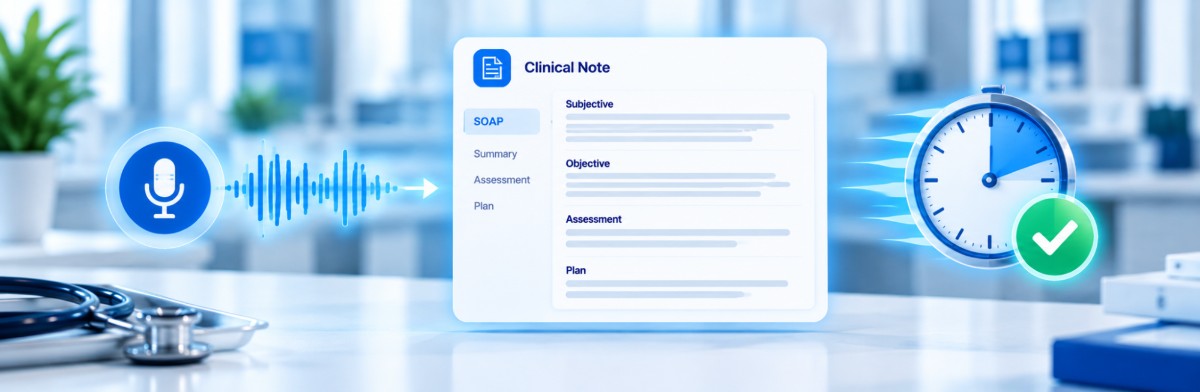
Clinical documentation has become an invisible bottleneck in modern healthcare. Physicians spend valuable time translating patient conversations into structured electronic health records (EHRs), often extending documentation into evenings and weekends. AI medical scribes promise to change that equation by automatically capturing clinical encounters, generating structured notes, and reducing administrative workloads. But faster documentation does not necessarily mean better clinical efficiency. An AI-generated note that requires extensive corrections, misses critical details, or disrupts existing workflows can introduce more problems than it solves.
At Testiva, we believe healthcare AI deserves the same rigorous quality assurance as any mission-critical software. Through structured AI testing, performance validation, and usability assessments, clinics can determine whether medical scribes genuinely improve productivity without compromising patient safety. The real question is not whether AI can write clinical notes, but whether it can produce accurate, reliable documentation that makes healthcare delivery measurably more efficient.
What Is an AI Medical Scribe, and How Does It Work?
An AI medical scribe is a software application that uses artificial intelligence to capture clinical conversations and transform them into organized medical documentation. Unlike traditional human scribes, these systems use speech recognition, natural language processing, and generative AI to interpret patient-provider interactions.
During consultations, an AI scribe may record or process conversations, identify relevant medical information, and generate documentation such as SOAP notes, encounter summaries, or structured clinical records. Depending on the product, these notes can be reviewed and transferred into an EHR.
However, successful transcription is only one component of clinical usefulness. A system must distinguish relevant findings from casual conversation, preserve medical context, recognize uncertainty, and avoid inventing information. These capabilities require systematic validation before clinics can trust the technology in everyday practice.
Does an AI Medical Scribe Actually Improve Clinical Efficiency?
AI medical scribes can improve efficiency, but the benefits depend on implementation quality, clinical workflows, and documentation accuracy. Automating note generation may reduce typing time while allowing clinicians to concentrate on patient interactions.
Nevertheless, efficiency must be evaluated across the complete documentation process. If physicians spend several minutes correcting AI-generated notes, the apparent time savings may disappear. Similarly, an AI scribe that produces incomplete documentation can create downstream problems for billing, coding, and continuity of care.
The most meaningful efficiency improvements occur when documentation becomes faster without increasing clinical risk or administrative rework. Clinics should therefore measure outcomes rather than rely exclusively on vendor demonstrations or advertised productivity claims.
Documentation Time Versus Total Workflow Time
A medical scribe might generate a consultation note in seconds, but that metric alone reveals little about actual productivity. Clinicians still need to review, edit, approve, and potentially reorganize the generated content.
A practical assessment compares the total time required to complete documentation before and after implementation. This includes recording setup, note generation, corrections, EHR entry, and final approval.
If the combined workflow becomes shorter while maintaining documentation quality, the system demonstrates measurable operational value. Otherwise, automation may simply shift administrative effort from writing to verification.
A Practical AI Medical Scribe Testing Framework for Clinics
Clinics need a repeatable evaluation framework that measures efficiency, clinical accuracy, technical reliability, and usability. Testing should reflect realistic patient encounters rather than carefully scripted demonstrations designed to showcase ideal performance.
At Testiva, our approach to quality assurance emphasizes measurable outcomes, realistic usage conditions, and early identification of software risks. These principles are particularly important for healthcare applications, where seemingly minor documentation defects can have significant consequences.
The following framework helps clinical teams evaluate AI scribes before committing to organization-wide deployment.
Step 1: Establish Baseline Documentation Metrics
Before introducing an AI medical scribe, clinics should document how their existing workflows perform. Without baseline measurements, determining whether automation delivers meaningful improvements becomes difficult.
Track average documentation time per encounter, time spent completing notes after clinic hours, correction frequency, and documentation turnaround time. Consider differences between appointment types, specialties, and clinician experience levels.
Collect representative measurements over several weeks where practical. This creates a reliable reference point for comparing AI-assisted workflows against existing processes.
Step 2: Test Clinical Documentation Accuracy
Accuracy is arguably the most important dimension of AI medical scribe performance. A beautifully formatted note provides little value if it misrepresents clinical information.
Testing should examine whether generated documentation accurately captures symptoms, diagnoses, medications, allergies, treatment recommendations, and follow-up instructions. Particular attention should be paid to negation, dosage information, medical terminology, and uncertainty.
For example, confusing “no history of diabetes” with “history of diabetes” can materially change the clinical record. Test scenarios should include similar terminology, interrupted conversations, multiple speakers, accents, and complex medical histories.
Clinician reviewers should classify errors by severity rather than relying solely on overall transcription accuracy. Critical omissions and fabricated clinical statements deserve greater attention than minor formatting inconsistencies.

Step 3: Measure Real Documentation Time Savings
Efficiency testing should measure actual clinician involvement, not merely AI processing speed. The primary comparison should be between complete manual documentation and the entire AI-assisted documentation workflow.
Measure time spent reviewing generated notes, correcting inaccuracies, adding missing details, and finalizing records. Include technical interruptions and repeated processing attempts where applicable.
Calculate the percentage improvement using the following formula:
Time Savings (%) = [(Baseline Documentation Time − AI-Assisted Documentation Time) ÷ Baseline Documentation Time] × 100
For example, reducing documentation time from 12 minutes to 8 minutes represents approximately 33% time savings. However, this improvement is meaningful only if documentation quality remains acceptable.
Clinics should evaluate whether vendors support granular permissions, separation between administrative and clinical roles, and immediate access revocation when employees leave.
For larger healthcare organizations, patient-level or department-level access restrictions may also be necessary.

Step 4: Validate EHR Integration and Data Integrity
Even an accurate AI scribe can become operationally inefficient when integration with existing healthcare systems is unreliable. Clinics should test how generated documentation moves into their electronic health records.
Integration testing should verify correct patient identification, encounter association, field mapping, formatting, and preservation of clinical details. Systems must not silently overwrite existing information or attach documentation to incorrect records.
Testing should also cover interrupted connections, duplicate submissions, synchronization delays, and recovery after failed transfers. Reliable integration reduces manual intervention and helps prevent documentation inconsistencies.

Step 5: Evaluate Usability Under Real Clinical Conditions
Healthcare environments rarely resemble controlled product demonstrations. Physicians handle interruptions, overlapping conversations, background noise, and appointments that vary considerably in complexity.
Usability testing should examine whether clinicians can start, pause, review, and finalize documentation without unnecessary navigation or cognitive effort. The interface should make errors easy to identify and corrections straightforward to perform.
Include clinicians from different specialties and experience levels. Their feedback can reveal workflow friction that conventional functional testing might overlook.
A successful implementation should simplify existing processes rather than require clinicians to adapt their entire consultation style around the technology.
Key Performance Indicators Clinics Should Monitor
A structured pilot needs clearly defined key performance indicators (KPIs). These measurements help distinguish genuine productivity improvements from perceived convenience.
Documentation completion time should be a primary metric because it captures the combined effects of automation and clinician review. Note correction rate provides another important signal, revealing how frequently generated content requires intervention.
Clinical error severity, EHR synchronization success, system availability, and clinician satisfaction should also be monitored. Where appropriate, clinics can evaluate documentation completed outside scheduled working hours.
Importantly, metrics should be interpreted together. A system that reduces documentation time but increases critical errors cannot reasonably be considered a successful efficiency improvement.
Common AI Medical Scribe Failures Testing Can Reveal
AI medical scribes introduce failure modes that traditional documentation software may not exhibit. Generative systems can produce plausible but unsupported clinical statements, misunderstand context, or omit information that appears insignificant linguistically but matters medically.
Hallucinated findings represent a particularly concerning risk. An AI model might generate an examination result that was never discussed or incorrectly infer a diagnosis from symptoms.
Other failures include confusing speakers, misinterpreting medication names, mishandling negation, and generating inconsistent outputs from similar conversations. Background noise and specialty-specific terminology can further affect performance.
Quality assurance should include negative testing, edge cases, and regression testing after model updates. Clinics need evidence that system improvements do not introduce new documentation risks.
Security, Privacy, and Regulatory Considerations
Clinical efficiency cannot come at the expense of patient confidentiality. AI medical scribes may process sensitive conversations, identifiable patient information, and medical records, making privacy and security testing essential.
Clinics should evaluate encryption, access controls, authentication, audit logging, data retention, and third-party processing arrangements. They should also confirm whether patient information is used for model training and under what contractual restrictions.
Regulatory requirements vary by jurisdiction. In the United States, organizations should assess applicable HIPAA obligations, including business associate agreements where required. Other regions may impose additional healthcare data protection requirements.
Testing should verify actual security behavior rather than relying exclusively on vendor documentation. Unauthorized access attempts, session handling, and data deletion workflows deserve particular scrutiny.
How to Run a Controlled AI Medical Scribe Pilot
A controlled pilot provides stronger evidence than an immediate organization-wide rollout. Begin with a representative group of clinicians, appointment types, and documentation scenarios.
Where feasible, compare AI-assisted encounters with a matched baseline or control group. Account for specialty differences, appointment complexity, and individual documentation habits to avoid misleading conclusions.
Establish predefined acceptance criteria for accuracy, efficiency, reliability, and clinician satisfaction. Critical documentation errors should trigger investigation regardless of apparent productivity gains.
During the pilot, collect quantitative metrics alongside structured clinician feedback. Review unexpected outcomes, identify recurring defects, and retest after configuration changes.
Only expand deployment when the evidence supports both operational improvement and acceptable clinical risk.
Final Thoughts: Efficiency Must Be Proven, Not Assumed
AI medical scribes have the potential to reduce administrative workload and return valuable time to clinical care. However, their effectiveness depends on accurate documentation, seamless integration, dependable performance, and workflows that genuinely support clinicians.
A practical testing framework transforms vendor promises into measurable evidence. By evaluating complete documentation time, clinical correctness, usability, security, and reliability, clinics can make informed adoption decisions.
At Testiva, we help organizations approach complex software quality challenges through systematic testing and evidence-driven validation. For healthcare technology teams developing or deploying AI-powered documentation tools, rigorous QA provides a foundation for safer, more dependable performance.