




Latest Insights
Top Challenges in Testing AI Medical Scribe Applications
- Aug 14, 2026
- Sajid M.
- AI Medical Scribe

Introduction to Challenges in Testing AI Medical Scribe Applications
An AI medical scribe doesn’t fail the way most software does. It doesn’t crash or show an error message. Instead, it writes a clear, confident sounding medical note, even when it got something wrong, like hearing the wrong drug name or describing an exam that never happened. That makes it a very different kind of thing to test.
The hard part usually isn’t running the test, it’s knowing what to even look for. Effective AI medical scribe and healthcare AI testing require identifying subtle failures that may not be obvious from the generated note alone. This blog walks through the challenges we ran into while testing a real AI medical scribe across more than 100 test cases.
Why AI Medical Scribe Testing Is More Complex Than Traditional Software Testing
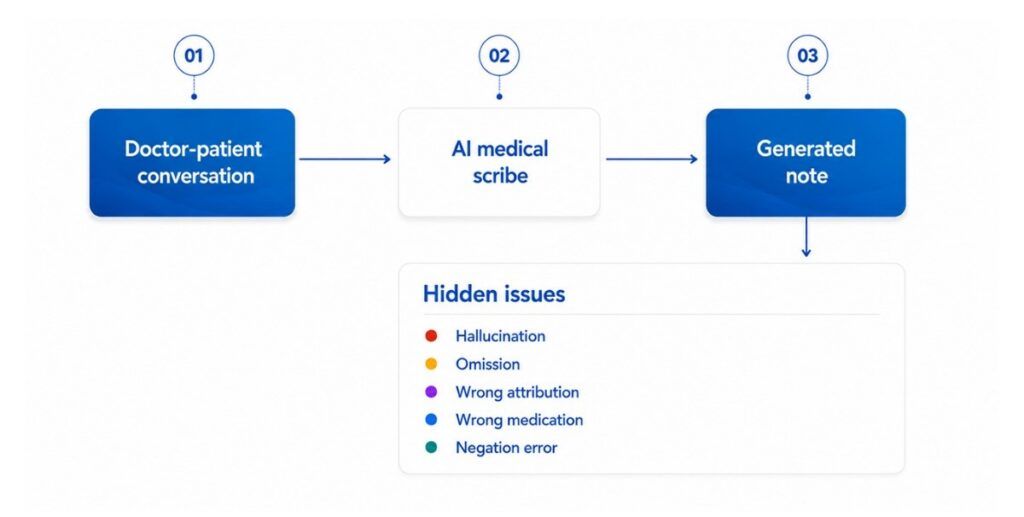
AI medical scribes are difficult to test because there is rarely a single “correct” output. The system must accurately transcribe speech, identify speakers, understand clinical context, and perform reliable clinical note generation, all while preserving the meaning of the original conversation.
The challenge is that many failures do not look like failures. A note can be well written, professional, and clinically plausible while still containing made up information, missing important details, or subtly changing the meaning of what was said. As a result, testing is not just about checking whether the note sounds right, but whether it accurately reflects the actual consultation.
Key Challenges in AI Medical Scribe QA and Evaluation
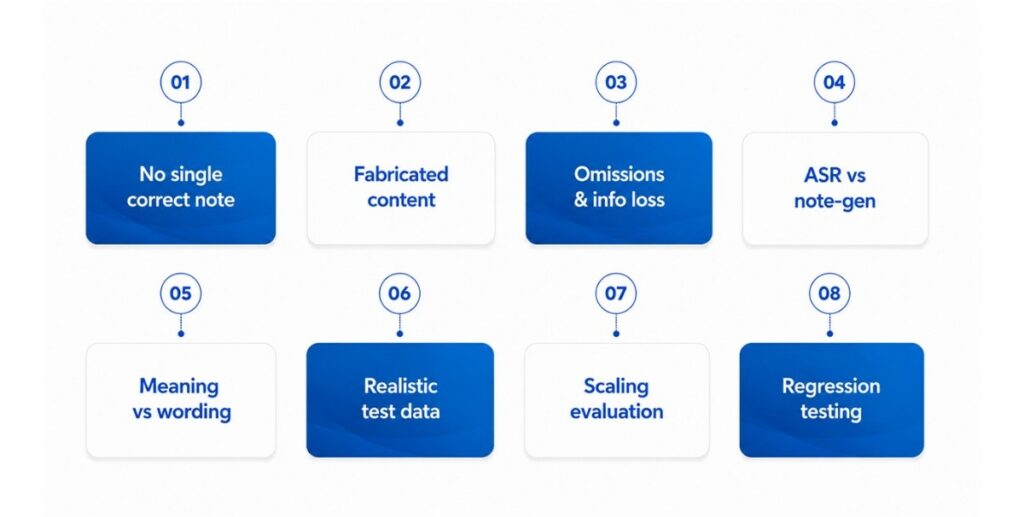
No Single "Correct" Medical Note
The challenge: There is rarely one expected output.
Most software testing starts with a clear expected result. An AI medical scribe doesn’t give you that luxury. Two clinicians can listen to the same consultation and write two different notes, both of which are perfectly acceptable.
Why it matters:
- Multiple summaries can be clinically correct
- Exact text comparison is often misleading
- Accuracy depends on meaning, not wording
The challenge is no longer checking whether the wording matches. It’s deciding whether the note faithfully represents what happened in the consultation.
Detecting Hallucinated Clinical Content
The challenge: Finding information that was never said.
We saw cases where the system documented examination findings that never took place, described observations the doctor never made, or linked diagnoses to evidence that did not exist in the conversation.
Common examples:
- Invented exam findings
- Invented symptoms
- Invented diagnoses
- Unsupported clinical observations
The problem is that hallucinations blend into otherwise professional looking notes, making hallucination detection one of the most important aspects of AI medical scribe testing.
Detecting Omissions and Information Loss
The challenge: Identifying what is missing.
Patients often mention important details only once. If the system misses that moment, the final note can still appear complete while leaving out clinically important information.
Common examples:
- Missing allergies
- Missing medications
- Missing symptoms
- Missing follow up instructions
Unlike hallucinations, omissions leave no visible trace behind, making them especially difficult to detect.
Distinguishing ASR Failures from Note Generation Failures
The challenge: Finding the real source of an error.
When a generated note contains a mistake, the problem may have started much earlier in the pipeline.
Possible sources:
- Speech recognition errors
- Speaker diarization errors
- Note generation errors
Without testing these components separately, it becomes difficult to understand what actually needs fixing.
Evaluating Clinical Meaning Rather Than Text Accuracy
The challenge: Understanding intent and context.
Some mistakes are not about whether a topic was mentioned. They are about what the note claims actually happened.
Examples:
- A possible diagnosis becomes a confirmed diagnosis
- A conditional referral becomes a completed referral
- A withdrawn medication remains in the treatment plan
The challenge is understanding clinical meaning rather than simply matching keywords.
Building Realistic Test Data
The challenge: Reproducing real clinical conditions.
Many failures only appear outside of clean laboratory style recordings.
Important variables:
- Multiple speakers
- Background noise
- Interruptions
- Accents
- Low volume speech
- Overlapping conversations
Creating realistic test data at scale is essential for understanding real world performance.
Scaling Clinical Evaluation
The challenge: Reviewing large numbers of notes.
Many note quality issues require clinical judgment rather than simple automated checks.
Why it’s difficult:
- Clinical accuracy is nuanced
- Human review is expensive
- Expert reviewers are limited
- Test volumes grow quickly
What works for a handful of conversations becomes much harder across hundreds or thousands.
Regression Testing in Rapidly Changing AI Systems
The challenge: Keeping improvements from creating new problems.
AI systems evolve constantly through model updates, prompt changes, and configuration changes.
Common risks:
- Improved summaries causing new omissions
- Better transcription affecting speaker attribution
- Prompt changes altering note quality
Regression testing becomes a continuous process rather than a one time activity.
Our Approach to AI Medical Scribe Testing and Quality Assurance
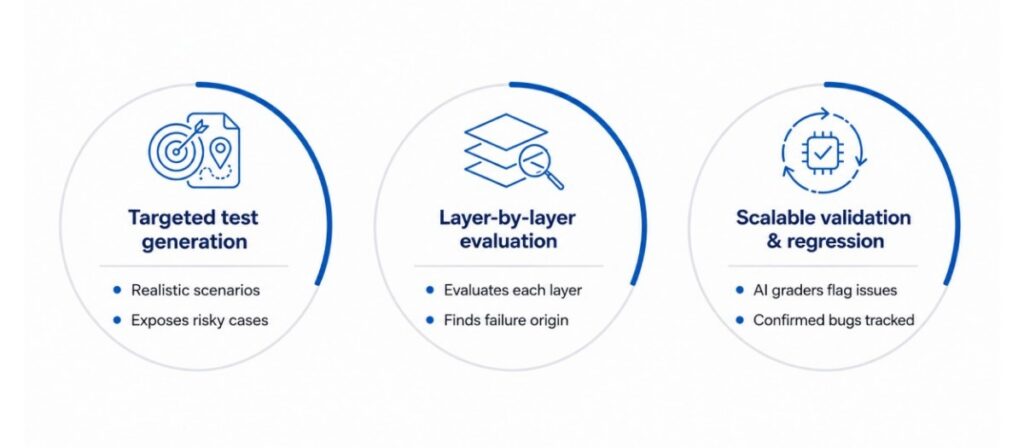
While testing an AI medical scribe application, we found that simply reviewing the final note was not enough. Many of the most important failures were rare, subtle, or only appeared under specific conditions, so we built a testing framework designed to surface them intentionally.
At Testiva, this framework was developed specifically to evaluate AI medical scribes across both transcription and clinical note generation layers, supporting scalable healthcare AI testing while helping teams identify issues that traditional output review often misses.
Our approach focused on three areas:
Targeted Test Generation
We generated realistic clinical conversations across different conditions, specialties, speaker counts, languages, and recording environments. We also introduced scenarios specifically designed to expose hallucinations, omissions, speaker attribution mistakes, negation errors, and other high risk failures.
Layer by Layer Evaluation
Rather than treating the scribe as a black box, we evaluated speech recognition, speaker diarization, and note generation separately before assessing the system end to end. This made it much easier to identify where a failure actually originated.
Scalable validation and regression testing
We used AI based graders to help identify hallucinated content, missing information, and factual inaccuracies at scale. However, we treated their findings as indicators rather than final verdicts and validated significant failures against the original conversation. Whenever we confirmed a bug, we added it to our regression suite to ensure future model updates and prompt changes did not reintroduce the same issue.
Conclusion
Testing AI medical scribes is about more than producing well-written notes. A strong QA framework helps detect hallucinations through effective hallucination detection, identify omissions, validate clinical accuracy, and ensure the final documentation remains faithful to the original consultation. This is critical for building trust in AI-generated clinical records and protecting patient safety.
At Testiva, we apply these best practices through a dedicated testing framework that combines targeted test generation, layer-by-layer evaluation, and scalable validation. This helps teams uncover hidden failures, improve accuracy, and gain confidence in real-world performance.
Ready to identify hidden risks in your AI medical scribe application? Contact Testiva today for a demo of our testing framework and learn how structured healthcare AI testing can improve accuracy, reduce hallucinations, and strengthen trust in your clinical documentation workflows.