





Real-world conversations
Interruptions, corrections, multiple speakers, overlapping speech, and complex encounters can make results less predictable.


A practical session for teams building AI Medical Scribe applications. Learn what to test beyond traditional QA before your product reaches clinicians.
Traditional QA can verify that the application works, but it may not catch AI-specific failures in how a conversation is understood and documented.
Interruptions, corrections, multiple speakers, overlapping speech, and complex encounters can make results less predictable.

Accents, noise, medical terminology, or incorrect speaker attribution can affect what the system captures.

The generated note may misinterpret or incorrectly represent information from the conversation.

Important symptoms, medications, decisions, or other details may be left out of the final note.

The AI may add information that was never stated or supported by the conversation.

Real conversations are hard to reproduce at scale. Synthetic data and scripted scenarios help build meaningful coverage.
Practical areas to consider when building a testing strategy for AI Medical Scribes. The session closes with a live walkthrough of Testiva's in-house AI Scribe testing tool, showing how it evaluates clinical accuracy, hallucination rates, and transcription quality.
 Building a practical QA and evaluation strategy
Understanding the speech/ASR and note-generation layers
Testing note accuracy, completeness, and structure
Synthetic test data and realistic test scenarios
Live demo of Testiva's in-house AI Scribe testing tool
AI Medical Scribe testing fundamentals
Testing transcription and speaker diarization
Hallucination, omission, and factuality testing
Real-world edge cases and adversarial testing
Q&A with the Testiva team
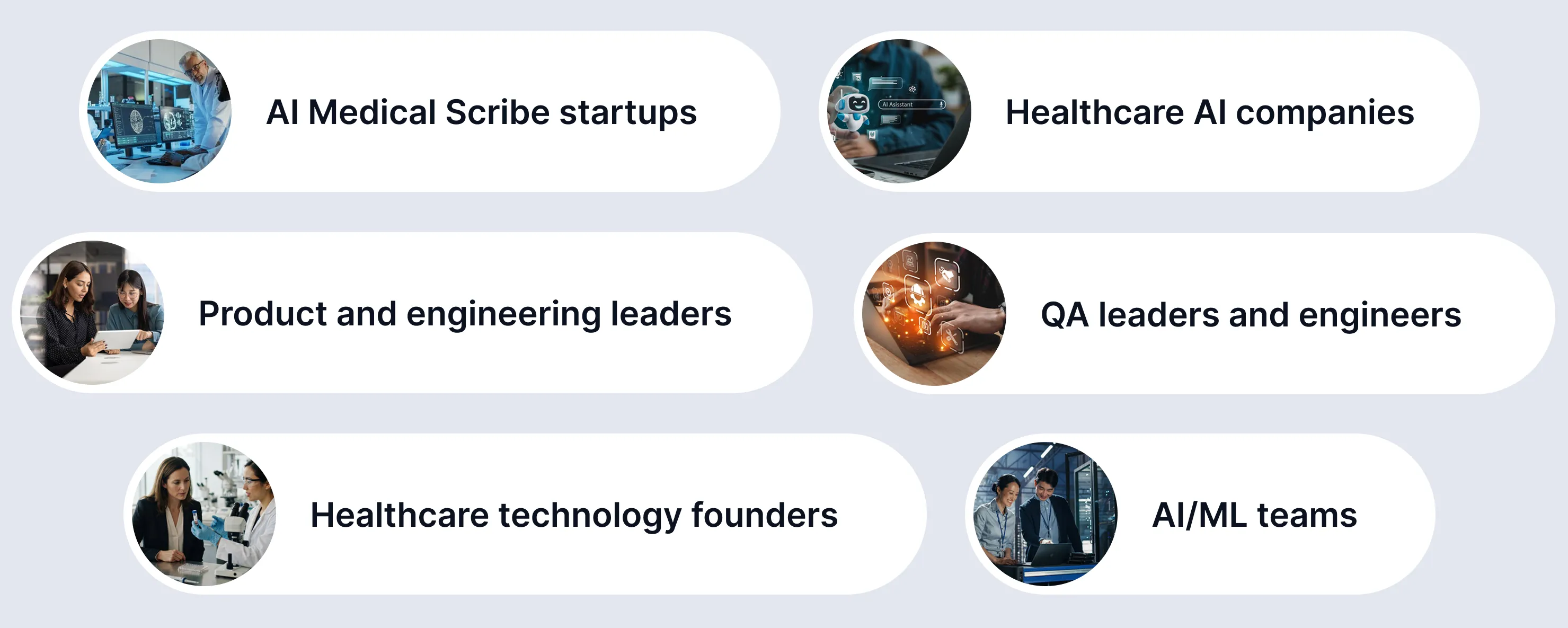
Built for teams shipping or preparing to deploy AI Medical Scribe products.

Reserve your spot and learn how to build a stronger testing strategy for your AI Medical Scribe.
After registration, Testiva team will contact you and will share the webinar link via email