




Latest Insights
How to Test AI Meeting Notes Applications: A Complete QA Framework
- Aug 27, 2026
- Sajid M.
- AI Meeting Notes Testing

AI meeting assistants have quickly evolved from convenient productivity tools into business-critical software. They record meetings, transcribe conversations, identify speakers, summarize discussions, extract action items, and integrate with collaboration platforms like Slack, Microsoft Teams, Google Workspace, and CRM systems. Organizations increasingly rely on these applications to preserve institutional knowledge, improve productivity, and eliminate manual note-taking.
However, building an AI meeting notes application is only half the challenge. Ensuring it consistently delivers accurate, secure, and reliable results across thousands of real-world conversations is where quality assurance becomes indispensable.
At Testiva, we’ve seen firsthand that AI-powered applications require a fundamentally different QA strategy than traditional software. Our AI testing and software QA services help organizations validate not only application functionality but also the quality, consistency, and trustworthiness of AI-generated outputs. Traditional test cases alone simply cannot cover the complexity of machine learning systems interacting with unpredictable human conversations.
Why AI Meeting Notes Applications Are Different to Test
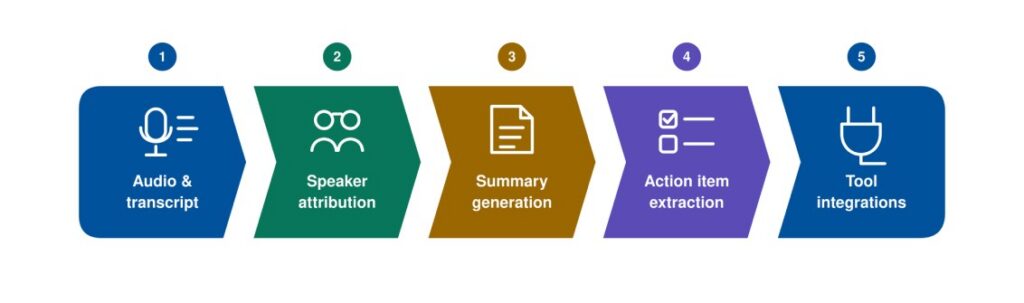
Unlike conventional business applications, AI meeting assistants rarely produce deterministic outputs. The same meeting recording may generate slightly different summaries depending on model versions, temperature settings, or prompt optimizations. This makes testing significantly more challenging.
QA engineers must validate both the software surrounding the AI and the intelligence produced by the model itself. The application isn’t merely processing inputs and generating fixed outputs—it is interpreting language, understanding context, recognizing speakers, identifying decisions, and summarizing conversations that often include interruptions, accents, slang, and incomplete sentences.
This introduces multiple testing dimensions that traditional regression testing does not adequately cover. Accuracy becomes probabilistic rather than absolute, requiring evaluation metrics, benchmark datasets, human review, and continuous monitoring rather than simple pass-or-fail assertions.
A mature QA strategy acknowledges this complexity and builds testing around measurable quality standards instead of expecting identical outputs every time.
Building a Strong Testing Foundation
Before writing individual test cases, QA teams should define what “good” actually means for the application.
Many organizations immediately begin testing transcription accuracy without establishing measurable acceptance criteria. This often leads to subjective debates over whether a summary is “good enough.”
Instead, teams should establish quality benchmarks for every major capability. These benchmarks typically include transcription accuracy, speaker identification accuracy, summary completeness, action item extraction, meeting title generation, integration reliability, processing speed, and overall user satisfaction.
Creating benchmark datasets is equally important. These datasets should include meetings of varying lengths, industries, languages, accents, audio quality, participant counts, and discussion styles. Real-world diversity is essential because production users rarely speak in perfectly structured sentences within quiet environments.
The richer the benchmark dataset, the more confidence teams can have that production performance will remain consistent.
Testing Speech Recognition and Transcription
Transcription is the foundation upon which every downstream AI capability depends. Even a highly sophisticated summarization model struggles when the underlying transcript contains significant errors.
Testing should begin with audio quality variation. Applications must handle clear recordings, noisy environments, echo, overlapping speech, background conversations, mobile microphones, conference room systems, and poor internet connections.
Speaker diversity is another major consideration. Test datasets should include multiple accents, dialects, speaking speeds, genders, age groups, and multilingual participants. AI systems frequently perform well under ideal conditions but experience accuracy degradation when exposed to less common speech patterns.
QA teams should also validate how the application handles interruptions, incomplete sentences, filler words, simultaneous conversations, and long pauses. Business meetings rarely follow orderly speaking patterns.
Instead of evaluating only overall transcription accuracy, testing should measure word error rate (WER), punctuation quality, timestamp precision, speaker attribution, and formatting consistency.
Edge cases deserve particular attention. Meetings with ten or more participants, rapid brainstorming sessions, technical jargon, product names, abbreviations, and industry-specific terminology often reveal weaknesses that ordinary conversations never expose.
Evaluating AI-Generated Summaries
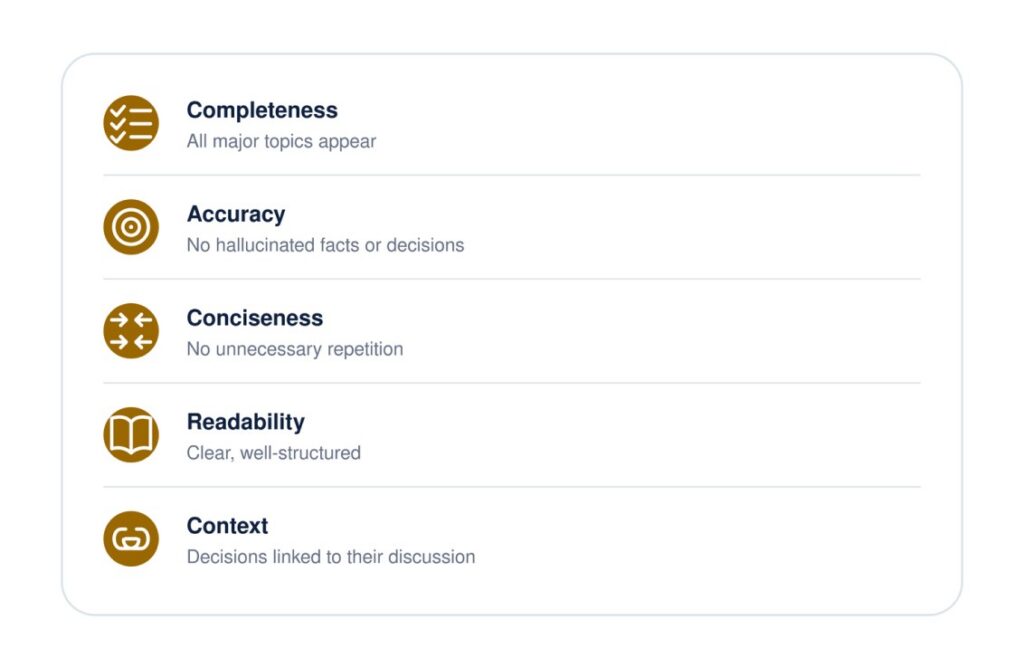
Summary testing is considerably more nuanced than transcription testing because there is rarely a single correct answer.
Rather than comparing summaries word-for-word, QA engineers should evaluate several quality dimensions.
Completeness measures whether all major discussion topics appear in the summary.
Accuracy determines whether the generated content faithfully represents the conversation without hallucinating facts or inventing decisions.
Conciseness evaluates whether unnecessary repetition has been removed while preserving essential information.
Readability ensures the summary is well structured, grammatically correct, and easy to consume.
Context preservation verifies that important business decisions remain connected to their supporting discussion instead of appearing as isolated statements.
Human evaluation remains one of the most effective approaches for measuring summary quality. Multiple reviewers can score outputs using standardized rubrics, reducing subjectivity while producing actionable quality metrics.
Automated evaluation metrics such as ROUGE, BLEU, and BERTScore can provide additional insight, but they should complement—not replace—human review.
Validating Action Item Extraction
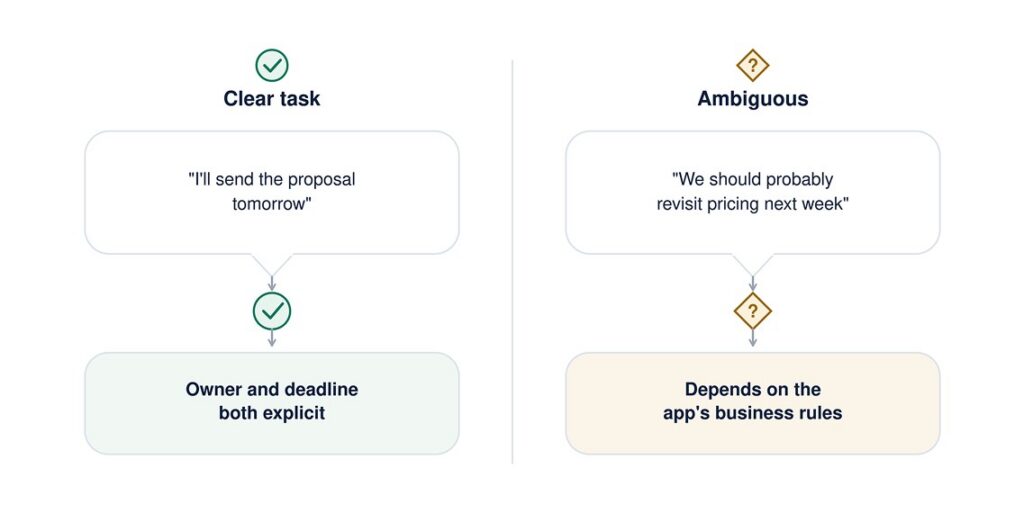
Many organizations adopt AI meeting assistants primarily because they automatically identify action items.
This feature requires extensive testing because action items are often implied rather than explicitly stated.
For example, “I’ll send the proposal tomorrow” clearly represents a task. Meanwhile, “We should probably revisit pricing next week” may or may not qualify depending on business rules.
QA engineers should verify whether the application correctly identifies task owners, deadlines, priorities, dependencies, and incomplete assignments.
Testing should include scenarios where responsibilities change during conversations, multiple people share ownership, or deadlines are discussed several times before reaching consensus.
False positives deserve as much attention as missed tasks. Creating unnecessary action items can damage user trust just as much as failing to identify legitimate ones.
Speaker Recognition and Attribution
Modern meeting assistants frequently identify individual speakers throughout a conversation.
Speaker attribution affects transcript readability, summary accuracy, and action item assignment.
Testing should evaluate how reliably the system distinguishes speakers with similar voices, changing audio quality, interruptions, and overlapping conversations.
Long meetings introduce additional challenges because speaker characteristics may drift over time due to microphone movement or environmental changes.
QA should also validate how the application handles unidentified participants, renamed users, guest attendees, and participants joining midway through meetings.
Accurate attribution becomes especially important when organizations integrate meeting notes with CRM platforms, project management systems, or compliance workflows.
Testing Integrations Across the Ecosystem
AI meeting applications rarely operate in isolation.
They commonly integrate with calendar platforms, video conferencing software, messaging tools, document repositories, CRM systems, project management applications, and knowledge bases.
Integration testing should validate authentication flows, permission handling, synchronization timing, duplicate prevention, API rate limits, retry mechanisms, and failure recovery.
Calendar synchronization should correctly identify meeting updates, cancellations, recurring events, and participant modifications.
CRM integrations should map meeting outcomes to the appropriate contacts without creating duplicate records.
Slack or Microsoft Teams notifications should deliver summaries consistently while respecting organizational permissions.
Robust integration testing ensures users experience a seamless workflow rather than disconnected automation.
Performance, Scalability, and Reliability Testing
AI inference often introduces higher computational costs than traditional software operations.
Meeting assistants must process recordings efficiently while maintaining acceptable response times.
Performance testing should evaluate processing speed across different meeting durations, concurrent uploads, and varying infrastructure loads.
Load testing helps determine how the application behaves when hundreds or thousands of meetings are processed simultaneously.
Stress testing identifies system behavior beyond expected capacity and verifies graceful degradation rather than catastrophic failure.
Long-duration meetings also deserve focused testing. Recordings lasting several hours often expose memory limitations, timeout issues, and processing bottlenecks that shorter meetings never reveal.
Reliability testing should include interrupted uploads, temporary cloud service failures, expired authentication tokens, and partial processing failures to ensure the application recovers gracefully.
Security, Privacy, and Compliance Testing
Meeting recordings often contain highly sensitive business information.
Testing must extend beyond application security to include AI data handling practices.
QA teams should verify encryption during transmission and storage, secure authentication, access control policies, audit logging, retention settings, and secure deletion workflows.
Organizations operating in regulated industries may also require validation against GDPR, HIPAA, SOC 2, ISO 27001, or regional privacy regulations depending on their operating environment.
Prompt injection, unauthorized data exposure, cross-tenant information leakage, and unintended model memorization should all be evaluated as part of AI security testing.
Privacy testing should confirm that users can manage recording consent, delete meeting histories, and export their data where applicable.
Continuous Testing for Continuously Evolving AI
Unlike traditional software, AI models evolve frequently.
New model releases, prompt modifications, fine-tuning updates, and infrastructure changes can significantly impact output quality even when application code remains unchanged.
This makes continuous testing essential.
Regression suites should include benchmark conversations that are evaluated after every model update.
Output quality trends should be monitored over time rather than relying solely on one-time acceptance testing.
Production monitoring should also track user feedback, transcription accuracy, processing latency, hallucination frequency, and summary quality to identify gradual performance degradation before customers notice.
AI quality assurance becomes an ongoing process rather than a final testing phase before deployment.
Final Thoughts
AI meeting notes applications combine speech recognition, natural language processing, cloud infrastructure, integrations, and user experience into a single product. Each component introduces unique quality risks, making comprehensive testing essential for delivering a trustworthy solution.
Organizations that rely solely on traditional functional testing often overlook the unpredictable nature of AI-generated outputs. A modern QA framework must evaluate accuracy, consistency, performance, security, scalability, and real-world usability through a combination of automated validation, benchmark datasets, and human evaluation.
At Testiva, we believe successful AI applications are built on confidence as much as innovation. Thorough quality assurance enables development teams to release AI-powered meeting assistants that users can trust to capture conversations accurately, generate meaningful insights, and perform reliably under real-world conditions. As AI continues transforming workplace productivity, rigorous testing will remain one of the most important investments any software team can make.
Whether you’re developing a next-generation meeting assistant or enhancing an existing AI-powered collaboration platform, a structured QA framework is the foundation for delivering intelligent software that consistently meets user expectations. Unlock flawless delivery with a testing strategy designed for both software quality and AI reliability, and start your QA journey with confidence.