




Latest Insights
How to Test AI Note Taking Applications for Healthcare Providers
- Sep 04, 2026
- Sajid M.
- AI Note Taking Testing

Artificial intelligence is rapidly transforming healthcare, and one of its most practical applications is AI-powered medical note taking. From ambient clinical documentation to automated transcription and structured electronic health record (EHR) generation, these tools promise to reduce physician burnout, improve documentation quality, and allow healthcare professionals to spend more time with patients instead of keyboards.
However, healthcare is an industry where “mostly correct” simply isn’t good enough. A missing allergy, an incorrect medication dosage, or an inaccurate diagnosis summary can have serious consequences. That’s why testing AI note taking applications requires a far more rigorous approach than testing conventional business software.
At Testiva, we’ve seen firsthand that successful AI products require a different quality assurance mindset. Traditional software testing remains essential, but AI introduces an entirely new layer of uncertainty that demands specialized QA strategies. Thorough functional, usability, and AI validation testing ensures healthcare providers can trust these systems in real clinical environments while maintaining patient safety and regulatory compliance.
Why AI Note Taking Is Different from Traditional Software
Traditional applications operate using deterministic logic. Given the same inputs, they produce the same outputs every time. Testing them focuses on validating workflows, verifying business logic, identifying bugs, and ensuring consistent functionality.
AI note taking applications don’t work that way.
Large Language Models (LLMs), speech recognition engines, and natural language processing models generate probabilistic outputs. Two nearly identical patient conversations may produce slightly different documentation. Background noise, speaker accents, medical terminology, interruptions, and conversational context all influence the final notes.
This creates unique testing challenges.
Instead of asking whether the application works, QA teams must ask whether it consistently produces clinically accurate, complete, and trustworthy documentation under thousands of real-world conditions.
The focus shifts from verifying exact outputs to evaluating output quality, reliability, safety, and consistency.
Understanding the Real Workflow Before Testing
One of the biggest mistakes QA teams make is testing AI note taking software as though it’s simply another transcription application.
In reality, these platforms support an entire clinical workflow.
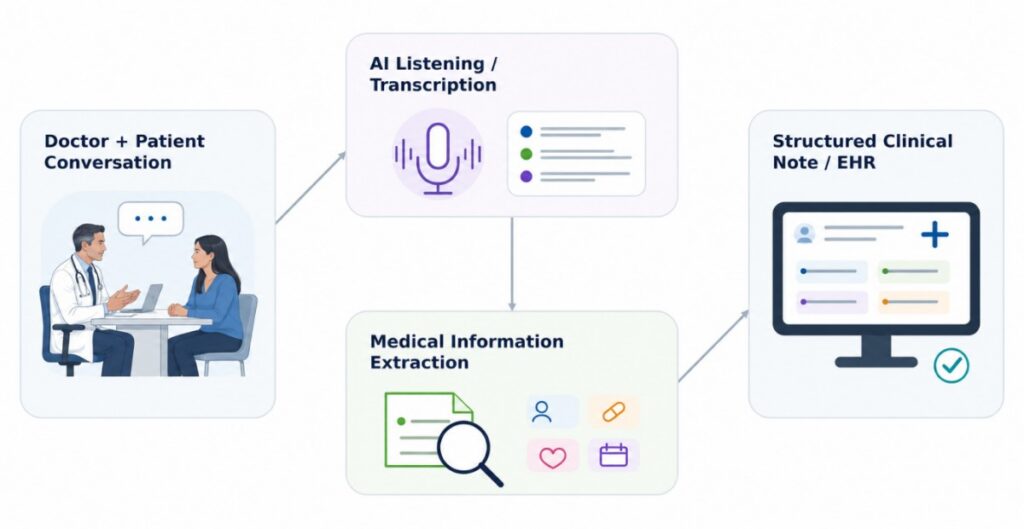
A physician begins a consultation, discusses symptoms, medical history, medications, and treatment plans with the patient. The AI listens continuously, identifies relevant medical information, filters casual conversation, organizes findings into standardized sections, and often generates structured EHR documentation.
Testing should therefore mirror actual clinical workflows instead of isolated software features.
Real patient appointments rarely follow perfect scripts. Patients change topics, interrupt themselves, forget details, speak emotionally, or involve family members in discussions. Physicians frequently use abbreviations, incomplete sentences, and shorthand medical terminology.
If testing only uses clean, scripted conversations, the AI will appear far more reliable than it actually is.
Realistic simulation is essential.
Functional Testing Still Matters
Despite the excitement around AI, traditional QA remains the foundation.
The application must reliably perform every non-AI function before evaluating the intelligence behind it.
Authentication, appointment management, clinician profiles, permissions, session recording, note storage, search functionality, synchronization with EHR systems, export capabilities, and user settings all require comprehensive functional testing.
Integration testing becomes especially important because AI note taking platforms often connect with multiple healthcare systems simultaneously.
A perfectly generated clinical note has little value if it fails to synchronize with the patient’s electronic record or becomes corrupted during export.
Regression testing is equally important as AI vendors frequently update models and backend services. Every release should verify that core workflows remain stable even as AI capabilities evolve.
Validating Clinical Accuracy
Clinical accuracy is where AI testing becomes significantly more specialized.
The goal isn’t simply verifying that speech becomes text.
The generated documentation must accurately capture medically significant information while preserving clinical intent.
For example, consider a physician stating:
“The patient denies chest pain but reports occasional shortness of breath during exercise.”
An inaccurate AI system might summarize this as:
“The patient reports chest pain and shortness of breath.”
That single omission fundamentally changes the patient’s medical record.
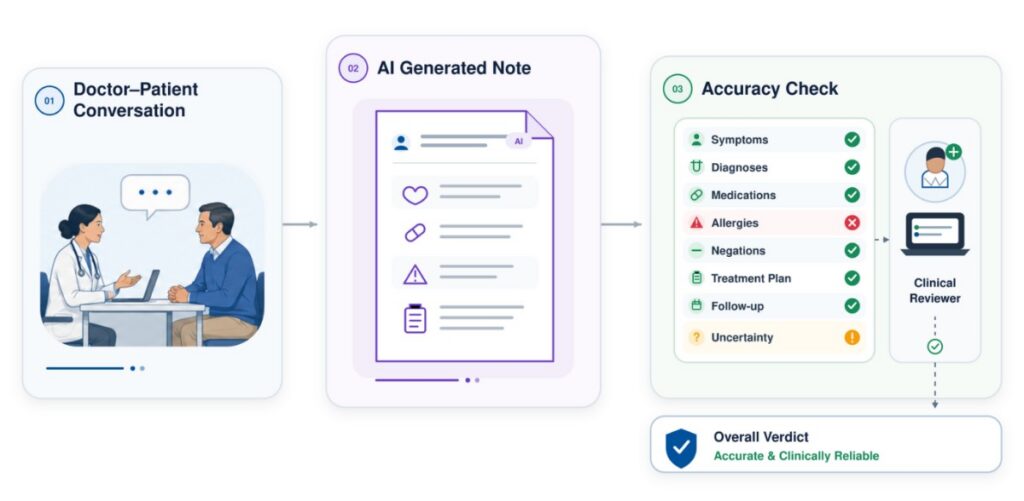
Testing should therefore evaluate whether the AI correctly identifies:
- Symptoms
- Diagnoses
- Medications
- Allergies
- Family history
- Treatment plans
- Follow-up recommendations
- Negations
- Clinical uncertainty
Medical negation deserves particular attention because words like “denies,” “no evidence of,” and “unlikely” dramatically alter clinical meaning.
Specialized medical reviewers should participate in validation whenever possible to assess documentation quality beyond simple transcription accuracy.
Testing Medical Terminology Across Specialties
Healthcare providers rarely use generic vocabulary.
Each specialty introduces highly specialized terminology that challenges both speech recognition and language models.
Cardiologists discuss arrhythmias, echocardiograms, and myocardial infarctions.
Dermatologists reference melanocytic lesions and seborrheic keratoses.
Orthopedic surgeons describe complex fractures, ligament injuries, and surgical hardware.
Pediatricians use developmental milestones and age-specific terminology.
Testing datasets should include conversations from multiple specialties rather than relying solely on general family medicine appointments.
Abbreviations present another significant challenge.
Medical professionals frequently say:
- CABG
- COPD
- DVT
- CHF
- MRI
- CBC
The AI must correctly understand abbreviations based on clinical context rather than expanding them incorrectly.
Evaluating Speech Recognition Under Real Conditions
Healthcare environments are noisy.
Testing should never assume perfect recording conditions.
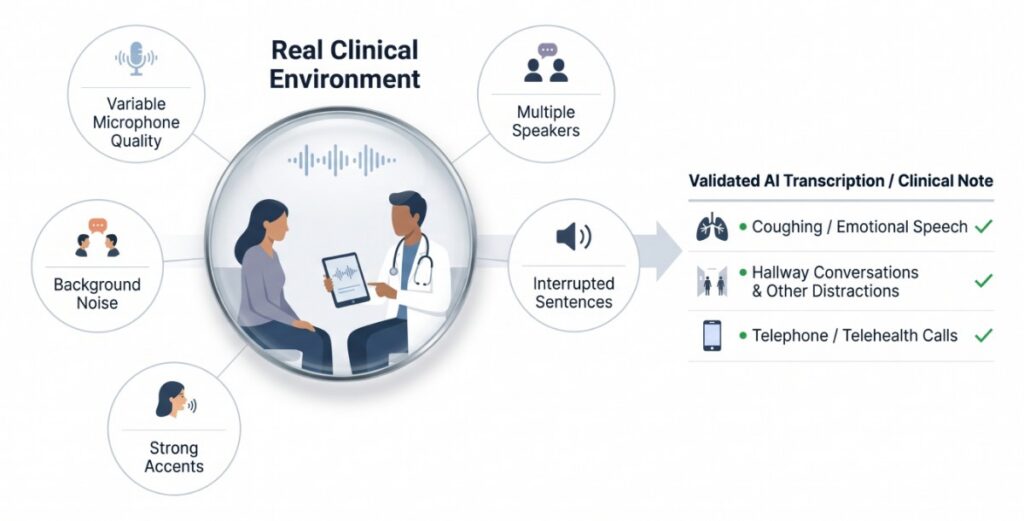
Clinics contain ringing phones, hallway conversations, typing, medical equipment, and multiple people speaking simultaneously.
Doctors often wear masks, speak quickly, or dictate while walking between examination rooms.
Patients may speak quietly, mumble, cry, cough, or have speech impairments.
Comprehensive testing should intentionally introduce realistic environmental conditions.
QA teams should evaluate conversations involving:
- Strong regional accents
- Multiple speakers
- Background conversations
- Interrupted sentences
- Simultaneous speech
- Variable microphone quality
- Telephone consultations
- Telehealth appointments
The objective is determining whether documentation quality remains clinically reliable even when audio quality deteriorates.
Measuring AI Hallucinations
Perhaps the most unique challenge in AI software testing is identifying hallucinations.
Unlike traditional bugs, hallucinations occur when the AI confidently generates information that never existed in the original conversation.
Imagine a physician discussing hypertension and diabetes.
The AI unexpectedly inserts:
“The patient reports a penicillin allergy.”
No allergy was ever mentioned.
In healthcare, fabricated information is unacceptable.
Testing should specifically compare every generated statement against the original conversation.
Reviewers should classify outputs into several categories:
- Accurate information.
- Missing information.
- Misinterpreted information.
- Fabricated information.
Hallucinated content should receive particularly high severity because clinicians may overlook subtle inaccuracies during busy workdays.
Privacy and Security Testing Cannot Be an Afterthought
Healthcare applications process some of the world’s most sensitive personal information.
Testing must extend well beyond authentication screens.
QA should validate encryption during transmission and storage, secure authentication mechanisms, session timeout behavior, role-based access controls, audit logging, and proper handling of patient identifiers.
If the platform integrates with third-party AI providers, testers should verify how patient data is transmitted, anonymized, retained, and deleted.
Compliance testing should also consider applicable regulations such as HIPAA in the United States, GDPR within Europe, and any regional healthcare privacy frameworks relevant to the application’s target market.
Security testing should include penetration testing, vulnerability assessments, API security validation, and authorization testing to ensure patient records remain protected throughout every workflow.
Performance Testing at Clinical Scale
A single physician using AI documentation presents minimal infrastructure demands.
An entire hospital presents a completely different scenario.
Performance testing should simulate hundreds or thousands of concurrent consultations while monitoring transcription latency, AI response times, synchronization delays, database performance, and infrastructure scalability.
Healthcare professionals expect documentation almost immediately after patient visits.
Waiting several minutes for AI-generated notes can disrupt clinical workflows and reduce adoption.
Load testing should also evaluate peak usage periods such as morning clinics when many physicians begin appointments simultaneously.
Human-Centered Usability Testing
Even highly accurate AI systems fail if clinicians don’t trust them.
Usability testing should focus on how healthcare professionals interact with generated documentation.
Can physicians quickly identify AI-generated content?
Are edits intuitive?
Can clinicians easily compare original transcripts with summarized notes?
Does the interface clearly indicate uncertain interpretations?
Medical professionals work under significant time pressure.
Interfaces should minimize cognitive load rather than introducing additional complexity.
Observing clinicians during realistic patient documentation sessions often reveals workflow friction that traditional usability testing overlooks.
Continuous Testing Is Essential for AI Systems
Unlike traditional applications, AI products constantly evolve.
Model updates, prompt changes, speech recognition improvements, and third-party AI service modifications can subtly alter outputs without changing the surrounding application.
This makes continuous testing indispensable.
Automated regression suites should verify application functionality, while curated clinical conversation datasets should continuously evaluate documentation quality across new AI releases.
Establishing benchmark conversations enables QA teams to detect declining accuracy before production deployments affect healthcare providers.
Monitoring should continue after release as well, with anonymized quality metrics helping identify emerging issues in real-world usage while respecting patient privacy.
Building Trust Through Comprehensive AI Testing
Healthcare providers place enormous trust in their clinical documentation systems. Every diagnosis, prescription, referral, and treatment decision depends on accurate patient records.
Testing AI note taking applications therefore requires much more than checking whether the software functions correctly. It demands careful validation of clinical accuracy, resilience under real-world conditions, security, compliance, performance, usability, and the unique behaviors of AI models themselves.
For organizations developing healthcare AI solutions, quality assurance becomes a critical component of patient safety rather than simply a development milestone. Combining traditional software testing with specialized AI validation creates applications clinicians can confidently rely on during every patient interaction.
As AI continues reshaping healthcare documentation, the organizations that invest in rigorous, continuous QA won’t just deliver better software—they’ll help healthcare providers deliver better patient care. At Testiva, we believe that’s the standard every healthcare AI application should strive to meet, because when software supports clinical decisions, quality is never optional—it’s foundational.