




Latest Insights
Testing AI Meeting Assistants for Sales Teams
- Aug 28, 2026
- Sajid M.
- Testing AI Meeting Assistants

Sales teams have always relied on conversations to build trust, qualify prospects, overcome objections, and close deals. What has changed dramatically over the past few years is how those conversations are captured, analyzed, and transformed into actionable insights. AI meeting assistants have become an essential part of modern sales technology stacks, automatically recording meetings, generating summaries, identifying action items, analyzing customer sentiment, and even coaching sales representatives on how to improve future conversations.
While these capabilities promise significant productivity gains, they also introduce a new category of software quality challenges. A meeting assistant that misses critical action items, incorrectly attributes speakers, or generates misleading summaries can create confusion instead of efficiency. From our perspective at Testiva, this is where comprehensive AI application testing becomes essential. AI-powered software shouldn’t simply function—it must consistently deliver trustworthy, accurate, and reliable outcomes that sales teams can confidently depend on.
Testing AI meeting assistants requires a different mindset than testing traditional business applications. Instead of verifying only deterministic outputs, QA teams must evaluate probabilistic behavior, natural language processing, contextual understanding, performance under real-world conditions, and the overall user experience. The goal isn’t merely to ensure the software works—it’s to ensure it works well enough that sales professionals trust it with their most valuable customer interactions.
Why AI Meeting Assistants Have Become Essential for Modern Sales Teams
Sales professionals spend countless hours in discovery calls, product demonstrations, negotiation meetings, and follow-up conversations. Historically, capturing detailed notes during these discussions meant dividing attention between listening to customers and documenting important information. AI meeting assistants eliminate much of this manual effort by automatically transcribing conversations and generating structured summaries.
The benefits extend well beyond note-taking. Modern AI assistants identify customer pain points, highlight objections, extract commitments, recommend follow-up actions, and even measure how much each participant spoke during the meeting. Sales managers use these insights for coaching, while revenue leaders analyze conversation trends across hundreds or thousands of meetings.
Because these tools influence business decisions, their outputs directly affect customer relationships and revenue generation. An inaccurate summary can cause a salesperson to misunderstand a customer’s requirements. Missing an agreed deadline could delay a proposal. Incorrectly identifying buying signals might result in lost opportunities.
This growing dependence means software quality becomes a business-critical concern rather than a technical afterthought.
Why Traditional Software Testing Isn't Enough
Conventional software testing focuses on deterministic behavior. If a user clicks a button, a specific action should occur. If data is entered correctly, expected results should appear consistently every time.
AI systems operate differently.
Machine learning models generate predictions rather than guaranteed outputs. Speech recognition accuracy varies depending on accents, audio quality, industry terminology, speaking speed, and background noise. Large language models summarize conversations based on probability rather than fixed programming logic.
This creates an entirely different testing landscape.
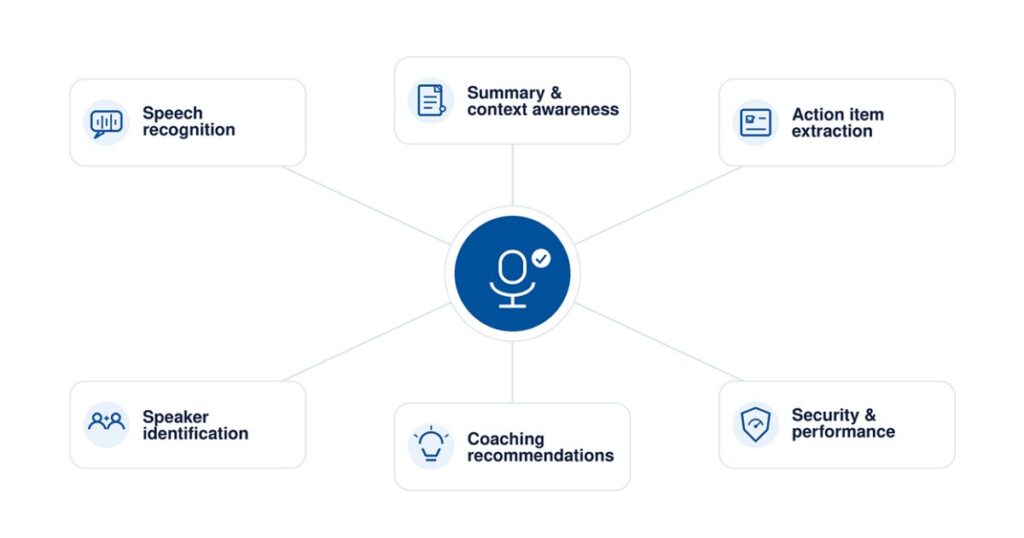
Instead of asking whether the software produces the correct output every time, QA engineers evaluate questions such as:
- Does the AI consistently produce accurate summaries?
- Does transcription quality remain acceptable across different speakers?
- How does the assistant perform during overlapping conversations?
- Are action items extracted correctly?
- Does sentiment analysis remain unbiased across different communication styles?
- Can users trust the generated insights enough to act on them?
These are far more nuanced questions than traditional functional testing addresses.
Evaluating Speech Recognition Accuracy
The foundation of every AI meeting assistant is accurate speech recognition. Every downstream feature—including summaries, coaching recommendations, sentiment analysis, and action items—depends on high-quality transcription.
Testing transcription quality involves far more than verifying whether spoken words appear correctly on screen.
Real sales meetings include interruptions, multiple participants, varying microphone quality, poor internet connections, regional accents, technical terminology, acronyms, and company-specific product names. Customers may switch topics rapidly or speak over one another during active discussions.
QA teams should create realistic testing scenarios representing diverse speaking conditions. This includes testing native and non-native English speakers, different speaking speeds, noisy environments, virtual meetings with unstable audio, and hybrid conference room setups.
Industry-specific vocabulary deserves special attention. Sales conversations frequently include technical product names, competitor references, pricing models, integrations, abbreviations, and customer-specific terminology. AI models that misunderstand these words can significantly alter the meaning of a conversation.
Rather than measuring only word accuracy, testers should evaluate whether transcription errors meaningfully impact business understanding.
Testing Summary Generation and Context Awareness
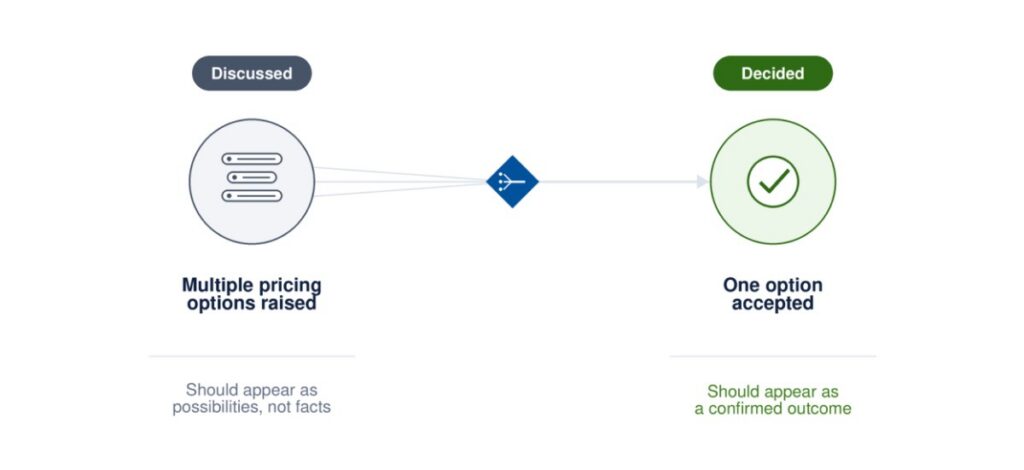
Generating concise meeting summaries is one of the most valuable features of AI meeting assistants. However, summary quality depends heavily on contextual understanding rather than simple text compression.
A high-quality summary should distinguish between casual discussion and confirmed decisions. It should recognize customer concerns, identify business priorities, capture commitments, and ignore irrelevant small talk.
Testing this capability requires carefully designed evaluation datasets representing real sales conversations.
For example, during a discovery call, a customer may mention several challenges before identifying the primary business problem. The AI should prioritize the core issue rather than treating every comment equally.
Similarly, if multiple pricing options are discussed but only one is accepted, the summary should clearly distinguish between possibilities and final decisions.
QA engineers should also verify that summaries remain consistent across repeated processing. Excessive variation between identical inputs may reduce user confidence in the system.
Verifying Action Item Extraction
Sales success depends heavily on effective follow-up.
Meeting assistants automatically generate action items such as sending proposals, scheduling demonstrations, providing documentation, or introducing additional stakeholders. While this automation saves considerable time, inaccurate action extraction creates operational risks.
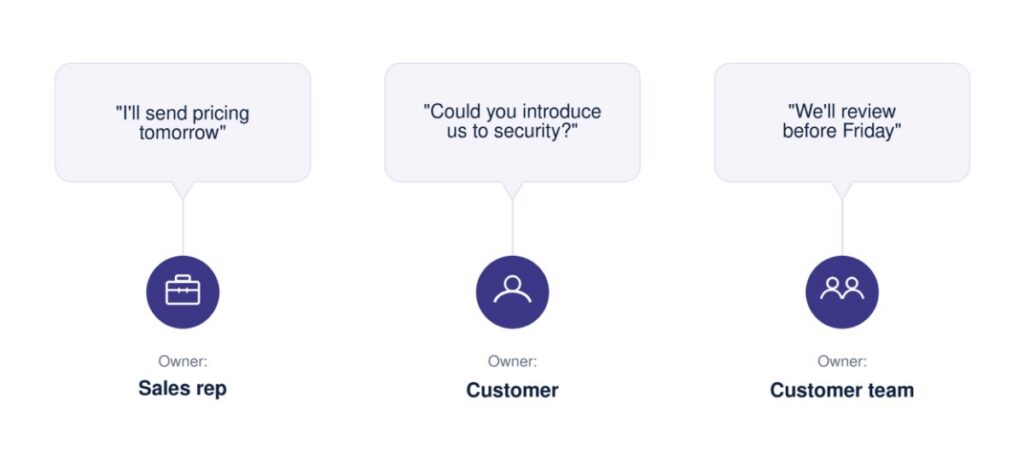
Testing should examine whether the AI correctly identifies responsibilities, deadlines, and ownership.
Consider statements such as:
“I’ll send pricing tomorrow.”
“Could you introduce us to your security team next week?”
“We’ll review the proposal internally before Friday.”
Each statement assigns responsibility differently. A reliable AI assistant should correctly determine who owns each action and avoid confusing customer commitments with salesperson tasks.
Edge cases become especially important when conversations contain hypothetical discussions, changing plans, or incomplete commitments.
Assessing Speaker Identification
Many AI meeting assistants automatically identify speakers throughout conversations. This capability appears straightforward but becomes surprisingly complex during actual meetings.
Participants interrupt one another. Audio overlaps. New attendees join unexpectedly. Speakers change devices during meetings. Similar voices may confuse speaker recognition algorithms.
Testing speaker attribution requires diverse participant combinations and realistic meeting dynamics.
Incorrect speaker labeling can dramatically change meeting interpretation. If customer objections are mistakenly attributed to the salesperson, coaching recommendations and CRM updates may become misleading.
Accurate speaker identification therefore contributes directly to trustworthy business intelligence.
Measuring AI Coaching Recommendations
Many modern meeting assistants offer sales coaching features that evaluate conversation quality. They may recommend asking more open-ended questions, reducing talking time, discussing pricing earlier, or improving objection handling.
Testing these recommendations involves more than validating software functionality.
QA teams should determine whether coaching advice aligns with established sales methodologies and produces meaningful guidance rather than generic suggestions.
Recommendations should remain consistent, explainable, and supported by observable conversation patterns.
False coaching signals may encourage sales representatives to change successful behaviors unnecessarily, reducing confidence in the platform.
Security, Privacy, and Compliance Cannot Be Overlooked
Sales meetings frequently contain confidential customer information, pricing discussions, competitive strategies, financial forecasts, and personally identifiable information.
Testing AI meeting assistants therefore extends well beyond functional accuracy.
Security testing should verify encryption during recording, secure storage, controlled access permissions, authentication mechanisms, and proper data deletion workflows.
Privacy testing becomes particularly important when organizations operate across multiple jurisdictions with different regulatory requirements. Users should understand when meetings are recorded, how transcripts are stored, who can access them, and how customer information is processed.
Compliance testing also ensures AI systems meet organizational governance requirements without compromising usability.
Performance Testing Under Real Business Conditions
Many AI meeting assistants perform well during small demonstrations but encounter challenges under enterprise workloads.
Organizations may simultaneously process hundreds or thousands of meetings daily. Large enterprises expect summaries to be generated quickly without sacrificing quality.
Performance testing should evaluate transcript generation speed, summary latency, concurrent meeting processing, API responsiveness, and integration performance with CRM platforms.
Load testing also reveals infrastructure bottlenecks that may only emerge during peak business hours.
Equally important is resilience testing. QA engineers should observe system behavior when internet connectivity drops, cloud services experience temporary delays, or third-party integrations become unavailable.
Reliable recovery mechanisms often determine whether users continue trusting the platform.
Human Evaluation Remains Essential
No automated metric fully captures the quality of AI-generated meeting insights.
While transcription accuracy percentages and benchmark scores provide valuable indicators, experienced human reviewers remain essential for evaluating usability and business relevance.
Human evaluators can determine whether summaries genuinely help sales representatives prepare follow-up emails, whether coaching advice feels actionable, and whether generated insights accurately reflect customer intent.
Combining automated testing with structured human evaluation creates a more comprehensive quality assessment framework.
This hybrid approach also helps organizations identify subtle weaknesses that quantitative metrics alone may overlook.
Continuous Testing for Continuously Learning Systems
Unlike traditional software, AI-powered applications evolve continuously. Language models improve, speech recognition engines receive updates, prompts change, and underlying algorithms are refined regularly.
Every update introduces opportunities for both improvement and regression.
Continuous AI testing ensures previously solved issues do not reappear while verifying that new capabilities perform as expected.
Regression testing should include representative meeting datasets covering various industries, accents, meeting lengths, customer personas, and business scenarios.
Organizations should also monitor production behavior by collecting anonymized quality metrics, user feedback, and model performance indicators. Continuous observation enables faster detection of quality degradation before it affects large numbers of users.
Building Trust Through Quality Assurance
The success of an AI meeting assistant isn’t measured solely by the sophistication of its underlying models. Success is measured by whether sales teams trust the information the system provides and confidently use it to strengthen customer relationships.
That trust is earned through rigorous quality assurance. Accurate transcription, reliable summaries, meaningful action items, secure data handling, resilient performance, and consistent user experiences all contribute to software that genuinely improves the sales process rather than adding uncertainty.
As AI becomes increasingly embedded in sales operations, comprehensive QA will continue to play a defining role in ensuring these intelligent systems deliver dependable business value. Organizations that invest in thorough AI testing are better positioned to deploy meeting assistants that enhance productivity, support better decision-making, and enable sales professionals to focus on what they do best: building lasting customer relationships. At Testiva, we believe that thoughtful, real-world QA is what transforms impressive AI capabilities into dependable business tools—helping organizations unlock flawless delivery while maintaining confidence in every customer conversation.