




Latest Insights
Ambient AI Testing Companies: Who Can Validate Your Clinical AI?
- Oct 29, 2026
- Sajid M.
- Ambient AI Testing Companies
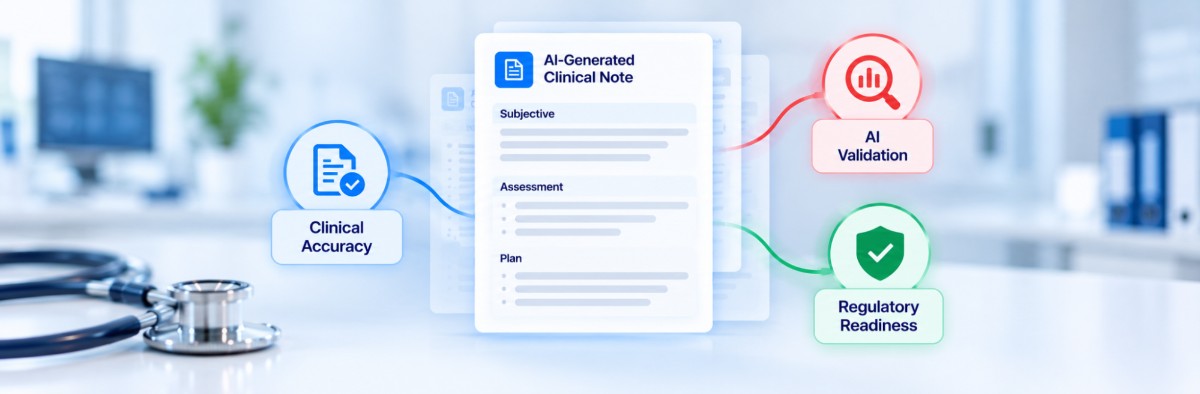
Ambient AI is quietly becoming part of everyday healthcare. Medical scribes can turn conversations into clinical notes, voice agents can manage patient intake, and AI can pull symptoms, medications, diagnoses, and next steps from natural speech. It looks effortless—but behind the scenes, there are plenty of ways things can go wrong.
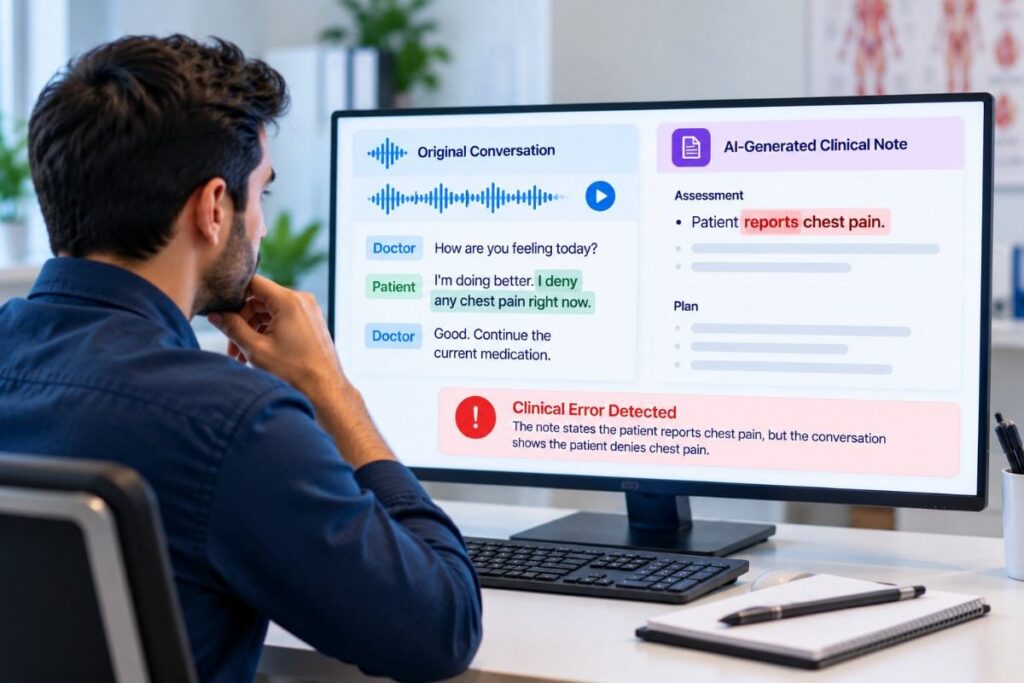
Unlike conventional software, clinical AI can fail without crashing. A note may look polished while missing an allergy, changing a dosage, confusing family history with patient history, or turning “possible pneumonia” into a confirmed diagnosis. At Testiva, our healthcare AI testing services go beyond checking whether the software works. We test whether its clinical outputs can actually be trusted.
And that raises an important question: who should validate your ambient AI? Specialist AI QA companies, medical-device testing organizations, and certification bodies all play a role—but they solve very different parts of the clinical AI quality puzzle.
Why Ambient Clinical AI Needs a Different Validation Model
An ambient clinical system is essentially a chain of probabilistic and deterministic components. Audio capture feeds speech recognition; transcription feeds an LLM or another inference layer; that layer identifies clinical concepts and generates documentation; structured information may then flow into an EHR, billing workflow, or downstream decision-support system.
A defect can enter anywhere in that chain. Poor speaker separation can assign a caregiver’s medication to the patient. Speech recognition can mishear a drug name. An LLM can generate a clinically plausible statement unsupported by the conversation. Mapping logic can place correct information in the wrong field. An integration bug can then write that information into the wrong patient record.
This means “accuracy” cannot be represented by one convenient score. Validation should examine transcription fidelity, clinical fact extraction, omission rates, unsupported statements, speaker attribution, medication accuracy, note structure, EHR integration, latency, privacy, security, bias, and performance across specialties, accents, acoustic conditions, and patient populations.
The World Health Organization has similarly emphasized risk-benefit assessment, performance evaluation, monitoring, and lifecycle thinking in its regulatory considerations for AI in health. Its evidence framework for AI-based medical devices also addresses validation and evaluation from development through post-market surveillance.
What “Validation” Actually Means for Clinical AI
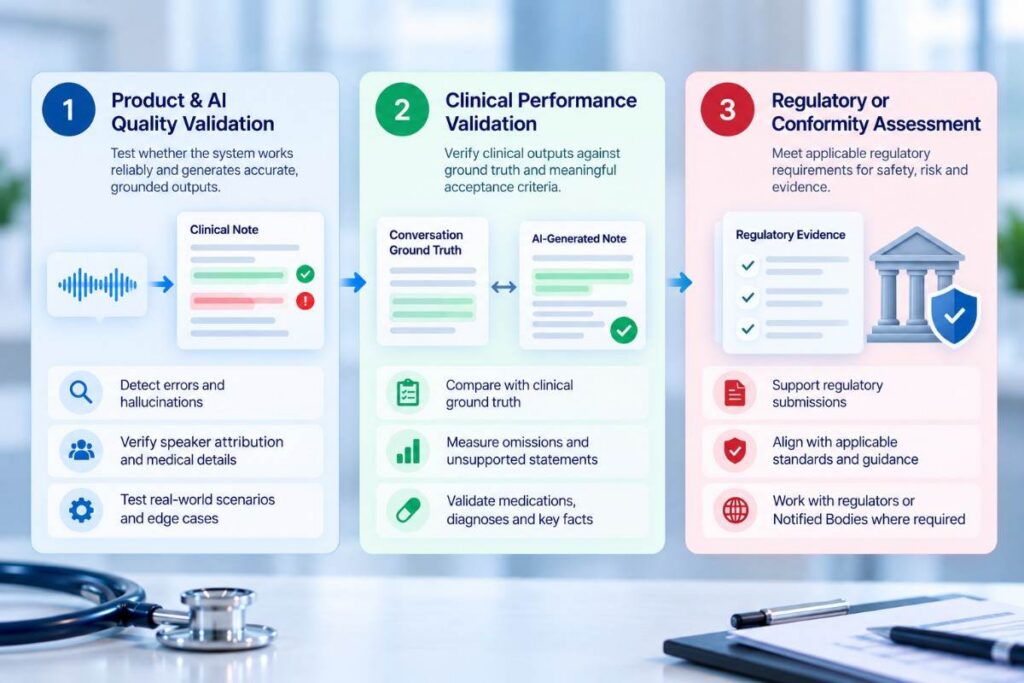
Before comparing companies, healthcare AI teams should define what they mean by validation. There are at least three layers.
The first is product and AI quality validation. Does the system work reliably? Are generated clinical statements grounded in the encounter? What happens with overlapping speech, negation, corrections, unusual terminology, missing context, contradictory information, or adversarial inputs? This is where specialist QA and AI evaluation teams operate.
The second is clinical performance evidence. Here, outputs are compared against suitable ground truth and clinically meaningful acceptance criteria. A system that achieves impressive general NLP metrics can still be unsafe if its errors disproportionately affect medications, allergies, diagnoses, or treatment plans.
The third is regulatory or conformity assessment. Depending on intended purpose and jurisdiction, certain AI products may fall within medical-device regulations and require evidence assessed by regulators or designated conformity-assessment bodies. These activities should not be confused with ordinary outsourced QA.
That distinction matters particularly in 2026. The U.S. FDA maintains specific guidance and resources for AI-enabled medical-device software and emphasizes lifecycle risk management. In Great Britain, the MHRA published specific guidance in July 2026 addressing qualification and classification of ambient voice technology-enabled products that may constitute medical devices.
In other words, the regulatory question is no longer theoretical.
Leading Companies for Ambient and Clinical AI Testing
There is no universally “best” clinical AI testing company because the correct partner depends on the evidence you need. A startup validating an ambient scribe before a hospital pilot has different requirements from a medical-device manufacturer preparing for EU conformity assessment.
Testiva: Specialist QA for Ambient and Healthcare AI
Testiva sits on the specialist QA and independent product-validation side of the market. Our healthcare AI work covers AI medical scribes, clinical voice agents, healthcare RAG applications, clinical decision-support systems, predictive analytics, and automated medical coding.
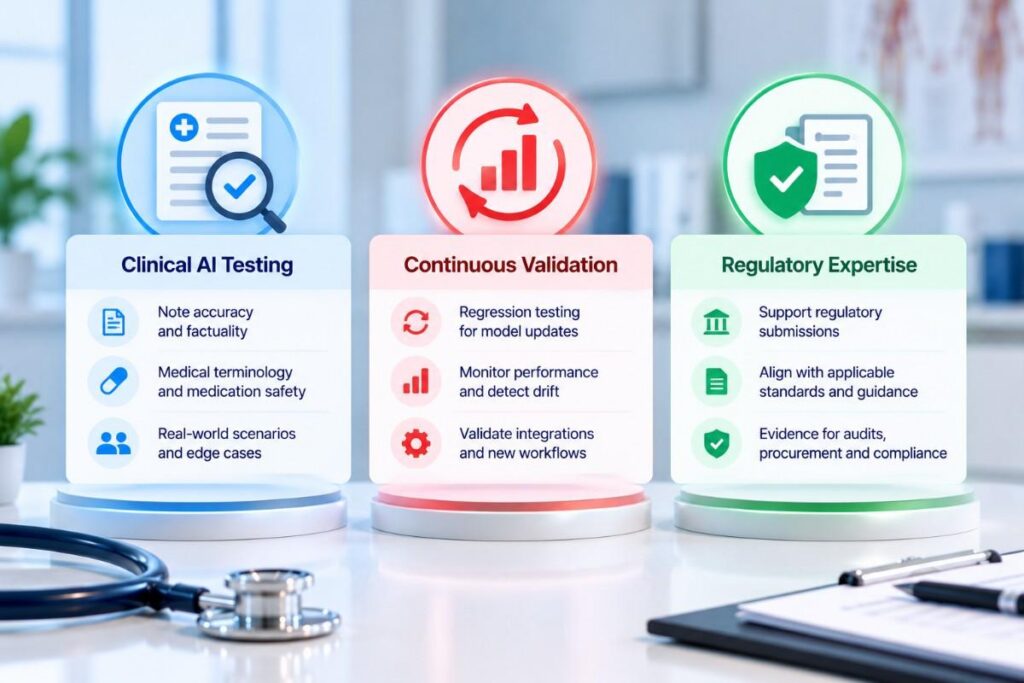
For ambient systems specifically, our testing addresses clinical note accuracy, SOAP structure, hallucinations, medication safety, ambient audio and clinical speech recognition, EHR workflows, PHI handling, regression, and real-world scenario behavior.
This makes Testiva relevant when a team needs engineering-level validation integrated into development rather than only a certification exercise near launch. We can repeatedly challenge new prompts, model versions, integrations, and workflows and turn failures into reproducible defects.
The important boundary is equally clear: specialist QA evidence can support quality, procurement, risk-management, and regulatory-readiness activities, but it does not replace a regulator, Notified Body, or other legally required conformity-assessment organization.
UL Solutions: Independent Testing and AI Assurance
UL Solutions brings a different strength: established third-party testing and assurance infrastructure. Its medical-device portfolio includes regulatory testing, cybersecurity, usability, product testing, certification, and verification services. UL Solutions also offers an AI algorithm reproducibility program focused on whether AI technology can produce predictable and repeatable outcomes.
That makes UL particularly relevant for organizations seeking independent assurance around AI performance and broader medical-device safety requirements. Its offering is less about becoming an embedded sprint-level QA team and more about structured, independent evaluation.
For clinical AI manufacturers operating across markets, that independent-assurance perspective can become valuable as products mature beyond proof-of-concept testing.
BSI: Strong for AI Medical-Device Conformity Assessment
BSI is especially relevant to companies navigating regulated medical AI in Europe and other standards-driven markets. As an MDR and IVDR Notified Body, BSI performs AI-focused reviews within medical-device conformity assessments, examining areas including safety, performance, and risk management.
BSI also offers AI performance assessment and ISO/IEC 42001 certification services. According to BSI, it has completed more than 100 AI system reviews in the medical-device context.
This makes BSI a logical candidate when the problem has progressed beyond “Does our ambient AI behave correctly?” to “Can we demonstrate conformity with the applicable regulatory and governance requirements?”
Again, these are different jobs. Development-stage clinical QA should discover failures before formal assessment. A conformity-assessment body should not become the substitute for the engineering validation that should already have happened.
TÜV SÜD: Medical AI Testing and Regulatory Expertise
TÜV SÜD combines medical-device expertise with dedicated AI assessment capabilities. Its AI medical-device services include technical-documentation review, conformity assessment and CE certification under applicable medical-device regulation, alongside training and regulatory expertise.
Its work is particularly relevant for manufacturers targeting the European market, although TÜV SÜD operates internationally. The company explicitly addresses AI training and verification data, algorithm development, risk management, repeatability, and reliability.
TÜV SÜD also demonstrates how specialized healthcare AI assessment is becoming. In radiology, for example, it offers independent algorithm assessment against ground truth, dataset evaluation, version-controlled model testing, and reporting intended to support assurance and regulatory evidence.
For ambient AI developers, the broader lesson is important: credible validation increasingly requires evidence about both the model and the data used to evaluate it.
Intertek: Software Validation and Medical-Device Assurance
Intertek is another global testing and assurance organization with medical-device software capabilities. Its services cover software validation and testing for embedded software and mobile medical applications, alongside broader medical-device compliance work.
Intertek’s published thinking on trustworthy medical AI also highlights several practices that sophisticated clinical AI teams should recognize: independent validation datasets, cross-institution testing, shadow-mode deployment, controlled clinical pilots, drift monitoring, and trigger-based revalidation.
Those principles map extremely well to ambient AI. A medical scribe that performs beautifully on one specialty, hospital, microphone setup, or patient population has not necessarily demonstrated generalizable clinical performance.
TÜV Rheinland: Medical AI Testing and Conformity Expertise
TÜV Rheinland is also relevant for organizations requiring medical-device assurance and international regulatory support. Its medical AI expertise addresses robustness, trustworthiness, cybersecurity, clinical evaluation, EU AI Act considerations, MDR conformity assessment, and emerging AI testing methodologies.
For global manufacturers, this breadth matters because clinical AI rarely stays inside one regulatory border. A product designed in the United States may be deployed in Europe, Britain, the Middle East, Asia-Pacific, and other markets, each introducing its own regulatory and procurement expectations.
How to Choose the Right Clinical AI Validation Partner
Do not begin by asking which company has the longest list of testing services. Start with the failure modes that could harm your users.
For an ambient medical scribe, ask prospective partners how they detect clinically significant omissions, hallucinated facts, negation errors, speaker-attribution mistakes, medication discrepancies, and temporal errors. Ask how they construct ground truth and whether clinicians or qualified domain experts participate in defining expected outputs. Ask how performance is segmented across specialties, accents, demographics, noisy environments, encounter lengths, and difficult edge cases.
Then investigate lifecycle capability. Ambient AI changes constantly. A new foundation model, transcription provider, system prompt, retrieval configuration, or summarization strategy can improve one metric while silently degrading another. Validation therefore needs reproducible datasets, versioned test cases, severity-based defect classification, regression baselines, and post-deployment monitoring.
Finally, match the provider to the actual job. Specialist QA firms are valuable for continuous product validation and defect discovery. Medical-device testing organizations can supply formal independent evidence. Notified Bodies and other designated organizations have specific conformity-assessment roles. Mature clinical AI companies may need more than one of these partners rather than forcing a single vendor to cover every layer.
The Real Test Is Whether the Evidence Survives Reality
Ambient AI should not be trusted because a demo sounds impressive or because 95% of generated notes look reasonable. Healthcare operates in the remaining 5%: unusual medications, interrupted consultations, contradictory histories, strong accents, pediatric encounters, complex comorbidities, corrections, uncertainty, and information that absolutely must not be invented.
The strongest validation programs therefore test clinical AI as a living system. They connect software functionality with clinical accuracy, human factors, privacy, security, integrations, bias, model regression, and real-world monitoring. That approach also aligns with the direction regulators and international health organizations are taking: evidence and risk management must extend across the AI lifecycle, not stop when a model passes an internal benchmark.
For companies building ambient medical scribes and other clinical AI, the question is no longer whether independent validation is worth doing. The meaningful questions are what evidence you need, who is qualified to produce it, and whether your validation process is rigorous enough to catch a clinically dangerous error that still looks perfectly plausible on screen.
At Testiva, that is the standard we believe clinical AI QA should be built around. Validate the behavior clinicians and patients will actually experience, generate evidence that survives scrutiny, and keep testing as the system evolves.