



Latest Insights
Building Trustworthy AI Note-Taking Systems Through Continuous Evaluation
- Aug 22, 2026
- Sajid M.
- AI Note Taking

Introduction to Continuous Evaluation for AI Note-Taking Systems
A note-taking system that passes every test today isn’t guaranteed to behave the same way tomorrow. A single test pass tells you the system worked under one set of conditions, at one point in time. It doesn’t tell you the system will keep working as the model behind it, the audio it receives, and the fixes applied to it all keep changing.
Unlike traditional software, AI systems are not static. Their behavior can shift as models are updated, prompts change, infrastructure evolves, and new types of real-world inputs appear. Trust in a system like this isn’t something you prove once and file away. It’s something you have to keep re-confirming through effective AI quality assurance practices.
This blog explains why continuous evaluation for AI note-taking systems is essential and shares what we learned while building and applying Testiva’s continuous evaluation framework to a real AI medical scribe.
Why Continuous Evaluation Is Essential for AI Note-Taking Systems
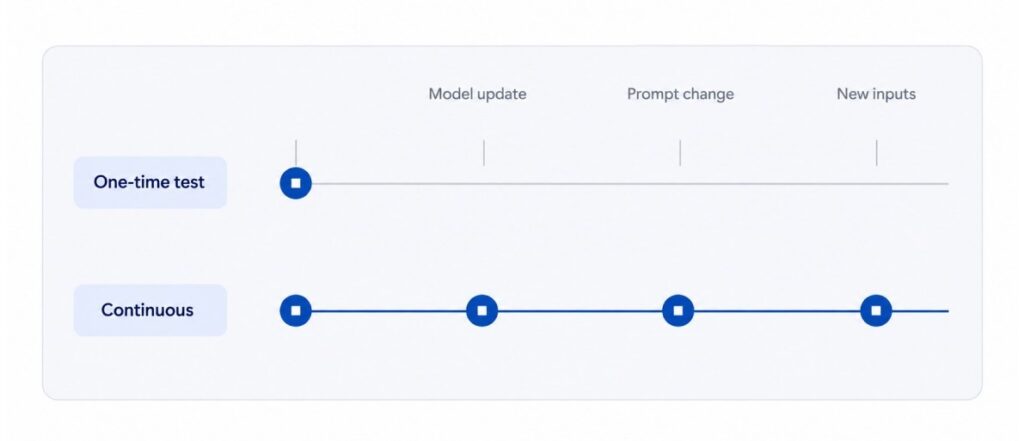
A passing test result is evidence, not a guarantee. It tells you the system behaved correctly under one specific set of conditions. It says nothing about whether the same result will hold next week, after a model update, under different recording conditions, or on a new type of consultation.
Treating a passing result as a permanent fact creates false confidence. A result that was true once gets quietly assumed to still be true months later, with nothing in between to verify that it actually is.
Continuous evaluation exists to close that gap. Instead of assuming yesterday’s performance still holds today, it continually checks whether the system is maintaining the same level of quality over time. This continuous AI performance testing helps identify regressions before they affect users.
How Model Updates Impact AI Note-Taking System Performance
The model behind a note-taking system is rarely static. Vendors retrain, fine-tune, and replace underlying models on their own schedules, often with limited visibility into what changed.
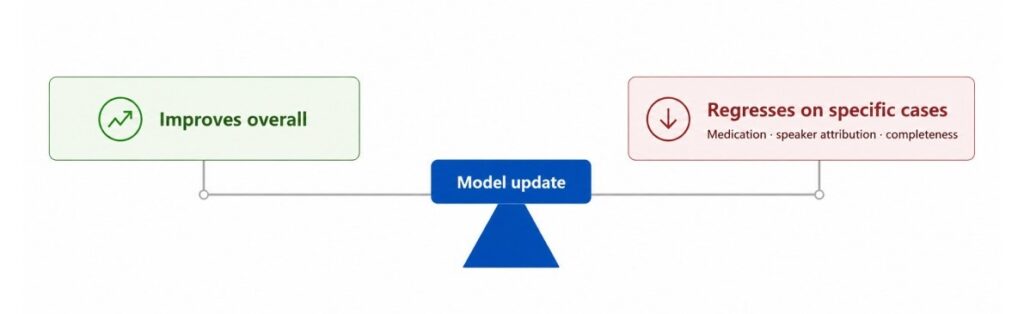
A system that behaved one way last month can behave differently this month without any obvious signal to users. A model update may improve performance overall while introducing regressions in specific scenarios such as medication transcription, speaker attribution, or note completeness.
This risk is especially relevant when the model is third-party or vendor-hosted, since you don’t control the release cycle and may not even know when a change ships. And it isn’t limited to the core model. Any component in the pipeline, including the audio processing layer feeding into it, can change behavior in the same way.
Why AI Note-Taking Systems Must Be Tested with Real-World Conditions
A fixed test set assumes a fixed idea of what “normal” input looks like. Real-world usage doesn’t work that way.
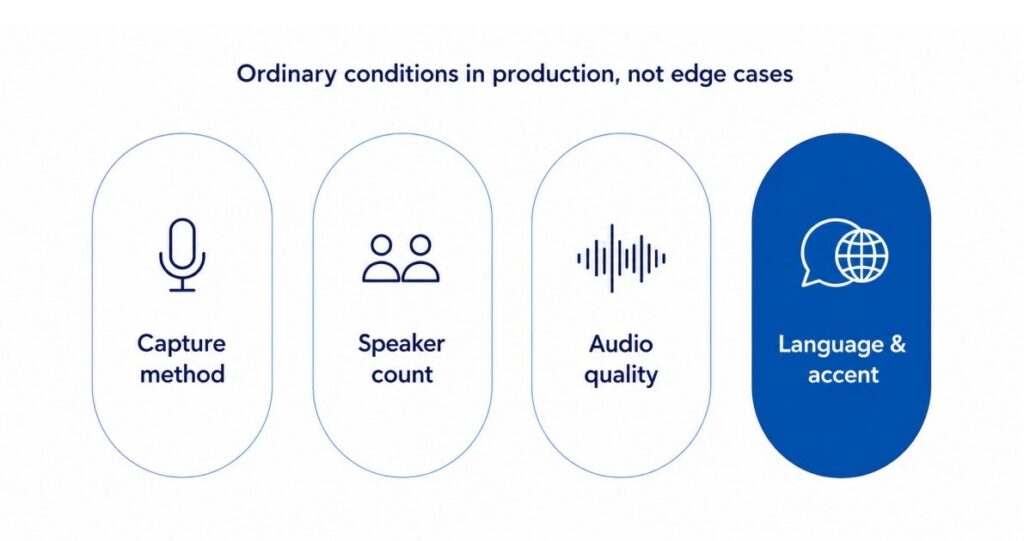
Common variations include:
- Capture method: the same content can transcribe differently depending on how it was recorded
- Speaker count: additional speakers introduce attribution problems a two-person test never surfaces
- Audio quality: background noise, microphone placement, and volume vary from recording to recording
- Language and accent: consultations don’t all happen in the same language, dialect, or speaking style
None of these are edge cases. They are ordinary conditions that occur every day in production environments. A system tested only against a narrow set of examples may perform well in the lab while failing to generalize to real-world usage.
Detecting Silent Failures in AI Note-Taking Systems
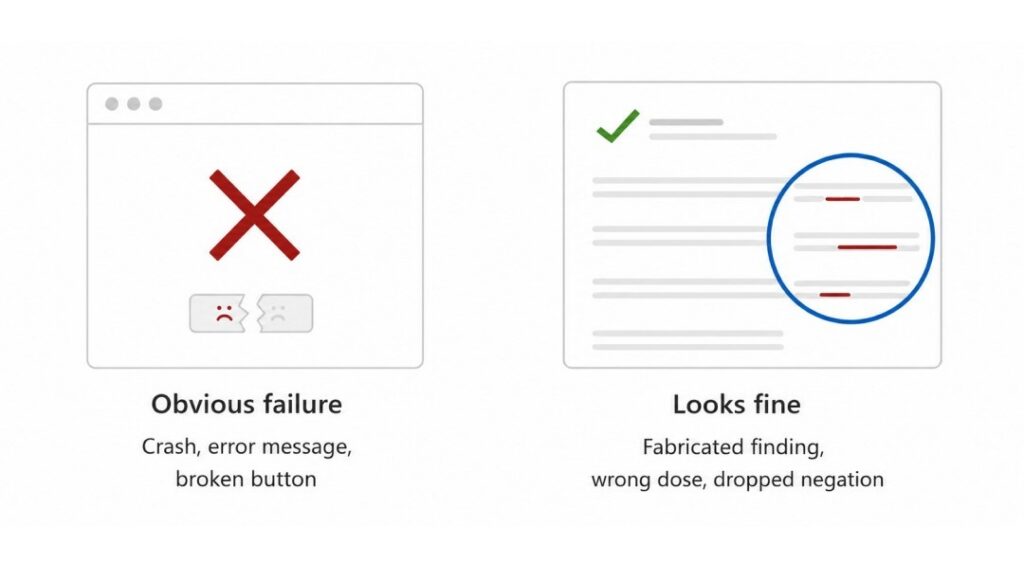
One reason continuous evaluation is especially important for AI systems is that failures are often difficult to spot.Traditional software failures are usually obvious. A page crashes, a button stops working, or an error message appears.AI failures often look correct.
A note may contain a fabricated examination finding, an incorrect medication dosage, or a dropped negation while still reading as fluent, professional clinical documentation. Someone reviewing the note may never realize the information wasn’t actually present in the conversation. Because these failures can appear plausible, they are easy to miss without systematic evaluation. Continuous testing helps detect issues that would otherwise remain hidden until they affect real users.
Using Real-World Failures to Strengthen Continuous AI Evaluation
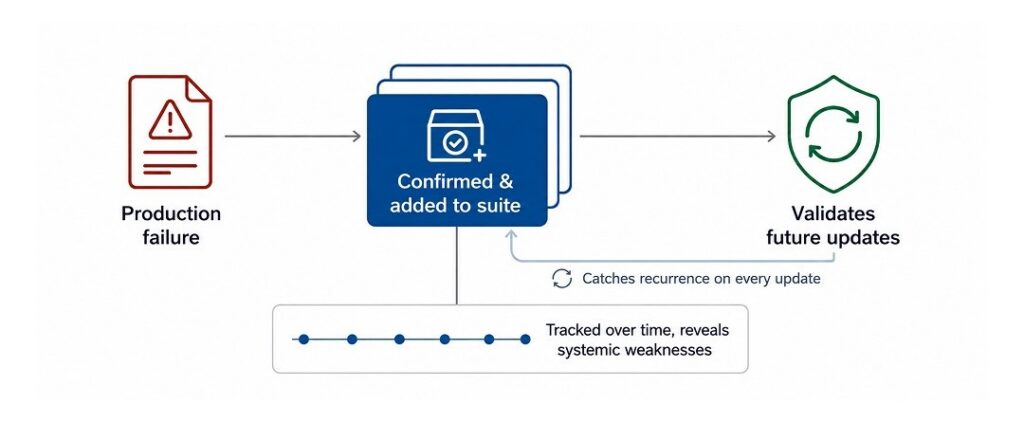
A failure discovered once is only useful long term if it becomes something you continue testing for.The strongest evaluation suites are not static. They evolve alongside the product. Every production issue, recurring defect, and unexpected failure becomes a new test designed to prevent that problem from reappearing unnoticed.
At Testiva, every confirmed defect becomes part of our growing AI regression testing suite. Rather than treating failures as isolated bugs, we convert them into repeatable test cases that continue to validate future model updates.
Patterns that initially look like unrelated one-off incidents often reveal themselves as systemic weaknesses when tracked over time.This process transforms a collection of bug reports into a growing body of evidence about where the system is genuinely vulnerable.
Continuous Evaluation Results from AI Note-Taking System Testing
Applying Testiva’s framework for continuous evaluation for AI note-taking systems uncovered several patterns that would have been difficult to identify through one-time testing alone.
Trust had to be re-earned repeatedly. The same script, run through microphone capture three separate times, produced word error rates of 10.43%, 4.99%, and 1.83%, despite no changes to the underlying content.
Upstream changes affected downstream quality. We couldn’t directly observe changes inside the scribe’s own model, but changing only the capture method was enough to shift transcription accuracy, negation handling, and speaker attribution results.
Real-world variability exposed new issues. Our testing covered upload versus microphone capture, consultations involving more than two speakers, low-volume recordings with silently dropped content, and consultations conducted in non-English languages.
Single fixes rarely solved every variation. Our largest defect category, examination-finding hallucinations, appeared in four distinct forms. Addressing one form provided no assurance that the others were resolved.
Tracking failures revealed recurring patterns. Terminology drift involving regional drug names and abbreviation substitutions initially appeared as isolated incidents. Tracking them across multiple test cases revealed a consistent underlying weakness. We applied the same approach to hallucination defects, grouping thirteen separate occurrences into a single systemic issue.
Conclusion
Continuous evaluation for AI note-taking systems is essential for building trustworthy AI note-taking applications. A strong continuous evaluation framework helps detect regressions, supports ongoing AI performance monitoring, uncovers hidden failures, and ensures AI-generated notes remain accurate and reliable over time.
At Testiva, we apply these best practices through a continuous evaluation framework that combines targeted testing, AI regression testing, scalable evaluation, and real-world validation. This helps teams identify emerging issues early, improve model reliability, strengthen AI quality assurance, and build greater confidence in their AI note-taking applications.
Ready to build a more trustworthy AI note-taking system? Contact Testiva today for a demo of our continuous evaluation framework and learn how structured QA can help detect regressions, improve reliability, and safeguard your AI-generated clinical documentation.