




Latest Insights
The Ultimate Checklist: How to Choose the Right AI Medical Scribe for Your Clinic
- Sep 27, 2026
- Sajid M.
- Right AI Medical Scribe

For many clinicians, the patient visit ends long before the paperwork does. Notes still need to be completed, records updated, and important details documented accurately all while the next patient is waiting.
That workload is exactly what AI-powered documentation tools promise to reduce. But in healthcare, “AI-powered” doesn’t automatically mean accurate, secure, or dependable. At Testiva, our functional, usability, integration, and performance testing work reinforces a simple principle: healthcare technology needs to perform reliably in real clinical conditions, not just during a polished demo.
So, how do you separate a genuinely useful AI medical scribe from one that creates a new set of problems? This checklist covers the factors clinics should evaluate before making the call.
1. Start With Clinical Documentation Accuracy
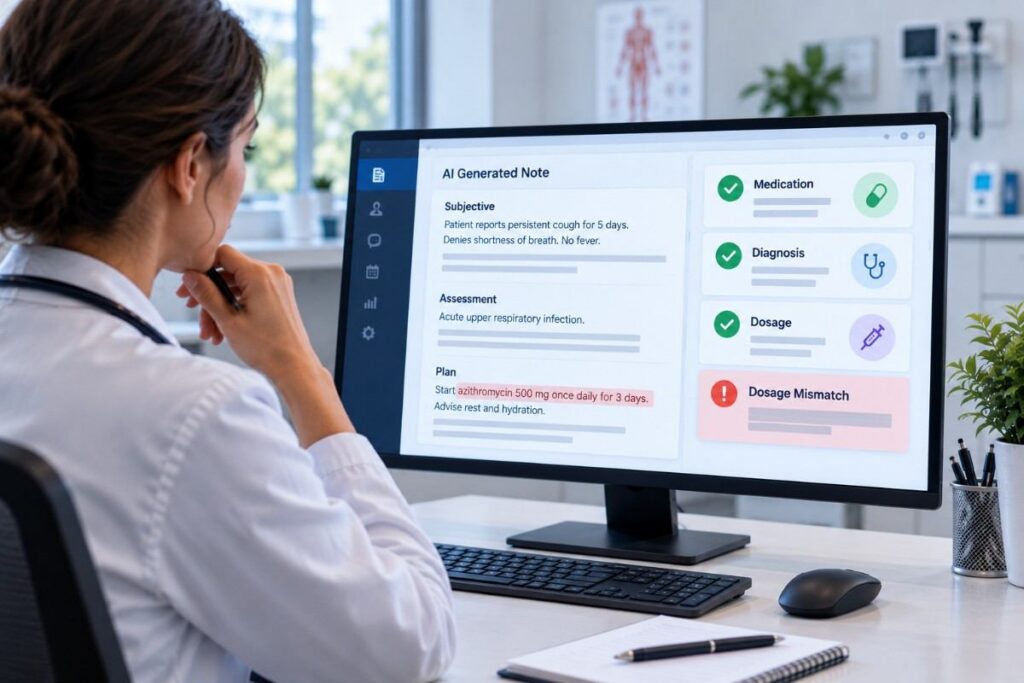
Accuracy should be the first gate, not merely another item on the scorecard. An AI medical scribe needs to understand more than words. It must correctly capture clinically meaningful details and organize them without changing their meaning.
Evaluate the platform using realistic encounters from the specialties it will actually serve. Pay particular attention to medication names, dosages, diagnoses, symptoms, measurements, abbreviations, negations, and specialist terminology. A small transcription error can become much more significant when it changes clinical context.
Also test difficult scenarios. What happens when the physician speaks quickly, the patient has a strong accent, multiple people talk, or the room becomes noisy? A dependable system should remain useful outside ideal demo conditions.
2. Check Whether It Understands Clinical Context
Transcription and clinical documentation are not the same thing. A basic speech-to-text engine can capture a conversation, but an effective AI medical scribe must transform that conversation into useful documentation.
Look closely at whether the system distinguishes patient-reported information from physician observations and recommendations. It should understand statements such as “no history of diabetes” without accidentally recording diabetes as an active condition. Contextual errors like these are exactly where seemingly impressive AI systems can create risk.
Review generated SOAP notes, histories, assessments, plans, and other documentation formats your clinic commonly uses. The output should require reasonable review rather than extensive rewriting.
3. Evaluate EHR Integration Before You Commit
A medical scribe that creates excellent notes but introduces extra copy-and-paste work can defeat much of its own purpose. Integration therefore deserves serious attention early in the evaluation process.
Determine whether the solution integrates with your clinic’s existing EHR or EMR environment and how information moves between systems. Test authentication, patient matching, note transfer, field mapping, synchronization, and failure recovery. Pay special attention to what happens when connections are slow or temporarily unavailable.
Integration testing should cover the complete workflow rather than proving that two APIs can communicate. The important question is whether clinicians can move from patient encounter to completed documentation without unnecessary friction or opportunities for error.
4. Put Security and Privacy Under the Microscope
Medical conversations contain highly sensitive information, so privacy cannot be treated as a checkbox buried near the end of vendor evaluation. Clinics should understand exactly how patient information is captured, transmitted, processed, stored, and deleted.
Review applicable regulatory requirements, including HIPAA where relevant to your organization, as well as contractual and local privacy obligations. Ask vendors about encryption, access controls, authentication, audit trails, data retention, subprocessors, and incident-response procedures.
You should also know whether patient data is used to train or improve AI models and what controls exist around that use. If a vendor cannot clearly explain its data lifecycle, that uncertainty itself deserves attention.

5. Test the Real Clinician Experience
Software can technically “work” and still be painful to use. In healthcare, where clinicians already operate under significant time pressure, usability problems quickly become adoption problems.
Run pilot sessions with the physicians, nurses, and administrative staff who will actually interact with the product. Measure how easily they can start an encounter, review generated notes, make corrections, approve documentation, and recover from mistakes.
Count clicks and interruptions, but also observe cognitive load. If clinicians constantly have to check whether the scribe is listening, fix formatting, or search for misplaced information, the tool may simply replace one administrative burden with another.
6. Measure How Much Time It Actually Saves
“AI-powered” is not a productivity metric. Your evaluation should determine whether the product measurably reduces documentation work in your specific environment.
Establish a baseline for documentation time before deployment, then compare it with pilot results. Consider time spent recording, reviewing, correcting, approving, and transferring notes not simply the speed at which the AI generates its first draft.
A scribe that produces notes in seconds but requires several minutes of corrections may offer less value than a slightly slower system with consistently cleaner output. Measure the complete workflow.
7. Stress-Test Reliability and Performance
Imagine a clinician finishing a full day of appointments only to discover that several encounters were not processed correctly. Reliability problems can rapidly destroy confidence in an otherwise capable product.
Evaluate performance during busy periods, long consultations, unstable network conditions, and concurrent usage across multiple clinicians. Check upload and processing times, application responsiveness, recovery behavior, and whether partially completed work survives interruptions.
This is where systematic QA becomes particularly valuable. Performance and reliability testing can reveal bottlenecks and edge cases that ordinary feature demonstrations rarely expose.
8. Examine How the AI Handles Uncertainty
One of the most important characteristics of a trustworthy AI system is knowing when it may be wrong. A medical scribe should not confidently invent information simply because part of a conversation was unclear.
During evaluation, deliberately introduce ambiguous phrases, interruptions, incomplete sentences, uncommon medication names, and contradictory information. Observe whether the platform flags uncertainty, requests review, or silently generates a confident interpretation.
Human oversight should remain easy and visible. Clinicians need straightforward mechanisms to inspect, edit, and approve AI-generated documentation before it becomes part of the clinical record.
9. Look Beyond the Perfect Demo
Vendor demonstrations are designed to showcase software under favorable conditions. Your clinic operates in the real world, where someone closes a laptop mid-session, Wi-Fi drops, patients change topics unexpectedly, and microphones pick up conversations from the hallway.
Create realistic test scenarios before making a final decision. Include different specialties, accents, age groups, appointment lengths, room environments, devices, browsers, and network conditions. Test interruptions and failure states alongside ordinary workflows.
The geeky rule here is simple: happy-path testing tells you whether software can work. Edge-case testing tells you whether you can depend on it.
10. Review Customization and Specialty Support
Clinical documentation varies dramatically between specialties. The workflow that suits primary care may not fit psychiatry, cardiology, orthopedics, dermatology, or another specialist environment.
Determine whether templates, terminology, note structures, and documentation preferences can be configured without making the system unnecessarily complex. Ideally, customization should help the AI adapt to clinicians rather than forcing clinicians to adapt to the software.
Ask how configuration changes are managed over time. Updates should not unexpectedly break established templates or workflows.
11. Calculate Total Cost, Not Just Subscription Price
Pricing comparisons can become misleading when they focus exclusively on the monthly license. Consider implementation, integration, training, support, customization, usage limits, additional users, and future scaling.
Then compare those costs against measurable benefits such as documentation time saved, reduced after-hours charting, faster note completion, and improved workflow efficiency. The cheapest platform is not necessarily the most economical if staff spend significant time correcting its output.
Scalability matters too. Understand how pricing and performance change when adoption expands from a small pilot group to an entire organization.
12. Investigate Vendor Support and Product Maturity
An AI medical scribe becomes part of an operational workflow, which means vendor quality matters alongside software quality. Find out what happens when something goes wrong during a busy clinic day.
Evaluate support availability, response expectations, onboarding resources, status communication, release processes, and escalation procedures. Ask how frequently models and features are updated and how customers are informed about changes that could affect documentation behavior.
AI products can evolve rapidly. Your vendor should have disciplined processes for validating updates rather than treating every model improvement as automatically safe for production use.
Build a Scorecard Before Making the Final Decision
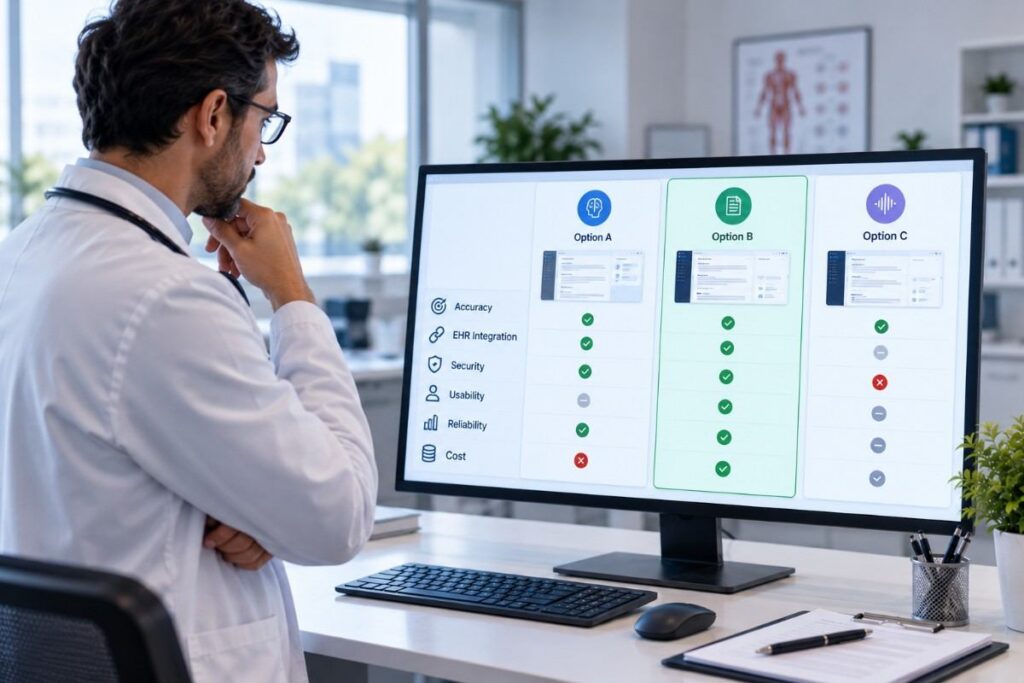
The easiest way to avoid being distracted by impressive demos is to define your evaluation criteria before comparing vendors. Create a weighted scorecard covering clinical accuracy, contextual understanding, EHR integration, privacy and security, usability, reliability, specialty support, vendor support, and total cost.
Give the greatest weight to factors that create genuine clinical or operational risk. Then conduct a controlled pilot using representative users and realistic patient scenarios. Record both quantitative metrics and clinician feedback.
Most importantly, distinguish between “feature available” and “feature proven.” A checkbox on a vendor comparison sheet tells you that functionality exists. Testing tells you whether it performs reliably enough for your clinic.
The Final Checklist: Choose Evidence Over Hype
The best AI medical scribe is not necessarily the platform with the biggest model, flashiest interface, or longest list of AI capabilities. It is the one that reliably supports your clinicians, integrates with existing workflows, protects sensitive information, handles real-world conditions, and consistently produces documentation that professionals can trust.
Before signing off, make sure you have validated accuracy across realistic encounters, tested integrations end to end, reviewed privacy and security practices, measured genuine time savings, challenged the system with edge cases, and gathered feedback from the people who will use it every day.
AI medical scribes can remove meaningful administrative friction from healthcare, but healthcare software earns trust through evidence. Treat vendor selection as a quality exercise rather than a feature-shopping exercise, and you will be far better positioned to choose technology that performs when it matters.
At Testiva, we approach healthcare and AI software with that same principle: test the workflows users depend on, challenge assumptions, and uncover problems before they reach production. If your team is building or validating an AI-enabled healthcare product, get in touch with our experts and start your QA journey with confidence.