




Latest Insights
How to Test a Medical Electronic Record System: A Complete QA Checklist
- Oct 31, 2026
- Sajid M.
- Medical Electronic Record System
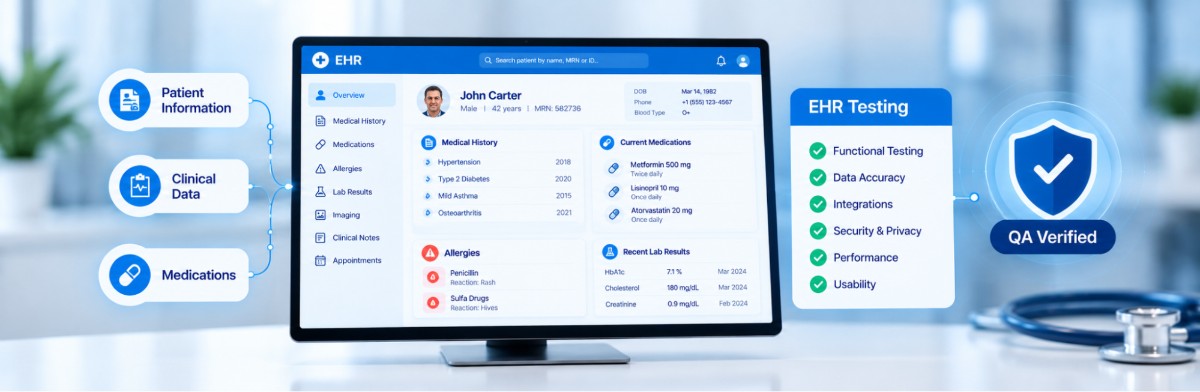
An Electronic Health Record (EHR) or Electronic Medical Record (EMR) system is not ordinary business software. A minor UI defect in an e-commerce application might frustrate a shopper. A defect in a medical record system can display the wrong patient information, interfere with a prescription, hide a critical allergy, delay clinical decisions, or expose protected health information. In healthcare software, quality is inseparable from patient safety.
That makes EHR testing a particularly demanding QA challenge. At Testiva, when we approach healthcare software testing, we look beyond whether screens load and buttons work. The real question is whether the system can preserve accurate clinical information, support real healthcare workflows, communicate reliably with connected systems, protect sensitive data, and remain usable when clinicians are working under pressure.
A strong QA strategy therefore needs to test the EHR as an interconnected clinical ecosystem rather than a collection of isolated features. Here is our complete checklist for doing that effectively.
1. Start With Requirements and Clinical Workflow Analysis
Before executing test cases, QA teams need to understand how the system will actually be used. EHR requirements frequently combine technical rules, business logic, clinical workflows, privacy controls, integrations, and regulatory obligations. Testing without understanding these dependencies produces impressive test counts but weak coverage.
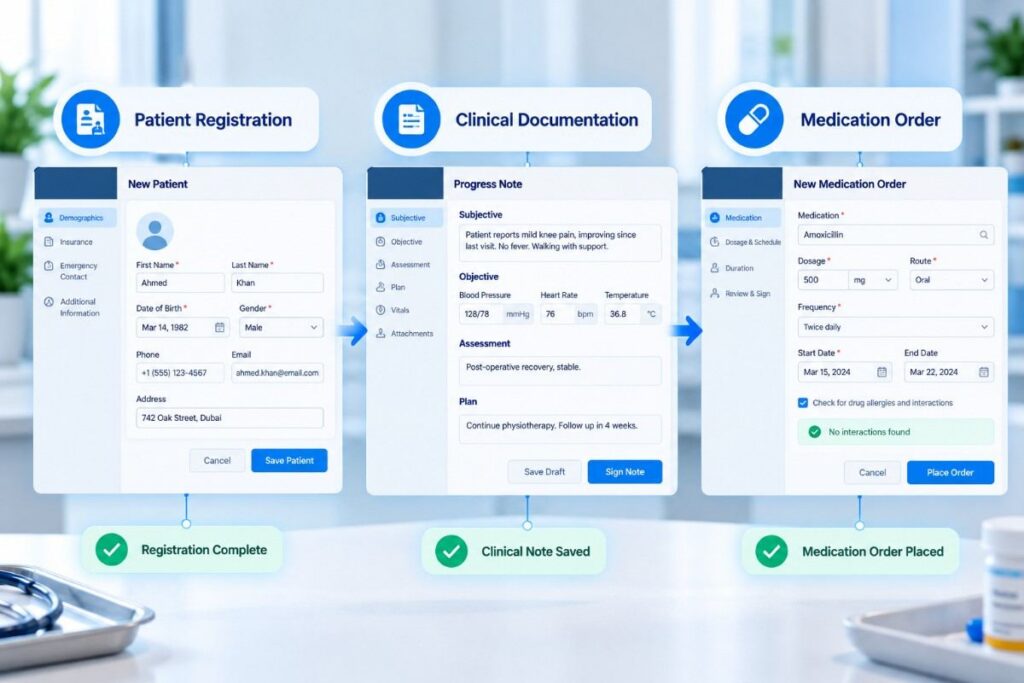
Start by mapping major user journeys for physicians, nurses, administrative staff, laboratory personnel, pharmacists, patients, and system administrators. A patient visit, for example, might begin with registration, continue through clinical documentation and medication ordering, trigger laboratory or imaging requests, and eventually reach billing.
Trace requirements across these workflows and identify high-risk points. Pay particular attention to functions where incorrect data or system behavior could affect clinical decisions. QA should also include negative scenarios and exceptions: duplicate patients, incomplete records, interrupted workflows, conflicting information, expired sessions, unavailable integrations, and invalid clinical values.
This risk-based thinking determines where testing needs to go deepest.
2. Test Core EHR Functionality End to End
Functional testing verifies that every clinical and administrative feature behaves according to its requirements. But EHR functional testing should not stop at checking individual fields or screens. Test complete workflows and confirm that information remains consistent throughout them.
Patient registration deserves especially careful attention. Verify demographic creation and updates, unique identifiers, duplicate-record detection, insurance details, emergency contacts, and patient search. Test similar names, identical birth dates, special characters, incomplete demographics, and record merges. The system must make it extremely difficult for users to accidentally work in the wrong patient chart.
Then test clinical documentation, including medical history, diagnoses, allergies, vital signs, progress notes, procedures, immunizations, and attachments. Verify required fields, validation rules, timestamps, amendments, version history, and electronic signatures.
Medication workflows require similarly aggressive testing. Validate medication selection, dosage, route, frequency, start and end dates, renewals, discontinuations, allergy warnings, duplicate therapies, and interaction alerts. Computerized provider order entry is also among the capabilities addressed in ONC’s Base EHR definition.
3. Verify Clinical Data Integrity
Data integrity is one of the most important parts of medical record testing because an EHR can appear perfectly functional while storing or displaying incorrect information.
QA teams should verify that information entered in one module remains accurate everywhere it appears. If an allergy is updated, for example, does the new information immediately appear in medication workflows and relevant clinical views? If a patient’s demographic information changes, do downstream systems receive the correct update?
Test create, edit, merge, import, export, archive, and retrieval operations. Pay particular attention to rounding, units of measurement, dates, time zones, character encoding, record associations, and data transformations between systems. Boundary-value testing matters here: clinically unusual values should trigger the correct validation without blocking legitimate edge cases.
Auditability is equally important. Corrections should not silently destroy clinically significant history. Verify who changed information, what changed, and when it happened.
4. Test Interoperability and Healthcare Integrations
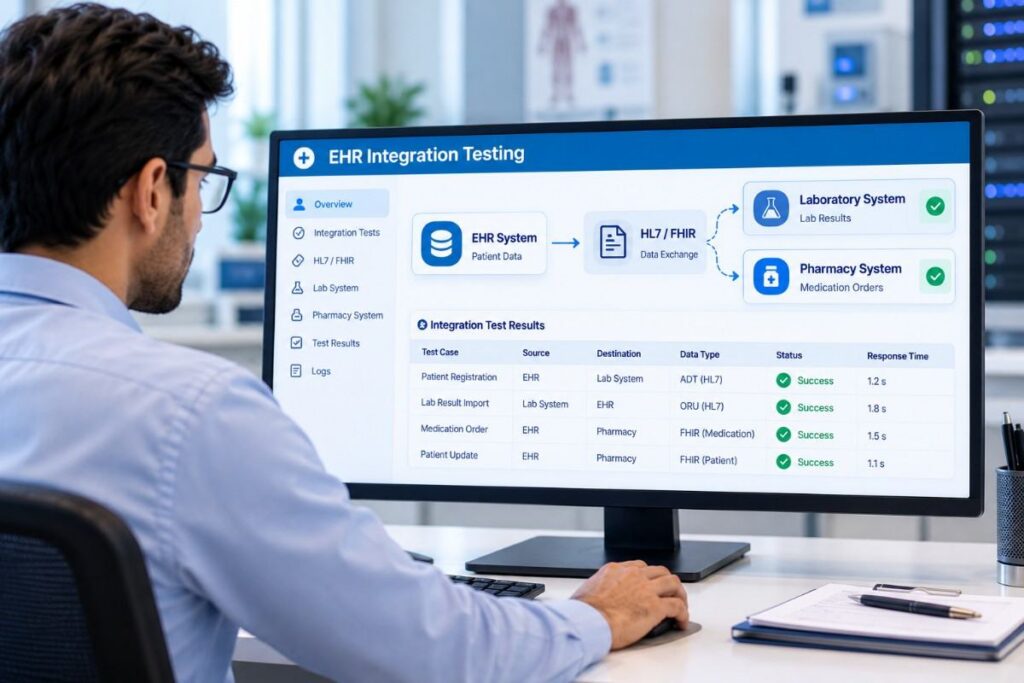
Modern EHRs rarely operate alone. They communicate with laboratories, pharmacies, imaging systems, billing platforms, patient portals, health information exchanges, medical devices, and third-party applications. Every interface creates another opportunity for data to be delayed, duplicated, corrupted, mapped incorrectly, or attached to the wrong patient.
Testing should cover the standards and implementation profiles actually used by the product, including relevant HL7 messaging, FHIR APIs, and other healthcare exchange formats. FHIR, for example, is an HL7 standard specifically designed for electronic healthcare information exchange and provides standardized resources representing healthcare entities and data.
Validate both message structure and clinical meaning. A technically valid payload containing the wrong unit or patient reference is still a dangerous failure.
Test successful exchanges alongside malformed messages, duplicate messages, missing fields, unexpected codes, authentication failures, network interruptions, retries, timeouts, delayed responses, and unavailable external services. Then verify reconciliation after connectivity returns. Integration testing should answer a deceptively simple question: did the right clinical information reach the right destination, exactly once, without losing its meaning?
5. Perform Rigorous Security and Privacy Testing
Medical records contain some of an organization’s most sensitive information, so security testing cannot be treated as a final pre-release scan.
For systems subject to HIPAA, the Security Rule requires appropriate administrative, physical, and technical safeguards to protect the confidentiality, integrity, and availability of electronic protected health information. HHS also identifies controls involving access, auditing, authentication, integrity, and transmission security.
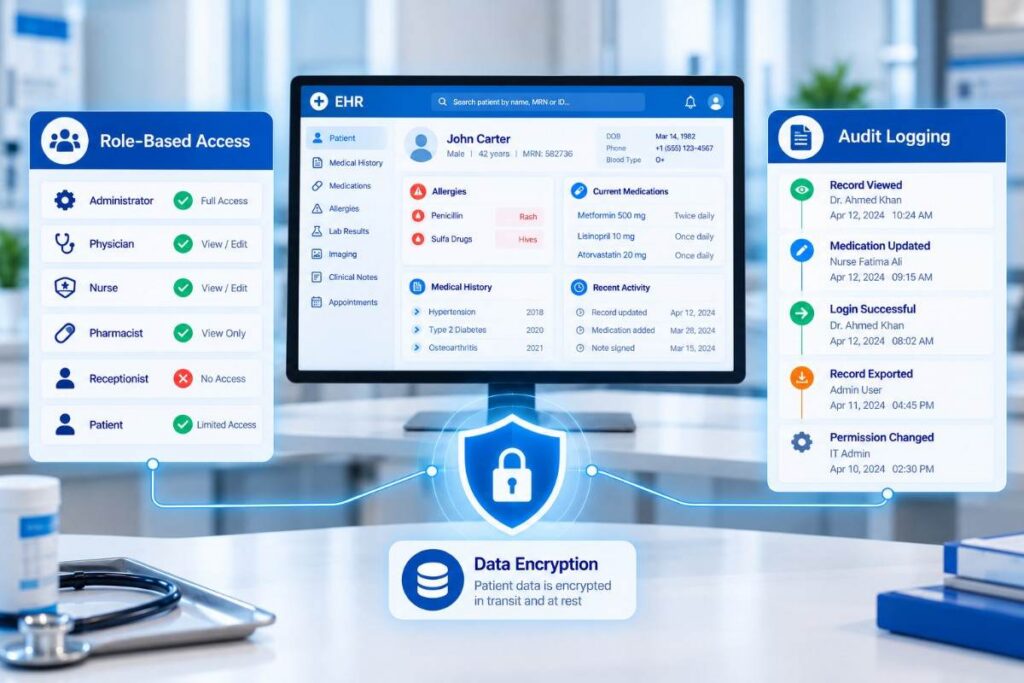
QA should verify role-based access control in detail. A receptionist, physician, billing specialist, patient, and administrator should see only the data and functions appropriate to their roles. Test privilege escalation, direct URL access, unauthorized API requests, inactive accounts, password policies, multifactor authentication where implemented, session expiration, concurrent sessions, and account recovery.
Verify encryption and secure transmission, and test whether sensitive information leaks through application logs, error messages, browser storage, exported files, notifications, or backups. Audit logs should accurately record relevant access and modification events without becoming another source of unnecessary exposure.
Security testing should also include vulnerability assessment and penetration testing appropriate to the application’s architecture and risk profile.
6. Validate Clinical Decision Support and Alerts
Clinical decision support (CDS) can include medication warnings, preventive-care reminders, diagnostic assistance, dose recommendations, and other patient-specific guidance. Testing these features requires more than confirming that a popup appears.
Create scenarios in which alerts should trigger and closely related scenarios in which they should not. Verify the patient data, thresholds, rules, terminology, timing, and evidence inputs behind each decision. Test missing or contradictory information and confirm how the system behaves when dependencies are unavailable.
False negatives are dangerous because clinicians may miss critical information. Excessive false positives create another problem: alert fatigue. A technically correct system that constantly interrupts clinicians with low-value warnings can train users to ignore important alerts.
Regulatory scope also deserves attention. FDA guidance distinguishes certain non-device CDS functions from software functions that remain under medical-device oversight, so teams should understand which requirements apply to their particular product and intended use.
7. Test Performance, Reliability, and Recovery
An EHR that works beautifully with five test users may behave very differently across a busy hospital or healthcare network. Performance testing should reproduce realistic clinical demand rather than relying only on generic page-load benchmarks.
Test concurrent logins, patient searches, chart loading, medication ordering, documentation, reporting, API traffic, batch processing, and large records. Measure response times at normal, peak, and beyond-expected loads. Look for database contention, memory problems, queue backlogs, resource exhaustion, and degradation in dependent services.
Reliability testing should cover application restarts, network interruptions, database failures, integration outages, and infrastructure failover. Verify that incomplete transactions do not create duplicate orders or inconsistent patient data.
Backup and disaster-recovery procedures also need testing rather than assumption. Confirm that records can actually be restored, that recovery objectives can be met, and that restored data remains complete and usable.
8. Evaluate Usability and Accessibility in Real Clinical Contexts
Healthcare professionals often interact with EHR systems while simultaneously talking to patients, reviewing results, making decisions, and managing interruptions. Usability problems therefore become operational and sometimes clinical risks.
Test navigation consistency, readability, terminology, keyboard workflows, search behavior, error prevention, form design, and the number of interactions required for common tasks. Important patient context—such as identity, allergies, or critical warnings—should remain obvious where clinicians need it.
Accessibility should also be built into QA. Evaluate keyboard navigation, focus behavior, screen-reader compatibility, contrast, labels, scalable text, and error messaging against the accessibility requirements relevant to the product.
Most importantly, involve representative users. Clinicians can identify workflow friction that a technically focused QA team may never discover from requirements alone.
9. Automate Strategically, Not Blindly
EHR platforms are excellent candidates for automation because releases must repeatedly verify large numbers of workflows, permissions, integrations, and calculations. But trying to automate everything is rarely the best strategy.
Prioritize stable, repeatable, high-value scenarios such as authentication, patient search, core CRUD operations, API contracts, permission checks, regression workflows, and critical clinical rules. API-level automation is particularly valuable because it can validate large combinations of data faster and more reliably than UI-only suites.
Keep exploratory testing human. New clinical workflows, usability problems, unusual edge cases, and complicated interactions between features benefit from testers who can reason about unexpected behavior.
Automation should increase confidence and feedback speed—not merely inflate the number of test scripts in the repository.
10. Complete the Final EHR QA Checklist Before Release
Before approving a medical record system for production, we expect evidence across the full quality picture, not simply a green regression dashboard.
Your final checklist should confirm:
- Core patient, clinical, medication, order, scheduling, and administrative workflows work end to end.
- Patient information remains accurate across creation, modification, transfer, export, and integration.
- Roles, permissions, authentication, sessions, audit trails, encryption, and privacy controls have been verified.
- HL7, FHIR, APIs, and third-party integrations handle normal and failure scenarios correctly.
- Clinical alerts and decision-support rules produce appropriate, explainable outcomes.
- Performance remains acceptable under realistic and peak workloads.
- Failover, backup, restoration, and interrupted transactions have been tested.
- Accessibility and usability have been evaluated in realistic user workflows.
- High-risk regressions are automated where automation provides reliable coverage.
- Known defects have been evaluated according to clinical and operational risk rather than severity labels alone.
For U.S. products seeking applicable certification, teams should additionally map testing to current ONC certification criteria and conformance methods. ONC’s program evaluates health IT against defined technological capability, functionality, and security requirements, but certification testing should complement not replace broader product QA.
Build an EHR People Can Trust
Testing an Electronic Medical Record system ultimately comes down to trust. Clinicians need to trust that the information on screen belongs to the correct patient. Patients need to trust that their private information is protected. Healthcare organizations need to trust that integrations, workflows, and infrastructure will continue functioning when demand is high.
That level of confidence cannot come from a few happy-path test cases before launch. It requires risk-based functional testing, deep data validation, interoperability testing, security assessment, realistic performance testing, usability evaluation, and disciplined regression coverage throughout the software lifecycle.
At Testiva, that is how we think about healthcare QA: test the software as a real clinical system, not just another application. When every field, interface, permission, alert, and workflow can potentially influence care, quality needs to be engineered deliberately.
Ready to strengthen the quality of your healthcare software? Start your QA journey today and build a medical record experience clinicians and patients can depend on.
Healthcare has always depended on information. A physician needs an accurate patient history before making a diagnosis, nurses need current medication information before administering treatment, and administrators need reliable records for billing, compliance, and reporting. When that information is fragmented across paper files, disconnected applications, or outdated databases, even routine healthcare workflows can become unnecessarily complicated.
A medical electronic record system brings clinical information into a structured digital environment where authorized healthcare professionals can record, retrieve, update, and use patient data more efficiently. But digitizing medical records is only the beginning. Healthcare organizations need systems that are accurate, interoperable, secure, responsive, and dependable under real-world clinical conditions. From our perspective at Testiva, this is exactly why healthcare software testing and QA deserve attention throughout development—not simply as a final checkpoint before release.
A malfunction in an ordinary business application may inconvenience a user. A malfunction in healthcare software can interfere with clinical workflows, expose sensitive information, or present inaccurate data at precisely the wrong moment. Understanding what makes a strong electronic medical record solution is therefore essential for healthcare providers, product teams, and technology decision-makers alike.
What Is a Medical Electronic Record System?
A medical electronic record system, commonly associated with EMR software, is a digital platform for storing and managing patient information that would traditionally exist in paper medical charts. Depending on the solution, these records can include diagnoses, medications, allergies, treatment histories, laboratory results, clinical notes, immunizations, vital signs, imaging information, and other healthcare data.
Although EMR and electronic health record (EHR) are sometimes used interchangeably, there is a useful distinction. An EMR typically focuses on records maintained within a particular practice or organization, while an EHR is generally designed for broader information exchange across different healthcare settings and providers. Modern platforms increasingly blur that boundary by supporting interoperability and external data exchange.
Whatever terminology a healthcare organization uses, the fundamental expectation is the same: clinicians should be able to access trustworthy information quickly without technology becoming an obstacle to patient care. That expectation influences virtually every feature and quality requirement of the system.
Essential Features of a Medical Electronic Record System
A successful medical record platform requires more than a digital patient database. Its features must support actual clinical workflows while keeping information organized, accessible, and protected.
Comprehensive Patient Record Management
The patient record is the foundation of the system. Healthcare professionals should be able to view relevant demographic information, medical histories, diagnoses, allergies, prescriptions, laboratory findings, treatment plans, and clinical documentation without searching through multiple disconnected screens.
Data accuracy is equally important. Systems need appropriate validation, structured data entry, versioning, and audit capabilities to reduce the possibility of incomplete, duplicated, or contradictory information. Good interface design also matters because clinicians frequently interact with these systems while simultaneously communicating with patients.
A well-designed record should give users the information they need without overwhelming them with irrelevant details. In healthcare UX, adding more information to a screen does not necessarily make the software more useful.
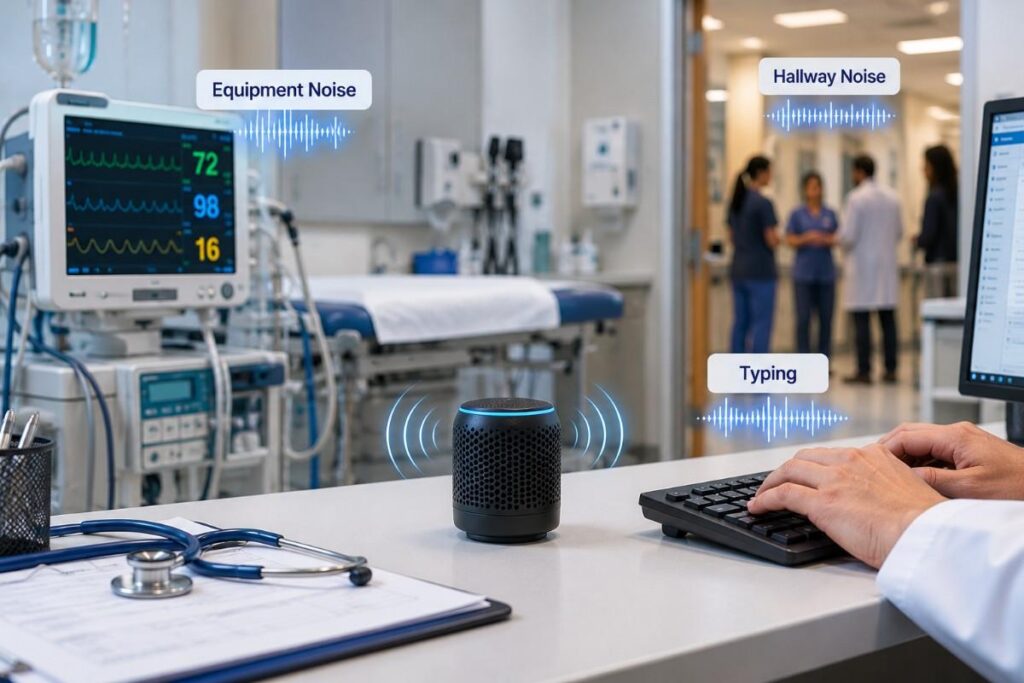
Clinical Documentation and Workflow Support
Electronic medical record software should make clinical documentation efficient rather than creating additional administrative work. Templates, configurable forms, electronic notes, order entry, prescription management, and workflow automation can reduce repetitive manual tasks.
The challenge is flexibility. A workflow suitable for a general practitioner may not fit a cardiologist, laboratory professional, nurse, or emergency department. Medical software should accommodate different roles and clinical contexts without creating unnecessary complexity.
Testing these workflows requires realistic scenarios rather than isolated feature checks. A function can technically work while still failing the people expected to use it because it requires too many steps, behaves unpredictably, or does not fit the surrounding clinical process.
Interoperability and Healthcare System Integration
Healthcare technology rarely operates independently. Medical record systems may need to exchange information with laboratories, pharmacies, imaging platforms, billing applications, insurance systems, patient portals, medical devices, and external healthcare organizations.
Standards such as HL7 and FHIR (Fast Healthcare Interoperability Resources) support structured healthcare information exchange. However, supporting an interoperability standard does not automatically guarantee flawless integration. Differences in implementations, mappings, data formats, validation rules, and third-party behavior can still create failures.
Integration testing is therefore critical. Teams need to confirm not only that information can be transmitted but also that the correct information reaches the correct destination, retains its meaning, and is displayed accurately after the exchange.
Appointment, Prescription and Patient Portal Capabilities
Modern medical record platforms often extend beyond the clinician-facing record. Appointment scheduling, automated reminders, electronic prescribing, patient registration, billing integrations, and secure patient portals can create a more connected healthcare experience.
Patient portals are especially important because they allow individuals to access information such as test results, appointment details, prescriptions, and communications without repeatedly contacting a provider. These features can improve convenience, but they also expand the application’s security and usability requirements.
Every additional integration and user-facing feature creates another pathway through which data moves. Development teams therefore need to evaluate functionality, permissions, error handling, privacy, accessibility, and performance together rather than treating them as separate concerns.
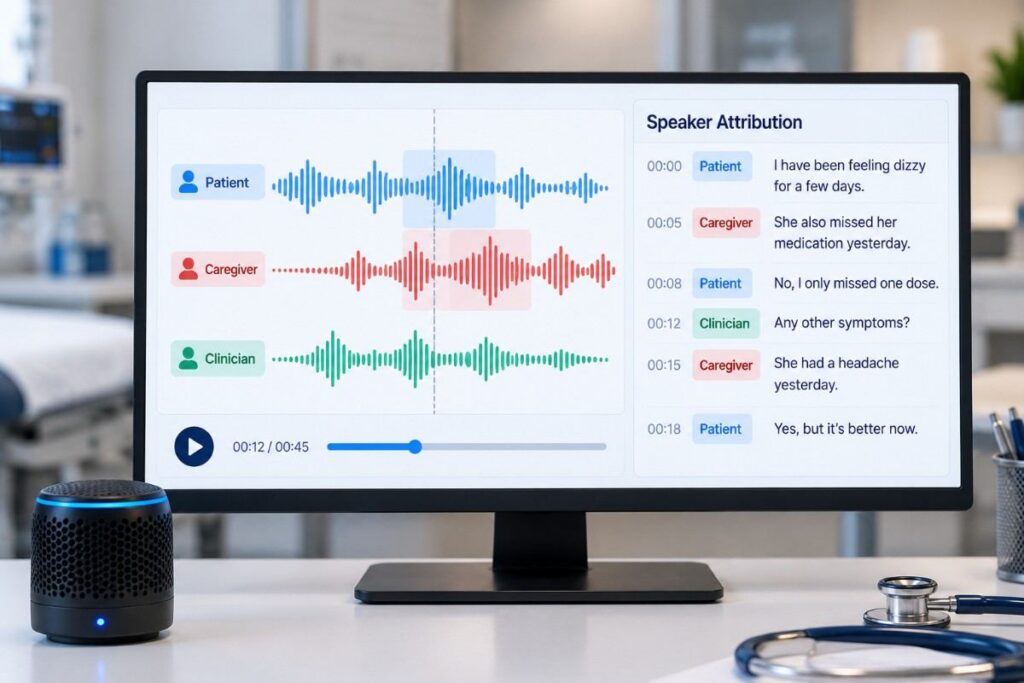
Key Benefits of Electronic Medical Record Systems
One of the most significant benefits of electronic records is faster access to patient information. Authorized professionals can retrieve relevant data without locating physical files, interpreting handwritten notes, or requesting documents from another department. That can make clinical workflows more efficient and help healthcare teams work with a more complete view of the patient.
Digital systems can also improve information consistency. Structured fields, validation rules, alerts, and standardized documentation can reduce some of the ambiguity associated with manual recordkeeping. When implemented carefully, electronic records can make information easier to search, analyze, share, and audit.
Operational benefits extend beyond direct patient care. Healthcare organizations can streamline scheduling, billing, reporting, documentation, and administrative workflows while reducing reliance on physical storage. Electronic data can also support analytics and population-level insights when it is collected and governed appropriately.
Perhaps most importantly, a dependable system helps healthcare professionals spend less time fighting software. Technology should support clinical decision-making and patient interactions, not turn a simple task into a ten-click adventure worthy of its own troubleshooting manual.
Security Requirements for Medical Electronic Record Systems
Medical information is highly sensitive, making cybersecurity and privacy central requirements rather than optional enhancements. Security must be designed into the architecture, development process, testing strategy, deployment environment, and ongoing maintenance of a medical record platform.
Authentication and Role-Based Access Control
Not every healthcare employee should have unrestricted access to every piece of patient information. Role-based access control allows organizations to assign permissions according to responsibilities, helping users access the information and functionality required for their jobs while limiting unnecessary exposure.
Strong authentication should complement those controls. Depending on the system and its risk profile, this can include multifactor authentication, secure password policies, session management, account lockout mechanisms, and safeguards against unauthorized credential use.
Authorization deserves particularly thorough testing. It is not enough to confirm that legitimate users can access a feature. QA teams should also verify that users without the required permissions cannot reach protected data through alternate screens, APIs, manipulated requests, or unexpected workflows.
Encryption, Audit Trails and Data Integrity
Encryption, Audit Trails and Data Integrity
Sensitive medical information should be appropriately protected both when stored and when transmitted. Encryption reduces the risk of readable patient information being exposed if communications are intercepted or storage environments are compromised.
Medical systems also need comprehensive audit logging. Organizations should be able to determine who accessed or modified sensitive information, what action occurred, and when it happened. Logs themselves must be appropriately protected because poorly secured audit information can introduce additional security and privacy risks.
Data integrity is another essential requirement. A system must protect information from unauthorized or accidental modification while ensuring legitimate updates remain consistent across databases, integrations, backups, and connected applications.