




Latest Insights
Human-in-the-Loop Testing for AI Medical Documentation Systems
- Sep 25, 2026
- Sajid M.
- Human-in-the-Loop AI Testing

AI can draft a clinical note in seconds. The harder question is whether anyone should trust that note.
Medical documentation is one of the most compelling applications of generative AI. Ambient clinical systems can listen to patient encounters, identify medically relevant information, organize it into structured notes, and reduce the administrative load that has frustrated clinicians for years. But a documentation system does not become dependable simply because its output sounds clinical. A polished sentence can still contain the wrong medication, omit an important symptom, misrepresent uncertainty, or confidently document something that was never said.
At Testiva, we approach these systems as a QA problem where automation alone is not enough. Our AI testing and quality assurance services combine systematic validation with human judgment to examine functionality, accuracy, reliability, and real-world behavior. For medical documentation AI in particular, human-in-the-loop (HITL) testing provides something conventional test automation cannot: informed evaluation of whether generated documentation actually represents the clinical interaction correctly.
What Human-in-the-Loop Testing Actually Means
Human-in-the-loop testing deliberately places qualified people at critical points in the AI evaluation process. Instead of judging a model exclusively through automated metrics, human reviewers assess outputs against defined clinical, functional, and usability criteria.
This distinction matters because language quality and clinical quality are not synonymous. A generated note may receive strong similarity scores against a reference document while changing the meaning of a clinically important statement. “Patient denies chest pain” and “patient reports chest pain” differ by a single word, but no sensible medical QA strategy would treat that difference as minor.
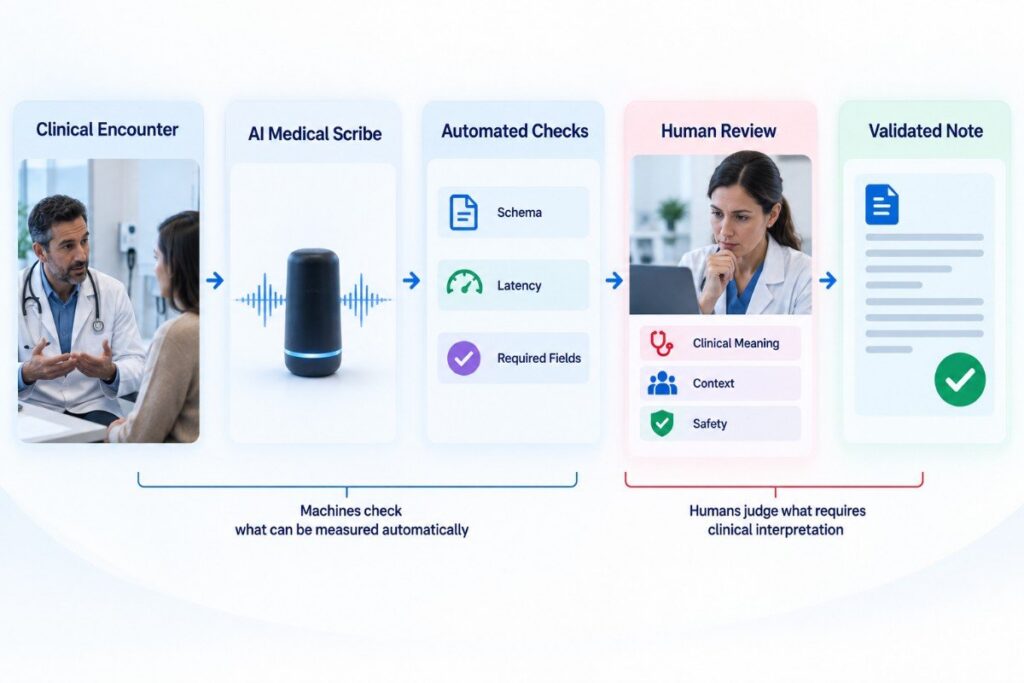
HITL testing therefore focuses on meaning, context, and consequences. Automated checks remain valuable for repeatable tasks such as schema validation, latency measurement, regression detection, and required-field verification. Humans handle the areas where interpretation becomes essential.
The objective is not to replace automation with manual testing. It is to design a testing system where machines perform what machines evaluate well and people investigate what requires contextual judgment.
Why Medical Documentation AI Creates a Different QA Challenge
Traditional software usually behaves according to explicit logic. Given a known input and system state, testers can often define the expected result precisely. Generative AI introduces probabilistic behavior, which makes the testing landscape considerably more interesting and considerably less forgiving.
Two nearly identical conversations may produce differently structured notes. A model update may improve average performance while introducing a new failure pattern for a particular specialty, accent, terminology set, or conversation style. An apparently harmless prompt change can alter how aggressively the system infers information that clinicians never explicitly stated.
Medical conversations also contain ambiguity by nature. Patients interrupt themselves, clinicians use abbreviations, family members contribute information, medications have similar names, and symptoms may be discussed hypothetically rather than confirmed. A documentation system must distinguish between “we should test for pneumonia” and “the patient has pneumonia.” That is semantic reasoning, not simple transcription.
This is why testing only ideal, carefully scripted conversations creates dangerous confidence. Quality emerges when the system is challenged with the messy conditions it will encounter outside the test environment.
The Core Risks HITL Testing Should Target
A strong HITL program begins by defining failure categories rather than asking reviewers whether a note simply “looks good.” Reviewers need a shared understanding of what constitutes an error and how serious that error is.
Hallucination is an obvious concern. The system may introduce diagnoses, symptoms, examination findings, medications, or treatment details unsupported by the source conversation. These additions can appear perfectly plausible, which makes them particularly important to detect.
Omission is equally significant. A beautifully summarized note is still defective if it leaves out an allergy, worsening symptom, medication change, follow-up instruction, or other material detail. Human reviewers should therefore evaluate both what the AI wrote and what it failed to write.
Other high-value categories include incorrect attribution, negation errors, temporal confusion, dosage mistakes, terminology errors, and inappropriate certainty. Testing should also examine whether information is assigned to the correct person when conversations involve caregivers or family members.
The severity model matters too. A punctuation issue should not receive the same weight as a fabricated prescription. Categorizing defects by potential impact helps QA teams identify where model improvements matter most.
Building a Human-in-the-Loop Testing Workflow
A useful workflow starts with representative test data. Test cases should cover routine encounters as well as difficult scenarios involving interruptions, incomplete statements, background noise, specialized terminology, multiple speakers, corrections, contradictory information, and uncommon clinical situations.
Each generated document should then be evaluated against its source evidence. Reviewers can score factual consistency, completeness, attribution, clinical meaning, structure, readability, and adherence to documentation requirements. Clear rubrics are essential because an undefined instruction such as “check the quality” produces inconsistent feedback.
The next layer is adjudication. When reviewers disagree, the disagreement itself becomes useful data. It may reveal an ambiguous rubric, a genuinely uncertain source conversation, or a model behavior that requires deeper investigation. Mature QA processes do not hide disagreement inside an average score; they examine why it happened.
Finally, findings should feed back into regression testing. Once a meaningful failure has been discovered, a corresponding test case should remain in the suite. Otherwise, teams risk fixing the model today only to reintroduce the same behavior after a future prompt, model, workflow, or integration change.
Test the Entire Documentation Pipeline, Not Just the Model
One of the easiest mistakes in AI QA is treating the model as though it exists in isolation. Medical documentation products are systems, and defects can emerge anywhere along the pipeline.
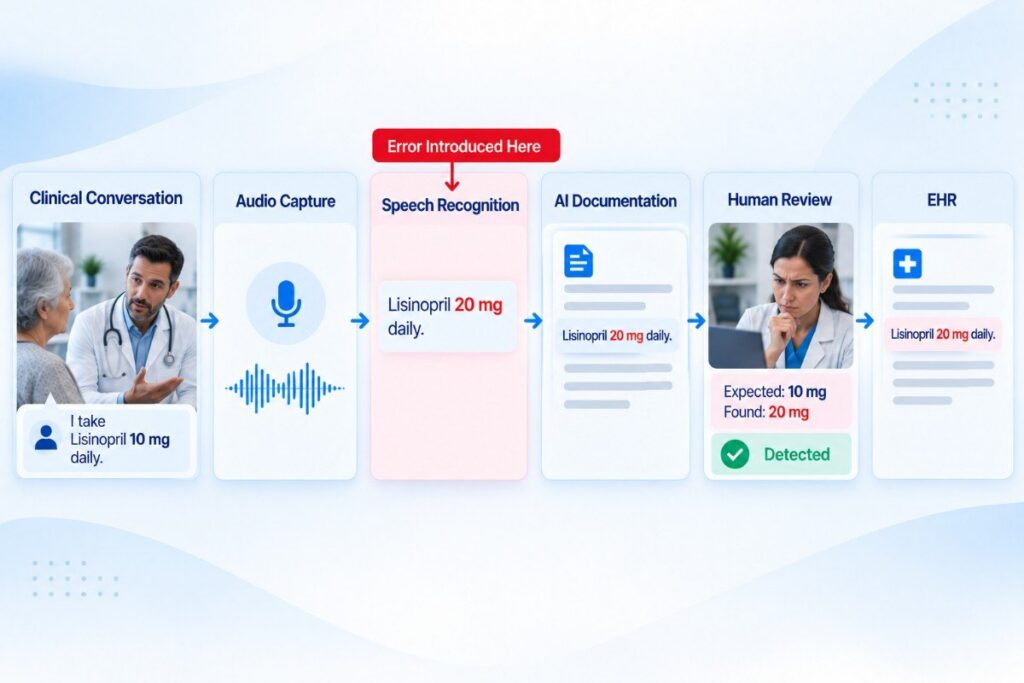
Audio capture can lose words. Speaker diarization can assign a statement to the wrong person. Speech recognition can incorrectly transcribe a drug name before the language model ever sees it. The model may produce correct structured information that is subsequently mapped into the wrong field during an EHR integration.
Human-in-the-loop evaluation should therefore support end-to-end testing. Reviewers need enough context to determine whether the final documentation accurately reflects the original encounter, while QA engineers trace failures back through the technical workflow.
This approach also prevents teams from blaming the AI model for every defect. Sometimes the “hallucination” is actually a transcription error upstream. Sometimes a correct model response becomes incorrect because of transformation logic downstream. Finding the true failure point is what makes testing actionable.
Human Review Should Be Risk-Based
Human review is valuable, but it is also expensive and difficult to scale. The answer is not to have clinicians manually inspect every output forever. A better strategy concentrates human expertise where uncertainty and potential impact are highest.
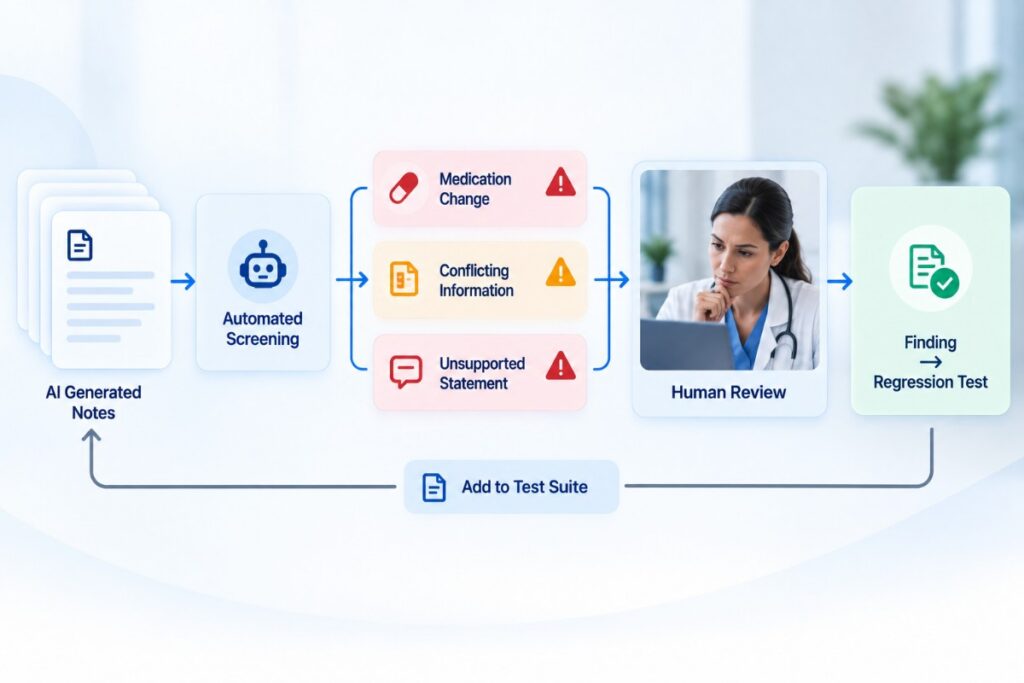
Automated evaluation can continuously monitor measurable signals and route suspicious cases for deeper review. Outputs containing medication changes, conflicting information, unusual terminology, unsupported assertions, or significant differences from previous versions may deserve additional scrutiny.
Sampling can also be stratified. Instead of reviewing a random collection of ordinary encounters, teams can intentionally include different specialties, patient populations, acoustic conditions, encounter lengths, documentation formats, and known edge cases.
Over time, this produces a feedback loop: automated systems identify anomalies, humans interpret them, findings become structured test cases, and those cases strengthen future automated regression coverage. That is where HITL testing becomes scalable rather than becoming a permanent manual bottleneck.
Measure More Than “Accuracy”
A single accuracy percentage is rarely sufficient for a medical documentation system. It compresses different kinds of errors into one comforting number and can hide exactly the weaknesses stakeholders need to understand.
Teams should separately monitor factual consistency, omission frequency, unsupported-content rates, critical-error rates, reviewer disagreement, correction burden, and performance across defined scenarios. Operational metrics such as generation latency, failure rates, and integration reliability belong alongside these quality measures.
It is also useful to measure clinician editing behavior during controlled validation. If users repeatedly rewrite the same section, correct similar terminology, or remove unsupported statements, those patterns can reveal systematic weaknesses even when conventional evaluation scores appear healthy.
The most useful metrics connect technical performance to actual workflow quality. The question is not merely, “How often does the AI generate acceptable text?” It is, “How reliably does this system produce documentation that a clinician can safely and efficiently verify?”
HITL Testing Must Continue After Release
AI testing cannot end at launch because the environment does not remain static. Models change, prompts evolve, integrations are updated, workflows shift, and real-world users produce inputs no pre-release dataset anticipated.
Post-release monitoring should therefore feed unusual and high-risk cases back into the QA process. New failure patterns can become regression scenarios, while periodic human review helps detect gradual quality drift that automated dashboards may overlook.
Every significant model or prompt update should also be evaluated against a stable benchmark containing both common workflows and previously discovered failures. Improvement on one metric should never be assumed to mean improvement everywhere.
For teams building medical AI, this turns QA from a release gate into an ongoing quality system. That mindset is essential for software whose output depends on probabilistic models and constantly changing real-world inputs.
The Goal Is Calibrated Trust, Not Perfect AI
Human-in-the-loop testing is sometimes described as a temporary bridge until AI becomes “good enough.” For medical documentation, that framing misses the point.
The value of human involvement is not simply catching mistakes that machines will eventually stop making. Humans help define what acceptable behavior means, identify consequences that aggregate metrics cannot express, uncover novel failure modes, and continuously sharpen the testing system.
The strongest medical documentation products will therefore combine automated evaluation, rigorous software QA, domain-informed human review, regression testing, and production monitoring. None of these layers is sufficient alone.
AI can make clinical documentation dramatically faster. Quality assurance must make sure faster does not quietly become riskier. If your team is developing an AI documentation platform and needs a testing strategy built around real-world reliability rather than impressive demos, get in touch with our experts at Testiva and start your QA journey today.