




Latest Insights
How to Test LLM Accuracy in Clinical Documentation Applications
- Sep 10, 2026
- Sajid M.
- LLM Testing for Healthcare

Large Language Models (LLMs) are rapidly changing the way clinical documentation is created. From generating physician notes and discharge summaries to assisting with medical coding and patient communication, these models promise significant improvements in efficiency while reducing administrative burden for healthcare professionals.
However, in healthcare, “mostly correct” simply isn’t good enough. A single inaccurate diagnosis, omitted medication, or hallucinated clinical finding can have serious consequences for patient safety, regulatory compliance, and organizational trust. Unlike consumer AI applications, clinical documentation systems operate in an environment where every generated sentence can influence medical decisions.
This is why testing LLM accuracy requires a far more rigorous approach than conventional software testing. At Testiva, we’ve seen firsthand that validating AI-powered healthcare applications demands a combination of traditional Quality Assurance, domain-specific validation, and systematic AI evaluation techniques. Building a functional application is only the beginning the real challenge lies in proving that the AI consistently produces clinically reliable documentation under real-world conditions.
Why Accuracy in Clinical Documentation Is Different
Testing a traditional application usually involves verifying expected outputs against predefined inputs. If a login button works or a calculation returns the expected value, the test passes.
LLMs fundamentally change this equation.
Given the same prompt, an LLM may produce several equally acceptable responses. Some responses may be stylistically different while still remaining clinically accurate. Others may introduce subtle inaccuracies that appear perfectly reasonable to human readers. This probabilistic behavior makes conventional pass/fail testing insufficient.
Clinical documentation also introduces an additional layer of complexity because the generated content becomes part of a patient’s medical record. Errors aren’t merely software defects they can affect diagnoses, treatment plans, billing accuracy, insurance claims, legal documentation, and patient outcomes.
Consider a simple physician encounter involving hypertension and diabetes. A human reviewer immediately recognizes if the generated summary incorrectly introduces chronic kidney disease or omits insulin therapy. An automated testing framework must be capable of identifying these discrepancies consistently across thousands of scenarios.
This is why testing LLMs for healthcare must focus on factual correctness, clinical completeness, contextual understanding, and consistency rather than simply measuring linguistic quality.
Defining What "Accurate" Actually Means
One of the biggest mistakes organizations make is treating accuracy as a single metric.
In reality, clinical documentation quality consists of several independent dimensions.
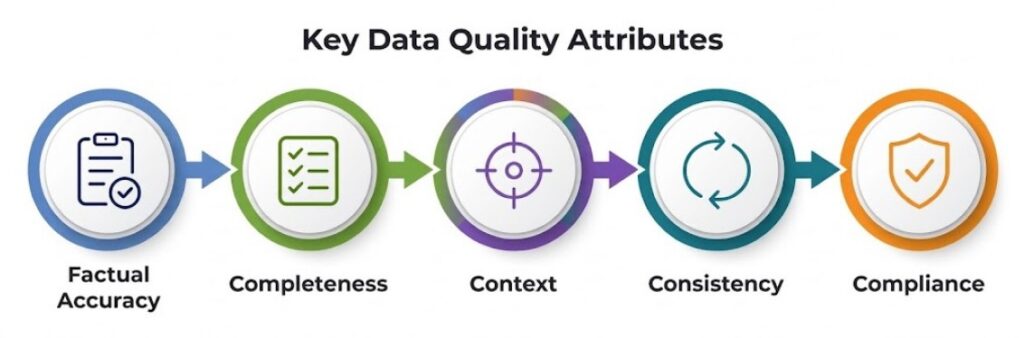
The first is factual accuracy. Every diagnosis, medication, dosage, laboratory value, procedure, and timeline must match the underlying source data. Even minor numerical errors can significantly alter clinical meaning.
The second dimension is completeness. Documentation should capture all clinically relevant information without omitting significant findings, allergies, medications, or patient history. Missing information is often just as dangerous as incorrect information.
Another important factor is contextual understanding. Healthcare documentation depends heavily on nuance. The statement “history of stroke” carries an entirely different meaning than “currently experiencing stroke symptoms.” Likewise, “family history of diabetes” should never become “patient has diabetes.”
Clinical consistency also matters. The generated documentation should not contradict itself across different sections. A patient cannot simultaneously be documented as allergic and not allergic to penicillin.
Finally, organizations must evaluate regulatory compliance. Documentation should align with standards such as HIPAA, clinical coding guidelines, institutional documentation policies, and applicable healthcare regulations.
Testing each of these dimensions independently provides a far more realistic picture of LLM performance than relying on a single accuracy percentage.
Building a High-Quality Evaluation Dataset
The quality of testing depends heavily on the quality of the evaluation data.
Healthcare organizations should begin with curated datasets representing realistic clinical encounters rather than artificially simplified examples. These datasets should include multiple specialties, varying patient demographics, different encounter types, and diverse levels of clinical complexity.
For example, an evaluation corpus may include emergency department visits, outpatient consultations, surgical procedures, chronic disease management, pediatric assessments, psychiatric evaluations, oncology cases, and intensive care scenarios.
Edge cases deserve particular attention.
Patients with multiple comorbidities, rare diseases, conflicting historical records, incomplete notes, ambiguous terminology, or complex medication regimens often expose weaknesses that routine cases fail to uncover.
Synthetic datasets can supplement testing, but they should never replace real-world de-identified clinical records. Authentic clinical language contains abbreviations, incomplete sentences, dictation errors, physician shorthand, and varying documentation styles that are difficult to replicate synthetically.
A robust evaluation dataset should evolve continuously as new clinical scenarios emerge and production feedback identifies previously unseen edge cases.
Measuring More Than Just Accuracy Scores
Many AI benchmarks report a single accuracy score, but healthcare applications require considerably richer evaluation metrics.
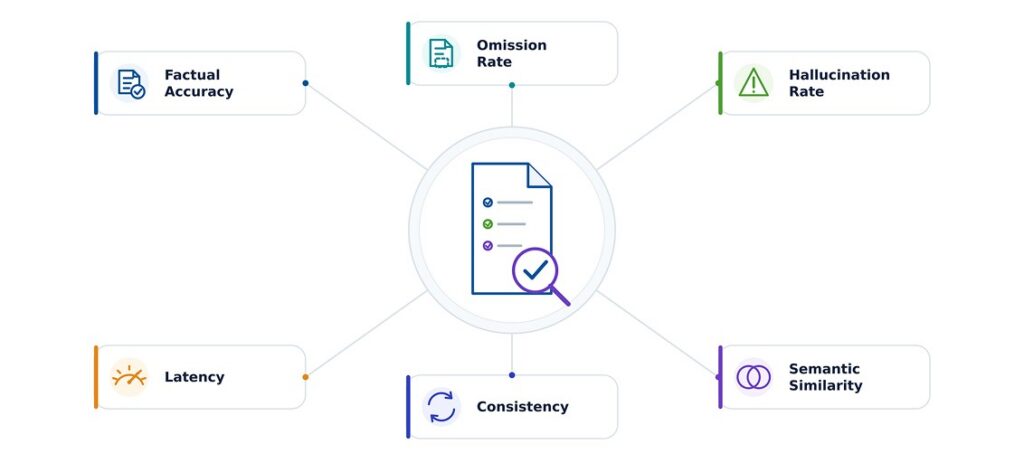
One useful metric is concept extraction accuracy. Does the model correctly identify diagnoses, medications, procedures, allergies, laboratory values, and vital signs?
Another valuable measure is omission rate. Missing clinically relevant information is frequently more problematic than minor wording differences.
Hallucination rate is equally critical. Every generated fact that cannot be traced back to the source documentation should be considered a significant defect requiring investigation.
Semantic similarity metrics can help compare generated notes with reference documentation, although they should never replace expert clinical review. Two notes may have similar wording while conveying entirely different medical meanings.
Consistency testing should also be performed across repeated executions. If identical inputs produce significantly different clinical conclusions, the model’s reliability becomes questionable.
Latency and response stability deserve attention as well. A clinically accurate model that requires excessive processing time may be impractical for physicians working in fast-paced clinical environments.
Combining these metrics provides a far more meaningful evaluation framework than relying on any individual measurement.
The Essential Role of Human Clinical Review
No automated evaluation framework can fully replace clinical expertise.
Experienced physicians, nurses, clinical documentation specialists, and medical coders remain essential participants in the testing process because they understand subtle clinical reasoning that automated metrics cannot easily capture.
Human reviewers evaluate whether generated notes accurately reflect physician intent, maintain appropriate clinical terminology, preserve diagnostic reasoning, and communicate effectively with other healthcare providers.
They can also identify documentation that appears technically correct but may encourage unsafe clinical interpretation.
For example, changing “rule out myocardial infarction” into “patient diagnosed with myocardial infarction” represents a serious clinical error that simple similarity metrics may overlook.
Human review also helps establish high-quality reference datasets that future automated evaluations can leverage.
The most effective testing strategies combine automated large-scale validation with targeted expert review rather than relying exclusively on either approach.
Stress Testing Clinical AI Systems
Testing should extend well beyond ideal clinical scenarios.
Healthcare documentation systems encounter incomplete dictation, transcription mistakes, background noise, contradictory physician statements, missing laboratory values, fragmented patient histories, and inconsistent terminology every day.
LLMs should therefore be evaluated under challenging conditions that reflect actual clinical workflows.
For example, testers should examine how the model handles interrupted speech recognition transcripts, conflicting medication lists, duplicate clinical findings, abbreviated physician notes, and multiple revisions to the same encounter.
Long-context testing is becoming increasingly important as patient records grow larger. Models must accurately interpret information spread across hundreds of pages without overlooking relevant historical details or introducing contradictions.
Stress testing also includes adversarial prompts designed to expose hallucinations, prompt injection vulnerabilities, or unexpected behavior triggered by unusual inputs.
These evaluations often reveal weaknesses that remain invisible during standard functional testing.
Validating Against Clinical Workflows
Accuracy cannot be evaluated in isolation.
Clinical documentation applications exist within larger healthcare ecosystems that include Electronic Health Record (EHR) systems, billing platforms, coding engines, laboratory information systems, radiology systems, and clinical decision support tools.
Testing should therefore validate the entire workflow.
Generated notes should transfer correctly into EHR systems without formatting issues or data loss. Medical terminology should remain compatible with downstream coding systems. Structured clinical fields should populate correctly, and audit trails should remain complete for compliance purposes.
Workflow testing should also consider different user roles. Physicians, nurses, medical assistants, transcriptionists, and billing specialists interact with documentation differently, and the AI should support each workflow appropriately.
This broader systems perspective often uncovers integration issues that pure model evaluation fails to identify.
Continuous Monitoring After Deployment
Testing does not end once an LLM enters production.
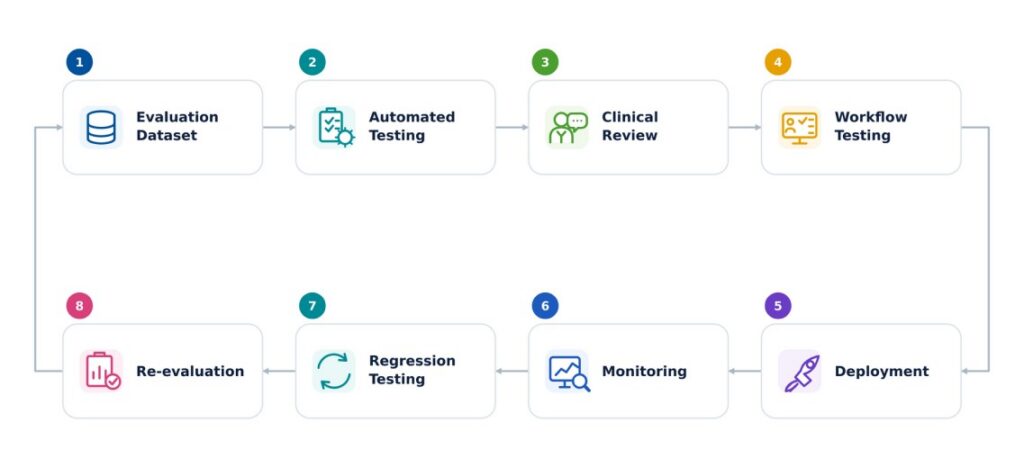
Healthcare terminology evolves, clinical guidelines change, new medications enter the market, and AI models themselves may be updated over time. All of these factors can affect documentation quality.
Continuous monitoring enables organizations to detect gradual performance degradation before it becomes clinically significant.
Production monitoring should include periodic sampling of generated notes, expert clinical review, hallucination tracking, user feedback analysis, and comparison against historical performance benchmarks.
Regression testing becomes especially important whenever prompts, model versions, retrieval systems, or supporting infrastructure change.
Organizations should also maintain clear governance procedures for documenting model updates, validating new releases, and approving deployment only after predefined quality thresholds have been met.
Healthcare AI should be treated as a continuously evolving clinical system rather than a one-time software release.
Why Comprehensive QA Matters for Healthcare AI
As LLMs become increasingly integrated into clinical documentation, expectations for quality continue to rise. Healthcare providers need systems that are not only intelligent but also predictable, transparent, and trustworthy.
Achieving that level of confidence requires far more than verifying whether an AI can generate fluent medical text. It demands structured evaluation frameworks, realistic datasets, expert clinical validation, workflow testing, security assessments, regression testing, and continuous monitoring throughout the application’s lifecycle.
For organizations developing healthcare AI solutions, comprehensive QA becomes a strategic investment rather than a final checkpoint. It helps reduce clinical risk, improve physician confidence, strengthen regulatory readiness, and ultimately protect patient outcomes.
The future of AI-powered clinical documentation is incredibly promising, but its success will depend less on how sophisticated the language model is and more on how rigorously its accuracy is tested. By combining disciplined quality assurance practices with healthcare expertise, organizations can move beyond impressive demos and deliver clinical AI systems that healthcare professionals can genuinely rely on day after day, patient after patient.
That is the standard modern healthcare software should aim for, and it is exactly where disciplined AI testing makes the greatest difference.