




Latest Insights
Why Multilingual AI Medical Scribe Testing Matters for Diverse Practices
- Oct 20, 2026
- Sajid M.
- Multilingual AI Medical Scribe Testing
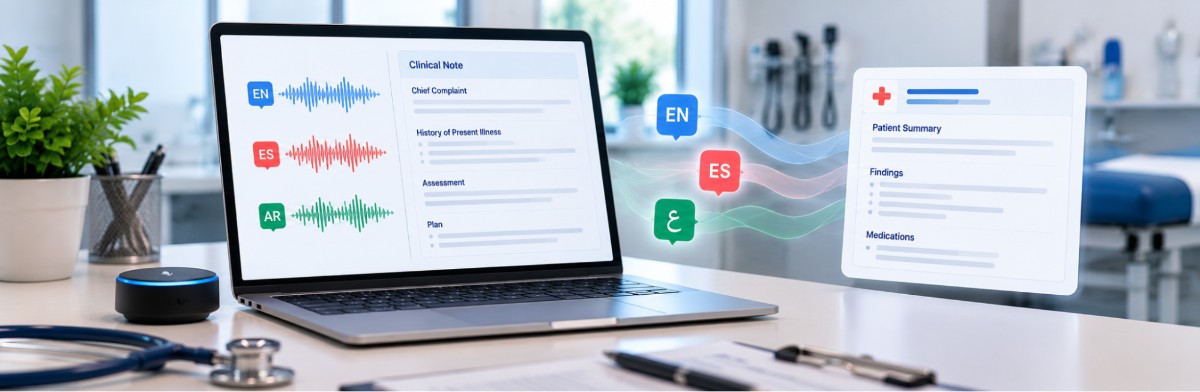
Healthcare is becoming increasingly diverse, and communication is at the center of delivering quality patient care. Medical professionals regularly interact with patients who speak different languages, use regional dialects, or communicate through a combination of languages. While artificial intelligence is transforming clinical documentation, ensuring these technologies understand multilingual conversations accurately remains a significant challenge.
AI medical scribes promise to reduce administrative workloads by automatically converting patient-provider conversations into structured clinical notes. However, their effectiveness depends on more than speech recognition capabilities. At Testiva, we understand how comprehensive AI testing services help healthcare technology providers validate linguistic accuracy, clinical reliability, and consistent performance across diverse patient populations.
For multilingual healthcare environments, testing is not simply about recognizing different languages. It involves understanding medical terminology, preserving clinical context, identifying subtle communication differences, and preventing documentation errors that could compromise patient safety.
Understanding Multilingual AI Medical Scribes in Modern Healthcare
An AI medical scribe is an intelligent documentation solution that captures clinical conversations and transforms them into organized medical records. These systems typically combine automatic speech recognition (ASR), natural language processing (NLP), and generative AI to interpret conversations and produce clinical summaries.
Traditional medical documentation requires healthcare professionals to manually record symptoms, diagnoses, treatment recommendations, and follow-up instructions. AI-powered scribes streamline this process, allowing clinicians to focus more attention on patients rather than keyboards.
However, multilingual functionality introduces additional complexity. A system trained primarily on English medical conversations may struggle when processing Spanish, Arabic, Mandarin, Hindi, or conversations involving multiple languages.
Even when speech recognition appears successful, the generated clinical summary may contain incorrect terminology, omitted symptoms, or misleading interpretations. This makes multilingual AI medical scribe testing essential for practices serving linguistically diverse communities.
Why Language Diversity Creates Unique Testing Challenges
Language is rarely as predictable as AI training datasets suggest. Real clinical conversations include interruptions, incomplete sentences, colloquial expressions, emotional responses, and culturally influenced descriptions of symptoms.
Accents, Dialects, and Pronunciation Variations
Two patients speaking the same language may pronounce medical terms differently depending on their geographic background. Regional accents, speech patterns, and pronunciation differences can significantly affect automated transcription accuracy.
For example, an AI medical scribe trained on standardized Spanish might perform differently when processing Caribbean, Mexican, or European Spanish. Similar challenges exist across Arabic dialects and English-speaking populations.
Testing must therefore include representative speakers, varied accents, and realistic clinical interactions. Evaluating only standardized pronunciation creates misleading confidence in system performance.
Code-Switching During Medical Conversations
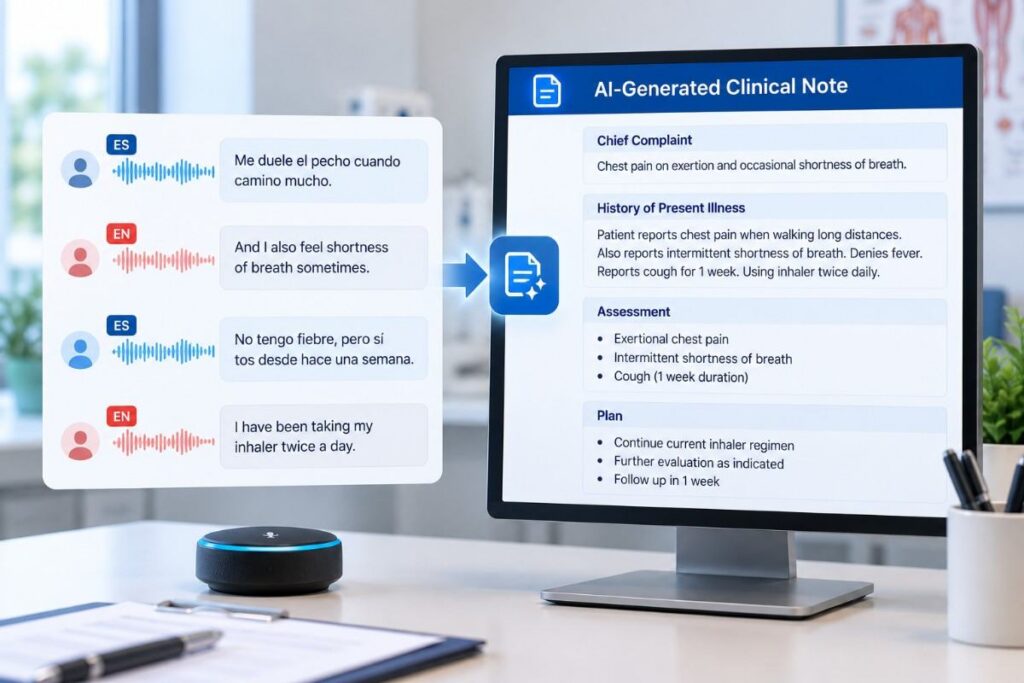
Code-switching occurs when speakers alternate between languages within the same conversation or sentence. This is particularly common in multilingual communities where patients and clinicians share more than one language.
A patient might describe symptoms in their native language while using English terminology for medications, procedures, or diagnoses. AI systems must recognize these transitions without losing meaning.
Testing should verify whether the medical scribe maintains clinical context across language switches, accurately identifies medication names, and generates coherent documentation without inventing missing information.
Cultural Differences in Symptom Descriptions
Patients do not always describe medical conditions using standardized terminology. Cultural background can influence how individuals communicate pain, emotional distress, fatigue, and other symptoms.
An expression that appears straightforward in one language may carry a different clinical meaning in another. Literal translation can therefore introduce dangerous inaccuracies.
Multilingual testing must evaluate semantic understanding rather than word-for-word transcription alone. The objective is to preserve the patient’s intended meaning while producing clinically useful documentation.
Clinical Accuracy Is More Important Than Translation Accuracy
A multilingual AI medical scribe can produce grammatically correct documentation while still misrepresenting critical medical information. This distinction makes clinical validation one of the most important aspects of healthcare AI quality assurance.
Consider a patient describing intermittent chest discomfort rather than continuous chest pain. If the AI incorrectly summarizes the symptom as persistent, the resulting documentation could influence clinical decisions.
Similarly, errors involving medication dosage, allergies, symptom duration, or negative findings can create significant patient safety risks.
At Testiva, we approach healthcare AI testing with an emphasis on functional reliability and realistic usage scenarios. Clinical accuracy evaluation should involve qualified medical reviewers who can determine whether generated notes faithfully represent the original conversation.
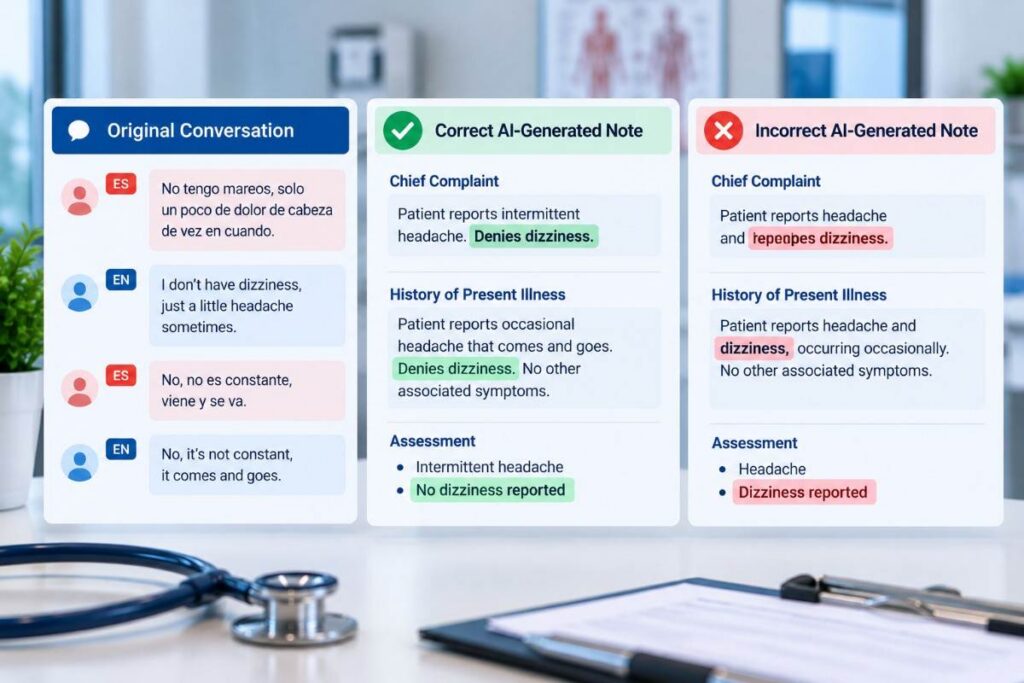
Important measurements include medical entity recognition, factual consistency, omission rates, hallucination frequency, and preservation of clinical negation.
For example, the difference between “patient reports dizziness” and “patient denies dizziness” is only one word, but clinically enormous.
How Multilingual AI Medical Scribe Testing Should Work
Effective testing requires a structured methodology that evaluates the entire documentation pipeline rather than individual AI components in isolation.
Building Representative Multilingual Test Datasets
Reliable evaluation begins with diverse, carefully curated test data. Datasets should reflect the languages, accents, specialties, and patient demographics encountered in actual healthcare environments.
Test conversations should include routine appointments, complex consultations, emergency scenarios, follow-up visits, and discussions involving sensitive medical information.
Synthetic conversations can help expand coverage, but they should not completely replace appropriately consented, de-identified, or otherwise lawfully processed real-world data.
Test datasets should also include difficult scenarios such as overlapping speech, background noise, unfamiliar medication names, and patients with limited language proficiency.
Evaluating Speech Recognition and Clinical Context
Speech recognition accuracy is commonly measured using Word Error Rate (WER), which compares recognized words against reference transcripts.
However, WER alone cannot establish whether an AI medical scribe is clinically reliable. A transcript might achieve impressive overall accuracy while repeatedly misidentifying critical medication names.
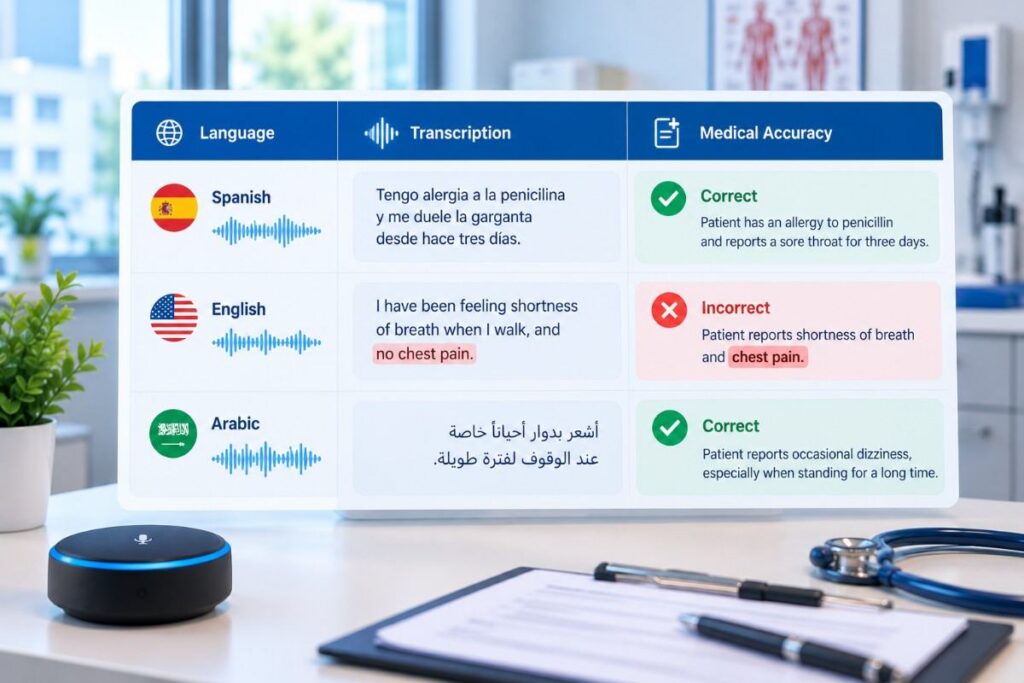
Testing should therefore combine transcription metrics with clinically weighted evaluations. Medical terminology recognition, numerical accuracy, language identification, and context preservation deserve particular attention.
Clinical reviewers should examine whether the final documentation accurately captures symptoms, diagnoses, treatment plans, and relevant patient history.
Validating Generated Medical Notes
The final clinical note is the most consequential output of an AI medical scribe. Even accurate transcription can produce unreliable documentation if the summarization model introduces unsupported conclusions.
Quality assurance must verify that generated notes remain faithful to the source conversation and follow the required documentation structure.
Testing should identify missing clinical details, duplicated information, contradictory statements, unsupported diagnoses, and incorrect attribution of speaker statements.
For multilingual conversations, reviewers should additionally verify that translation and summarization preserve medical meaning across languages.
The Role of Functional, Performance, and Security Testing
Language accuracy is only one dimension of medical scribe reliability. Healthcare organizations also need systems that integrate smoothly into clinical workflows, respond consistently, and protect sensitive patient information.
Functional testing validates recording controls, language selection, transcription workflows, note editing, clinician approval, and electronic health record (EHR) integration.
Performance testing examines response times, transcription latency, concurrent usage, and system stability under realistic workloads. A medical scribe that performs well during isolated demonstrations may struggle when dozens of clinicians use it simultaneously.
Security testing evaluates authentication, authorization, encryption, access controls, and potential exposure of protected health information. Multilingual processing pipelines may involve external services, making data handling and vendor boundaries especially important.
Healthcare AI developers must also evaluate applicable privacy and regulatory requirements, including HIPAA where relevant. Testing supports compliance efforts but does not independently establish regulatory compliance.
Why Continuous Testing Matters for Evolving AI Models
Unlike conventional software, AI medical scribes can change behavior when underlying models, prompts, transcription engines, or supporting datasets are updated.
An update that improves English transcription might unexpectedly reduce accuracy for less-represented languages. Similarly, a new summarization model could improve readability while introducing additional clinical omissions.
This is where continuous regression testing becomes essential.
Organizations should maintain multilingual benchmark datasets and execute repeatable evaluations whenever significant system changes occur. Results should be compared across languages, clinical specialties, accents, and high-risk documentation scenarios.
Automated testing can efficiently detect measurable changes, while human clinical evaluation remains necessary for nuanced interpretation.
Monitoring production performance, with appropriate privacy safeguards, can also reveal emerging issues that controlled testing environments fail to capture.
The Business and Patient Care Impact of Multilingual Testing
For healthcare technology companies, multilingual quality assurance directly influences product adoption, operational efficiency, and customer confidence.
Clinical teams are unlikely to trust an AI medical scribe that consistently requires extensive corrections. Documentation errors can eliminate anticipated time savings and introduce additional review responsibilities.
Reliable multilingual performance, by contrast, can help practices support more diverse populations without sacrificing documentation consistency.
Testing also helps organizations identify limitations before deployment, prioritize improvements, and communicate supported language capabilities accurately.
Importantly, multilingual support should never be presented as universal capability without sufficient evidence. Each supported language and clinical environment requires appropriate validation.
For diverse practices, dependable documentation technology contributes to more inclusive patient experiences while allowing healthcare professionals to retain control over clinical decisions.
Common Mistakes Healthcare AI Developers Should Avoid
One frequent mistake is evaluating multilingual functionality using translated English test scripts exclusively. Such datasets rarely capture authentic language switching, cultural expressions, or spontaneous clinical speech.
Another is relying entirely on aggregate accuracy scores. Strong overall performance can conceal serious failures affecting particular languages or patient groups.
Developers should also avoid treating successful transcription as proof of accurate clinical documentation. Transcription, interpretation, summarization, and EHR integration each introduce distinct failure opportunities.
Finally, launching multilingual features without clearly defined acceptance criteria makes it difficult to determine whether the system is genuinely ready for clinical use.
A risk-based testing strategy should establish measurable quality thresholds, prioritize patient safety, and require additional review for high-impact errors.
Building Trust Through Better Multilingual AI Testing
Multilingual AI medical scribes have enormous potential to improve healthcare documentation, but linguistic diversity makes rigorous validation indispensable.
Accurate transcription is only the beginning. Reliable systems must preserve clinical meaning, accommodate accents and code-switching, protect sensitive information, and produce documentation clinicians can confidently review.
At Testiva, we believe meaningful software quality comes from testing realistic conditions, identifying risks early, and validating performance throughout the product lifecycle.
For healthcare technology teams developing multilingual AI solutions, comprehensive quality assurance is an investment in safer workflows, stronger product reliability, and better patient experiences.