




Latest Insights
How to Scale Testing for an AI Note-Taking Application
- Aug 21, 2026
- Sajid M.
- AI Note Taking

Introduction to Scalable Testing for AI Note-Taking Application
Testing an AI note-taking application with five or ten recordings is enough to confirm it works on a good day. It tells you almost nothing about how it behaves the other 90% of the time, with a noisy room, a retracted medication, or a consultation in a language other than English.
A small, fixed set of test recordings tends to validate the same easy cases every time you run it. The failure modes that actually matter, a fabricated exam finding, a misattributed speaker turn during a brief interruption, a dropped negation under noisy audio, are exactly the kind of thing that only shows up reliably once you’re testing enough variety and volume. If your test set never includes a retracted medication or a non-English consultation, you won’t find out the system mishandles those cases until a real one happens in production.
Getting real confidence means scaling testing up: not just running more of the same recordings, but covering more scenarios, more formats, and more conditions, while still being able to trust the results coming out the other end. Scaling AI note-taking application testing requires expanding both test coverage and evaluation capacity together rather than focusing on only one part of the pipeline.
Four Pillars of Scalable Testing for AI Note-Taking Applications
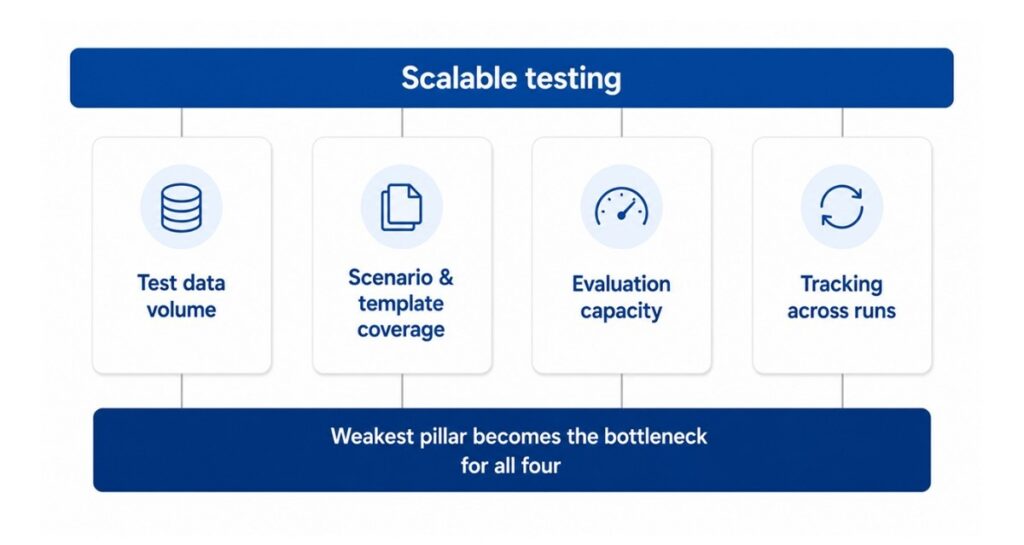
Scaling testing isn’t just “generate more audio.” Scalable AI testing requires test data, evaluation, execution, and tracking to grow together rather than independently. Four things need to grow together, or the weakest one becomes the bottleneck for all of them:
- Test data volume: enough conversations to cover rare scenarios, not just common ones
- Scenario and template coverage: every known failure pattern, tested across every note format the system supports, not just one or two
- Evaluation capacity: something has to check every generated note for hallucination, completeness, and accuracy, and that something has to keep up with the volume
- Tracking across runs: a way to know what’s already been tested, what failed, and whether a fix actually held the next time around
These four pillars form the foundation of scaling AI note-taking application testing, ensuring that increasing test volume also improves the reliability and usefulness of the results. Scaling one of these without the other three just moves the bottleneck somewhere else. More test data with no way to evaluate it just means more time before bugs are uncovered.
Common Challenges in Scaling AI Note-Taking Application Testing
Manually writing and recording conversations. Each new scenario means another script and another recording session, which doesn’t scale past a handful of cases.
Manually reading every generated note. Once you’re producing results across many test cases and multiple note formats, reading every one by hand stops being realistic.
An unverified automated judge. Using an LLM to grade notes solves the manual reading problem, but only if you also check whether that judge itself is consistent, which it often isn’t on its own.
No system for tracking what’s been tested. Without a structured record, it becomes easy to lose track of which scenarios have been covered, which defects are already known, and whether a fix actually resolved something or just looked like it did on one run.
These were the same bottlenecks we encountered while expanding Testiva’s AI testing framework from small-scale validation to large-scale AI testing and automated evaluation.
Scaling Test Data Generation for AI Note-Taking Applications
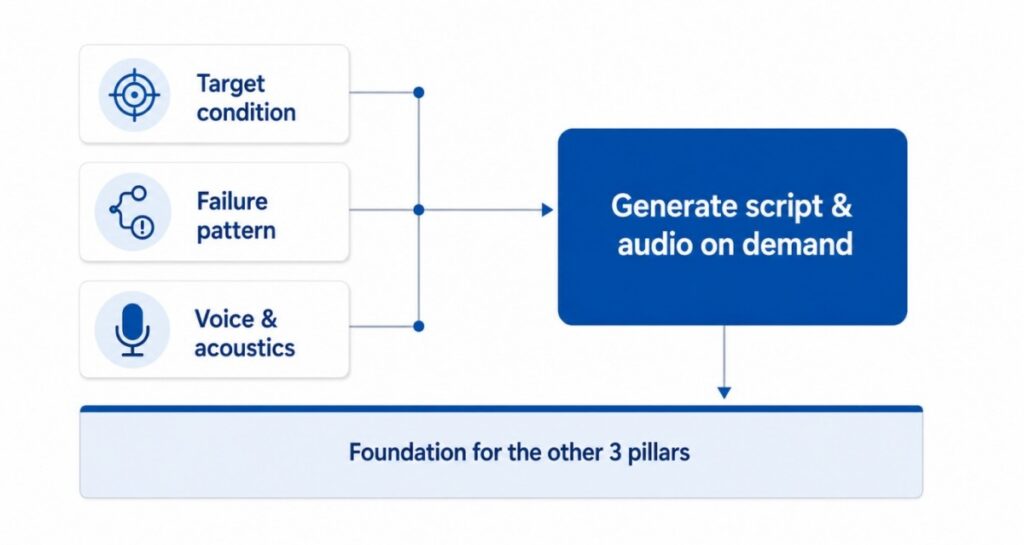
The starting point for scale is generating scripts and audio on demand instead of recording everything by hand. Asking for a script targeting a specific condition and a specific failure pattern, then converting it to audio with a chosen voice and acoustic condition, is what makes producing dozens or hundreds of test cases realistic instead of a multi-week effort.
At Testiva, automating this process became the foundation of our AI testing framework, allowing us to scale testing through consistent, repeatable scenarios across a wide range of clinical conditions and recording environments.
This part is covered in more depth in our test data generation guide. The short version here: without this step, none of the other three things can scale either.
Scaling Test Execution Across AI Note-Taking Applications
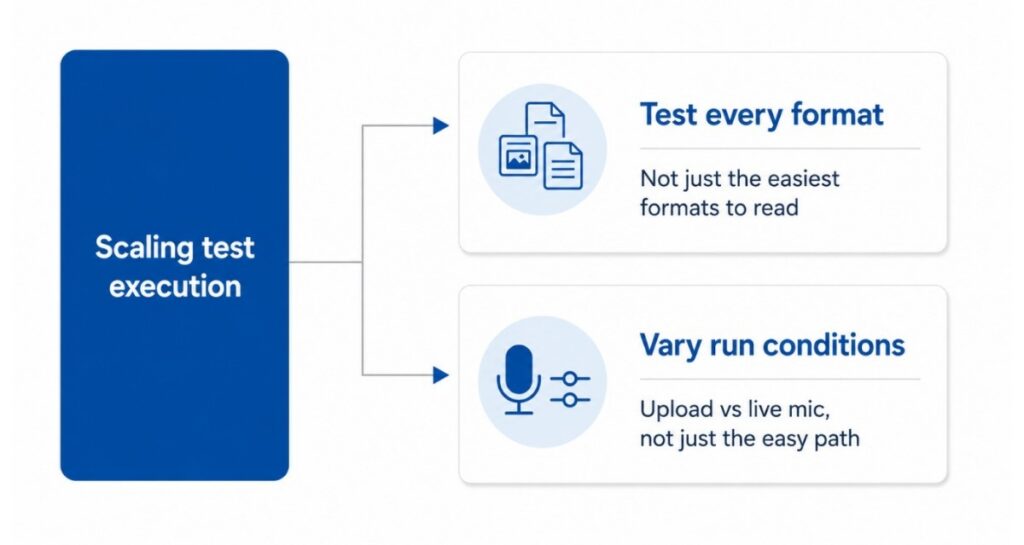
Once you can generate test data quickly, the next bottleneck is running it through the system in a structured way:
- Test every note format, not just the one or two formats that are easiest to read, since a defect doesn’t always show up identically across formats.
- Vary the conditions a script is run under on purpose, like testing the same conversation through both an uploaded file and a live microphone, instead of only ever testing the easiest path.
Scaling AI Note-Taking Application Evaluation Without Losing Trust
This is the hardest part to scale honestly. Reviewing every generated note by hand doesn’t scale past a small batch, but trusting a single automated judge fully isn’t reliable enough either, since a judge can give a different verdict on the exact same note depending on when you run it.
The approach that scales without losing trust combines three layers:
- Programmatic metrics that check transcription accuracy directly
- More than one LLM judge scoring the generated notes, so their verdicts can be cross-checked against each other
- A smaller layer of targeted human review, focused specifically on anything the judges disagree on or flag as failing
This keeps the volume of manual work manageable while still catching the cases where the automated check alone would have been wrong. Combining automated evaluation with targeted human review is essential for scaling AI note-taking application testing without sacrificing confidence in the results.
Scaling Regression Testing for AI Note-Taking Applications
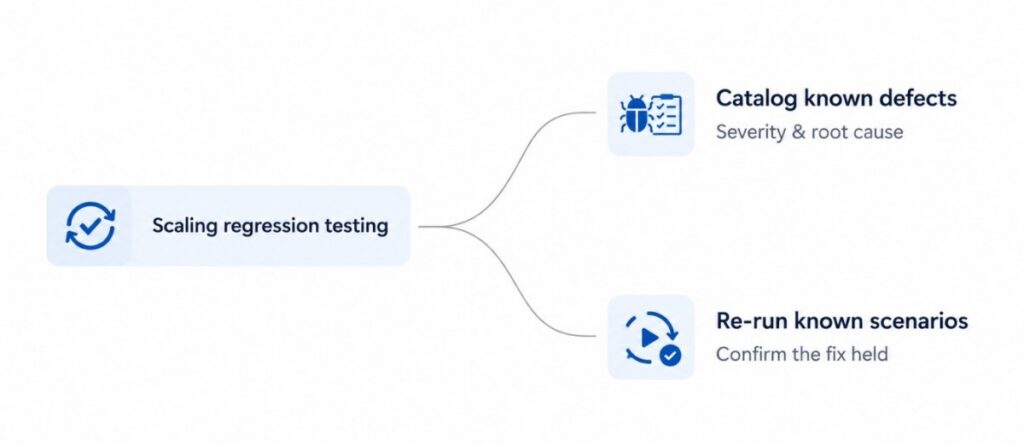
As test volume grows, you need a structured way to record what’s been tested, not a pile of one-off recordings and notes:
- Catalog known defects with a severity and a root cause, so a new test result can be checked against what’s already known rather than treated as a brand new mystery every time.
- Re-run known scenarios after every model or prompt update, to confirm a fix actually held rather than assuming it did because the update was supposed to address it.
Real-World Results from Scaling AI Note-Taking Application Testing
As part of Testiva’s evaluation framework, we scaled from a handful of manually recorded consultations to more than 70 test cases, each one evaluated across all seven note formats the system supports, resulting in several hundred individually generated notes being evaluated rather than just a few dozen. This approach enabled large-scale AI testing across hundreds of generated notes while keeping evaluations structured and repeatable.
That volume is what caught the rarer defects, the kind a small batch of easy recordings would have missed entirely:
- A non-English consultation propagating into every output format
- A low-volume recording silently dropping 16% of its content
- An Arabic transcript’s word error rate inflated by orthographic variants rather than real mistakes
- A parent-child consultation where the two voices got merged into one speaker about half the time
None of these are exotic edge cases, they’re exactly the kind of scenario you’d expect to encounter eventually, just not in five clean recordings.
Conclusion
Scaling AI note-taking application testing is essential for building reliable AI note-taking applications. Expanding test data, scenario coverage, evaluation capacity, and regression testing together helps uncover rare defects, detect hallucinations and transcription failures, and ensure consistent performance as AI models evolve.
At Testiva, we apply these best practices through a comprehensive testing framework that combines automated test generation, scalable evaluation, and structured regression testing. This enables teams to increase testing coverage, identify hidden failures, and build greater confidence in their AI note-taking applications.
Ready to scale testing for your AI note-taking application? Contact Testiva today for a demo of our testing framework and learn how structured QA can improve coverage, strengthen reliability, and reduce risks before deployment.