




Latest Insights
How to Test Voice-to-Clinical Note AI Systems: A Practical QA Framework for Accuracy, Safety, and Trust
- Sep 06, 2026
- Sajid M.
- Voice-to-Clinical Notes Testing
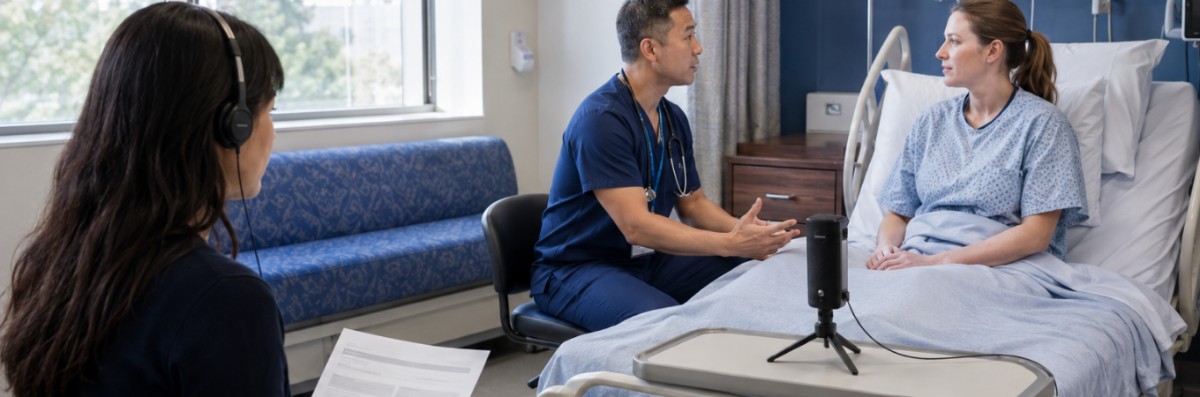
Healthcare documentation is changing rapidly. Voice-to-clinical note AI systems promise to reduce administrative workload, improve physician efficiency, and allow clinicians to focus more on patient care instead of keyboards. But unlike traditional software, these systems don’t simply process user input, they interpret conversations, understand medical terminology, infer context, and generate structured clinical documentation that may influence patient care.
That complexity makes quality assurance far more demanding than standard application testing. A voice AI system that transcribes a medication incorrectly, misses a symptom, or invents clinical information can introduce serious risks that extend well beyond usability issues. This is exactly why organizations developing healthcare AI increasingly invest in specialized QA testing services that combine functional validation, AI evaluation, healthcare workflows, and regulatory awareness from the earliest stages of development.
Testing a voice-to-clinical note AI platform requires far more than measuring transcription accuracy. Every component from speech recognition and language understanding to clinical reasoning, security, workflow integration, and human usability must be validated under realistic healthcare conditions. The goal isn’t simply to determine whether the AI works. It’s to determine whether clinicians can trust it when documenting real patient encounters.
Understanding the Complexity of Voice-to-Clinical Note AI
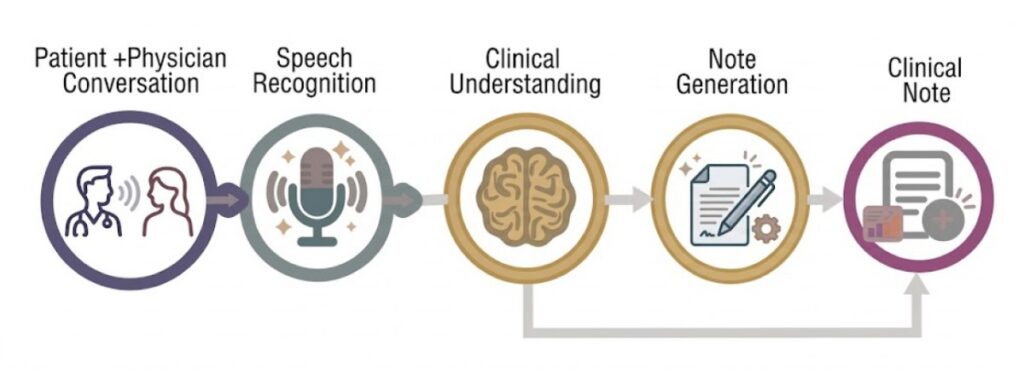
A voice-to-clinical note platform is rarely a single AI model. Instead, it’s an ecosystem of interconnected technologies working together throughout a patient encounter.
The process often begins with automatic speech recognition (ASR), which converts spoken conversation into text. That transcript is then analyzed by natural language processing models capable of identifying symptoms, diagnoses, medications, procedures, medical history, and contextual relationships between clinical concepts. Finally, a large language model or documentation engine transforms the extracted information into structured SOAP notes, discharge summaries, consultation reports, or specialty-specific documentation.
Every stage introduces opportunities for failure.
A transcription engine may confuse similar-sounding medications. The language model might misunderstand negation in a physician’s statement. The summarization model could omit clinically significant findings or generate unsupported conclusions. Even when each component performs well individually, unexpected behavior may emerge once the entire pipeline operates together.
Because of this layered architecture, testing must evaluate the complete workflow rather than isolated components.
Why Traditional Software Testing Isn't Enough
Conventional software testing focuses on expected outputs given predefined inputs. Functional requirements can often be verified through deterministic test cases.
AI-powered clinical documentation behaves differently.
Machine learning models produce probabilistic outputs. Two identical conversations may generate slightly different notes. Multiple documentation styles may all be clinically acceptable. Testing therefore shifts from checking whether the output matches an exact expected value to determining whether the output remains clinically accurate, complete, consistent, and safe.
This changes the definition of quality.
Instead of asking whether the note matches a reference document word for word, testers should ask questions like:
- Does the generated note preserve all clinically significant information?
- Were medications documented correctly?
- Were symptoms attributed to the correct patient?
- Was any information hallucinated?
- Would another physician consider this documentation medically acceptable?
- Could the output introduce patient safety risks?
Evaluating AI requires both technical metrics and clinical judgment.
Building Representative Test Data
The quality of AI testing depends heavily on the quality of the datasets used during validation.
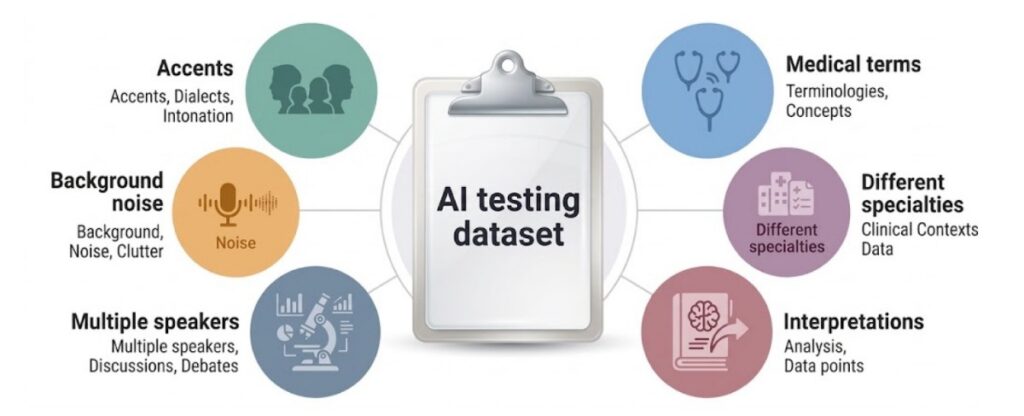
Synthetic conversations can help during early development, but production-level validation requires realistic clinical interactions representing diverse healthcare scenarios.
Test datasets should include conversations involving:
- Primary care visits
- Emergency medicine
- Pediatrics
- Cardiology
- Oncology
- Behavioral health
- Telemedicine consultations
- Follow-up appointments
- Medication reconciliation
- Complex multi-condition patients
Variation is equally important.
Patients speak differently depending on age, geography, education, emotional state, and native language. Physicians also have unique documentation styles, accents, pacing, and conversational habits.
A robust test dataset should include:
- Multiple English accents
- Fast and slow speech
- Background hospital noise
- Interrupted conversations
- Multiple speakers
- Medical abbreviations
- Rare disease terminology
- Drug brand and generic names
- Spontaneous corrections
- Incomplete sentences
Without sufficient diversity, impressive benchmark scores may fail to reflect real-world performance.
Evaluating Speech Recognition Accuracy
Speech recognition forms the foundation of the entire documentation pipeline.
Even small transcription mistakes can propagate into significant downstream clinical errors.
Testing should extend beyond calculating the traditional Word Error Rate (WER). Although WER remains valuable, healthcare requires additional metrics that prioritize clinical significance.
For example, confusing “hyperglycemia” with “hypoglycemia” carries dramatically different implications than confusing “the” with “a.”
Clinical transcription testing should therefore measure:
- Medication recognition accuracy
- Dosage accuracy
- Laboratory value recognition
- Numeric accuracy
- Medical abbreviation recognition
- Specialty terminology accuracy
- Speaker attribution accuracy
Edge cases deserve special attention.
Physicians often interrupt themselves, restart sentences, think aloud, or verbally revise diagnoses during conversations. The AI should correctly interpret these natural communication patterns without producing contradictory documentation.
Testing Clinical Understanding
Accurate transcription alone does not produce useful clinical notes.
The AI must understand meaning.
This is where natural language understanding becomes critical.
Clinical understanding testing evaluates whether the AI correctly extracts:
- Symptoms
- Diagnoses
- Medical history
- Allergies
- Procedures
- Family history
- Social history
- Treatment plans
- Follow-up recommendations
Context matters enormously.
Consider the sentence:
“The patient denies chest pain but reports occasional shortness of breath.”
A weak language model may incorrectly document chest pain as a positive symptom.
Similarly:
“The patient’s father had diabetes.”
This should never become:
“The patient has diabetes.”
These contextual relationships require carefully designed test scenarios covering negation, temporality, family history, hypothetical discussions, and conditional statements.
Validating AI-Generated Clinical Notes
The generated documentation ultimately represents the product clinicians use.
Every note should be evaluated across multiple quality dimensions rather than relying on a single overall score.
Completeness assesses whether every clinically relevant finding from the conversation appears in the final note.
Accuracy determines whether documented information matches the original encounter without distortion.
Consistency verifies that no contradictory statements exist within the document.
Readability ensures the note follows professional documentation standards and is easy for healthcare providers to review.
Clinical relevance confirms that trivial conversational details have been excluded while important medical information has been retained.
Perhaps most importantly, testers must identify hallucinations.
Large language models occasionally generate plausible-sounding information that never appeared in the conversation. In healthcare, fabricated diagnoses, medications, laboratory values, or treatment recommendations represent critical defects regardless of how fluent the generated text appears.
Testing Clinical Safety and Risk
Healthcare AI should always be evaluated through a patient safety lens.
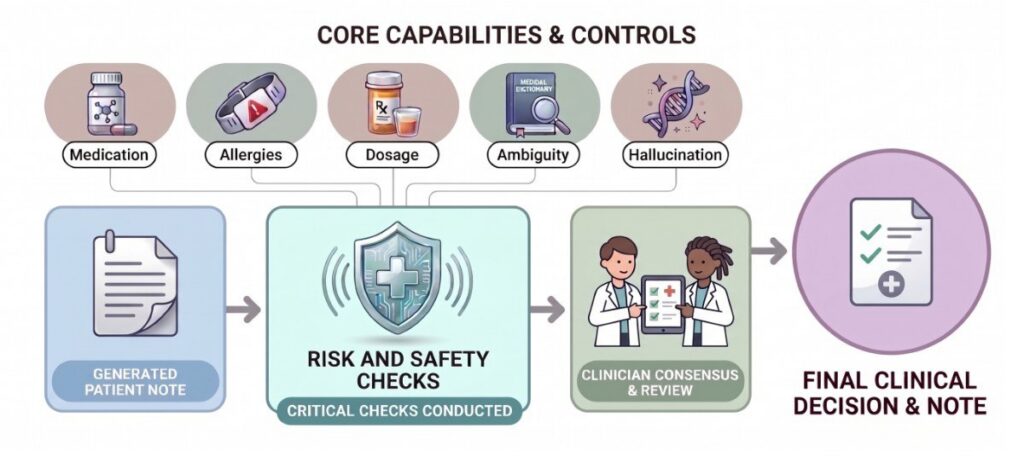
Risk-based testing prioritizes situations where documentation errors could cause clinical harm.
High-risk scenarios include medication prescriptions, allergy documentation, chronic disease management, emergency care, surgical procedures, pediatric dosing, and oncology treatment planning.
Testing should intentionally introduce challenging cases.
Examples include conversations involving similar medication names, conflicting information, multiple family members, overlapping diagnoses, or ambiguous symptoms.
The objective isn’t to prove perfection.
Instead, it’s to identify failure patterns before they reach production and determine whether appropriate safeguards prevent unsafe documentation from reaching clinicians.
Human review workflows should also be tested.
If the AI expresses low confidence or detects ambiguity, does it appropriately request clinician verification? Can physicians easily identify, edit, and approve suggested documentation?
Effective systems are designed around clinician oversight rather than blind automation.
Measuring Performance Under Real Clinical Conditions
Laboratory testing rarely reflects the realities of healthcare environments.
Hospitals are noisy. Internet connectivity varies. Conversations are interrupted. Clinicians multitask. Multiple devices interact simultaneously.
Performance testing should recreate these conditions as closely as possible.
Latency plays a major role in user experience.
If clinicians must wait several minutes after every patient encounter for note generation, workflow efficiency quickly declines.
Load testing should simulate:
- Hundreds of concurrent users
- Peak clinic hours
- Large hospital deployments
- Long consultations
- Multi-hour recordings
- Rapid back-to-back appointments
The platform should maintain acceptable response times without degrading transcription quality or note generation accuracy.
Scalability testing becomes especially important for enterprise healthcare organizations serving thousands of clinicians simultaneously.
Security, Privacy, and Compliance Testing
Voice recordings contain highly sensitive patient information.
Testing must verify that every stage of the system protects confidential healthcare data.
Security testing should evaluate authentication, authorization, encryption, secure storage, API protection, audit logging, and vulnerability management.
Privacy validation should confirm that recordings, transcripts, generated notes, and temporary processing data are handled according to applicable healthcare regulations.
Access controls deserve careful examination.
Only authorized users should be able to access patient recordings, generated documentation, or historical conversations. Session management, role-based permissions, and secure deletion policies should all be verified during testing.
Organizations should also validate that AI providers handle retained data appropriately and that data-sharing practices align with contractual and regulatory requirements.
Integration Testing Across Healthcare Ecosystems
Voice documentation platforms rarely operate independently.
They typically integrate with electronic health record (EHR) systems, scheduling platforms, clinical decision support tools, billing software, identity providers, and secure messaging systems.
Integration testing ensures information flows correctly between these systems.
Generated notes should populate the correct patient record.
Encounter metadata should remain synchronized.
Medication updates should not create duplicate records.
Failed integrations should generate meaningful alerts rather than silently losing documentation.
Testing should also include interrupted workflows, network failures, partial synchronization, duplicate submissions, and system recovery after outages.
Healthcare environments demand resilience because incomplete documentation can affect both patient care and reimbursement.
Human-Centered Testing for Clinical Adoption
Even highly accurate AI systems fail if clinicians don’t trust them.
Usability testing therefore becomes just as important as algorithm evaluation.
Clinicians should participate throughout the testing process to evaluate workflow efficiency, editing effort, cognitive load, and overall confidence in AI-generated documentation.
Useful metrics include average editing time, acceptance rate, correction frequency, physician satisfaction, and documentation completion time.
Qualitative feedback often reveals insights that automated metrics miss.
Physicians may report that certain summaries feel unnatural, that medication sections require frequent editing, or that the AI consistently emphasizes less relevant details while overlooking information they consider clinically important.
These observations help development teams refine documentation quality beyond statistical performance metrics.
Continuous Testing for Continuously Learning AI
Unlike conventional software, AI systems evolve rapidly.
Model updates, prompt modifications, retrieval improvements, and infrastructure changes can all influence documentation quality.
Testing should therefore become an ongoing process rather than a one-time release activity.
Regression testing should compare new model versions against established clinical benchmarks to detect unexpected declines in accuracy or safety.
Automated evaluation pipelines can continuously monitor transcription quality, hallucination rates, note completeness, latency, and clinician feedback after deployment.
Real-world monitoring is equally valuable.
Anonymous production metrics, human review outcomes, correction patterns, and clinician satisfaction scores provide early warning signals when model behavior begins to drift.
Continuous quality assurance ensures that improvements in one area don’t unintentionally introduce new risks elsewhere.
Delivering AI That Clinicians Can Trust
Voice-to-clinical note AI has enormous potential to reduce documentation burden and improve healthcare efficiency, but only when reliability is treated as a foundational requirement rather than an afterthought. Every stage of the pipeline from speech recognition and clinical language understanding to note generation, workflow integration, and security must be validated against realistic clinical scenarios.
At Testiva, we believe testing healthcare AI demands more than traditional software QA. It requires a thoughtful combination of functional testing, AI evaluation, performance engineering, usability validation, and risk-focused quality assurance that reflects how clinicians actually work. By rigorously evaluating accuracy, safety, resilience, and user experience, development teams can deliver systems that earn clinician confidence instead of merely demonstrating impressive benchmark scores.
As healthcare organizations continue adopting AI-assisted documentation, the differentiator won’t simply be how intelligent a model appears. It will be how consistently it performs in real clinical environments, how transparently it handles uncertainty, and how thoroughly it has been tested before reaching the point of care. Investing in comprehensive quality assurance today lays the foundation for AI solutions that support better documentation, stronger workflows, and, ultimately, safer patient outcomes.
If your organization is building AI-powered healthcare applications, comprehensive QA isn’t just another development phase it’s a strategic advantage. Unlock flawless delivery by partnering with experts who understand both software quality and the unique challenges of AI systems, ensuring your innovation reaches clinicians with the reliability they expect and patients deserve.