




Latest Insights
How to Test an AI SOAP Note Generator
- Aug 30, 2026
- Sajid M.
- AI Note Generation Testing

Healthcare documentation is undergoing a significant transformation. AI-powered SOAP note generators are helping clinicians reduce administrative burden, improve documentation speed, and spend more time with patients instead of keyboards. But while these tools promise greater efficiency, they also introduce an entirely new category of quality assurance challenges.
Unlike traditional software that follows predictable rules, AI systems generate content based on probabilities and learned patterns. That means testing an AI SOAP note generator goes far beyond verifying whether buttons work or forms submit successfully. It requires validating clinical accuracy, contextual understanding, consistency, privacy protections, and reliability across thousands of real-world scenarios.
At Testiva, we’ve seen firsthand how AI applications require a different QA mindset than conventional software. Rigorous AI testing helps organizations confidently deploy intelligent healthcare solutions without compromising quality, compliance, or user trust. While AI can dramatically improve documentation workflows, every generated note should be treated as clinical content that deserves comprehensive validation before reaching production.
Understanding What Makes AI SOAP Note Generators Different
A traditional application generally produces the same output every time a user performs the same action. AI doesn’t work that way.
Given identical patient conversations, an AI model may generate slightly different SOAP notes while remaining clinically accurate. That variability makes testing considerably more complex because the goal isn’t to verify exact outputs—it is to determine whether every acceptable output meets quality standards.
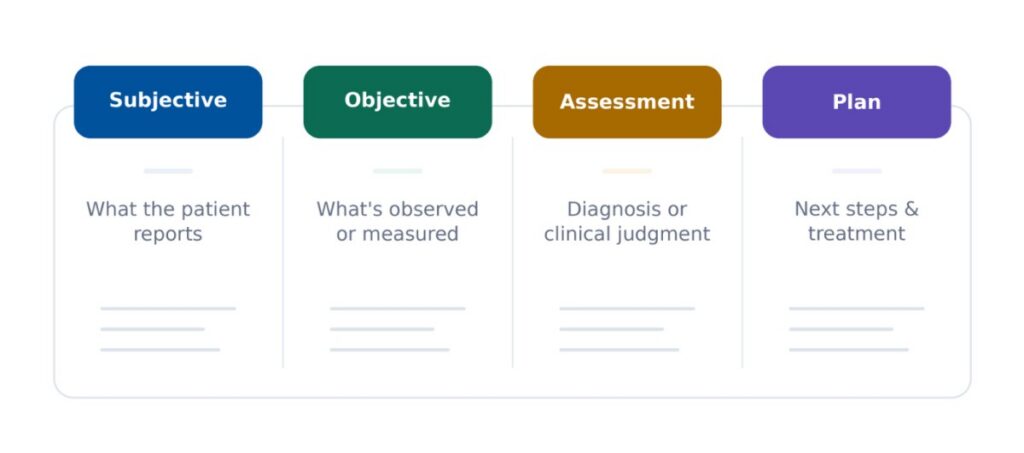
SOAP notes themselves also have a rigid clinical structure consisting of Subjective, Objective, Assessment, and Plan sections. A successful AI generator must not only produce grammatically correct text but also organize information appropriately, distinguish between patient-reported symptoms and objective findings, avoid fabricating information, and preserve medical meaning throughout the document.
This creates a multidimensional testing problem that spans software functionality, natural language generation, medical reasoning, usability, and security.
Establish Clear Evaluation Criteria Before Testing Begins
One of the biggest mistakes organizations make is jumping directly into test execution without defining success.
An AI SOAP note generator should be evaluated against measurable quality benchmarks rather than subjective impressions. Clinical reviewers, QA engineers, product owners, and healthcare stakeholders should collaborate to establish acceptance criteria before testing starts.
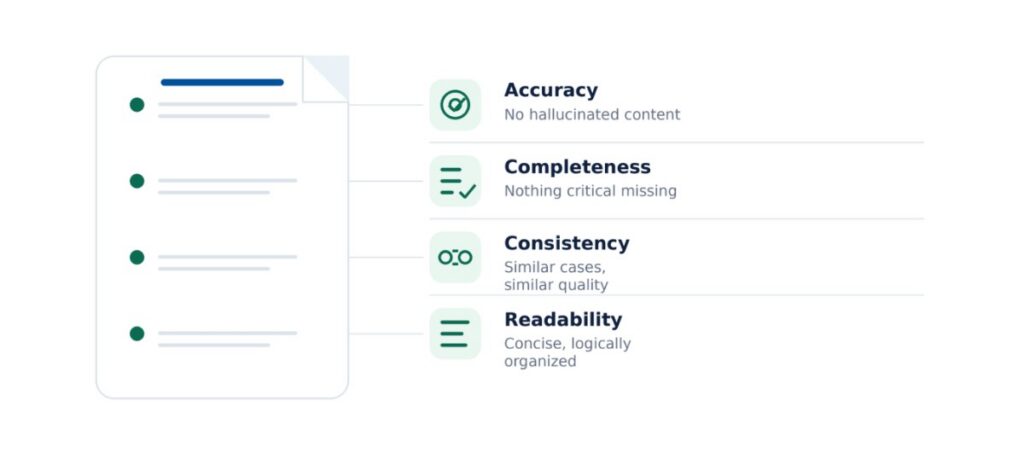
Accuracy should remain the highest priority. Every generated statement must faithfully represent the original patient encounter without introducing hallucinated symptoms, medications, diagnoses, or treatment plans.
Completeness is equally important. Critical medical information should never disappear simply because the model prioritized more common phrases or overlooked important conversational details.
Consistency also deserves attention. Similar patient encounters should produce documentation with comparable quality, structure, and terminology even if the wording varies naturally.
Finally, readability matters. Healthcare providers rely on notes that are concise, logically organized, and easy to interpret during future patient visits.
These criteria become the foundation for every testing activity that follows.
Build a Diverse and Realistic Test Dataset
AI quality depends heavily on the diversity of scenarios used during testing.
Limiting evaluation to straightforward patient conversations creates a dangerous false sense of confidence. Real clinical environments contain interruptions, incomplete information, conflicting statements, background noise, multiple speakers, and patients who describe symptoms using non-medical language.
An effective testing dataset should include routine wellness visits, chronic disease management, emergency consultations, pediatric appointments, mental health evaluations, telehealth sessions, specialist referrals, and follow-up visits.
Edge cases deserve particular attention.
Consider conversations where patients change their minds midway through the discussion, contradict previous statements, provide incomplete medication histories, or describe symptoms ambiguously. These situations often expose weaknesses that remain hidden during standard testing.
Testers should also evaluate conversations involving different accents, speech speeds, medical specialties, and varying levels of transcription quality if speech recognition is involved.
The broader the dataset, the greater the confidence that the AI will perform reliably in production.
Validate Clinical Accuracy Beyond Grammar
Perfect grammar does not guarantee a clinically correct SOAP note.
AI-generated documentation should undergo review by qualified healthcare professionals who can determine whether assessments accurately reflect patient information and whether plans align with accepted clinical reasoning.
Testing should identify situations where the AI:
- Attributes symptoms to the wrong patient
- Confuses historical conditions with current complaints
- Omits clinically significant findings
- Creates unsupported diagnoses
- Invents medications or treatments
- Misrepresents timelines
- Places information in incorrect SOAP sections
These issues can have serious consequences despite appearing linguistically flawless.
Clinical validation therefore remains one of the most important components of AI quality assurance.
Test Prompt Variability and Input Robustness
Users rarely interact with AI systems in perfectly standardized ways.
Clinicians may dictate notes differently depending on specialty, experience, workload, or personal preference. Some provide concise summaries while others narrate lengthy conversations.
Testing should intentionally introduce variability.
Evaluate short transcripts, lengthy consultations, fragmented conversations, repeated information, incomplete sentences, abbreviations, filler words, medical acronyms, and colloquial patient language.
The AI should consistently extract relevant information regardless of presentation style.
Noise tolerance should also be assessed.
If speech-to-text transcription is involved, evaluate how transcription errors influence SOAP note quality. Minor recognition mistakes should not completely derail documentation quality.
Robust AI systems gracefully recover from imperfect inputs rather than amplifying small errors throughout the generated note.
Evaluate Hallucination Resistance
Hallucinations remain one of the most discussed risks in generative AI.
A hallucination occurs when the model confidently generates information that was never present in the original conversation.
For healthcare applications, hallucinations represent more than simple inaccuracies—they may introduce clinical risk.
QA teams should specifically design tests intended to provoke hallucinations.
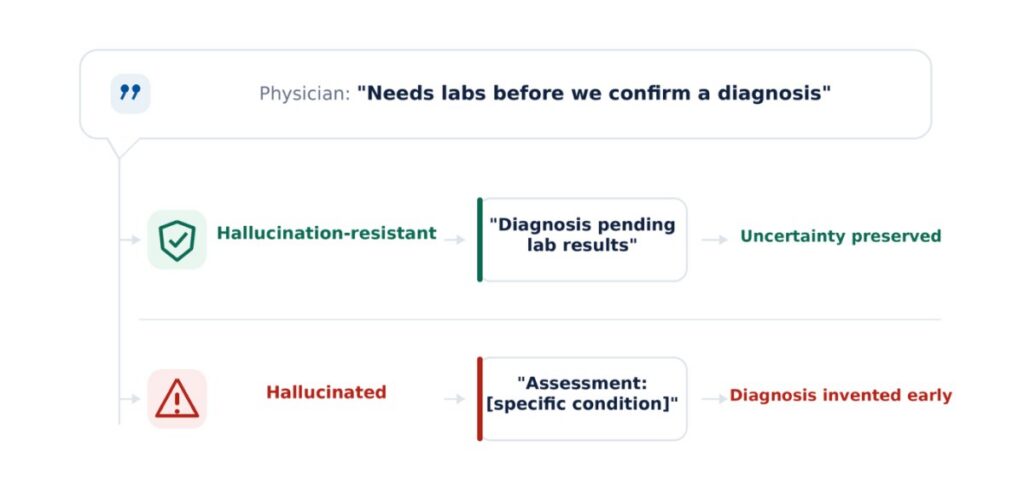
For example, provide conversations that intentionally omit medication information or diagnosis details. The resulting SOAP note should explicitly acknowledge missing information rather than inventing plausible content.
Similarly, test conversations containing uncertainty.
If a physician says additional laboratory testing is required before reaching a diagnosis, the generated note should preserve that uncertainty instead of prematurely assigning a condition.
Successful AI documentation testing understand the difference between inference and evidence.
Assess Consistency Across Multiple Generations
Unlike deterministic software, generative AI can produce different outputs from identical inputs.
Testing should therefore include repeated execution of identical scenarios.
Generate SOAP notes from the same transcript multiple times and compare outputs using predefined quality metrics.
Variation itself is not necessarily problematic.
However, critical clinical facts should remain stable.
Patient symptoms, diagnoses, medications, treatment recommendations, allergies, and timelines should never fluctuate between generations.
If medically significant information changes unpredictably, the model may require further refinement before deployment.
Perform Functional QA Alongside AI Validation
Although AI quality receives much attention, traditional software testing remains equally essential.
The surrounding application still requires comprehensive validation.
Test account creation, authentication, user permissions, note editing, export functionality, search capabilities, audit logs, version history, integrations with electronic health record systems, session management, notifications, and data synchronization.
Performance testing should evaluate how quickly SOAP notes are generated under realistic workloads.
Stress testing can identify bottlenecks when multiple clinicians simultaneously generate documentation during busy clinic hours.
Regression testing ensures future model updates or software releases do not unintentionally introduce new defects.
AI quality and application quality must evolve together.
Prioritize Security, Privacy, and Compliance Testing
Healthcare software operates under strict regulatory expectations regarding patient data.
Testing should verify that protected health information remains secure throughout every stage of processing.
Encryption should protect data both during transmission and while stored.
Access controls should prevent unauthorized users from viewing patient records.
Audit logs should accurately capture system activity for compliance purposes.
If third-party AI providers participate in note generation, organizations should carefully evaluate data handling practices, retention policies, and contractual obligations.
Penetration testing, vulnerability assessments, and privacy-focused QA become essential components of the overall testing strategy rather than optional additions.
Trust in healthcare AI depends just as much on protecting sensitive information as it does on generating accurate documentation.
Incorporate Human-in-the-Loop Testing
AI should support clinicians—not replace clinical judgment.
One of the most effective evaluation methods involves structured human review.
Healthcare professionals should assess generated notes based on predefined scoring rubrics covering accuracy, completeness, readability, usefulness, and required editing effort.
Track how often clinicians modify generated notes before finalizing documentation.
High edit frequency often indicates underlying AI weaknesses that automated evaluation may overlook.
Collect qualitative feedback alongside quantitative metrics.
Comments explaining why clinicians changed specific sections frequently reveal opportunities for model improvement that traditional bug reports fail to capture.
Continuous collaboration between QA teams and healthcare experts produces significantly better AI systems.
Measure Success Using Meaningful Quality Metrics
Testing should conclude with measurable evidence rather than subjective confidence.
Organizations should define key performance indicators that reflect both technical quality and clinical usefulness.
Examples include factual accuracy rates, hallucination frequency, clinical completeness scores, average editing time, user satisfaction ratings, response latency, generation success rate, structured formatting accuracy, and production defect rates.
Monitoring should continue after deployment.
Real-world usage inevitably uncovers scenarios that were absent during testing.
Continuous quality monitoring enables organizations to detect performance drift, evaluate model updates safely, and maintain long-term documentation quality.
Testing should be viewed as an ongoing process rather than a one-time milestone.
Final Thoughts
Testing an AI SOAP note generator demands a broader perspective than traditional software quality assurance. Functional correctness remains important, but it is only one piece of the puzzle. Clinical accuracy, contextual understanding, consistency, security, resilience, and human usability all play equally important roles in determining whether an AI documentation solution is ready for real-world healthcare environments.
The organizations that achieve the greatest success with healthcare AI are those that invest in comprehensive QA from the earliest stages of development. Instead of treating testing as a final checkpoint, they integrate quality throughout the entire AI lifecycle—from training data validation and model evaluation to functional testing, security assessments, and continuous production monitoring.
As AI continues to reshape healthcare documentation, rigorous testing becomes the foundation of trust. At Testiva, we believe quality assurance is what transforms promising AI technology into dependable clinical software that healthcare professionals can confidently rely on every day. By combining traditional QA expertise with specialized AI validation practices, organizations can unlock the full potential of intelligent documentation while maintaining the high standards that modern healthcare demands.