




Latest Insights
AI Clinical Documentation Testing: Everything You Need to Know
- Aug 24, 2026
- Sajid M.
- AI Clinical Documentation Testing

Clinical documentation has long been one of the most time-consuming aspects of patient care. Physicians spend countless hours recording encounters, updating Electronic Health Records (EHRs), and completing documentation that is essential for continuity of care, compliance, and reimbursement.
AI clinical documentation tools are changing that reality by automatically capturing conversations, generating structured clinical notes, and reducing the administrative burden on healthcare professionals without compromising workflow efficiency.
Yet the value of these systems depends entirely on one thing: trust. Clinical documentation isn’t an area where AI can afford to “mostly” get it right. Every diagnosis, medication, symptom, and treatment recommendation must be captured accurately and consistently because even a small error can affect patient outcomes, regulatory compliance, or financial processes.
That’s why comprehensive QA and AI testing play such a critical role in every deployment. At Testiva, we’ve seen that the difference between an impressive AI demo and a production-ready clinical documentation solution lies in rigorous testing that validates accuracy, reliability, security, and real-world performance before the technology reaches clinicians.
What Is AI Clinical Documentation?
AI clinical documentation refers to the use of artificial intelligence technologies to create, organize, summarize, or assist with medical documentation. Instead of requiring clinicians to manually type every observation, diagnosis, treatment plan, or patient interaction, AI systems can automatically generate structured clinical notes based on voice recordings, conversations, medical records, or physician inputs.
Modern solutions typically rely on Natural Language Processing (NLP), Large Language Models (LLMs), speech recognition technologies, and machine learning algorithms. These systems can identify medical entities, understand clinical context, extract relevant information, and produce documentation that aligns with healthcare standards.
Common applications include automated SOAP notes, discharge summaries, consultation reports, operative notes, referral letters, coding assistance, and documentation support within Electronic Health Record systems.
The primary objective is simple: reduce clinician burnout while improving documentation quality and efficiency. But achieving this objective depends entirely on the accuracy, reliability, and safety of the AI model behind the scenes.
Why AI Clinical Documentation Requires Specialized Testing
Traditional software testing focuses on whether an application functions correctly according to predefined requirements. AI systems introduce an entirely different layer of complexity because their outputs are probabilistic rather than deterministic.
Unlike conventional software, an AI documentation assistant may produce different responses when presented with similar clinical conversations. This variability makes testing significantly more challenging.
Healthcare also operates under strict regulatory expectations. Every generated clinical note must be medically accurate, contextually appropriate, complete, traceable, and compliant with privacy regulations. Testing therefore extends beyond validating application functionality—it must evaluate the intelligence itself.
An effective AI clinical documentation testing strategy verifies that the system consistently captures the correct diagnoses, medications, procedures, symptoms, allergies, laboratory values, and treatment recommendations without introducing hallucinations or omitting clinically significant information.
Core Components of AI Clinical Documentation Testing
Testing an AI documentation platform requires evaluating multiple dimensions simultaneously rather than treating it as a standard software application.
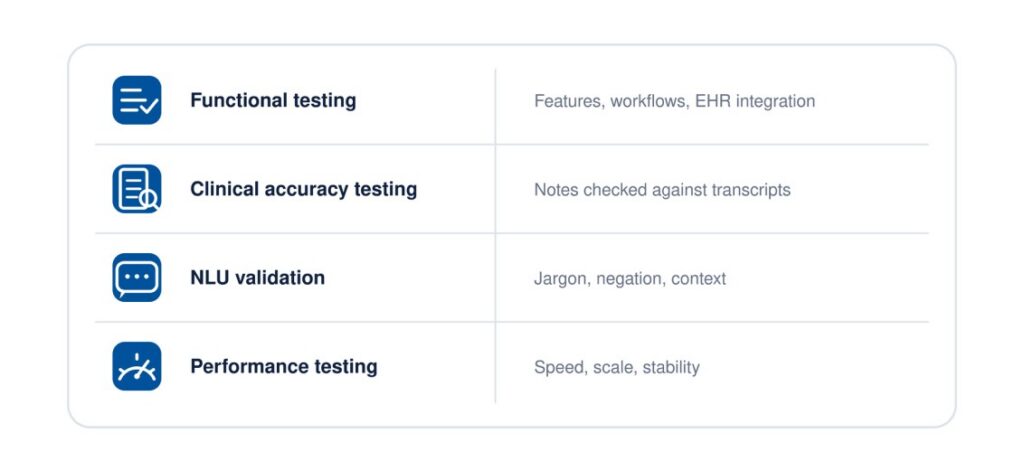
Functional Testing
Functional testing ensures that every feature performs as intended. The AI should correctly process voice recordings, generate notes, integrate with EHR platforms, save documentation, retrieve patient information where appropriate, and maintain expected workflows across different clinical scenarios.
Integration testing also plays an important role because AI documentation tools often communicate with scheduling platforms, patient management systems, billing software, and hospital information systems.
Clinical Accuracy Testing
Clinical accuracy is arguably the most critical aspect of testing.
The generated documentation must accurately reflect what was actually discussed during the patient encounter. Medical terminology, diagnoses, procedures, medications, laboratory values, allergies, and physician recommendations should all be represented correctly.
Even seemingly minor inaccuracies can have downstream effects on patient care, insurance claims, compliance, and legal documentation.
Testing teams often collaborate with healthcare professionals who review generated notes against verified clinical transcripts to evaluate accuracy and completeness.
Natural Language Understanding Validation
Healthcare language is remarkably complex.
The same symptom may be described in several different ways, abbreviations vary between specialties, and clinicians frequently use shorthand that depends heavily on context.
AI documentation systems must correctly interpret these variations without confusing similar medical concepts.
Testing evaluates how well the AI understands synonyms, abbreviations, medical jargon, contextual meaning, negations, temporal relationships, and specialty-specific terminology.
For example, the difference between “rule out pneumonia” and “confirmed pneumonia” is clinically significant. The AI must consistently understand that distinction.
Performance Testing
Clinical environments move quickly.
Healthcare professionals cannot afford delays while waiting for AI-generated documentation.
Performance testing measures response times, throughput, scalability, and system stability under realistic workloads. During peak clinic hours, thousands of concurrent users may generate documentation simultaneously.
The AI infrastructure must continue producing accurate outputs without latency, degradation, or service interruptions.
Evaluating AI Reliability Beyond Traditional QA
AI testing extends far beyond checking whether software works. It also examines whether the model behaves consistently across different situations.
Reliability testing includes evaluating repeatability, robustness, consistency, and resilience against unexpected inputs.
Clinical conversations rarely follow predictable scripts. Physicians interrupt themselves, patients change topics, accents vary, background noise exists, and incomplete sentences are common.
Testing must simulate these real-world conditions to determine whether the AI continues producing reliable documentation.
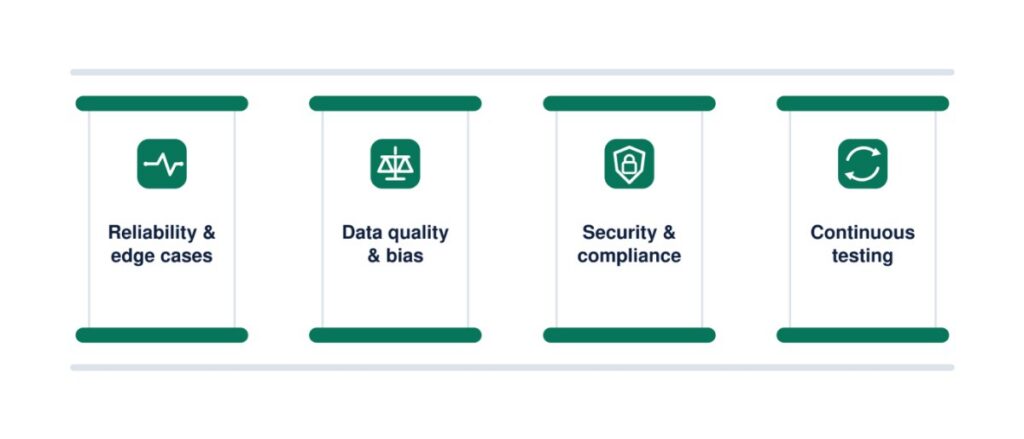
Edge case testing becomes particularly valuable here. Teams intentionally introduce difficult scenarios involving ambiguous symptoms, multiple concurrent conditions, unusual medical terminology, incomplete conversations, or conflicting information to assess how gracefully the AI responds.
Data Quality and Dataset Validation
An AI model is only as good as the data used to train and evaluate it.
Dataset validation ensures that training and testing data accurately represent diverse patient populations, specialties, languages, demographics, clinical settings, and documentation styles.
Poor data quality often leads to biased outputs, inconsistent recommendations, or reduced accuracy for underrepresented patient groups.
Testing should identify gaps within datasets while evaluating whether model performance remains consistent across age groups, genders, ethnic backgrounds, medical specialties, and geographic regions.
Balanced datasets significantly improve fairness while reducing unintended bias in generated documentation.
Security and Compliance Testing
Healthcare applications operate under some of the strictest privacy and security requirements of any industry.
AI documentation systems routinely process Protected Health Information (PHI), making security testing a mandatory part of quality assurance.
Testing should verify encryption, secure authentication, role-based access controls, audit logging, data retention policies, API security, vulnerability management, and infrastructure resilience.
Compliance testing also confirms alignment with applicable healthcare regulations such as HIPAA, GDPR, and regional healthcare privacy frameworks.
Organizations should additionally validate that AI-generated content does not unintentionally expose confidential patient information through logs, debugging tools, or external integrations.
Hallucination Testing and Risk Assessment
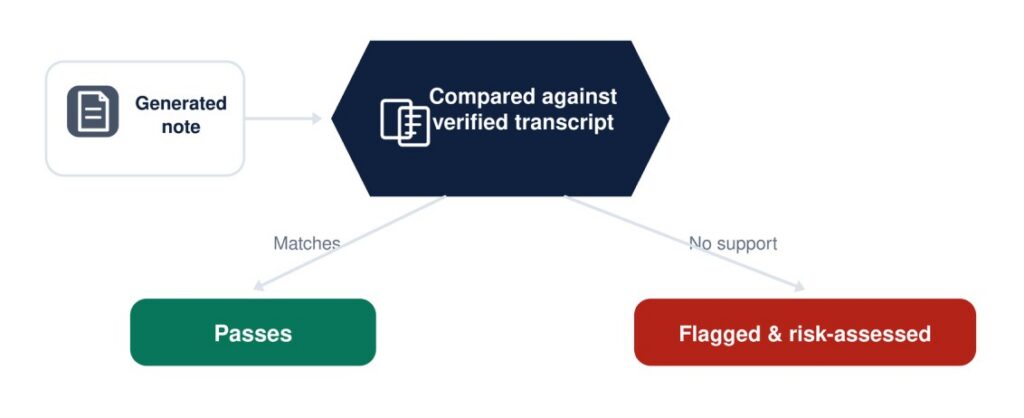
One of the unique challenges introduced by generative AI is hallucination.
Hallucinations occur when an AI confidently generates information that is inaccurate, fabricated, or unsupported by the source conversation.
In healthcare, hallucinations can become dangerous if nonexistent medications, diagnoses, procedures, or recommendations appear within patient documentation.
Testing teams intentionally compare generated notes against verified transcripts to identify fabricated content.
Risk assessment also measures the severity of different error categories. Some mistakes may be minor formatting issues, while others could directly affect patient safety.
Organizations should establish acceptable error thresholds and implement human review workflows where appropriate.
Bias and Fairness Testing
Healthcare AI should deliver equitable outcomes regardless of patient demographics.
AI Bias testing evaluates whether documentation quality varies across populations based on age, race, gender, disability status, language proficiency, socioeconomic background, or other protected characteristics.
Testing involves comparing outputs across diverse patient cases while identifying systematic disparities.
Addressing bias requires continuous monitoring rather than one-time validation because AI models evolve over time through updates and retraining.
Maintaining fairness is both an ethical responsibility and a practical requirement for trustworthy healthcare AI.
Continuous Testing for Continuously Learning AI
Unlike traditional software releases, AI systems frequently evolve.
New training data, updated language models, refined prompts, and model parameter adjustments can all influence documentation quality.
Continuous testing allows organizations to detect unintended regressions before they impact production environments.
Modern QA pipelines increasingly include automated regression testing, synthetic clinical datasets, benchmark evaluations, prompt validation, and ongoing production monitoring.
Rather than treating testing as a final deployment step, leading healthcare organizations integrate AI quality assurance throughout the entire development lifecycle.
This proactive approach enables faster innovation while maintaining confidence in model performance.
Best Practices for AI Clinical Documentation Testing
Organizations that successfully deploy AI clinical documentation platforms generally follow a structured testing strategy rather than relying solely on automated model evaluations.
Testing should combine traditional software QA with AI-specific validation techniques. Clinical experts should participate throughout testing to verify medical correctness, while QA engineers validate functionality, performance, security, and usability.
Realistic clinical scenarios should be incorporated into test datasets instead of relying exclusively on synthetic examples. Organizations should also establish measurable quality benchmarks, continuously monitor production performance, regularly evaluate bias, and perform regression testing whenever models or prompts change.
Most importantly, testing should be viewed as an ongoing quality process rather than a one-time milestone before release.
The Future of AI Clinical Documentation Testing
AI clinical documentation will continue evolving as language models become more capable and healthcare workflows become increasingly digital.
Future systems are expected to deliver real-time documentation, multilingual support, specialty-specific clinical reasoning, predictive insights, and deeper integration across healthcare ecosystems.
As these capabilities expand, testing methodologies must evolve alongside them.
The future belongs to organizations that recognize AI quality assurance as a competitive advantage rather than a compliance requirement. Thorough testing builds trust among clinicians, protects patients, supports regulatory compliance, and ultimately enables healthcare providers to confidently adopt AI technologies.
At Testiva, we believe that every AI solution deserves the same level of precision expected from the healthcare professionals who rely on it. Comprehensive QA isn’t just about finding defects—it’s about ensuring intelligent systems consistently deliver safe, reliable, and trustworthy outcomes in environments where accuracy matters most.
As AI becomes a permanent fixture in clinical documentation, organizations that invest in rigorous testing today will be far better positioned to deliver reliable healthcare solutions tomorrow. Unlocking flawless delivery starts with quality, and in healthcare, quality is never optional.