




Latest Insights
Testing Conversational AI for Patient Intake Workflows
- Sep 19, 2026
- Sajid M.
- Conversational AI Patient Intake Testing

Patient intake used to be a clipboard problem. Now, increasingly, it is a conversation problem.
Healthcare organizations are introducing conversational AI to collect symptoms, demographics, medication details, insurance information, appointment context, and other pre-visit data before a patient ever speaks with a staff member. Done well, these systems can reduce administrative friction and make intake feel less like completing a database record. Done poorly, they can misunderstand a patient, lose critical context, expose sensitive information, or confidently send the conversation down the wrong path.
That makes conversational AI a particularly interesting QA challenge. At Testiva, our AI testing and quality assurance services approach these workflows as complete systems rather than treating the chatbot interface as an isolated feature. The real question is not simply whether the AI can produce a plausible response. It is whether the entire intake journey behaves reliably when real patients communicate in unpredictable, incomplete, and sometimes contradictory ways.
Why Patient Intake AI Requires a Different Testing Mindset
Traditional application testing often starts with deterministic expectations: provide input A, perform action B, and verify result C. Conversational AI makes that model considerably messier.
Two patients can communicate exactly the same medical concern using completely different language. One might say, “I have had a headache since yesterday,” while another writes, “My head has been killing me all morning.” A third may misspell several words, switch topics halfway through the answer, or provide information the system never explicitly requested.
A robust intake assistant must recognize relevant meaning while maintaining the correct conversational state. QA therefore needs to evaluate intent recognition, context retention, workflow logic, backend behavior, and response appropriateness together. A chatbot that sounds intelligent but stores the wrong information in the patient record is not a successful implementation.
Test the Workflow, Not Just the Conversation
One of the easiest mistakes in conversational AI testing is focusing heavily on individual responses. A response may appear perfectly reasonable while the workflow underneath it is already broken.
Imagine that an assistant asks whether a patient takes medication. The patient replies, “Only metformin now. I stopped taking the other prescription two months ago.” The system must distinguish current medication from discontinued medication, preserve the relevant details, and map them correctly to downstream fields. Simply recognizing the word “metformin” is not enough.
Testing should therefore follow information throughout its lifecycle: what the patient says, what the AI interprets, what the application stores, what APIs receive, and what healthcare staff eventually see. This end-to-end perspective catches failures that conversational evaluations alone frequently miss.

Build Test Scenarios Around How Patients Actually Communicate
Patients rarely behave like carefully written test scripts. They answer questions out of order, provide unnecessary details, correct themselves, misunderstand prompts, and occasionally refuse to answer.
Consider an intake assistant asking, “When did the pain begin?” A patient could answer “Monday,” “three nights ago,” “after dinner,” “I’m not sure, maybe last week,” or “Actually, it started earlier than I told you.” Each response creates different interpretation and state-management challenges.
A strong QA strategy includes clean responses, ambiguous language, spelling errors, slang, incomplete answers, corrections, repeated messages, topic changes, and unexpected information. Testing should also examine very short and unusually long responses. The objective is not to prove that the system works under ideal conditions. It is to discover where normal human behavior causes the workflow to become unreliable.
Validate Context Retention Across Multi-Turn Conversations
Patient intake is inherently contextual. Information collected during one exchange often determines what should happen several turns later.
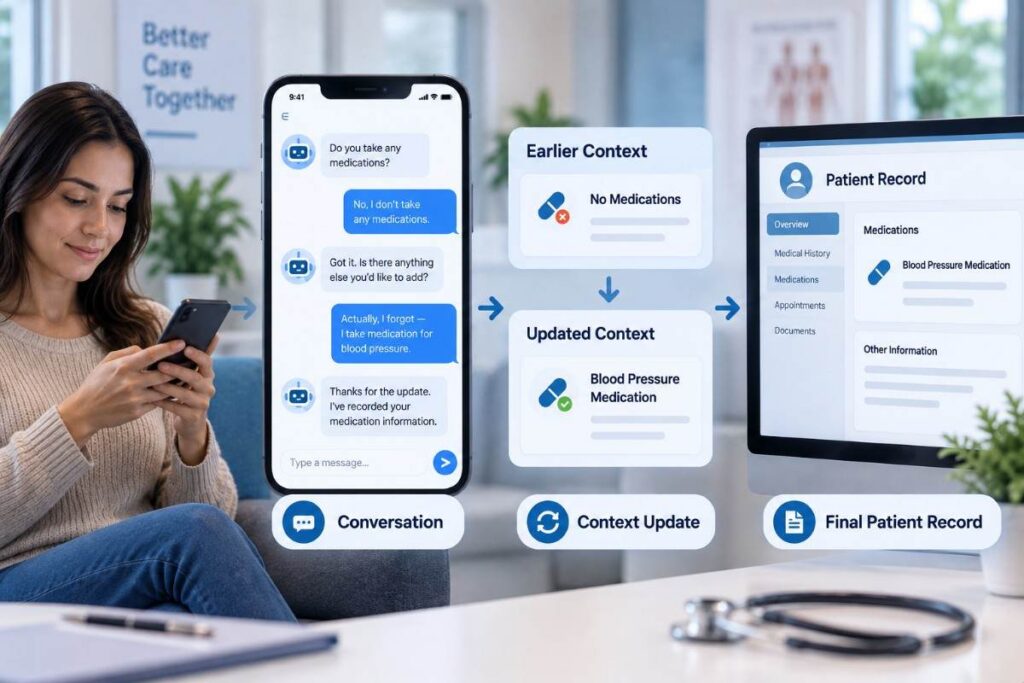
Suppose a patient initially reports no medications but later says, “I forgot I take something for blood pressure.” The assistant should be capable of updating the relevant context rather than preserving two contradictory facts without resolution. Similarly, if a patient changes an earlier answer about symptoms, contact information, or insurance, the workflow needs a predictable mechanism for handling that correction.
QA teams should deliberately create conversations containing revisions, contradictions, interruptions, and references to earlier statements. Long conversations deserve particular attention because context failures may only appear after numerous turns. Testing should verify not only whether the AI remembers information, but whether the application maintains an accurate final state.
Test Safety-Critical Escalation Behavior
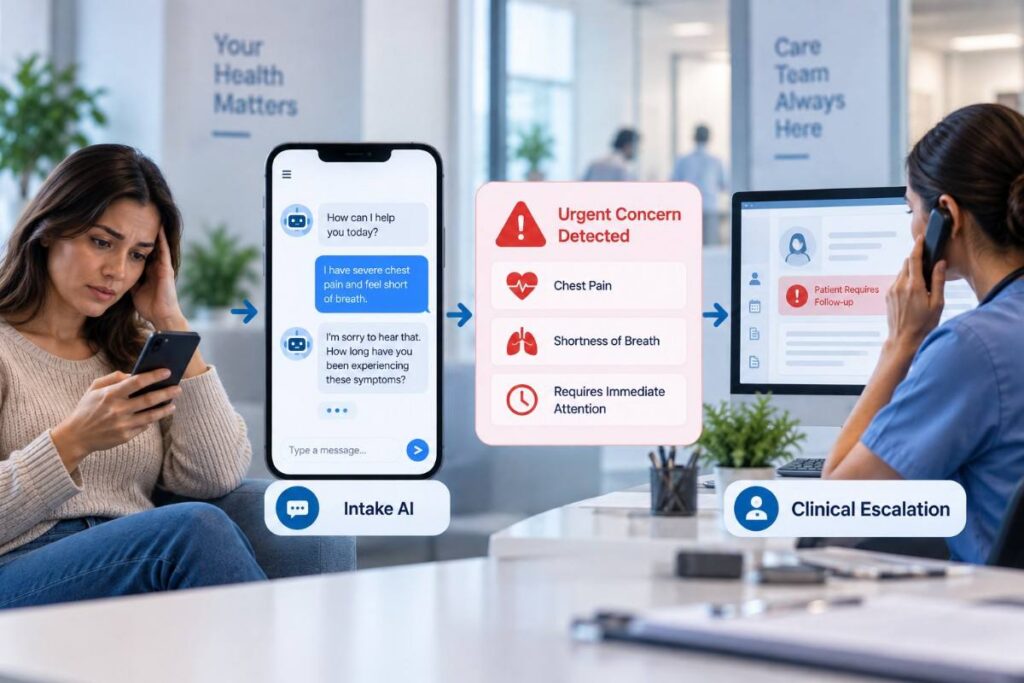
Patient intake automation becomes substantially more sensitive when conversations contain potentially urgent information. Even when an intake assistant is not intended to diagnose patients, it may encounter statements that require predefined escalation behavior.
Testing should verify that configured safety pathways activate consistently across different ways of expressing the same concern. Exact keywords cannot be the only mechanism if users naturally describe situations using varied language.
False negatives are particularly important because the system may fail to trigger an expected escalation. False positives matter too: excessive escalation can make the experience frustrating and reduce confidence in the tool. QA should test the boundaries around these rules and verify that escalation messages, routing, logging, and handoffs all operate as designed.
Treat Privacy and Security as Functional Requirements
Conversational intake systems can process highly sensitive patient information. Privacy cannot be something checked after the conversational experience has already been approved.
Testing should examine authentication, authorization, session handling, data transmission, storage, logs, analytics, and third-party integrations. QA teams should understand where patient information travels and whether unnecessary sensitive data appears in application logs, debugging tools, monitoring platforms, or error messages.
Session boundaries deserve special attention. One patient’s context must never leak into another session, and expired or interrupted sessions should behave safely. Security testing should also examine malicious or unusual inputs intended to manipulate the assistant, expose system instructions, bypass workflow restrictions, or retrieve information the user should not access.
Verify Integrations and Data Integrity
Conversational AI often sits on top of a much larger healthcare technology stack. It may communicate with scheduling platforms, patient portals, electronic health record systems, identity services, insurance workflows, or internal APIs.
Every integration introduces another opportunity for apparently successful conversations to produce incorrect outcomes. What happens when an API times out after the patient has completed ten minutes of intake? What if a downstream service accepts only part of the submitted data? What happens when two systems represent the same field differently?
Integration testing should validate field mapping, required data, retries, duplicate submissions, timeout handling, error recovery, and transaction integrity. The patient-facing interface should never announce successful completion when the backend has actually failed to save essential information.
Measure Conversational Quality Beyond “Pass” or “Fail”
Conversational AI benefits from metrics that reveal patterns traditional binary test results can hide. Intent recognition accuracy, task completion rate, fallback frequency, escalation accuracy, correction success, abandonment rate, response latency, and backend submission success can all expose different dimensions of quality.
These metrics become more useful when segmented. An overall 95% completion rate can look excellent until testing reveals that a particular intake path succeeds only 70% of the time.
QA should also evaluate qualitative characteristics such as clarity, consistency, relevance, and conversational efficiency. An assistant may technically complete intake while repeatedly asking confusing questions or forcing patients through unnecessary exchanges. Functional correctness and user experience need to be measured together.
Regression Testing Gets Harder When the AI Changes
Conversational systems evolve continuously. Model updates, prompt modifications, knowledge changes, workflow revisions, and backend releases can alter behavior that nobody intended to touch.
A small prompt adjustment designed to improve one intake question may influence responses elsewhere. This makes a strong regression suite essential. Teams should maintain representative conversation datasets covering standard journeys, edge cases, safety scenarios, integrations, and previously discovered defects.
Automated testing can replay large scenario libraries and detect changes at scale, but automation should not depend exclusively on exact text matching. The same acceptable answer can be phrased in multiple ways. Assertions should focus on required meaning, workflow state, captured data, prohibited behavior, and expected system actions wherever possible.
Human Evaluation Still Matters
Automation provides scale, but healthcare conversations contain nuance that metrics alone may miss. Human reviewers can identify awkward wording, confusing transitions, inappropriate tone, unnecessary repetition, or responses that are technically valid yet unsuitable for the context.
The strongest testing programs combine automated coverage with structured human evaluation. Automation can continuously exercise hundreds or thousands of conversation variants, while experienced testers investigate ambiguous outcomes and assess the overall patient journey.
This combination is especially useful before major releases. Machines are excellent at repetition; humans remain excellent at noticing when a conversation simply feels wrong.
Quality Is What Turns a Clever Chatbot Into a Reliable Workflow
Conversational AI can make patient intake faster and more accessible, but impressive language generation is only the visible layer of the system. Underneath it sits workflow logic, state management, sensitive data, APIs, safety rules, integrations, and countless assumptions about how people communicate.
Effective QA challenges all of those layers. It tests what happens when patients hesitate, contradict themselves, make mistakes, provide unexpected information, lose connectivity, or take paths the product team never included in the happy-flow diagram.
For healthcare organizations building conversational intake experiences, that distinction matters. The goal is not to ship an AI that can talk. It is to deliver a workflow patients and healthcare teams can depend on.