




Latest Insights
Common Bugs in AI Patient Intake Applications
- Sep 20, 2026
- Sajid M.
- AI Patient Intake Errors

A patient enters a symptom, answers a few questions, and receives a perfectly sensible response. Everything looks right. But behind that smooth interaction, the application may have misinterpreted a detail, lost context, or stored the correct information in the wrong field.
That is what makes AI patient intake applications uniquely challenging to test: bugs can hide behind an experience that appears intelligent. At Testiva, our AI application testing and functional QA focuses on uncovering these less-obvious failures across the entire patient journey.
Here are the common bugs teams should be watching for and why they matter.
AI Patient Intake Has More Failure Points Than a Standard Form
A traditional digital intake form is relatively deterministic. If a patient selects “Yes,” the application can be programmed to display question B. If they select “No,” it displays question C. There are still plenty of opportunities for bugs, but the expected behavior can usually be mapped clearly.
AI changes that equation. A patient might type, “I’ve had a tight feeling in my chest since yesterday, mostly when climbing stairs.” The application must extract useful meaning from natural language, retain relevant context, decide what to ask next, and pass structured information to downstream systems.
This creates a larger testing surface. The interface can behave perfectly while the interpretation layer fails. The AI can interpret the answer correctly while an integration stores it incorrectly. Or every individual component can appear healthy while the complete patient journey produces an inconsistent result.
That is why testing these systems requires attention to both conventional software defects and AI-specific behavior.
Incorrect Symptom Interpretation
Natural language is messy, and patients do not describe symptoms using standardized database values. They use abbreviations, misspellings, incomplete sentences, regional expressions, vague timelines, and everyday descriptions.
An AI intake application may therefore misunderstand phrases that seem obvious to a human reader. “My stomach has been off for three days” could be interpreted too broadly. “I get dizzy when I stand up” might lose the positional context. A negated statement such as “I haven’t had a fever” can become particularly problematic if the system incorrectly records fever as a positive symptom.
Testing needs to go well beyond clean, textbook prompts. We test variations in phrasing, spelling, context, negation, symptom combinations, and ambiguous descriptions to determine whether the application behaves consistently when patients communicate like actual humans rather than perfectly formatted test data.

Broken Conditional Questioning
One of the strongest features of AI-driven intake is adaptive questioning. Patients should not have to work through 40 irrelevant questions when their previous answers can determine which questions matter.
Unfortunately, branching logic is also an excellent hiding place for bugs.
An application might repeat a question that has already been answered, skip an important follow-up, display a question intended for a different patient profile, or continue asking about a symptom the patient explicitly denied. These defects can emerge from traditional rule logic, AI-generated follow-ups, or conflicts between the two.
The deeper the decision tree becomes, the harder it is to validate manually using only a few happy-path scenarios. QA must deliberately explore different answer combinations and transitions, including patients who change an earlier answer halfway through the intake process.
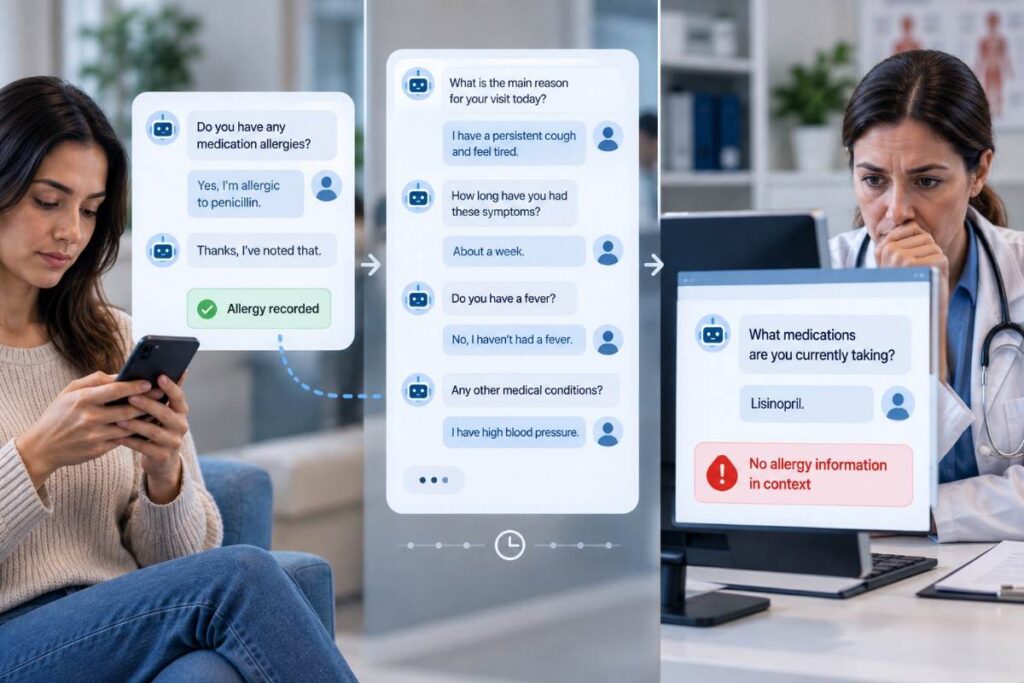
Context Loss During Longer Conversations
AI applications can appear remarkably intelligent for the first few exchanges and then suddenly develop digital amnesia.
Consider a patient who states early in the intake that they are allergic to a particular medication. Several screens later, the application asks for additional medical information and responds in a way that suggests the allergy is no longer part of the active context. The individual response may sound perfectly coherent while contradicting information already provided.
Context-loss bugs are especially important in conversational intake systems because users naturally expect the application to remember what they have already said. Testing should therefore include longer sessions, topic changes, corrections, back navigation, interrupted sessions, and information provided in different parts of the workflow.
The question is not simply, “Did the AI generate a reasonable response?” It is, “Did it generate a reasonable response given everything the patient has already told the system?”
Patient Data Mapping and EHR Integration Bugs
A polished intake interface means very little if the information arriving downstream is wrong.
Patient data often moves through several layers before reaching an EHR, practice management platform, scheduling system, or clinical dashboard. During that journey, fields can be truncated, transformed incorrectly, duplicated, assigned to the wrong category, or dropped entirely.
Dates are a classic example. Date formats, time zones, timestamps, and partially specified dates can create subtle discrepancies. The same applies to medications, dosage information, phone numbers, addresses, insurance identifiers, and structured symptom data.
Integration testing should verify more than a successful API response. We need to confirm that the correct information reaches the correct destination, retains its meaning, and remains associated with the correct patient and encounter.

Validation Bugs That Accept Bad Data or Reject Good Data
Validation sounds basic until real patients start entering information.
Overly permissive validation can allow impossible dates, malformed identifiers, unsupported file formats, blank mandatory fields, or nonsensical values into downstream systems. Overly restrictive validation creates the opposite problem: legitimate names, international phone numbers, unusual addresses, hyphenated information, or valid insurance details may be rejected.
AI can add another complication because unstructured input may eventually become structured data. If extraction and validation rules disagree, the application can silently modify information or force the patient into a value that does not accurately represent what they entered.
Good QA therefore tests boundaries, unusual but legitimate values, malformed input, copy-and-paste behavior, special characters, extremely long responses, and contradictory information not just standard examples.
Hallucinated or Unsupported AI Responses
Generative AI introduces a category of defect traditional form testing rarely encounters: an output can be grammatically excellent, contextually plausible, and still be unsupported.
In patient intake, this could mean the application infers information the patient never supplied, turns uncertainty into certainty, or presents an AI-generated assumption as though it were established patient data. Even subtle transformations matter. “I think I started taking it around March” should not silently become an exact medication start date.
QA teams need to evaluate groundedness as well as fluency. Generated responses and structured summaries should be checked against the original patient input to identify unsupported additions, omitted qualifiers, changed meanings, and unjustified certainty.
A confident interface should never make unverified data look more trustworthy simply because an AI generated it elegantly.
Session, Authentication, and Data Persistence Problems
Patient intake is rarely completed under laboratory conditions. People switch apps, lose connectivity, receive phone calls, accidentally refresh pages, use browser navigation, or abandon the process and return later.
These situations can expose persistence bugs. Answers may disappear after a refresh, previously deleted information can return, duplicate intake records may be created, or an expired session may behave unpredictably. In particularly problematic implementations, data from one state of the session can conflict with newer patient input.
Testing should cover session expiry, login recovery, autosave behavior, interrupted submissions, multiple tabs, repeated clicks, network failures, and resumed workflows. The application must know what has been successfully stored and communicate that state clearly to the patient.
File Upload and Document Extraction Errors
Many intake applications accept insurance cards, referral documents, identification, previous reports, or other files. AI-powered OCR and document extraction can make this process faster, but they also introduce another layer of potential failure.
Images can be blurry, rotated, cropped, poorly illuminated, or partially obscured. Documents can contain similar-looking characters, unusual layouts, handwriting, multiple pages, or information in unexpected locations. An extraction system may confidently populate a field with an incorrect value.
The QA challenge is therefore twofold. The upload mechanism itself must work across supported devices and formats, while extracted data must be validated against the source document. Testing only pristine sample files creates an unrealistic picture of production reliability.
Mobile and Accessibility Defects
A patient intake experience that works beautifully on a QA engineer’s desktop can become frustrating on a patient’s phone.
Virtual keyboards can cover fields or buttons. Date pickers can behave inconsistently. Long AI responses may push important controls below the visible area. Upload functionality may fail when accessing a mobile camera, and responsive layouts can break when validation messages appear.
Accessibility deserves equal attention. Keyboard navigation, screen-reader compatibility, meaningful labels, focus management, contrast, error messaging, and scalable text should be evaluated throughout the complete intake journey. Accessibility is not a decorative quality layer added after functionality; it directly determines whether some patients can complete the workflow at all.
Testing the Workflow, Not Just the AI
One of the biggest mistakes teams can make is treating an AI patient intake application as an “AI feature” surrounded by ordinary software. In reality, quality emerges from the complete system.
At Testiva, we look at these applications as connected journeys. A patient provides information. The interface captures it. AI interprets it. Business rules determine what happens next. Integrations move the data. Healthcare staff eventually consume the result. A defect anywhere along that chain can undermine everything that worked correctly before it.
Effective QA therefore combines functional testing, integration testing, compatibility checks, regression coverage, exploratory testing, and carefully designed AI behavior scenarios. It also requires testing uncertainty rather than pretending every input has one neat expected answer.
Reliable AI Starts With Relentless Testing
AI can make patient intake faster, more conversational, and considerably less tedious. But intelligence does not eliminate software defects. It gives them new places to hide.
The most dangerous bugs are not always dramatic crashes. They can be a missing negation, a forgotten piece of context, a subtly altered field, an unsupported inference, or a workflow branch that only fails for one unusual combination of answers. Those defects may be difficult to notice precisely because the rest of the experience looks polished.
For teams building AI-powered healthcare applications, the goal should be bigger than proving that the model works. The entire product must behave reliably when real patients provide imperfect information on imperfect devices under imperfect conditions.
That is where disciplined QA earns its place. Test the obvious paths, then test the strange ones. Test the model, the interface, the integrations, and the transitions between them. Because in patient intake, “the AI understood most of it” is not a quality benchmark worth shipping.