




Latest Insights
Testing AI-Powered Clinical Note Generation Systems
- Oct 14, 2026
- Sajid M.
- Note Generation testing

AI can turn a clinical conversation into a structured note in seconds, but fluent documentation is not necessarily accurate documentation. A system might record the wrong dosage, miss an allergy, or turn clinical uncertainty into a definitive diagnosis. In healthcare, these small errors can have serious consequences.
The challenge is ensuring generated notes accurately reflect the original encounter while preserving critical details, context, and uncertainty. At Testiva, our AI and software QA testing approach evaluates both application reliability and AI output under realistic, complex scenarios.
Because generative AI can produce unpredictable errors even when software functions correctly, testing must answer a critical question: can clinicians trust the generated note in a real-world workflow?
Why Clinical Note Generation Creates a Unique QA Challenge
Traditional applications generally operate according to predefined rules. Give the system a known input, follow a defined workflow, and testers can usually determine the expected output. Generative AI introduces probabilistic behavior. Two similar patient encounters may produce differently worded notes, and identical inputs can sometimes result in variations depending on model configuration, context, or system architecture.
That variability becomes especially important in healthcare. A generated sentence can be grammatically flawless while being clinically wrong. The system might confuse medication dosage, omit an allergy, attribute a symptom to the wrong person, transform uncertainty into certainty, or introduce information that was never discussed. None of these failures necessarily look like conventional software bugs.
Testing therefore needs to evaluate meaning, not simply output format. QA teams must determine whether generated documentation accurately represents the source encounter while preserving clinically significant details, uncertainty, chronology, and attribution. The question is no longer merely, “Did the feature work?” It becomes, “Can clinicians safely rely on what this feature produced?”
Clinical Accuracy Must Be Tested at the Fact Level
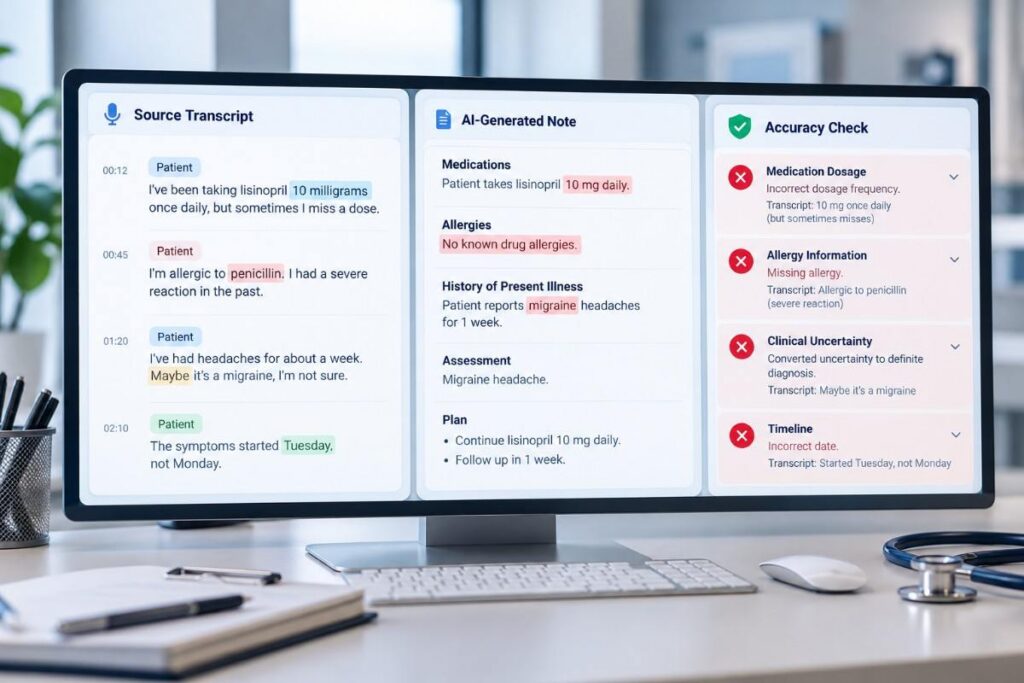
A polished note can create dangerous confidence. Clinical AI systems often generate coherent, professional language even when individual facts are inaccurate. Testing should therefore decompose generated notes into verifiable clinical claims and compare those claims with the original source material.
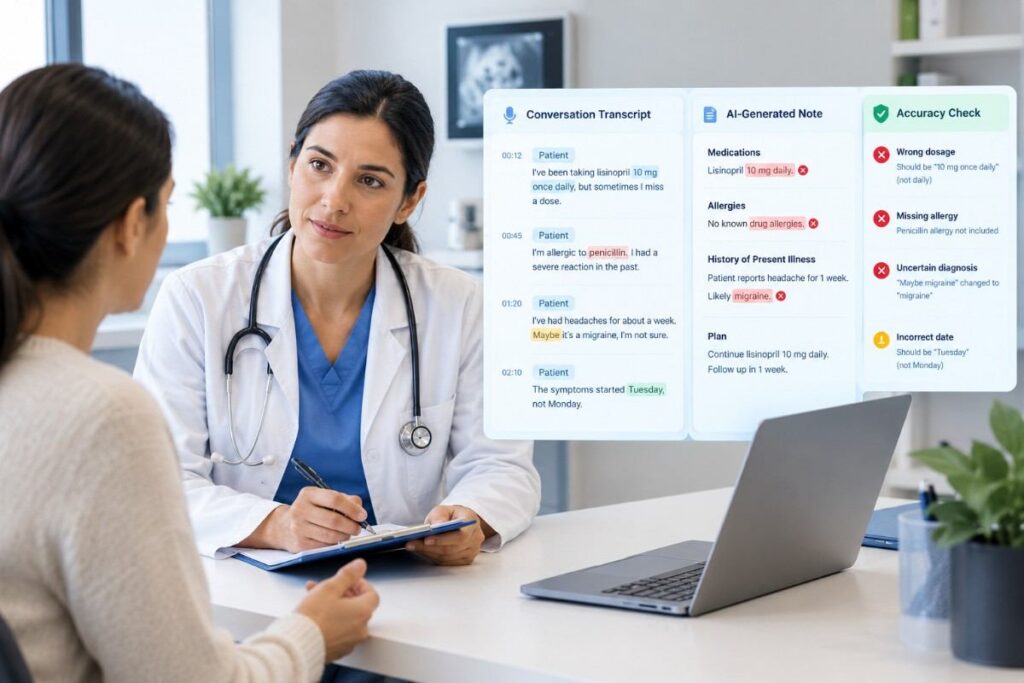
Suppose a patient reports taking 10 mg of a medication but occasionally missing doses. A generated note stating that the patient “takes 10 mg daily” has compressed away meaningful context. Similarly, converting “possible migraine” into “migraine” changes the clinical certainty of the statement. These differences may appear linguistically minor while carrying substantial downstream consequences.
Effective test datasets should include medications, dosages, symptoms, durations, allergies, diagnoses, family history, procedures, laboratory information, treatment plans, and follow-up instructions. Each category creates opportunities for insertion, deletion, substitution, or distortion. Testing at this granular level helps teams distinguish genuinely faithful summarization from text that merely sounds medically convincing.
Hallucinations Need Their Own Testing Strategy
Hallucination is one of the most recognizable risks associated with generative AI, but clinical hallucinations deserve particularly aggressive testing. A system may introduce a diagnosis that was never mentioned, invent a negative finding, add an unsupported medication, or infer a treatment recommendation from conversational context. Even occasional hallucinations can become unacceptable when generated notes enter clinical records.
QA teams should deliberately construct encounters containing incomplete information, ambiguous statements, interruptions, corrections, and unrelated conversation. These scenarios reveal whether the system acknowledges uncertainty or fills informational gaps with plausible inventions. Testing should also investigate whether particular note templates or specialty terminology increase hallucination frequency.
Crucially, hallucination testing cannot be reduced to checking for obviously fabricated sentences. Subtle hallucinations are often more dangerous because they blend naturally into legitimate documentation. A fictional blood pressure reading is easy to classify once detected; a slightly altered symptom duration may be much harder to notice during a busy clinician’s review.
Omissions Can Be Just as Dangerous as Fabrications
Generative AI quality discussions often focus on information the model invents, while missing information receives less attention. In clinical documentation, omission can be equally significant. Leaving out an allergy, contraindication, worsening symptom, medication change, or follow-up instruction may materially alter how another healthcare professional interprets the record.
Testing should measure whether clinically important information survives summarization. This requires more than calculating how much of a transcript appears in the final note. Different facts carry different clinical weight. Missing small talk is irrelevant; missing a patient’s history of anaphylaxis is not.
QA datasets should therefore identify critical facts before generation and measure their presence afterward. Teams can establish severity classifications for omissions and define acceptance thresholds according to clinical importance. This creates a more meaningful quality signal than generic text similarity metrics, which may reward stylistic resemblance while completely overlooking a missing safety-critical detail.
Test Ambiguity, Corrections, and Real Human Conversation
Real clinical conversations are messy. Patients change their answers, clinicians interrupt themselves, family members contribute information, and symptoms are often described indirectly. Someone might say, “Actually, it started Tuesday, not Monday,” or mention a medication before clarifying that they stopped taking it months ago. Clinical note systems must interpret these conversational dynamics correctly.
Test scenarios should reproduce this complexity instead of relying exclusively on clean synthetic transcripts. QA teams should include corrections, contradictory statements, background noise, accents, overlapping speakers, incomplete sentences, medical abbreviations, colloquial descriptions, and conversations that move rapidly between topics. Speaker attribution deserves particular scrutiny when multiple people participate.
These tests expose whether the complete pipeline understands the encounter rather than merely recognizing medical keywords. A system that captures both Monday and Tuesday but chooses the wrong date has technically extracted information while failing semantically. Clinical QA must be designed to catch precisely these deceptively plausible errors
Evaluate Note Structure and Clinical Usability
Accuracy alone does not guarantee that a generated note is useful. Documentation must also follow appropriate structures, preserve relevant sections, and present information in a way that clinicians can efficiently review. Depending on the product, that could involve SOAP notes, progress notes, consultation notes, discharge summaries, or specialty-specific templates.
Testing should confirm that information appears in the correct section and that generated content does not become unnecessarily repetitive or verbose. A symptom placed under the treatment plan or a historical medication represented as current can create confusion even when the underlying fact was extracted correctly. Formatting defects can therefore become semantic defects.
Human evaluation remains valuable here. Clinicians or qualified domain reviewers can assess whether notes are understandable, clinically appropriate, and realistically usable within daily workflows. Automated metrics can scale evaluation, but they should complement rather than replace expert judgment where interpretation affects clinical meaning.
Test Consistency Without Expecting Identical Language
Generative systems create an interesting testing problem: valid outputs do not need to be identical. Two notes can use different wording while communicating precisely the same clinical facts. QA teams therefore need consistency criteria based on meaning and required content rather than exact string matching.
Repeated evaluations can reveal whether important facts disappear intermittently, whether the model occasionally changes clinical certainty, or whether specific inputs trigger unstable behavior. Teams should test identical encounters multiple times where system configuration permits variation and compare the resulting notes for factual consistency.
This becomes especially important after model updates. A new model version may produce more elegant documentation while quietly increasing omission rates for certain encounter types. Regression testing should therefore maintain representative clinical evaluation sets and compare releases across meaningful quality dimensions instead of assuming newer automatically means safer or better.
Security, Privacy, and Data Handling Belong in the Test Plan
Clinical documentation systems process exceptionally sensitive information. QA must examine how patient data moves through transcription services, model endpoints, application databases, logs, analytics platforms, monitoring systems, and third-party integrations. Protecting the user interface while leaking sensitive content into debugging logs is not meaningful privacy.
Testing should verify authorization boundaries, encryption behavior, session management, data retention rules, auditability, deletion workflows, and safeguards around exported records. Teams should also investigate whether prompts, cached responses, error traces, or telemetry unintentionally preserve clinical information.
Privacy testing must reflect the actual architecture rather than relying on assumptions about the AI provider. Clinical note generation frequently involves multiple interconnected services. Every transition creates another place where data can be exposed, transformed incorrectly, duplicated, or retained longer than intended. Quality engineering needs visibility across that complete path.
Integration Testing Matters Beyond the AI Model
Even an exceptionally accurate model can fail inside an unreliable product. Clinical note generation typically depends on audio capture, transcription, identity management, APIs, template engines, electronic health record integrations, and synchronization mechanisms. Problems at any layer can corrupt the final documentation.
QA teams should test interrupted recordings, network failures, duplicate submissions, delayed responses, partial transcripts, expired sessions, integration outages, and concurrent edits. They should also verify that generated notes are attached to the correct patient and encounter. A perfectly accurate note associated with the wrong record is still a severe failure.
Resilience testing is particularly important because healthcare environments cannot assume perfect connectivity or uninterrupted workflows. Systems should fail transparently, preserve recoverable work where appropriate, and prevent incomplete generation from masquerading as completed documentation. Good AI testing therefore extends far beyond evaluating model prompts.
Build Risk-Based Metrics Before Production
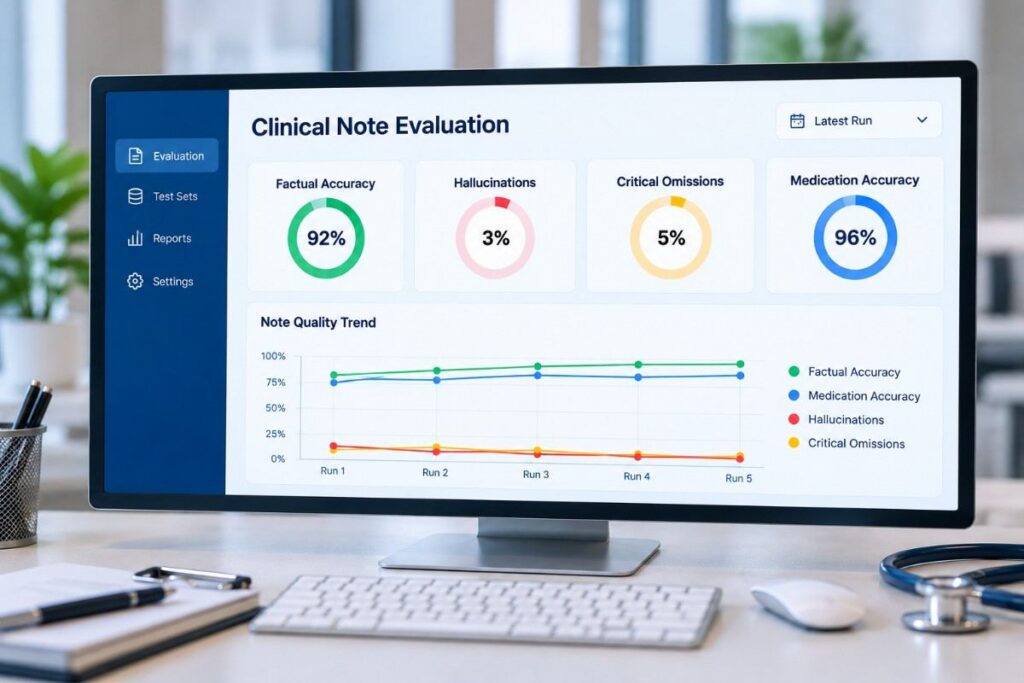
Clinical AI teams need measurable release criteria. Broad claims such as “the model is highly accurate” provide little operational value unless accuracy has been defined according to relevant failure categories. A stronger evaluation framework separates factual correctness, hallucination rate, critical omission rate, speaker attribution, medication accuracy, structural compliance, and workflow reliability.
Metrics should also be segmented. Overall performance can hide weaknesses affecting specific specialties, accents, encounter types, demographic groups, or unusually complex conversations. A system performing extremely well on routine primary-care encounters may behave differently during medication-heavy consultations or multi-speaker visits.
Severity matters as much as frequency. Ten harmless formatting inconsistencies should not necessarily outweigh one fabricated allergy or incorrect medication instruction. Risk-based scoring allows product teams to prioritize failures according to potential clinical impact and establish release gates that reflect real-world consequences rather than convenient aggregate percentages.
Continuous QA Is Essential for Clinical AI
Testing cannot stop when the system reaches production. Models change, prompts evolve, integrations are updated, user behavior shifts, and real encounters expose edge cases that development datasets never anticipated. Clinical AI therefore requires a continuous evaluation process.
Production feedback should feed controlled regression suites without turning sensitive patient data into unmanaged test material. Confirmed failures can be categorized, anonymized where appropriate, reproduced safely, and converted into future evaluation scenarios. Over time, the test suite should become a growing map of known risks.
Teams should also monitor whether improvements in one quality dimension cause regressions elsewhere. Prompt changes intended to create shorter notes, for example, could increase clinically important omissions. Continuous QA makes these trade-offs visible before seemingly small optimizations become systemic problems.
Reliable Clinical AI Requires Evidence, Not Impressions
AI-generated clinical notes can reduce documentation burden, but fluent output does not automatically mean reliable output. These systems must demonstrate factual accuracy, privacy, consistency, and resilience under realistic clinical conditions.
Effective QA combines software testing, AI model evaluation, clinical review, adversarial scenarios, and regression testing. It must examine what the AI generates, what it misses, and how it responds to ambiguous information and system failures.
For clinical AI teams, quality must be continuously measured rather than checked only before release. At Testiva, we believe rigorous, risk-based testing is essential to building clinical AI that teams can confidently integrate into real-world workflows.