




Latest Insights
Testing AI Note-Taking Apps for Different Accents and Medical Terminologies
- Oct 18, 2026
- Sajid M.
- AI Note-Taking App Testing

AI can take notes in seconds. But can it tell “hypertension” from “hypotension” when the speaker has a strong accent, talks quickly, or there is noise in the room? In healthcare, small transcription mistakes can create surprisingly big problems.
That is why medical AI note-taking apps need to be tested far beyond ideal recordings. Different accents, drug names, clinical abbreviations, specialist terminology, overlapping conversations, and everyday pronunciation can expose weaknesses that standard test cases miss. At Testiva, our AI testing services focus on these real-world conditions—not just whether the software works when everything around it is perfect.
The real test is simple: can the AI capture what was actually said, preserve the medical meaning, and do it consistently for different speakers? Let’s look at how QA teams can put that reliability to the test.
Why Medical AI Note-Taking Is a Difficult Testing Problem
Traditional speech-to-text testing can often focus heavily on transcription accuracy. Medical note-taking applications introduce another layer because the transcript may only be an intermediate step. The AI might summarize a consultation, extract symptoms, identify medications, organize information into clinical categories, or generate documentation for review.
An error early in that pipeline can propagate. Suppose the speech recognition component incorrectly transcribes the name of a medication. A downstream language model may then confidently include that incorrect medication in the generated note. The final output might appear grammatically perfect while being clinically inaccurate.
This distinction is crucial during QA. A polished note is not necessarily a correct note. Testing must examine the complete path from spoken conversation to final clinical output and determine whether important information survived that transformation accurately.
The problem becomes even more interesting when human speech enters the equation. People do not speak like carefully prepared training samples. They pause, interrupt themselves, change sentences halfway through, pronounce words differently, use local expressions, and mix everyday language with highly specialized terminology. A robust AI note-taking application must handle this messiness without silently turning ambiguity into false certainty.
Accent Testing Must Go Beyond a Few Different Voices
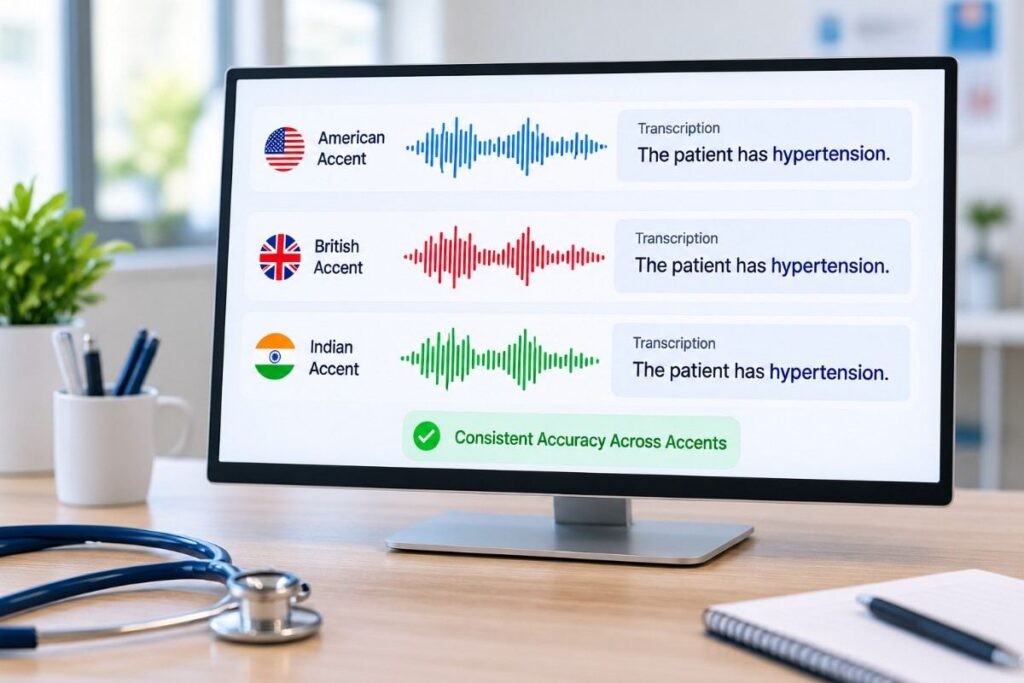
Testing an application with several speakers is a start, but it is not sufficient accent coverage. Accent performance should be evaluated systematically across the populations expected to use the product. Depending on the target market, that might include regional English accents as well as English spoken by people whose first languages are Arabic, Spanish, Hindi, Mandarin, French, Urdu, or other languages.
Test teams should also consider variation within accents. Two speakers from the same country may have dramatically different pronunciation, speaking speed, vocabulary, and intonation. Age, geography, education, multilingualism, and individual speech characteristics can create additional variation.
The goal is not simply to determine whether the application “supports” an accent. QA teams should measure how accuracy changes between speaker groups and identify whether particular groups experience disproportionately high error rates. Aggregate accuracy can hide serious weaknesses when high-performing samples compensate statistically for poorly performing ones.
We also need to test combinations of variables. A strong system should not only understand an accent under studio-quality conditions. It should remain usable when an accented speaker talks quickly, uses specialist terminology, speaks from across a consultation room, or interacts with another person who interrupts.
Medical Terminology Creates Its Own Accuracy Challenges
Healthcare vocabulary is an unforgiving test environment for speech recognition. Medical terminology contains long technical terms, similar-sounding words, abbreviations, brand names, generic medication names, anatomical terminology, laboratory measurements, and specialist expressions that may rarely appear in ordinary conversations.
Consider how easily phonetic similarity can create trouble. Drug names may resemble other drug names. Clinical terms may sound similar despite describing very different conditions. Acronyms can also have multiple meanings depending on specialty and context. An AI system cannot rely exclusively on phonetic recognition; contextual understanding becomes critical.
A strong terminology test dataset should therefore cover more than a dictionary of medical words. Terms should appear inside realistic conversations and sentences. Test cases should include medication names with dosages, diagnoses, procedures, symptoms, anatomical references, measurements, abbreviations, and specialty-specific language.
Terminology coverage should also reflect the product’s intended clinical environments. An application designed for general practice encounters different vocabulary from one built for cardiology, oncology, psychiatry, radiology, or orthopedics. Testing against irrelevant terminology can produce reassuring metrics while missing the vocabulary users actually depend on.

Build Test Data That Resembles Real Consultations
AI systems are highly dependent on their inputs, making test data one of the most important parts of the QA strategy. Perfectly recorded scripts read slowly by professional speakers may be useful for baseline measurements, but they should never represent the entire test suite.
Real consultations contain hesitation, filler words, corrections, incomplete statements, interruptions, and changes in subject. Patients may describe symptoms informally while clinicians translate those descriptions into medical terminology. Someone might initially state the wrong medication dosage and immediately correct it. The note-taking system needs to understand that the correction supersedes the earlier statement.
Audio conditions should vary too. Tests can introduce reasonable environmental noise, different microphone qualities, speaker distances, room acoustics, and multiple voices. The purpose is not to create impossibly hostile recordings but to reproduce conditions the application will realistically encounter.
Privacy also matters when constructing datasets. Healthcare test data should be appropriately synthetic, anonymized, or otherwise handled according to applicable privacy and security requirements. Teams should avoid solving an AI accuracy problem by accidentally creating a patient-data problem.
Measure More Than Word Error Rate
Word error rate can provide a useful baseline for speech recognition, but healthcare AI requires more meaningful quality metrics. Not every transcription error carries equal risk. Misrecognizing a conversational filler word is fundamentally different from changing a medication, dosage, allergy, diagnosis, or negative statement.
That means testing should incorporate clinically weighted accuracy. High-risk entities can be tracked separately so teams understand whether critical information is being preserved. Medication names, quantities, units, symptoms, diagnoses, allergies, dates, and negations deserve particular attention.
Negation is especially important. “The patient has chest pain” and “the patient has no chest pain” differ by only one small word, yet their clinical meaning is almost opposite. A generic transcription score may barely move after such an error, while the usefulness of the generated note changes dramatically.
Teams should also evaluate summary fidelity, information omission, unsupported additions, speaker attribution, formatting consistency, and the application’s handling of uncertainty. The best quality dashboard combines quantitative metrics with expert review rather than reducing performance to a single percentage.
Test the AI for Hallucinations and Unsupported Conclusions
Generative components introduce another category of risk: information that was never spoken may appear in the generated note. Language models are designed to produce coherent output, and coherence can occasionally become a liability when the system fills gaps with plausible but unsupported information.
QA scenarios should intentionally provide incomplete, ambiguous, and contradictory conversations. Testers can then examine whether the application preserves uncertainty or invents a clean conclusion. If a medication name is unclear, for example, flagging the uncertain transcription can be safer than confidently selecting the most statistically likely medication.
Testing should also compare the original audio, transcript, extracted entities, and final note. This creates traceability across the AI pipeline and makes it easier to identify where an error originated. Without that visibility, teams may know a generated note is incorrect without understanding which component caused the failure.
These tests become particularly valuable after model updates. A newer model may improve overall fluency while introducing regressions in specific terminology or accent groups. Regression testing should therefore preserve difficult historical examples and replay them whenever significant AI components change.
Include Human Review in the QA Strategy
Automated evaluation is essential when thousands of recordings and outputs need to be assessed, but healthcare language often requires human judgment. Subject matter experts can recognize subtle differences in clinical meaning that generic similarity metrics may miss.
Human review is particularly useful for ambiguous cases, high-risk terminology, summary accuracy, and determining whether generated notes represent conversations faithfully. Reviewers can also categorize errors by severity, helping development teams prioritize issues that genuinely affect users rather than treating every textual mismatch identically.
The strongest testing approach combines automated evaluation for scale with targeted human assessment for nuance. Automation identifies patterns quickly; expert review explains whether those patterns matter. Together, they provide a much more realistic picture of product readiness.
Make Accent and Terminology Testing Continuous
AI note-taking quality should not be treated as a one-time certification exercise before release. Models change, prompts evolve, vocabulary expands, users encounter new scenarios, and integrations can alter system behavior. Each change creates an opportunity for previously solved problems to return.
Teams should maintain a growing regression library containing difficult accents, confusing medical terms, noisy recordings, corrections, interruptions, negations, and historically problematic examples. Production feedback can inform this library as long as data is handled appropriately and privacy requirements are respected.
Performance should also be monitored by scenario rather than only globally. If overall accuracy improves while transcription quality declines for a particular accent or specialty, the release may still represent a regression for an important group of users. Segmented metrics make these problems visible before they become widespread user complaints.
Continuous testing turns QA into a feedback system for AI development. Instead of merely finding defects before launch, testing provides structured evidence about where models struggle and where future training, prompting, or product safeguards should focus.
Reliable Medical AI Starts With Realistic Testing
AI note-taking applications can reduce documentation burden and make clinical workflows more efficient, but their value depends on whether users can trust the information they produce. That trust cannot be established through polished demonstrations or headline accuracy numbers alone.
Testing needs to reflect the diversity of actual speech, including accents, speaking styles, medical specialties, terminology, acoustic conditions, interruptions, ambiguity, and human corrections. It must also distinguish harmless transcription differences from errors capable of changing clinical meaning.
For software teams building AI-driven healthcare products, the standard should be straightforward: test the system under the conditions in which people will actually use it. Combine representative datasets, clinically meaningful metrics, regression testing, human expertise, and end-to-end validation to uncover weaknesses before users do.
At Testiva, we approach AI quality with that real-world mindset. Because when software is responsible for turning complex conversations into meaningful documentation, “mostly accurate” is not a satisfying definition of quality. Unlock flawless delivery and start your QA journey today.