



Latest Insights
AI Medical Diagnosis in 2026: Medical Imaging, EHRs, Predictive Analytics & Generative AI
- Oct 01, 2026
- Sajid M.
- AI Medical Diagnosis in 2026
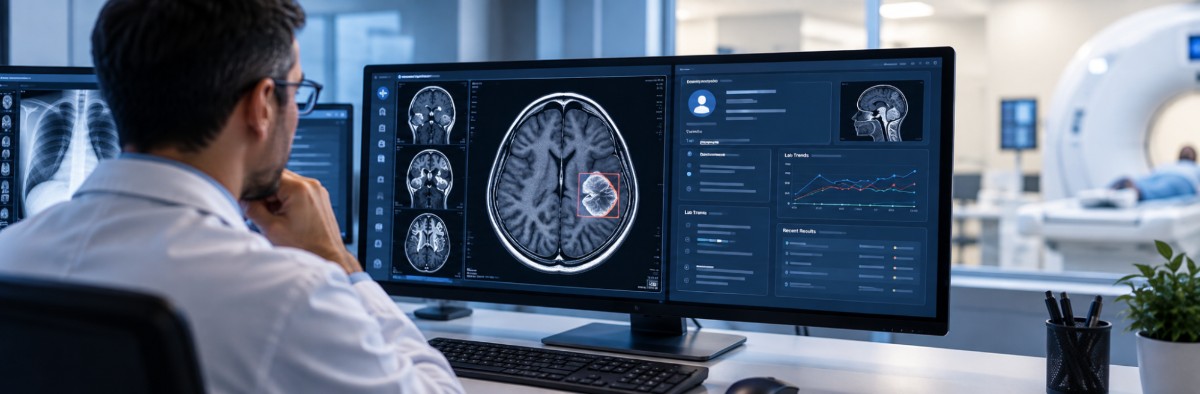
Artificial intelligence in healthcare has moved well beyond the experimental “Can AI diagnose this?” phase. In 2026, the more useful question is: how reliably can AI support diagnosis within a real clinical workflow? Medical imaging algorithms, electronic health record (EHR) intelligence, predictive analytics, and generative AI are increasingly being combined to help clinicians recognize patterns faster, prioritize cases, synthesize complex patient information, and make better-informed decisions.
But healthcare is one domain where impressive AI output is not enough. A diagnostic system has to perform consistently across patients, devices, data sources, clinical environments, and edge cases. From our perspective at Testiva, this makes rigorous software and AI quality assurance an essential part of deploying healthcare AI responsibly. A model can look brilliant in a controlled demonstration and still create serious problems when integrations fail, input data changes, latency increases, or unusual clinical scenarios appear.
The result is a fascinating shift. AI medical diagnosis in 2026 is becoming less about replacing physicians and more about building an intelligent diagnostic layer around them one that can see, correlate, predict, summarize, and assist without turning clinical judgment into an automated black box.
Medical Imaging Remains One of AI’s Strongest Diagnostic Use Cases
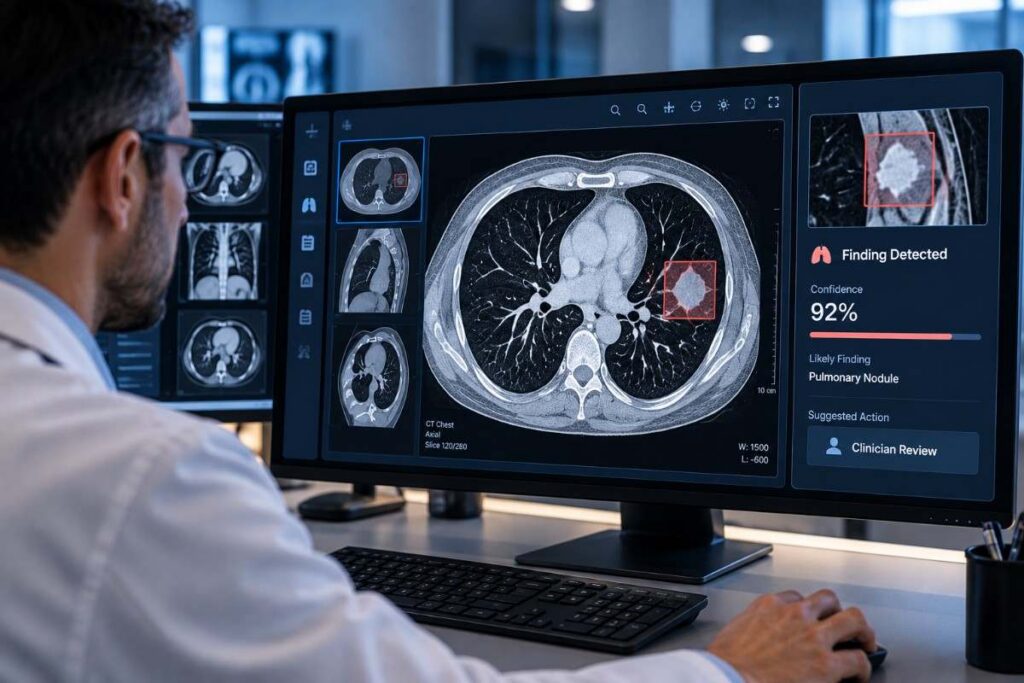
Medical imaging is particularly well suited to AI because radiology, pathology, ophthalmology, cardiology, and other specialties generate enormous quantities of visual data. Machine learning systems can analyze images for patterns associated with disease and surface suspicious findings for clinician review.
Modern imaging AI can assist with tasks involving X-rays, CT scans, MRIs, mammograms, retinal images, ultrasound, digital pathology slides, and other diagnostic media. Depending on the application, an algorithm might identify a suspicious lesion, segment an anatomical structure, quantify abnormalities, compare current and previous scans, or prioritize an urgent study in a radiologist’s worklist.
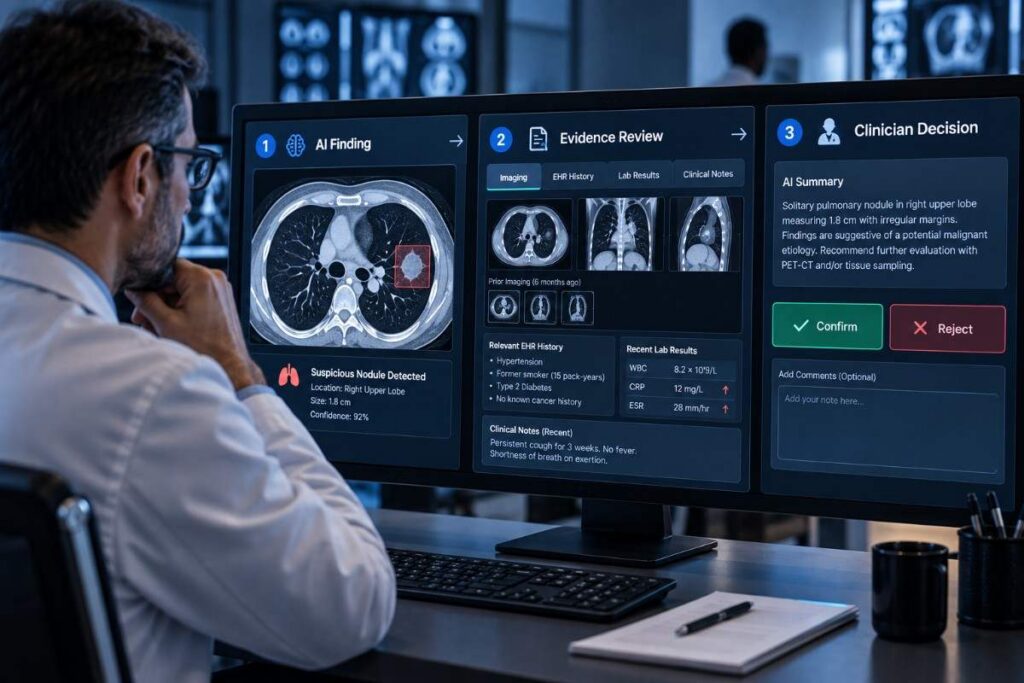
The important development in 2026 is that the conversation is increasingly about workflow integration rather than isolated image classification. Detecting an abnormality is valuable, but clinical usefulness depends on what happens next. Can the result reach the right clinician? Does it integrate correctly with imaging and hospital systems? Are confidence scores communicated appropriately? Can a physician inspect or override the result?
This is where software quality becomes inseparable from model quality. A highly accurate algorithm connected to an unreliable interface or incorrectly mapped patient record can become a highly accurate component of an unsafe system.
Multimodal AI Is Expanding the Diagnostic Picture
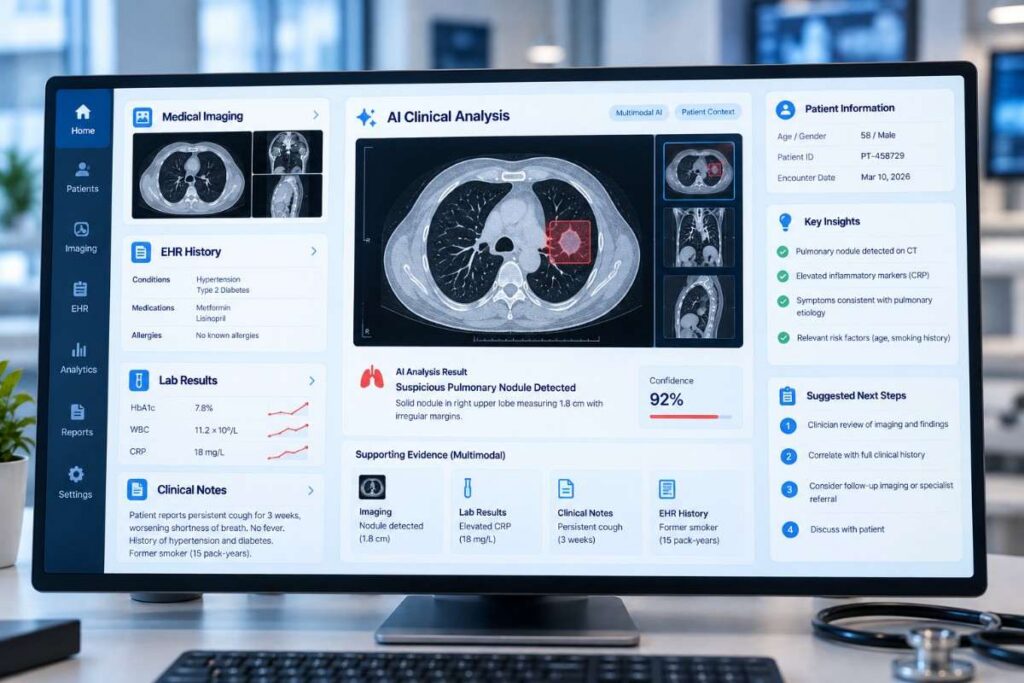
A scan rarely tells the entire clinical story. A suspicious image may need to be interpreted alongside symptoms, laboratory results, medication history, previous diagnoses, age, family history, and earlier imaging.
Multimodal AI aims to combine several of these information types rather than analyzing each in isolation. An AI system could, for example, evaluate an image while incorporating relevant clinical notes and laboratory values to provide richer decision support.
This is a significant technical leap because medical data is messy by nature. Images, structured EHR fields, free-text notes, PDFs, laboratory feeds, and data from connected devices may all use different formats and standards. The intelligence of the model matters, but so does the reliability of the entire data pipeline feeding it.
EHR Intelligence Is Turning Patient Records Into Diagnostic Context
Electronic health records contain enormous diagnostic value, but extracting it efficiently has always been difficult. A patient’s history can stretch across years of appointments, prescriptions, test results, referrals, procedures, diagnoses, and clinician notes.
AI can help transform that information overload into usable clinical context. Natural language processing and machine learning systems can identify relevant information from clinical notes, detect patterns across longitudinal records, highlight missing information, and surface details that deserve attention.
For clinicians, the potential benefit is not simply convenience. Diagnostic reasoning frequently depends on connections buried across different encounters. A laboratory trend from six months ago, a medication change, a previous symptom, and a new imaging result may collectively tell a story that none of those data points reveals independently.
In 2026, increasingly capable AI systems can assist in assembling that story. Yet EHR-based diagnosis also exposes one of healthcare AI’s biggest weaknesses: bad data can produce confidently bad conclusions. Duplicate records, inconsistent terminology, missing values, incorrect coding, delayed updates, and interoperability problems can all influence AI output.
That makes data validation and integration testing critical. Healthcare organizations need to know not only whether the model works, but whether it receives the correct patient information at the correct time and interprets that information as intended.
Predictive Analytics Is Moving Diagnosis Earlier
Traditional diagnosis is often reactive: symptoms emerge, tests are ordered, results arrive, and clinicians determine what is happening. Predictive analytics attempts to move part of that process upstream.
By analyzing historical and real-time patient data, predictive models can estimate the probability of future clinical events. Depending on their design and regulatory context, systems may help identify patients at elevated risk of deterioration, readmission, complications, or particular conditions.
The distinction between prediction and diagnosis matters. A risk score is not necessarily a diagnosis, and treating it as one can create dangerous overconfidence. Effective healthcare systems therefore need to present predictive outputs with appropriate context, limitations, thresholds, and escalation paths.
Another challenge is model drift. Patient populations, clinical practices, equipment, medications, data collection processes, and disease patterns change over time. A predictive model validated on historical data cannot simply be assumed to maintain identical performance indefinitely.
Continuous monitoring therefore becomes part of AI quality. Teams need visibility into performance changes, unusual output patterns, integration failures, and differences across relevant patient populations. In healthcare AI, “it passed testing before launch” is not a sufficient long-term quality strategy.
Generative AI Is Becoming the Interface Layer for Clinical Intelligence
Generative AI has introduced a different type of capability into medical diagnosis. Rather than simply assigning a classification or calculating a risk score, large language and multimodal models can synthesize information and communicate it in natural language.
That opens several practical possibilities. Generative systems can summarize lengthy medical histories, organize clinical findings, draft documentation, explain complex information, assist with clinical information retrieval, and potentially help clinicians explore differential diagnoses when used within appropriate safeguards.
Its greatest value may be its ability to act as an interface between humans and increasingly complex healthcare data. Instead of requiring clinicians to inspect dozens of disconnected screens, a well-designed system could synthesize relevant information and make the underlying evidence easier to navigate.
However, generative AI introduces a uniquely uncomfortable failure mode: plausibility without correctness. A traditional software error may produce a crash or an obvious incorrect value. A generative model can produce fluent, professional-sounding text containing an invented, omitted, or misinterpreted clinical detail.
Testing these systems therefore requires more than checking whether an answer “sounds right.” Evaluation needs to examine factual grounding, consistency, retrieval accuracy, instruction handling, context preservation, failure behavior, and whether important source information is represented correctly.
The Real Challenge Is Building Trustworthy AI Systems
Healthcare AI quality cannot be reduced to a single accuracy percentage. Diagnostic technology exists inside a larger system involving models, APIs, databases, interfaces, medical devices, hospital infrastructure, users, security controls, and external platforms.
Consider an imaging application with excellent model sensitivity. If the application occasionally associates analysis with the wrong study, truncates information on a clinician’s screen, times out during peak workloads, or fails after an EHR update, model accuracy becomes almost irrelevant.
This is why testing healthcare AI requires a system-level mindset. Functional testing verifies that workflows behave correctly. Integration testing examines communication between systems. Performance testing helps determine whether applications remain responsive under realistic loads. Security testing looks for weaknesses involving sensitive information and access controls. Usability testing examines whether clinicians can interpret and act on information safely.
AI introduces another layer: model behavior itself. Teams must investigate edge cases, unexpected inputs, ambiguous data, distribution shifts, false positives, false negatives, and situations in which the system should acknowledge uncertainty rather than manufacture certainty.
Human Oversight Is a Feature, Not a Limitation
The most credible direction for AI-assisted diagnosis is not an autonomous machine issuing unquestionable medical conclusions. It is a carefully designed partnership in which AI performs computationally intensive pattern recognition and information synthesis while qualified clinicians retain appropriate oversight.
That means interfaces need to support judgment rather than encourage automation bias. Clinicians should be able to understand where relevant information originated, review supporting evidence, identify uncertainty, and reject or correct AI-generated suggestions.
Good UX becomes surprisingly important here. A poorly designed confidence indicator, hidden warning, ambiguous label, or overly authoritative AI-generated paragraph can influence how people interpret a recommendation. In safety-sensitive software, presentation is part of functionality.
The geeky engineering lesson is straightforward: the AI model is only one component of the product. The surrounding software determines how that intelligence reaches a human, and that interaction can dramatically affect whether the technology helps or harms.
What Healthcare AI Teams Should Prioritize in 2026
Organizations developing AI diagnostic technology need to think beyond achieving strong benchmark performance. Real-world readiness requires representative data, robust integration architecture, traceable workflows, careful human-factor design, privacy and security controls, regulatory awareness, and comprehensive validation.
Testing should also reflect real clinical complexity. That means examining incomplete records, unusual imaging inputs, conflicting information, network interruptions, system updates, extreme workloads, malformed data, and other conditions that polished demos rarely encounter.
Generative AI applications require particularly strong evaluation frameworks because their outputs are probabilistic. Teams need repeatable methods for measuring groundedness, consistency, relevance, harmful omissions, unsupported claims, and behavior under adversarial or confusing inputs.
The organizations that treat QA as a final pre-release checkpoint risk discovering failures after the system encounters real-world variability. The stronger approach is to integrate quality engineering throughout development, from data pipelines and model evaluation to APIs, user interfaces, integrations, and post-deployment monitoring.
AI Medical Diagnosis Is Becoming a Systems Engineering Problem
Medical imaging, EHR intelligence, predictive analytics, and generative AI are converging into increasingly sophisticated clinical systems. The opportunity is substantial: earlier detection, faster information synthesis, smarter prioritization, reduced administrative friction, and better access to relevant patient context.
Yet the defining question for 2026 is not whether AI can produce impressive medical insights. We already know it can. The challenge is determining whether those insights remain accurate, secure, understandable, traceable, and dependable when deployed inside complicated healthcare environments.
For software companies building the next generation of healthcare technology, quality must evolve alongside intelligence. Smarter models create more powerful products but they also create new failure modes that conventional testing alone may not uncover.
At Testiva, we see that as the next frontier of QA: testing not just whether software works, but whether intelligent software behaves reliably when real users, real integrations, unpredictable data, and high-stakes decisions enter the equation. Because in healthcare, “almost correct” can be an exceptionally expensive bug.