




Latest Insights
Common Failures in Ambient AI Documentation Systems
- Sep 14, 2026
- Sajid M.
- Failures in AI testing

Ambient AI documentation systems promise something software teams have wanted for years: documentation that happens quietly in the background instead of becoming another task competing for attention. These systems can listen to conversations, observe workflows, extract relevant information, and turn unstructured activity into structured records with minimal manual effort. In healthcare, customer support, enterprise operations, and other documentation-heavy environments, that can translate into meaningful time savings.
But “ambient” should never be mistaken for “automatic and therefore reliable.” The less visible a system becomes, the easier it is for incorrect outputs to move downstream without scrutiny. From our perspective at Testiva, this makes rigorous AI and software quality assurance testing particularly important. An ambient documentation tool is only valuable when its captured context, generated records, integrations, and user experience remain dependable under real-world conditions not merely during a polished demo.
Understanding where these systems fail is therefore essential for anyone designing, deploying, or evaluating them.
Ambient AI Has a Context Problem Before It Has an AI Problem
The fundamental challenge with ambient documentation is context. Capturing words is relatively straightforward; determining what those words actually mean in a particular situation is much harder.
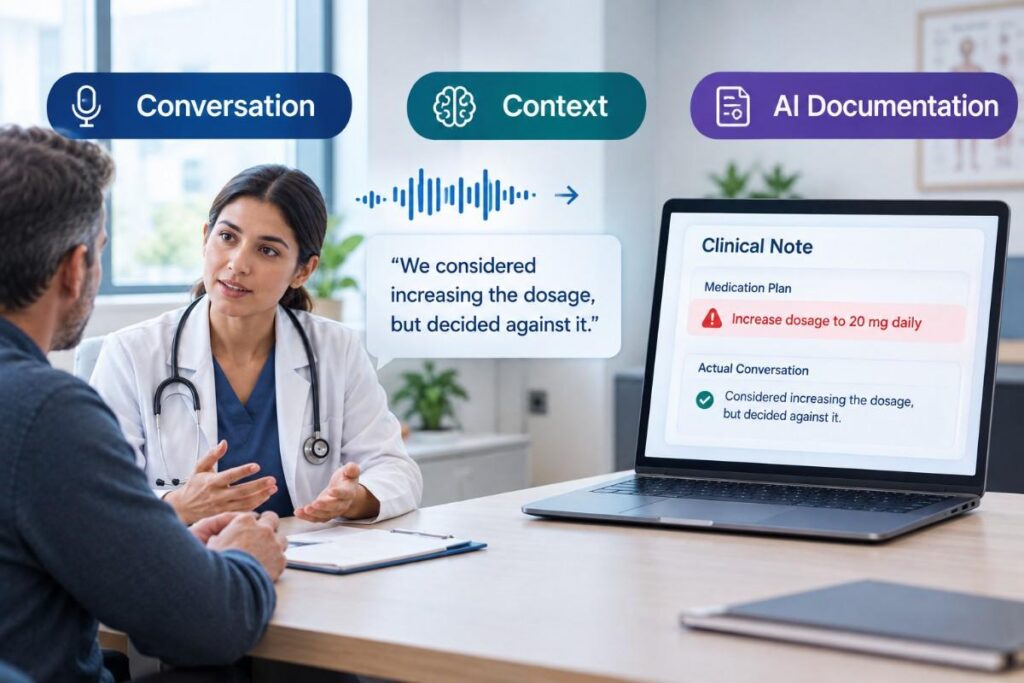
Consider a conversation containing corrections, interruptions, shorthand, references to previous discussions, and several speakers. A model might accurately transcribe every sentence while still producing an incorrect summary. “We considered increasing the dosage, but decided against it,” for example, is dangerously different from documentation stating that the dosage was increased.
The same problem appears outside healthcare. A product meeting might discuss a feature as an experiment, reject it five minutes later, and then move to another approach. If the documentation system records the discarded idea as a decision, technically fluent documentation becomes operational misinformation.
This is why testing ambient AI requires more than checking transcription accuracy. QA must evaluate whether the system preserves intent, chronology, speaker relationships, negation, uncertainty, and final decisions.
Hallucinations Become More Dangerous When They Look Like Documentation
Generative AI can produce plausible information that was never present in its source material. In a chatbot, a hallucination may be immediately noticeable because a user is actively reading the response. Ambient systems create a different risk: generated content can enter a record without attracting the same level of attention.
The most troublesome hallucinations are rarely absurd. They are small, believable additions a symptom that was never mentioned, a technical requirement that nobody approved, or a customer commitment inferred from an ambiguous conversation.
Good testing therefore needs to challenge the system with incomplete statements, contradictory information, background conversation, uncertain language, corrections, and deliberately ambiguous scenarios. The objective is not simply to ask, “Does the AI generate a good note?” It is to determine whether the system knows what it has sufficient evidence to document.
An AI system that confidently fills informational gaps may look impressive in controlled demonstrations while creating substantial risk in production.
Speaker Attribution Can Quietly Corrupt the Record
Ambient documentation often depends on diarization: identifying who said what. When that layer fails, everything built on top of it becomes less trustworthy.
Real environments are messy. People speak simultaneously. Participants move closer to or farther from microphones. Someone joins remotely. Background voices become audible. Similar voices can confuse identification algorithms, while poor acoustics make the problem worse.
Incorrect speaker attribution can fundamentally change meaning. A question from one participant may be documented as a statement from another. A recommendation can become an instruction. A customer’s concern can accidentally appear as an employee’s conclusion.
Testing should therefore include overlapping speech, multiple accents, different microphone distances, interruptions, environmental noise, and changing participants. Clean-room audio tests establish a baseline, but they do not tell you whether an ambient system is ready for the environments where humans actually work.
Negation, Corrections, and Uncertainty Break Simplistic Summaries
Human conversations are full of linguistic reversals. We say “maybe,” “probably,” “not anymore,” “actually, ignore that,” and “we haven’t decided yet” without thinking twice.
Documentation systems cannot afford to treat those phrases as minor details.
Negation failures are particularly serious because they can invert meaning. “No history of authentication failures” and “history of authentication failures” differ by a single word but represent opposite facts. Similarly, an initial statement corrected later in a conversation should not survive as an active fact simply because the system captured it first.
Uncertainty creates another challenge. Ambient AI should preserve the distinction between confirmed facts, hypotheses, possibilities, and unresolved questions. Testing needs to verify that the generated documentation reflects those distinctions rather than converting tentative language into definitive statements.

Audio Quality Creates Failure Modes That Lab Testing Misses
Ambient systems live in physical environments, which means software quality becomes partly dependent on microphones, rooms, networks, devices, and human behavior.
Air conditioners hum. Doors slam. People wear masks, turn their heads, mumble, speak quickly, or use specialized terminology. Conference calls introduce compression and latency. Bluetooth devices disconnect. Network quality fluctuates at exactly the wrong moment.
A system that performs beautifully with carefully recorded audio may degrade dramatically under these conditions. Worse, degradation may not be obvious. Instead of failing completely, the system might generate a polished document containing subtle inaccuracies.
That makes degraded-input testing essential. Teams should deliberately introduce background noise, packet loss, low microphone gain, cross-talk, clipped audio, device switching, and temporary connectivity failures. Graceful degradation matters just as much as peak accuracy: when confidence drops, the product should make uncertainty visible rather than pretending everything went perfectly.
Domain Terminology Exposes Weaknesses Fast
General-purpose language models understand a remarkable amount of vocabulary, but specialized environments have their own linguistic ecosystems. Acronyms, product names, internal terminology, medications, technical identifiers, and organization-specific shorthand can create ambiguity.
Context makes this harder. The same acronym can mean entirely different things across industries or even across teams inside one company.
Testing with generic vocabulary therefore provides limited assurance. Evaluation datasets should reflect the terminology, accents, sentence structures, and workflows of actual users. Newly introduced terminology also needs attention because production language changes continuously.
This is one reason QA for AI cannot be treated as a one-time certification exercise. A system may perform well against today’s vocabulary and gradually lose effectiveness as products, processes, customers, and terminology evolve.
Integration Failures Can Make Correct AI Output Useless
An ambient documentation system does not exist in isolation. Its output usually needs to travel somewhere: an electronic record, CRM, ticketing platform, knowledge base, project-management system, or another enterprise application.
That creates an entire category of failures unrelated to model intelligence.
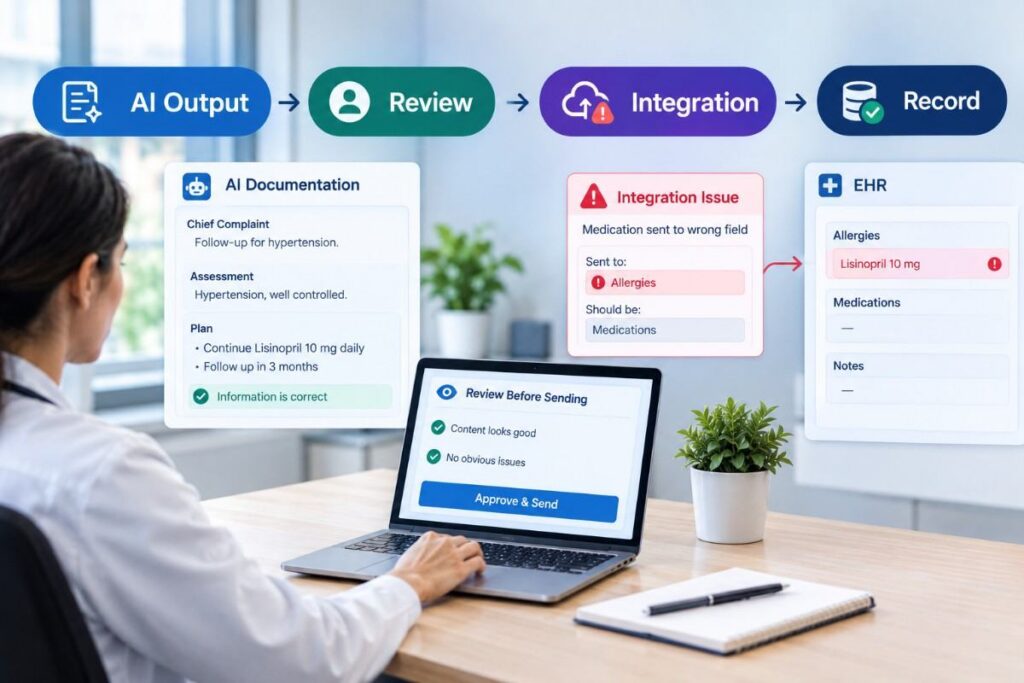
The AI may generate the correct information but send it to the wrong field. Formatting may break during transfer. API timeouts can create incomplete records or duplicate submissions. Synchronization errors may overwrite newer information. Authentication expiry can stop data movement while the user interface still appears healthy.
End-to-end testing is critical here. Teams need to verify not only whether the AI produced the correct document, but whether the right information reached the right destination, retained its structure, survived retries, and remained traceable throughout the workflow.
A perfect summary trapped inside a broken integration is still a failed product experience.
Automation Bias Turns Small Errors Into Bigger Ones
The better ambient AI becomes, the more users tend to trust it. That creates an interesting QA paradox: improving average accuracy can make occasional failures more consequential because users become less likely to check the output.
This phenomenon, often described as automation bias, means interface design is part of system safety. Users need practical ways to review, correct, and understand generated documentation without turning the product back into a manual documentation tool.
Testing should examine the review workflow itself. Can users quickly locate questionable information? Are edits preserved correctly? Does the system distinguish generated content from verified information where necessary? Are confidence or uncertainty signals understandable rather than distracting?
Human oversight only works when the product makes oversight realistically achievable.
Privacy and Data Handling Cannot Be an Afterthought
Ambient systems often process conversations that were never traditionally captured in full. That raises important questions about consent, retention, access control, encryption, deletion, and unintended recording.
Testing should verify what happens before, during, and after capture. Recording indicators must behave consistently. Permission changes should take effect correctly. Data scheduled for deletion should actually disappear according to defined policies. Access controls need to hold across interfaces, APIs, exports, backups, and administrative functions.
Privacy failures are not simply compliance problems. They can destroy user trust in the entire ambient experience. People will not comfortably use invisible technology if they cannot understand when it is active and what happens to the information it collects.
Performance Drift Makes Yesterday's Test Results Insufficient
AI systems are unusually dynamic. Models change, prompts evolve, integrations are updated, datasets shift, and user behavior introduces scenarios nobody anticipated during initial development.
A seemingly harmless prompt adjustment can improve one documentation pattern while degrading another. A model upgrade can change summarization style or increase sensitivity to certain phrases. An integration release can alter field mapping without touching the AI layer at all.
Regression testing therefore needs to include representative AI behaviors alongside conventional software functionality. Stable evaluation sets can help teams compare releases, while production monitoring can identify failure patterns that controlled tests miss.
The goal is not to freeze the system. It is to make improvement measurable rather than assumed.
Quality Is What Makes Ambient AI Actually Feel Ambient
The best ambient documentation experience is almost invisible. Users speak and work naturally, useful information appears where it belongs, and intervention is required only when something genuinely needs attention.
Achieving that experience requires considerably more engineering discipline than simply connecting speech recognition to a language model. Context interpretation, hallucination control, speaker attribution, integrations, privacy, degraded inputs, review workflows, and model drift all contribute to the final quality of the product.
For teams building ambient AI, the important question is no longer whether the technology can generate documentation. We already know it can. The harder question is whether it can generate the right documentation, consistently, under imperfect real-world conditions.
That is where serious QA earns its place. Test the conversation nobody planned for, the microphone that cuts out, the correction buried halfway through a meeting, the API that times out, and the ambiguous sentence the model desperately wants to “fix.” Those edge cases are not distractions from the product they are the product users will eventually encounter.
Build for them, test for them, and ambient AI can move from an impressive capability to dependable infrastructure.