




Latest Insights
What is Ambient AI in Healthcare and How Should It Be Tested?
- Aug 23, 2026
- Sajid M.
- Ambient AI Testing

Artificial intelligence is rapidly reshaping clinical workflows, with Ambient AI emerging as one of the most significant innovations in modern medical technology. By quietly capturing conversations between clinicians and patients, understanding medical context, and automatically generating structured clinical documentation, Ambient AI dramatically reduces the administrative burden associated with patient care. Rather than dividing their attention between patients and computer screens, clinicians can focus on meaningful interactions while the technology works seamlessly in the background.
As healthcare organizations adopt Ambient AI, success depends on far more than sophisticated algorithms. Because these systems directly influence medical records and clinical decision-making, they must be accurate, reliable, secure, and compliant. At Testiva, we’ve found that comprehensive Quality Assurance Testing is essential for validating AI-powered healthcare applications under real-world clinical conditions, where even minor inaccuracies can have serious consequences.
Ambient AI has the potential to redefine healthcare documentation, but it also introduces testing challenges that traditional software QA was never designed to address. From validating AI-generated outputs to ensuring data privacy and clinical accuracy, organizations must adopt a more rigorous testing strategy to build systems that healthcare professionals can trust with confidence.
Understanding Ambient AI in Healthcare
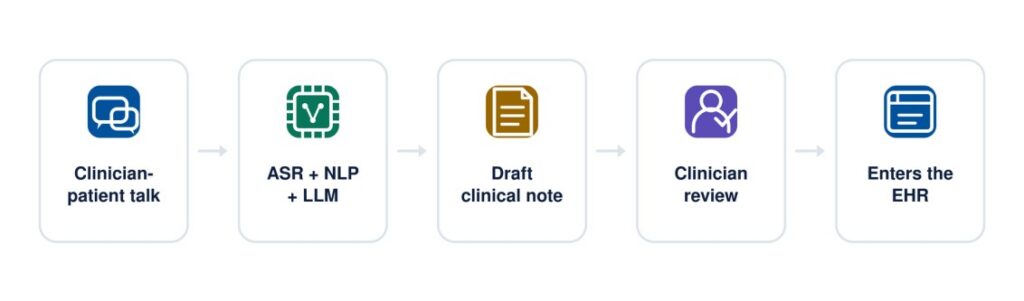
Ambient AI refers to artificial intelligence systems that operate continuously and unobtrusively within a healthcare environment. Rather than waiting for direct user commands, these systems capture contextual information from conversations, clinical workflows, and surrounding activities to assist healthcare professionals automatically.
Imagine a physician conducting a routine consultation. Throughout the discussion, the Ambient AI system securely records the conversation, identifies symptoms, medications, diagnoses, treatment plans, and follow-up instructions, then generates clinical notes that can be reviewed and approved by the physician before entering the patient’s electronic health record.
Modern Ambient AI solutions combine several advanced technologies, including automatic speech recognition (ASR), natural language processing (NLP), large language models (LLMs), medical terminology mapping, speaker identification, and clinical reasoning algorithms. Together, these components transform spoken language into structured medical documentation.
The result is a smoother clinical workflow, reduced administrative burden, improved documentation quality, and potentially better patient engagement.
However, because these systems influence medical records and clinical decisions, even small errors can carry significant consequences.
Why Ambient AI is Transforming Modern Healthcare
The healthcare industry faces growing documentation demands, physician burnout, staffing shortages, and increasing patient expectations. Ambient AI addresses multiple pain points simultaneously.
Administrative efficiency is perhaps the most obvious benefit. Physicians often spend nearly as much time documenting encounters as they spend treating patients. Automating documentation allows clinicians to reclaim valuable hours every week.
Patient interaction also improves. Instead of constantly switching attention between the patient and a computer screen, clinicians can maintain natural conversations while the AI handles note-taking behind the scenes.
Consistency is another major advantage. AI-generated documentation follows standardized clinical structures, helping reduce omissions and improving overall record quality.
Healthcare organizations also benefit from improved operational efficiency. Better documentation supports billing accuracy, regulatory compliance, clinical analytics, research initiatives, and care coordination across multidisciplinary teams.
As Ambient AI matures, its role may expand well beyond documentation to include real-time clinical decision support, automated coding assistance, medication reconciliation, appointment summarization, and proactive patient monitoring.
These expanding responsibilities only increase the importance of comprehensive quality assurance.
Why Testing Ambient AI is Fundamentally Different
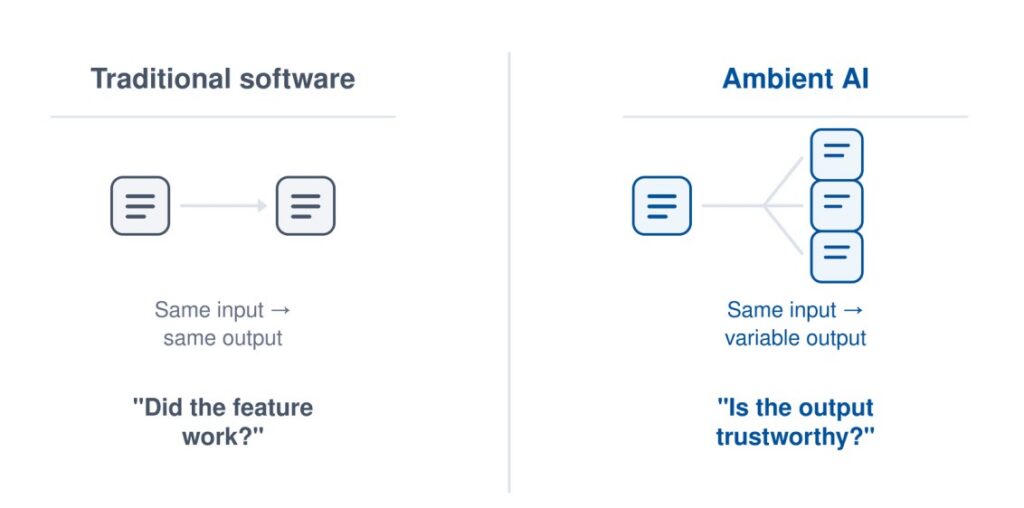
Testing conventional healthcare software generally focuses on verifying application functionality, user interfaces, APIs, integrations, security, and performance.
Ambient AI introduces an entirely different layer of complexity.
Instead of deterministic software behavior where identical inputs produce identical outputs, AI systems operate probabilistically. The same conversation may produce slightly different documentation depending on phrasing, accents, background noise, context, or model updates.
Traditional pass-or-fail testing is no longer sufficient.
QA teams must evaluate whether the generated clinical documentation is accurate, complete, clinically appropriate, unbiased, and safe—not merely whether the software executed successfully.
The challenge shifts from asking “Did the feature work?” to asking “Did the AI produce trustworthy medical information?”
This requires expanding QA strategies beyond functional testing into AI validation, linguistic evaluation, medical domain verification, and continuous model monitoring.
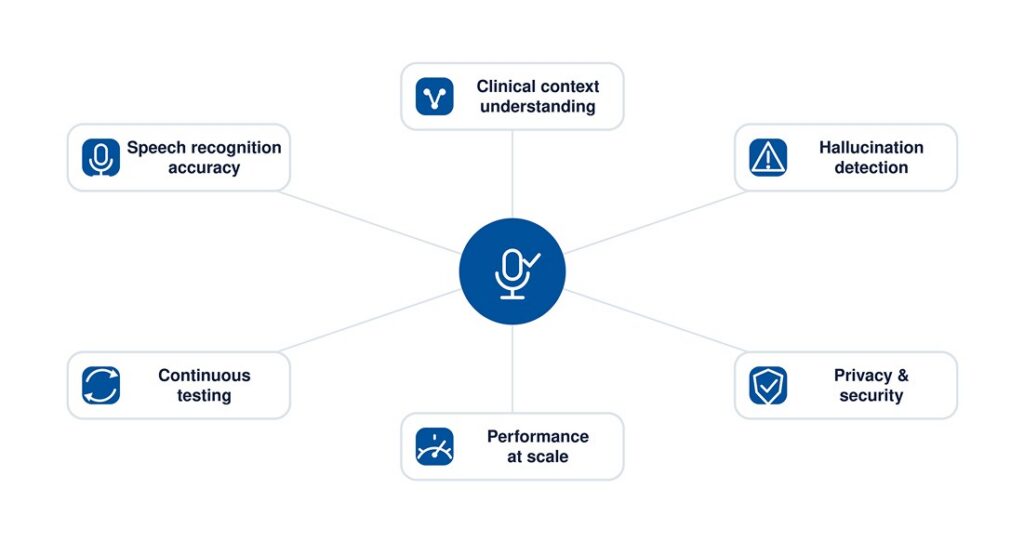
Everything begins with transcription.
If speech recognition fails, every downstream AI process inherits those mistakes.
Healthcare environments present difficult acoustic conditions. Multiple speakers may talk simultaneously. Medical terminology is highly specialized. Clinicians often speak quickly, use abbreviations, switch languages, or reference uncommon drug names and rare diseases.
Ambient AI must correctly distinguish between physicians, patients, nurses, caregivers, and other participants.
domain verification, and continuous model monitoring.
QA engineers should evaluate transcription accuracy across numerous scenarios, including:
- Different accents and dialects
- Pediatric consultations
- Emergency medicine
- Telemedicine appointments
- Noisy environments
- Rapid speech
- Medical abbreviations
- Interrupted conversations
- Multiple simultaneous speakers
Even seemingly minor transcription errors can alter diagnoses or medication instructions.
Clinical Context Matters More Than Grammar
Producing grammatically correct notes is only the starting point.
Ambient AI must correctly understand clinical intent.
Consider a patient saying:
“I don’t have chest pain anymore.”
If the AI incorrectly documents “Patient has chest pain,” the consequences become obvious.
Similarly, the system must distinguish between:
- Current symptoms
- Historical conditions
- Family medical history
- Physician recommendations
- Patient concerns
- Ruled-out diagnoses
- Future treatment plans
Medical conversations frequently include uncertainty, differential diagnoses, speculation, and conditional statements.
Testing should verify that AI correctly interprets these nuanced contexts rather than simply extracting keywords.
Clinical reviewers often become an essential part of the QA process because automated validation alone cannot fully evaluate medical correctness.
Hallucinations Must Be Identified and Eliminated
One of the most widely discussed risks associated with large language models is hallucination.
In healthcare, hallucinations are unacceptable.
A hallucination occurs when an AI generates information that was never actually stated or supported by the clinical conversation.
For example, the physician never mentioned diabetes, yet the generated summary includes diabetic management recommendations.
Or the patient discussed seasonal allergies, but the AI documents asthma treatment.
QA teams must specifically design validation strategies that compare generated documentation against original recordings to detect fabricated information.
These tests become especially important after every model update, prompt modification, or infrastructure change.
Privacy and Security Cannot Be an Afterthought
Ambient AI continuously processes some of the most sensitive personal information imaginable.
Patient conversations often contain protected health information, financial details, family history, insurance information, and highly confidential medical conditions.
Testing must therefore extend beyond application security.
Healthcare organizations should validate:
- Secure audio transmission
- Encryption during storage and processing
- Identity and access management
- Session isolation
- Data retention policies
- Audit logging
- Consent management
- Secure deletion
- Regulatory compliance
Security testing should also include penetration testing, vulnerability assessments, API testing, and infrastructure validation to ensure patient information remains protected throughout the AI pipeline.
Performance Testing Becomes Mission Critical
Healthcare professionals expect Ambient AI to operate seamlessly.
Long processing delays interrupt clinical workflows and reduce user confidence.
Performance testing should measure several critical aspects of the system’s responsiveness and reliability, including audio processing latency, transcription speed, summary generation time, concurrent consultation capacity, cloud infrastructure scalability, API response times, failover behavior, and recovery after network interruptions.
Real-world Ambient AI testing should simulate peak hospital workloads rather than isolated laboratory environments.
An AI platform performing well with ten simultaneous consultations may struggle dramatically when supporting thousands of physicians across multiple healthcare facilities.
Human Oversight Should Always Remain Part of the Workflow
Despite remarkable advances in AI, healthcare remains a human-centered profession.
Ambient AI should support—not replace—clinical judgment.
Well-designed systems always allow physicians to review, edit, approve, or reject generated documentation before it becomes part of the official medical record.
Testing should therefore validate not only AI outputs but also clinician workflows.
QA engineers should verify that edits are preserved correctly, approval mechanisms function reliably, version histories remain intact, and manual corrections improve future system performance where applicable.
Human-in-the-loop validation remains one of the strongest safeguards against clinical errors.
Continuous Testing is Essential as AI Evolves
Unlike conventional software, AI systems evolve continuously.
Language models receive updates. Medical guidelines change. Clinical terminology expands. Healthcare regulations evolve. New medications enter the market.
An Ambient AI solution that performs exceptionally today may gradually degrade if continuous validation is absent.
This makes continuous QA far more important than one-time certification.
Modern healthcare AI testing should include automated regression testing, ongoing model benchmarking, production monitoring, drift detection, real-world validation, and periodic clinical review.
Continuous quality assurance helps organizations detect subtle declines before they affect patient care.
For companies developing Ambient AI solutions, integrating continuous testing into the software development lifecycle is no longer optional—it’s an essential part of delivering trustworthy healthcare technology.
The Future of Ambient AI Depends on Trust
Ambient AI has the potential to redefine clinical documentation, reduce physician burnout, improve patient experiences, and streamline healthcare operations. Its ability to quietly assist clinicians without disrupting the natural flow of patient care represents one of the most meaningful advancements in healthcare technology in recent years.
Yet innovation alone is not enough. Every AI-generated note, transcription, recommendation, and workflow must earn the trust of clinicians, healthcare organizations, regulators, and, most importantly, patients. That trust is built through rigorous validation, comprehensive testing, and an unwavering commitment to software quality.
At Testiva, we believe quality assurance plays a foundational role in responsible AI adoption. Through comprehensive QA testing, performance validation, security assessments, and real-world scenario testing, organizations can confidently deploy Ambient AI systems that are not only intelligent but also accurate, secure, compliant, and dependable.
As Ambient AI becomes an integral part of modern healthcare, the organizations that invest in robust testing today will be the ones best positioned to deliver safer, smarter, and more reliable digital healthcare experiences tomorrow.