




Latest Insights
Testing Real-Time Ambient AI Systems in Healthcare Applications
- Sep 03, 2026
- Sajid M.
- Ambient AI Testing

Healthcare is entering a new era where technology no longer waits for clinicians to interact with it. Instead, it works quietly in the background, listening, observing, interpreting, and assisting without disrupting patient care. This shift is being driven by Ambient AI intelligent systems that operate seamlessly within clinical environments, capturing conversations, generating documentation, identifying clinical insights, and supporting medical decision-making in real time.
As organizations adopt these technologies, the focus naturally shifts from innovation to reliability. At Testiva, we’ve seen firsthand how advanced software requires equally advanced quality assurance strategies, particularly when applications process sensitive patient data, operate continuously, and influence clinical workflows. Testing Ambient AI systems demands far more than traditional functional validation. It requires rigorous verification of real-time performance, contextual understanding, privacy safeguards, and resilience under unpredictable clinical conditions.
The promise of Ambient AI is enormous. It can reduce physician burnout, improve documentation accuracy, streamline administrative tasks, and allow healthcare professionals to focus more on patient interactions rather than screens. However, these benefits only materialize when every component of the system performs consistently, safely, and predictably. Unlike conventional healthcare software, Ambient AI continuously interprets complex human conversations and environmental signals, making software quality a foundational requirement rather than an afterthought.
Understanding Ambient AI in Modern Healthcare
Ambient AI refers to intelligent systems that blend naturally into clinical environments while remaining largely invisible to users. Rather than requiring clinicians to manually enter data or issue commands, these systems continuously monitor conversations and activities, extracting relevant clinical information in real time.
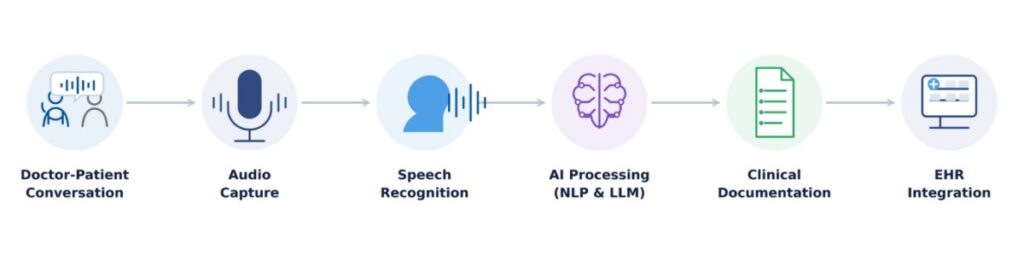
A typical Ambient AI platform combines multiple technologies, including automatic speech recognition, natural language processing, large language models, speaker identification, clinical terminology mapping, and electronic health record integration. Together, these components create an experience where physicians can conduct patient consultations naturally while documentation is generated automatically in the background.
Although this creates remarkable efficiency gains, it also introduces significant testing complexity. Every interaction depends on numerous interconnected AI models, APIs, streaming services, and healthcare integrations functioning simultaneously. A small error in one component can cascade through the entire workflow, potentially affecting documentation quality or clinical decision support.
Testing these systems therefore becomes a multidisciplinary exercise involving software engineering, machine learning validation, healthcare regulations, cybersecurity, usability, and performance engineering.
Why Traditional Software Testing Is No Longer Enough
Many conventional testing methodologies were designed around deterministic software. Given the same input, an application consistently produces the same output. Ambient AI rarely behaves this way.
Generative AI models introduce probabilistic outputs that vary depending on context, conversation flow, speaker behavior, background noise, and evolving medical terminology. This means testing teams cannot simply compare outputs against static expected values.
Instead, validation focuses on acceptable performance ranges, contextual correctness, factual consistency, and clinical relevance. A transcription may differ slightly between executions while still remaining clinically accurate. Conversely, a perfectly transcribed conversation may generate an inaccurate clinical summary if contextual understanding fails.
Healthcare raises the stakes considerably. Minor AI documentation errors may influence treatment plans, billing accuracy, compliance reporting, or patient safety. Consequently, QA teams must evaluate both technical correctness and medical appropriateness across thousands of realistic scenarios.
The objective shifts from verifying software features to validating trustworthy system behavior under real-world operating conditions.
Testing Real-Time Performance Under Clinical Conditions
One of the defining characteristics of Ambient AI is continuous, low-latency operation. Physicians cannot wait several minutes for documentation or clinical recommendations after every patient interaction. The system must process conversations almost instantly while maintaining high accuracy.
Performance testing extends far beyond measuring API response times. It involves evaluating the complete processing pipeline, including audio capture, speech recognition, AI inference, medical entity extraction, summarization, structured data generation, and electronic health record synchronization.
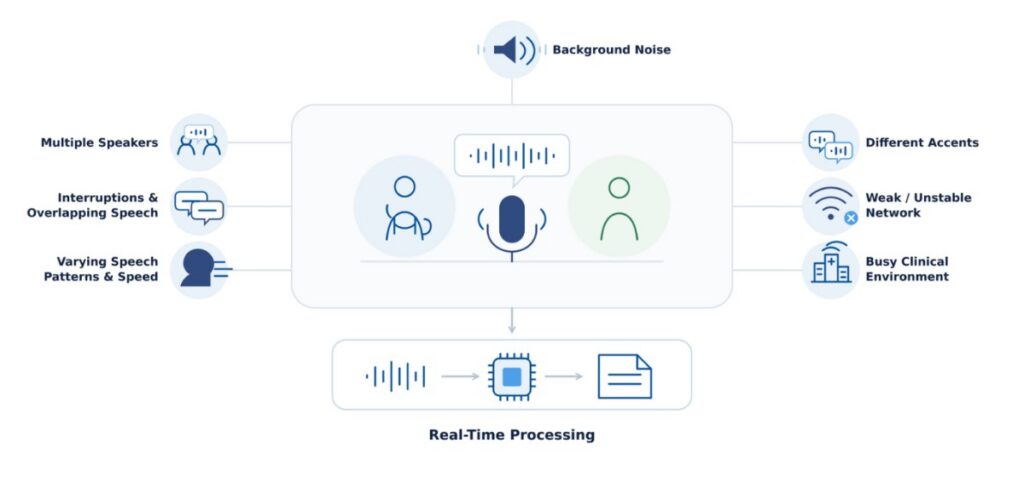
Healthcare environments introduce additional variables that laboratory testing rarely captures. Conversations frequently include interruptions, overlapping speech, changing speakers, varying accents, emotional stress, and medical terminology spoken at different speeds.
Network instability further complicates matters. Hospitals often contain areas with fluctuating wireless connectivity, multiple connected medical devices, and varying network loads. Ambient AI systems must continue functioning gracefully even when bandwidth decreases or temporary interruptions occur.
Real-time testing therefore requires realistic simulation environments rather than ideal laboratory conditions.
Validating AI Accuracy Beyond Simple Transcription
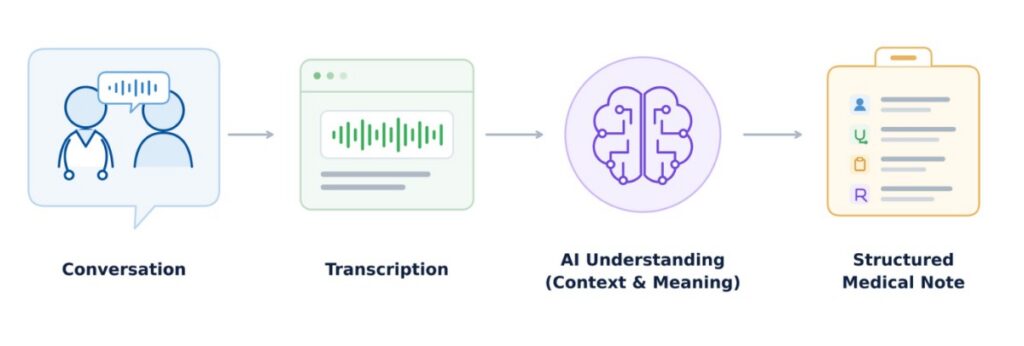
Accurate speech recognition is only the first step. Ambient AI systems must understand clinical intent rather than merely converting speech into text.
Consider a physician discussing differential diagnoses with a patient. The conversation may include possibilities that are intentionally ruled out during the consultation. The AI must distinguish between speculative discussion and confirmed diagnoses before generating documentation.
Similarly, medication conversations often contain dosage adjustments, discontinued prescriptions, historical treatments, and future recommendations within the same discussion. Context determines whether information belongs in the patient’s active medical record.
Testing these scenarios requires carefully curated datasets representing authentic clinical conversations across multiple specialties. QA engineers must evaluate whether generated summaries preserve medical meaning rather than simply matching specific wording.
Medical terminology introduces additional complexity. Drug names, abbreviations, laboratory values, anatomical references, and specialty-specific language require consistent interpretation even when pronunciation varies or speakers switch languages during consultations.
Evaluating contextual understanding becomes just as important as measuring transcription accuracy.
Privacy and Security Cannot Be Secondary Considerations
Ambient AI continuously processes some of healthcare’s most sensitive information. Patient conversations, diagnoses, medications, medical histories, and personally identifiable information all pass through multiple software components.
Testing must therefore validate privacy protections throughout the entire data lifecycle.
Encryption should be verified during transmission, storage, and processing. Access controls require extensive testing to ensure only authorized personnel can retrieve sensitive information. Logging mechanisms must balance operational visibility with patient confidentiality, ensuring protected health information does not inadvertently appear in diagnostic logs.
Healthcare organizations must also verify data retention policies, deletion workflows, consent management, audit trails, and regulatory compliance requirements.
AI introduces another important consideration: prompt security. As healthcare applications increasingly incorporate large language models, testing should verify resistance against prompt injection attacks, data leakage, unauthorized information retrieval, and malicious manipulation of AI-generated outputs.
Security testing evolves from protecting software infrastructure to protecting intelligent behavior itself.
Building Robust Test Data for Healthcare AI
High-quality testing depends on high-quality data. Unfortunately, healthcare datasets are among the most difficult to obtain because of strict privacy regulations.
Organizations frequently rely on anonymized patient records, synthetic clinical conversations, or carefully consented datasets for AI validation. Each approach presents unique advantages and limitations.
Synthetic datasets provide excellent scalability but may fail to capture the unpredictability of genuine patient interactions. Real clinical data offers authenticity but introduces governance, compliance, and privacy challenges.
An effective testing strategy typically combines multiple data sources while ensuring broad demographic representation. Different accents, age groups, speech patterns, medical specialties, and environmental conditions should all appear within validation datasets.
Bias testing also becomes essential. AI systems must perform consistently across diverse patient populations rather than demonstrating stronger accuracy for certain demographic groups.
The broader and more representative the testing data, the greater confidence organizations can have in production performance.
Human-Centered Testing Remains Essential
Despite remarkable advances in AI, healthcare remains fundamentally human.
Testing should therefore examine how clinicians interact with Ambient AI rather than focusing solely on technical correctness. User experience testing helps identify whether documentation feels trustworthy, summaries remain clinically useful, and workflows reduce rather than increase cognitive load.
Physicians may notice subtle issues that automated validation cannot detect. For example, generated notes might technically contain all necessary information while presenting it in a sequence that feels unnatural during clinical review.
Nurses, specialists, and administrative staff also interact differently with AI-generated documentation. Their workflows introduce unique usability considerations that should be incorporated into comprehensive testing programs.
Observational usability studies, pilot deployments, and continuous feedback loops become valuable complements to automated regression testing.
Successful Ambient AI ultimately depends on clinician confidence as much as algorithmic accuracy.
Continuous Testing for Continuously Learning Systems
Unlike conventional healthcare applications, AI-powered platforms evolve rapidly. Models receive updates, prompts change, language patterns shift, and clinical guidelines evolve over time.
This makes continuous testing indispensable.
Every model update should trigger automated regression testing across representative clinical scenarios. Performance baselines must be monitored continuously to detect accuracy drift before production quality declines.
Monitoring should extend beyond infrastructure metrics into AI-specific indicators such as hallucination frequency, summary completeness, transcription confidence, latency distributions, and clinical validation scores.
Production observability becomes another layer of quality assurance. Organizations should continuously analyze anonymized operational metrics to identify emerging issues that were not observed during pre-release testing.
Testing therefore becomes an ongoing operational discipline rather than a final development milestone.
The Future of QA for Ambient AI
The most valuable QA often comes from testing unusual scenarios that rarely appear during standard demonstrations.
Healthcare startups should deliberately evaluate encounters involving code-switching between languages, heavy use of medical abbreviations, overlapping conversations, incomplete consultations, emotional patients, emergency interruptions, and physicians correcting themselves multiple times.
Similarly, clinicians often dictate notes after appointments while relying on memory instead of live conversation. AI medical scribes should gracefully support both real-time and retrospective documentation workflows.
Edge case testing also includes extremely short consultations, unusually long appointments, repeated patient visits, duplicate audio uploads, interrupted internet connectivity, and partially completed documentation sessions.
These scenarios frequently reveal hidden reliability issues before customers encounter them in production.