




Latest Insights
How to Test Ambient Listening AI for Patient Encounters
- Sep 13, 2026
- Sajid M.
- Ambient Listening AI Testing
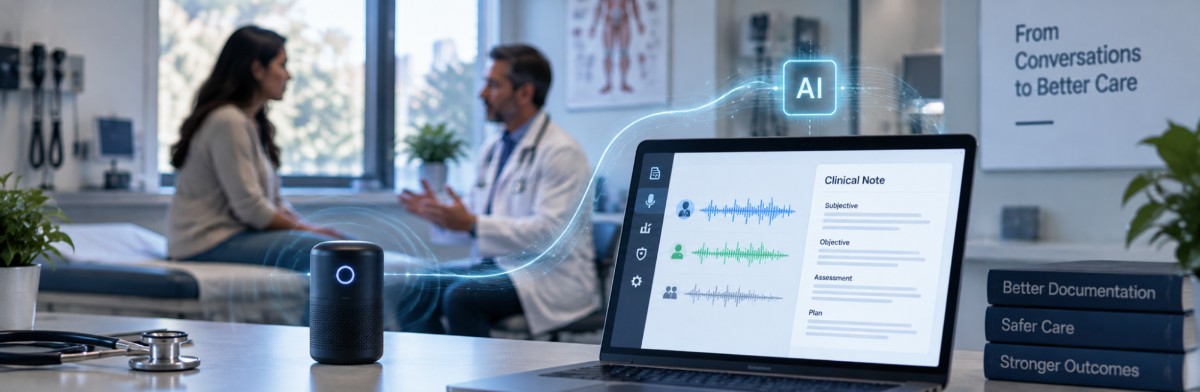
A patient says, “I’m not taking that medication anymore.” The AI-generated note says they are. One missing word can turn a convenient clinical tool into a serious quality problem.
That is what makes testing ambient listening AI different from testing ordinary software. These systems must do more than hear a conversation they need to preserve context, distinguish speakers, handle corrections, and produce reliable documentation from unpredictable real-world encounters. At Testiva, our AI testing and quality assurance services evaluate these systems across the full workflow, from audio capture and AI output to integrations, security, and usability.
For QA teams, the real question is simple: Can the system still be trusted when the conversation gets messy? This guide explains how to test exactly that.
Why Ambient Listening AI Requires a Different Testing Strategy
Traditional software testing often starts with deterministic expectations. A user performs action A, the system processes input B, and output C should appear. Generative AI makes that relationship much less predictable.
A single patient encounter can contain incomplete sentences, interruptions, medical terminology, background conversations, corrections, abbreviations, and contextual references. Two conversations communicating essentially the same clinical facts may therefore produce slightly different notes. Testing cannot rely exclusively on exact text matching.
Instead, QA teams need to evaluate whether the generated output preserves the meaning, clinical context, and important facts contained in the encounter. That requires combining conventional functional testing with AI-specific evaluation techniques and carefully designed clinical scenarios.
The testing objective also needs to extend beyond model accuracy. The complete product includes microphones, applications, APIs, authentication, electronic health record integrations, storage systems, and user interfaces. Each layer can introduce its own failures.

Start With Realistic Patient Encounter Scenarios
A strong test strategy begins with representative conversations rather than perfectly scripted audio. Real clinical encounters are messy, and test data should reflect that reality without exposing actual patient information.
Teams can build synthetic encounters representing common scenarios such as routine consultations, follow-up visits, medication reviews, chronic disease management, and conversations involving multiple participants. These scenarios should contain known facts so testers can compare the generated documentation against a controlled source of truth.
The dataset should deliberately include difficult situations. Test patients can change their answers, clinicians can correct themselves, speakers can interrupt one another, and unrelated conversation can occur during the visit. Accents, speaking speeds, background noise, medical abbreviations, medication names, and specialty-specific terminology should also vary.
The goal is not to trick the AI for sport. It is to reproduce the variability the product will encounter after deployment.
Test Audio Capture Before Testing AI Intelligence
When a generated clinical note is wrong, the model is not necessarily responsible. The problem may have started much earlier in the pipeline.
QA teams should test microphone permissions, device switching, temporary disconnections, low-volume speech, Bluetooth devices, network interruptions, and sessions where the application moves between foreground and background states. Audio should also be tested under realistic environmental conditions, including typing sounds, doors opening, equipment noise, and simultaneous speakers.
Session boundaries deserve particular attention. The system must reliably understand when listening starts and stops. Audio from one encounter must never accidentally become part of another patient’s documentation.
Testing this layer independently makes debugging significantly easier. If the captured audio is incomplete, evaluating the downstream model against the original conversation could produce misleading results.
Measure Transcription Accuracy in Clinical Context
Word error rate can provide useful baseline information, but healthcare QA should go deeper. Not every transcription mistake has the same impact.
Mishearing an insignificant conversational filler is very different from confusing “15 milligrams” with “50 milligrams.” Testers should therefore identify high-value entities such as medication names, dosages, symptoms, allergies, anatomical locations, dates, measurements, diagnoses, and negations.
Negation testing is especially important. Statements such as “no chest pain,” “doesn’t smoke,” and “not allergic to penicillin” can change meaning dramatically when a single word disappears.
Speaker attribution should also be evaluated. Ambient systems may hear the clinician, patient, caregiver, interpreter, nurse, or another person. The application needs to distinguish who said what whenever that distinction affects the generated record.
Validate the Generated Clinical Note Against Ground Truth
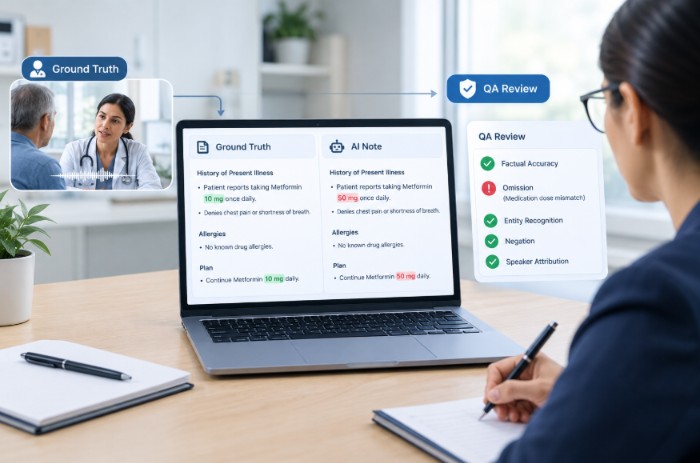
A transcript can be accurate while the generated note is wrong. The summarization and structuring stage therefore needs its own test methodology.
For every controlled encounter, QA teams should create expected clinical facts independently of the model’s preferred wording. Testing can then determine whether those facts were preserved in the generated note and placed in appropriate sections.
Three failure classes deserve particular attention: omissions, contradictions, and hallucinations. An omission occurs when clinically relevant information disappears. A contradiction changes the meaning of information that was present. A hallucination introduces information that was never stated or reasonably supported by the encounter.
Automated evaluation can help process large datasets, but expert review remains important for high-risk outputs. A scoring framework can evaluate factual completeness, unsupported claims, clinical entity accuracy, attribution, formatting, and consistency without requiring every generated sentence to match a reference note word for word.
Test Corrections, Ambiguity, and Changing Context
Human conversation is full of revisions. Ambient AI needs to understand the final meaning rather than simply collecting every statement it hears.
Consider a patient who says they take 20 mg of a medication and then immediately corrects themselves to 10 mg. The generated documentation should reflect the correction rather than recording both values as independent facts. Similar tests should cover changed appointment dates, corrected symptom duration, uncertain statements, and clinicians explicitly rejecting an earlier possibility.
Ambiguous statements deserve dedicated cases as well. When information is uncertain, the system should not manufacture certainty simply because a definitive sentence sounds cleaner.
These tests are valuable because generative systems can produce documentation that is linguistically convincing even when their interpretation is wrong. QA must evaluate semantic correctness, not writing quality alone.
Verify Privacy, Security, and Data Handling
Ambient listening applications process exceptionally sensitive information, so privacy testing needs to cover the entire data lifecycle.
QA teams should verify authentication, authorization, encryption, session handling, data retention behavior, deletion workflows, audit trails, and access controls. APIs and administrative functionality require particular scrutiny because a technically functional endpoint can still expose information to the wrong user or role.
Tenant isolation is critical in multi-organization platforms. Tests should confirm that users cannot access encounters, recordings, transcripts, or generated notes belonging to another account through APIs, modified identifiers, cached data, exports, or search functionality.
Logging also deserves inspection. Patient information can unintentionally appear in application logs, analytics platforms, debugging traces, crash reports, or monitoring systems even when the primary database is properly protected.
Test EHR and Workflow Integrations End to End
A perfect note is not useful if it reaches the wrong patient record.
Integration testing should validate patient matching, encounter identifiers, field mapping, note formatting, authentication failures, API timeouts, duplicate submissions, retries, and synchronization behavior. Testers should confirm what happens when an external system becomes temporarily unavailable and whether recovery can create duplicate or incomplete records.
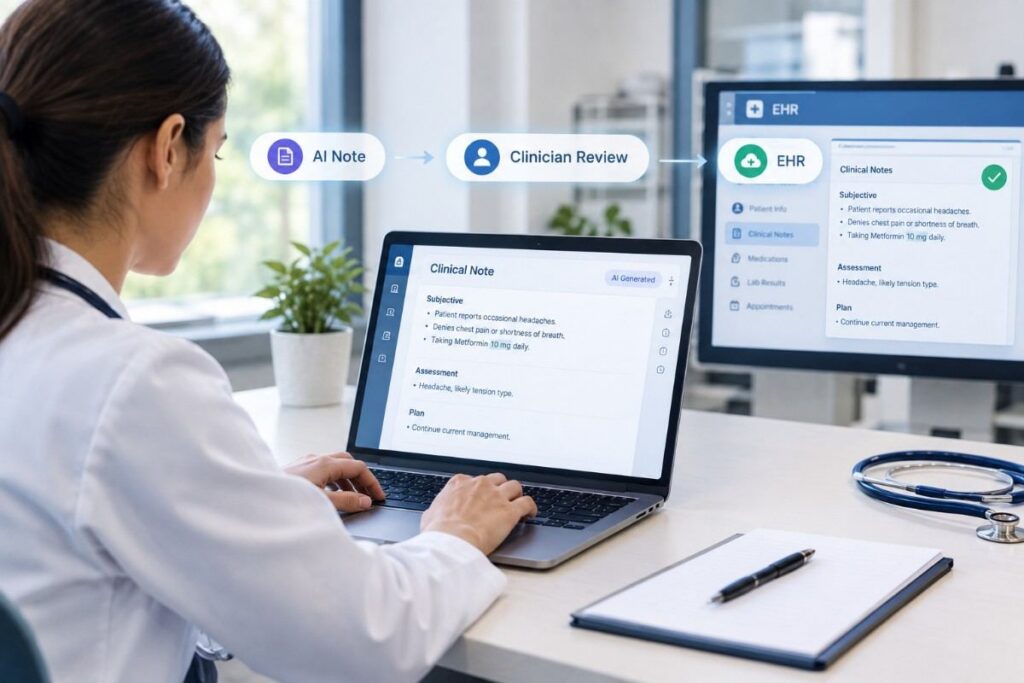
Editing workflows are equally important. Clinicians may need to review, modify, approve, reject, or regenerate documentation before it becomes part of the official record. Every state transition should be tested.
QA should also verify that AI-generated content is visually distinguishable where required and that the interface makes review practical. Human oversight becomes much less effective when important information is buried inside a frustrating workflow.
Evaluate Performance Under Real Clinical Conditions
Ambient AI introduces performance expectations that extend across an entire encounter. Teams should measure recording stability, transcription latency, note-generation time, API response times, synchronization delays, and resource consumption.
Long sessions are particularly important. A system that performs beautifully during a five-minute test may behave very differently during a 45-minute consultation. Memory consumption, device temperature, battery usage, network changes, and accumulated context can expose problems that short automated tests never reveal.
Load testing should simulate realistic concurrency as well. Clinics may have many clinicians recording simultaneously during peak periods, and performance degradation should not cause dropped audio or incomplete documentation.
Failure recovery must be part of performance testing rather than an afterthought. If connectivity disappears halfway through an encounter, testers need to know whether captured information survives and how safely processing resumes.
Build Regression Testing Around Clinical Risk
Ambient AI products evolve continuously. Model versions change, prompts are refined, terminology dictionaries expand, integrations are updated, and new specialties are introduced. An improvement in one area can unexpectedly reduce quality elsewhere.
A strong regression suite should therefore preserve difficult encounters discovered during development and production testing. Every significant defect can become a permanent test case. Over time, this creates a valuable library of scenarios representing the system’s historical weak points.
Teams should track quality metrics across releases instead of evaluating each build in isolation. Changes in factual accuracy, omission rates, hallucination frequency, entity recognition, latency, and workflow reliability can reveal regressions before users encounter them.
Model updates should be treated with the same discipline as major software changes. “The new model benchmarks better” is not sufficient evidence that the complete clinical product behaves better.
Test the Experience From the Clinician's Perspective
Ultimately, ambient listening AI exists to reduce friction rather than relocate it.
Usability testing should measure how easily clinicians can begin an encounter, understand listening status, review generated documentation, locate questionable information, make corrections, and finalize a note. Error messages should explain what happened and provide a practical recovery path.
Testers should also watch for automation bias. Highly polished AI-generated text can encourage users to trust output too quickly. Product design should support efficient verification without implying that generated documentation is automatically correct.
The best quality metric may therefore be broader than transcription accuracy. A successful ambient AI system should help clinicians create reliable documentation faster while maintaining appropriate control over the final record.
Ambient AI QA Is a System-Level Discipline
Testing ambient listening AI for patient encounters requires more than running sample recordings through a model and comparing transcripts. QA must validate everything from audio capture and clinical interpretation to privacy, integrations, resilience, and usability.
The strongest testing programs combine deterministic software checks with scenario-based AI evaluation and human review. They also treat high-risk clinical facts differently from harmless wording variations, because accuracy percentages alone cannot describe the real-world consequences of an error.
As ambient intelligence becomes increasingly embedded in healthcare workflows, quality will be determined by how reliably the entire system behaves when conversations become noisy, ambiguous, interrupted, or unexpected. That is precisely where rigorous QA earns its place.
For teams developing ambient clinical AI, testing early and continuously is far less expensive than discovering trust-breaking failures after deployment. Start your QA journey today and build the evidence that your AI experience is not only impressive in a demo, but dependable where it matters.