




Latest Insights
How to Test AI Clinical Documentation During Noisy Patient Encounters
- Oct 19, 2026
- Sajid M.
- Clinical Documentation Testing

AI clinical documentation tools face a challenge that polished demos rarely capture: real patient encounters are noisy. Clinicians talk while typing, patients speak softly, family members interrupt, equipment beeps, doors open, and conversations overlap. An AI system may perform impressively with clean audio yet struggle when these everyday conditions interfere with clinically important details. That gap makes real-world testing essential.
At Testiva, our AI testing and quality assurance services evaluate these systems under realistic conditions rather than idealized environments. Testing must go beyond measuring transcription accuracy to determine whether the AI preserves medications, symptoms, negations, diagnoses, and instructions despite acoustic interference. The goal is simple but critical: verify that clinical documentation remains accurate, reliable, and trustworthy when the exam room gets loud.
Why Noisy Clinical Encounters Are a Different Testing Problem
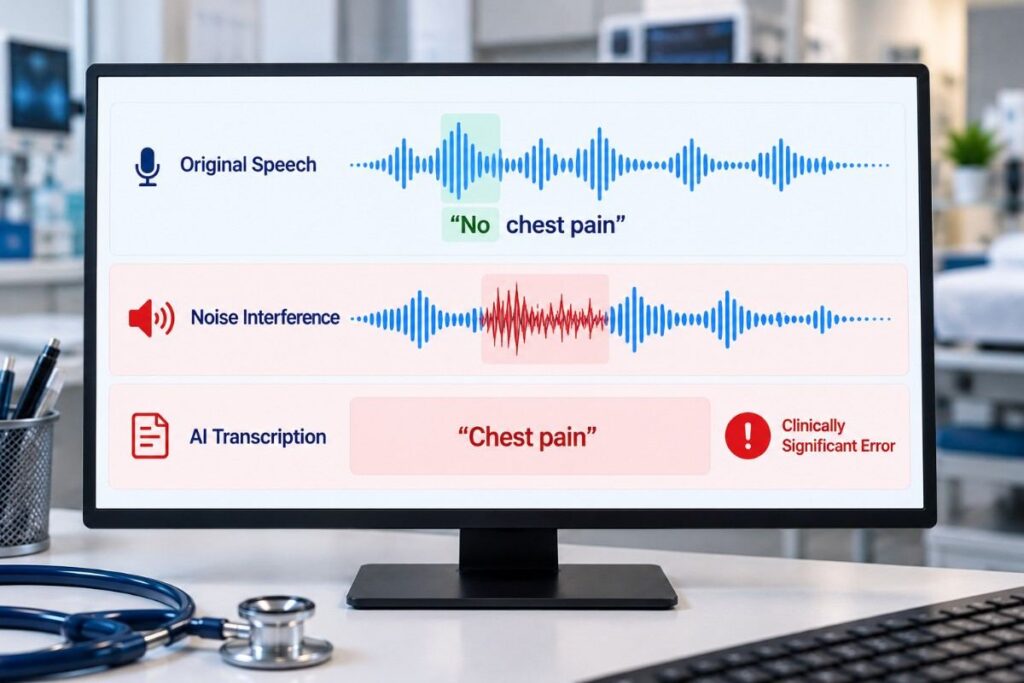
Traditional speech-recognition testing often revolves around word error rate. That metric remains useful, but clinical documentation raises the stakes because not every word carries equal meaning. Mishearing “Tuesday” may have little clinical consequence, while confusing “no chest pain” with “chest pain” can materially alter the medical record.
Ambient documentation systems also perform several transformations after speech recognition. They identify speakers, interpret clinical context, determine which statements belong in the note, organize information into sections, and generate a concise representation of the encounter. A relatively small transcription error can therefore propagate into a much larger documentation error.
Noise makes this chain more fragile. A clinician may quietly state a dosage while paper is rustling. A patient may answer “no” while another person speaks. A family member may describe a symptom that the patient later corrects. Good QA needs to reproduce these situations intentionally and determine whether the final documentation preserves the clinically meaningful truth.
Build a Noise Model Based on Real Clinical Environments
A useful test suite should not treat “noise” as one generic audio effect. Different acoustic conditions stress AI systems in different ways, so testing should represent the environments where the product will actually operate.
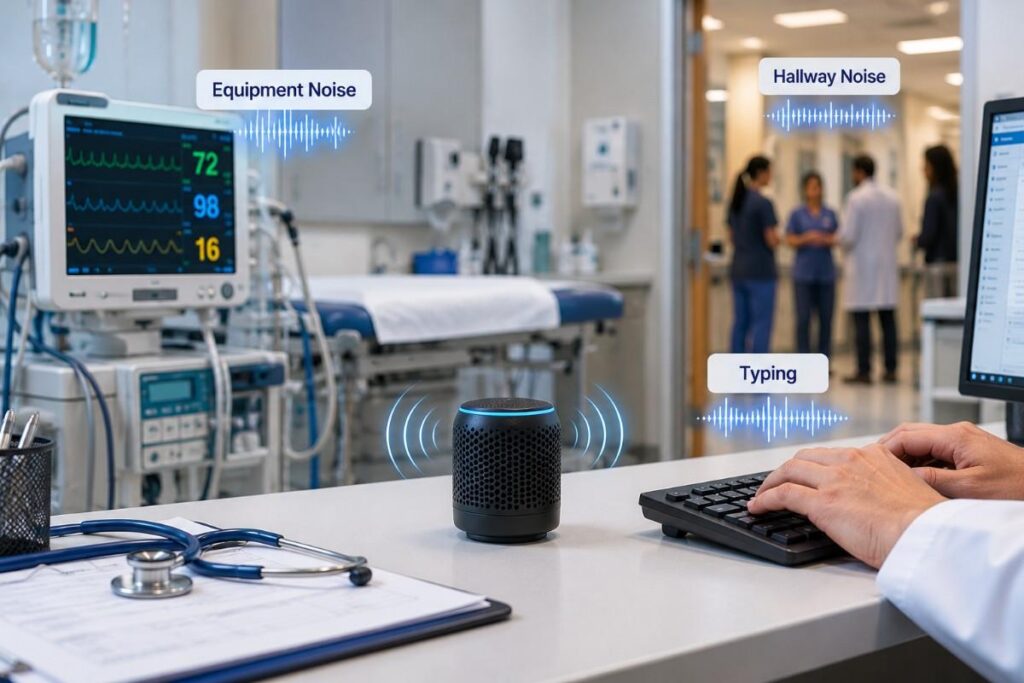
Start with continuous background noise such as HVAC systems, hallway activity, waiting-room conversations, ventilation, and medical equipment. Then introduce intermittent events including doors closing, alarms, phones ringing, typing, coughing, paper movement, and objects being placed on examination tables. These sudden events are especially valuable because they may obscure only a few words the exact few words that happen to contain a medication, symptom, or negation.
Distance should also be varied. Clinicians do not remain beside a microphone throughout an encounter. They may walk toward a sink, examine the patient, turn away while entering information, or speak while opening cabinets. Testing at multiple speaker-to-device distances exposes weaknesses that clean recordings played at fixed volume will never reveal.
The objective is not maximum chaos. It is controlled realism. QA teams should know exactly which acoustic variable was introduced so failures can be reproduced, compared, and diagnosed.
Establish a Clean-Audio Baseline Before Adding Noise
Before measuring degradation, establish what the system produces from an ideal version of the encounter. A clean reference recording provides a baseline against which noisy variants can be compared.
Create representative encounters containing clinically important information such as symptoms, allergies, medications, dosage changes, diagnoses, relevant negatives, examination findings, and follow-up instructions. The expected documentation should be reviewed carefully enough that testers know which facts are essential, optional, or inappropriate to infer.
Next, produce multiple versions of the same encounter with progressively more difficult conditions. Because the underlying clinical conversation remains constant, differences in output can be attributed more confidently to acoustic degradation.
This methodology also reveals something more useful than simple pass/fail results: the system’s degradation curve. A robust clinical AI product should fail gracefully. Documentation quality should not suddenly collapse because background noise increased slightly or the clinician moved another meter from the microphone.
Measure Clinical Accuracy, Not Just Transcription Accuracy
Word error rate can identify deterioration in speech recognition, but final-note evaluation should focus on clinical meaning. Testers need to ask whether the generated documentation accurately represents what occurred during the encounter.
Critical entities deserve particular attention. Medication names, dosages, frequencies, symptoms, anatomical locations, durations, allergies, diagnoses, measurements, dates, and follow-up instructions should be compared against ground truth. Errors involving these elements should generally carry greater severity than stylistic differences.
Negation requires dedicated testing. Phrases such as “no fever,” “denies shortness of breath,” and “has not taken the medication” contain small linguistic markers with significant clinical meaning. Introduce noise specifically around those markers and verify that the system does not reverse the statement.
QA teams should also distinguish between transcription errors and documentation errors. If the transcript is correct but the final note changes the meaning, the problem lies downstream. If the transcript itself is wrong, the investigation starts earlier in the pipeline. That distinction makes defect reports far more actionable for engineering teams.
Test Overlapping Speech and Speaker Attribution Aggressively
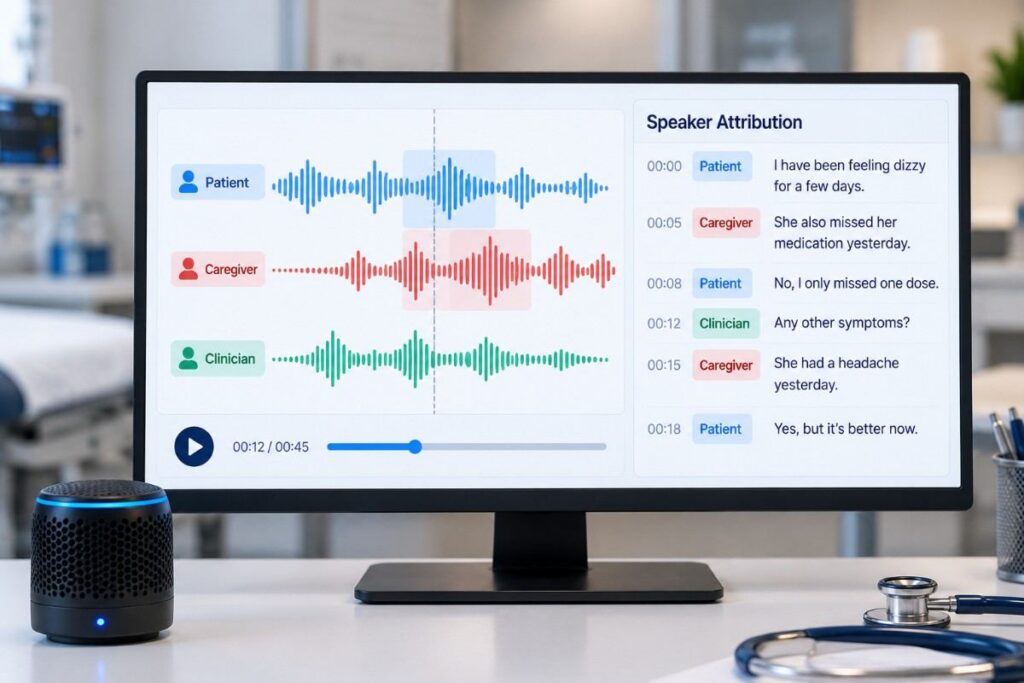
Clinical conversations are rarely turn-based. Patients interrupt clinicians, parents answer for children, caregivers add information, and multiple staff members may enter the room. Speaker overlap should therefore be a first-class test condition.
Build scenarios where two people speak simultaneously and vary which speaker contains the clinically important information. Test subtle overlaps as well as complete collisions. Then examine whether the system loses information, merges statements, or attributes one person’s claims to another.
Speaker attribution is particularly important when statements conflict. Imagine a caregiver saying, “She stopped taking it last week,” followed by the patient saying, “No, I only missed one dose.” A documentation system should not confidently record the caregiver’s statement as established patient history while ignoring the correction.
Tests should also cover clinician-to-clinician conversation. Not every sentence spoken near the recording device belongs in the patient’s note. The system needs enough contextual discrimination to avoid transforming unrelated background speech into clinical documentation.
Design Tests Specifically for Hallucinations
Noise does not merely increase the chance that AI will miss information. It can increase uncertainty, and generative systems may respond to uncertainty by producing plausible information that was never actually stated.
Create test cases where clinically important phrases are partially obscured and observe the model’s behavior. If a medication name becomes unintelligible, does the system omit it, flag uncertainty, or confidently substitute a common medication? The third outcome deserves immediate attention.
Use adversarial cases where contextual clues strongly suggest an answer that the audio never confirms. For example, an encounter may discuss symptoms commonly associated with a particular diagnosis without the clinician ever making that diagnosis. Noise should not give the system permission to complete the clinical story itself.
This is where precision can matter more than apparent completeness. In clinical documentation, acknowledging uncertainty or omitting unsupported information can be safer than generating a beautifully written but fictional detail.
Test Noise at the Most Dangerous Moments
Randomly applying background noise is useful for general robustness testing, but targeted noise produces deeper insights. Place interference precisely over high-risk pieces of information.
Obscure the word “no” in a negative statement. Add a cough during a medication dosage. Introduce keyboard noise while an allergy is stated. Create overlapping speech during follow-up instructions. Move the clinician farther from the microphone while discussing a treatment change.
These tests reveal whether particular classes of information are resilient to degradation. They also allow teams to build risk-weighted quality metrics rather than treating every transcription mistake as equally important.
A system that occasionally misses conversational filler but consistently captures medications and allergies may be performing acceptably. A system with impressive overall transcription accuracy that occasionally invents dosages has a much more serious quality problem.
Include Diverse Voices and Encounter Patterns
Noise robustness cannot be separated from speaker diversity. The same acoustic environment may affect recognition differently depending on accent, speech rate, pitch, pronunciation, vocabulary, or speaking style.
Test patients who speak quietly, rapidly, hesitantly, or with incomplete sentences. Include clinicians who dictate medical terminology quickly and patients who use informal descriptions rather than clinical vocabulary. Encounters should also vary naturally in length and conversational structure.
Testing should examine combinations rather than isolated variables. A quiet speaker in a quiet room is one scenario; a quiet speaker with an accent while equipment operates nearby is another. Production failures frequently emerge from combinations of conditions that individually appear harmless.
That is why coverage matrices are valuable. They make it possible to track combinations of speaker characteristics, noise types, signal levels, encounter complexity, device position, and clinically significant content without relying on an undefined collection of “realistic recordings.”
Evaluate the Final Note as a Clinical Artifact
Ultimately, users interact with documentation, not an acoustic benchmark. QA should therefore evaluate the final generated note independently of intermediate model metrics.
Compare the note with verified ground truth and classify errors by clinical significance. Look for unsupported additions, missing critical facts, incorrect attribution, contradictions, duplicated information, distorted chronology, and statements placed in inappropriate sections.
Consistency matters too. Repeating the same noisy encounter should not produce radically different interpretations of essential facts. Some linguistic variation is normal for generative systems, but medications, symptoms, diagnoses, and other core facts should remain stable.
Testing should also verify how the product exposes uncertainty. If the system cannot reliably understand part of an encounter, the interface and workflow should help users identify that limitation rather than burying uncertainty beneath fluent prose.
Make Noisy-Encounter Testing Part of Continuous QA
Noise testing should not be a one-time certification exercise performed shortly before release. Changes to speech models, prompts, summarization logic, audio preprocessing, infrastructure, or third-party AI components can alter behavior unexpectedly.
Maintain a regression dataset containing both clean encounters and carefully designed noisy variants. When the system changes, rerun clinically significant scenarios and compare results against established baselines. Track not only overall accuracy but also critical omissions, hallucinations, negation failures, speaker-attribution errors, and other risk-weighted measures.
Production observations can strengthen this library over time. When users encounter a new acoustic failure pattern, reproduce it safely in a controlled test case and add that condition to regression coverage. The QA suite then evolves alongside the realities of clinical use.
Reliable Clinical AI Has to Survive the Real Room
AI clinical documentation should not be judged by how elegantly it handles studio-quality conversations. Its meaningful test is the exam room: people interrupting, equipment operating, clinicians moving, patients speaking softly, and important details appearing in imperfect audio.
Effective QA recreates those conditions systematically, isolates variables, measures clinically meaningful accuracy, challenges hallucination behavior, and evaluates the final note rather than stopping at transcription metrics. The result is a much clearer picture of whether an AI documentation system is merely impressive in demonstrations or dependable in practice.
For teams building clinical AI, noisy-encounter testing belongs at the center of the quality strategy. Testiva helps software teams design rigorous QA programs that examine functionality, AI behavior, reliability, and real-world user experience under conditions that conventional test cases can miss. Start your QA journey today and build clinical documentation software that remains trustworthy when the real world gets loud.