




Latest Insights
How to Test Noise and Speaker Variation for AI Note-Taking Applications
- Aug 20, 2026
- Sajid M.
- AI Note Taking
Introduction to Testing Noise/Speaker Variation Scenarios for Note-Taking Applications
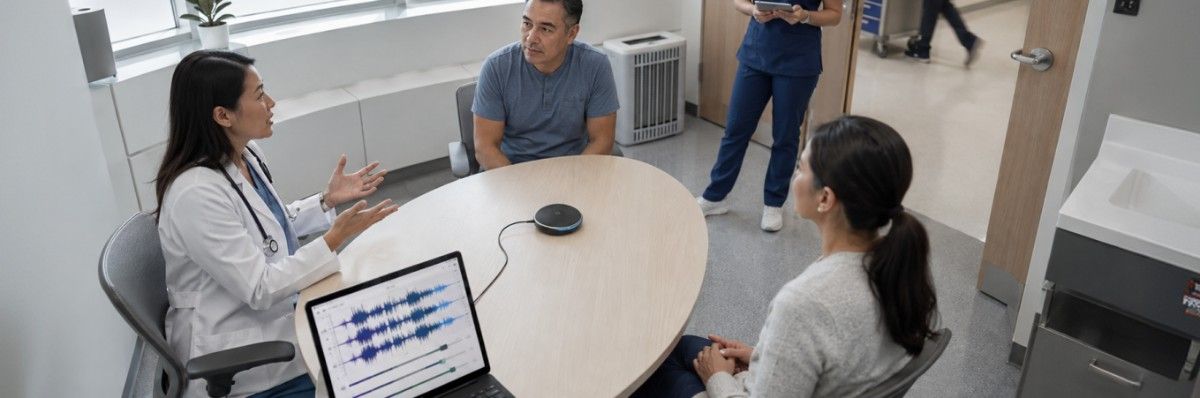
Real consultations rarely happen in a quiet room with two clear voices speaking one at a time. There’s a nurse who steps in, a parent answering for a child, a clinic hallway humming in the background, a phone held too far from the speaker’s mouth.
This blog covers noise and speaker variation testing for AI note-taking applications, including how to deliberately test for the noise and speaker conditions that actually occur, based on what we found while evaluating a real AI medical scribe using Testiva’s AI note-taking testing framework.
Why Noise and Speaker Variation Matter in AI Note-Taking Applications
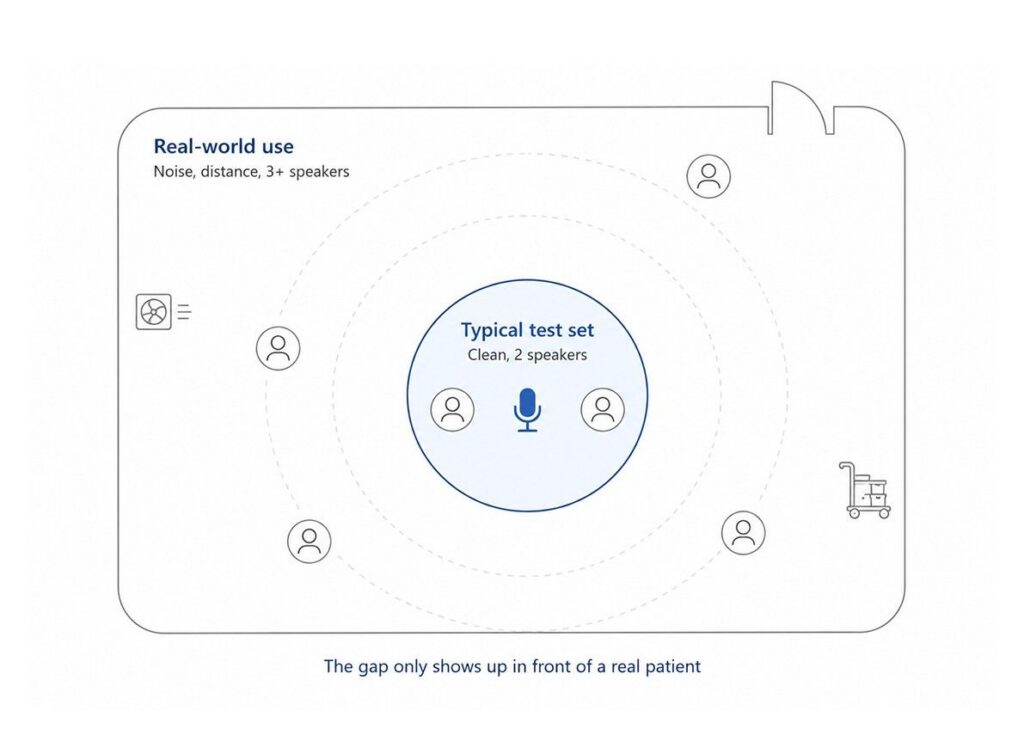
A system tested only on clean, two-speaker audio gets validated against a condition that’s the exception in real use, not the norm. Effective noise and speaker variation testing for AI note-taking applications requires deliberate coverage across both acoustic conditions and speaker configurations rather than relying on a single clean recording.
If your test set never includes background noise, a distant microphone, or more than two people talking, you find out how the system handles those conditions only after it’s already in front of a real patient.
Two Key Test Dimensions for AI Note-Taking Applications
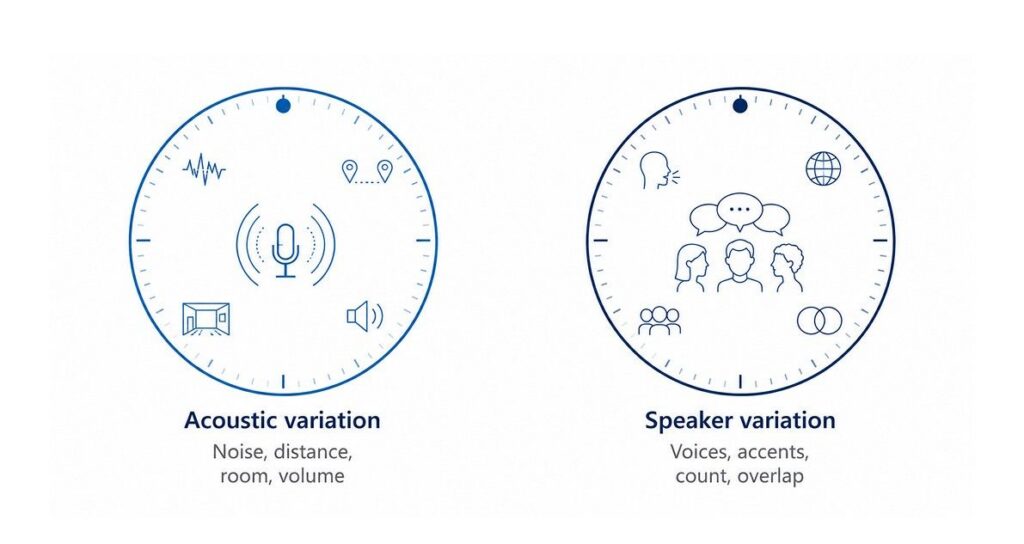
These failures come from two separate axes, and each needs its own deliberate coverage:
- Acoustic/noise variation: how the audio sounds: background noise, distance from the mic, room conditions, volume.
- Speaker variation: who’s talking and how many: voice differences, accents, number of speakers, overlapping speech.
Testing one doesn’t tell you much about the other. A noisy two-speaker recording and a clean four-speaker recording stress completely different parts of the system. Together, these scenarios form an essential part of speech recognition testing for AI note-taking applications.
Testing AI Note-Taking Applications Under Different Noise Conditions
As part of noise and speaker variation testing for AI note-taking applications, acoustic testing evaluates how recording conditions affect transcription quality and downstream note generation. This includes background noise testing, microphone distance, room acoustics, and speaker volume.
- Background noise: clinic chatter, typing, doors, general ambient sound
- Microphone distance: close, desk-distance, or far from the speaker
- Room acoustics: echo, dead rooms, varying recording environments
- Volume levels: including quiet or near-silent speech, not just normal conversational volume
During Testiva’s evaluation of a live AI medical scribe, we found that volume introduced a distinct failure pattern. In one low-volume recording, the system didn’t mishear words, it dropped them outright. 324 of 337 total errors on that test case were pure deletions, and the resulting transcript came out roughly 16% shorter than the actual conversation. Nothing about that shorter transcript looked broken on a read-through; it just looked like a quieter patient.
The capture method made a similar point at a larger scale. Running identical scripts through an uploaded file versus a live microphone, with nothing else changed, produced word error rates ranging from a small increase to nearly 20 times worse. In one distant-microphone recording, two specific drug names were dropped entirely and replaced with a generic phrase, reinforcing why background noise testing and other acoustic conditions should be included in any comprehensive evaluation strategy.
Testing AI Note-Taking Applications with Multiple Speakers
As part of noise and speaker variation testing for AI note-taking applications, speech recognition testing should cover conversations involving different numbers of speakers, overlapping dialogue, and varied voice characteristics. These scenarios help evaluate whether the system can accurately separate speakers while preserving transcription quality.
- Voice and accent variety – not the same one or two voices repeated across every test
- Number of speakers – beyond the standard doctor and patient pair
- Similar-sounding voices – speakers who are acoustically close, like a parent and child
- Overlapping speech – two people talking at the same time
We found two distinct ways extra speakers break attribution. In one consultation with a brief nurse interruption, the nurse’s lines were mislabeled as the patient’s own speech for 2 of 39 total turns, a small number, but exactly the moment most likely to matter. In a parent-child consultation, roughly half of the parent’s turns were attributed to the child’s speaker instead, with overall accuracy landing around 83%, below the 90% mark we treat as a pass. Notably, the capture method didn’t move speaker accuracy in one consistent direction either, it improved on one two-speaker recording under microphone capture and got worse on a three-speaker recording under the same conditions.
How Noise and Speaker Variation Interact in AI Note-Taking Applications
Noise and speaker count aren’t independent variables, testing them only in isolation misses how they interact. Overlapping speech is the clearest example: it’s simultaneously a speaker problem (two people talking at once) and an acoustic problem (the resulting audio is genuinely harder to parse). In one of our test cases with frequent overlapping speech, 13 of 48 total turns went missing from the transcript entirely, with short responses dropped rather than attributed to anyone, a failure that wouldn’t show up testing either a clean multi-speaker recording or a noisy two-speaker one separately.
We saw the same compounding effect with a scenario that already had natural coughing and background noise built into the conversation itself. Adding microphone capture on top of that pushed word error rate to 19.48%, the worst degradation across every comparison we ran, including the ones where mic capture was the only variable changed on an otherwise clean recording.
These results show why background noise testing should be combined with speaker variation scenarios rather than evaluated in isolation.
How to Generate Noise and Speaker Variation Test Data for AI Note-Taking Applications
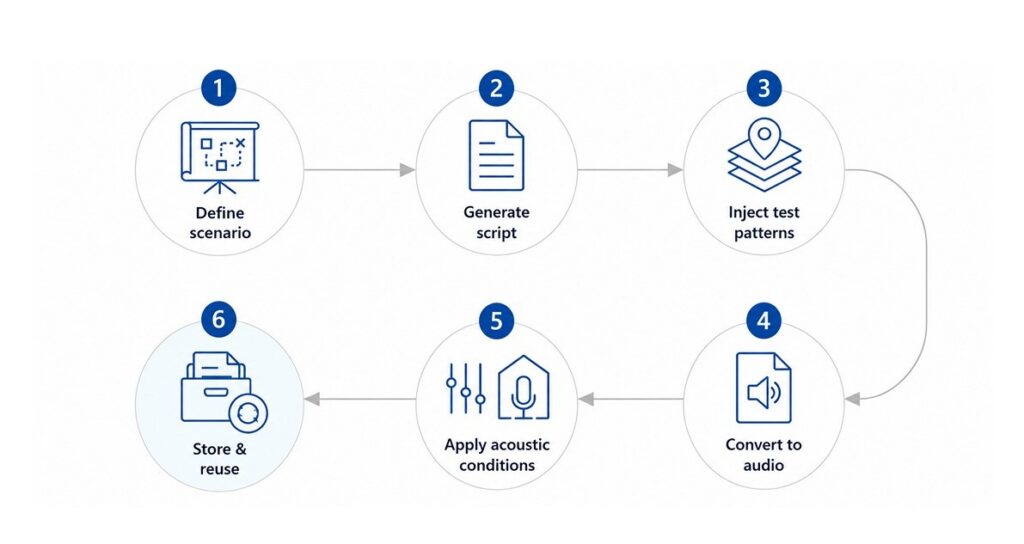
Producing this range of conditions by recording real audio in real rooms with real people doesn’t scale. As part of Testiva’s testing framework, we generate these scenarios using a repeatable process that allows the same consultation to be evaluated under multiple acoustic and speaker conditions. We generated it instead, following a consistent process:
Step 1: Define the scenario. Decide what’s being tested, the medical context, the complexity of the conversation, and the specific behavior to check.
Step 2: Generate the conversation script. A language model produces realistic dialogue for that scenario, covering the symptoms, history, and outcome appropriate to it.
Step 3: Inject specific test patterns into the script. Targeted behaviors get built directly into the conversation rather than hoped for by chance, like a statement that gets denied and later contradicted, or a dosage revised partway through the visit.
Step 4: Convert the script into audio. The script is sent to a text-to-speech model with a voice profile set per speaker, a chosen voice, accent, or language, so the same script can be tested with different speakers without rewriting anything.
Step 5: Apply real-world acoustic conditions. Background noise, room acoustics, microphone distance, and volume are layered onto the generated audio, simulating a noisy clinic or a quiet, distant speaker without a second recording session.
Step 6: Store and reuse the generated data. Once a scenario exists, it can be regenerated or rerun later, making it possible to retest the same case after a model update instead of treating it as a one-time check.
This is what lets us test the same underlying script across multiple speaker counts and multiple acoustic conditions without re-recording anything by hand each time.
Conclusion
A robust noise and speaker variation testing for AI note-taking applications strategy goes beyond clean recordings and ideal conditions. Testing across different noise levels, speaker variations, and their combined effects helps uncover transcription errors through comprehensive speech recognition testing, speaker attribution evaluation, and note validation.
At Testiva, we apply these best practices through realistic test data generation, acoustic testing, controlled recording variations, multi-speaker testing, and comprehensive evaluation. This enables teams to validate AI note-taking applications under real-world conditions and build greater confidence in their performance before deployment.
Ready to evaluate your AI note-taking application under real-world conditions? Contact Testiva today for a demo of our testing framework and learn how structured QA can improve transcription accuracy, strengthen reliability, and reduce risks before deployment.