




Latest Insights
How to Generate Test Data for AI Note-Taking Applications
- Aug 19, 2026
- Sajid M.
- AI Note Taking
Introduction
AI note-taking applications are now trusted to listen to real conversations and turn them into records that other people rely on. Before that trust is earned, the system needs to be tested against far more than a few clean examples.
Most teams start by recording a handful of sample conversations and checking if the output looks right. This works for proving the system functions at all. It does very little to prove the system is actually safe to use. When we first started testing a medical scribe application at Testiva, this was exactly where we began too, and it didn’t take long to run into its limits. This led us to adopt synthetic test data and scalable generation techniques to improve test coverage.
Why Manual Test Data Generation Falls Short for AI Note-Taking Applications
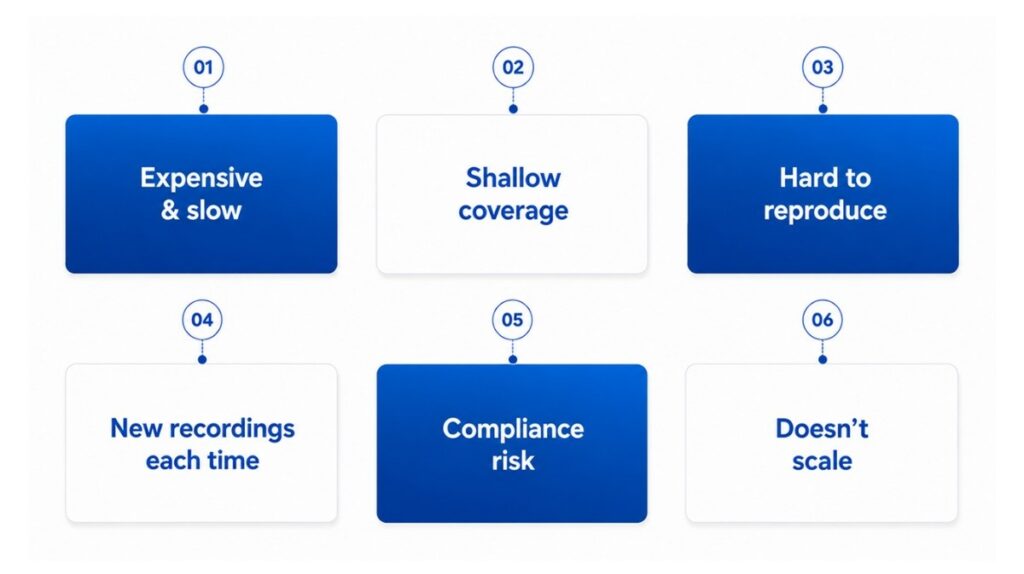
Creating test data by hand means writing a script, finding someone to read it, recording the audio, and reviewing it, for every single scenario you want to test. That process is slow even for one example. Multiplied across dozens of conditions and failure types, it becomes impractical.
A few specific problems showed up consistently during Testiva’s testing:
- It’s expensive and slow. Scripting, recording, and editing audio for each scenario takes real time and often real money, especially if voice talent or a studio is involved.
- Coverage stays shallow. With limited time, teams naturally record the easiest, most obvious conversations. The result is a test set full of happy paths and almost nothing else.
- Precise scenarios are hard to reproduce. Asking a human actor to hit an exact sequence, such as denying something and then contradicting that denial later, consistently and correctly, is difficult to direct and even harder to repeat.
- Acoustic variation requires new recordings. Testing how the system performs with background noise, a distant microphone, or low volume usually means recording the same conversation again under different physical conditions.
- Real recordings introduce compliance risk. Using actual patient conversations for testing creates consent, privacy, and storage concerns that have nothing to do with whether the AI itself works correctly.
- It doesn’t scale. Testing across multiple conditions, multiple failure types, and multiple languages multiplies the manual effort needed, often beyond what any team can realistically sustain.
What Is Test Data for AI Note-Taking Applications?
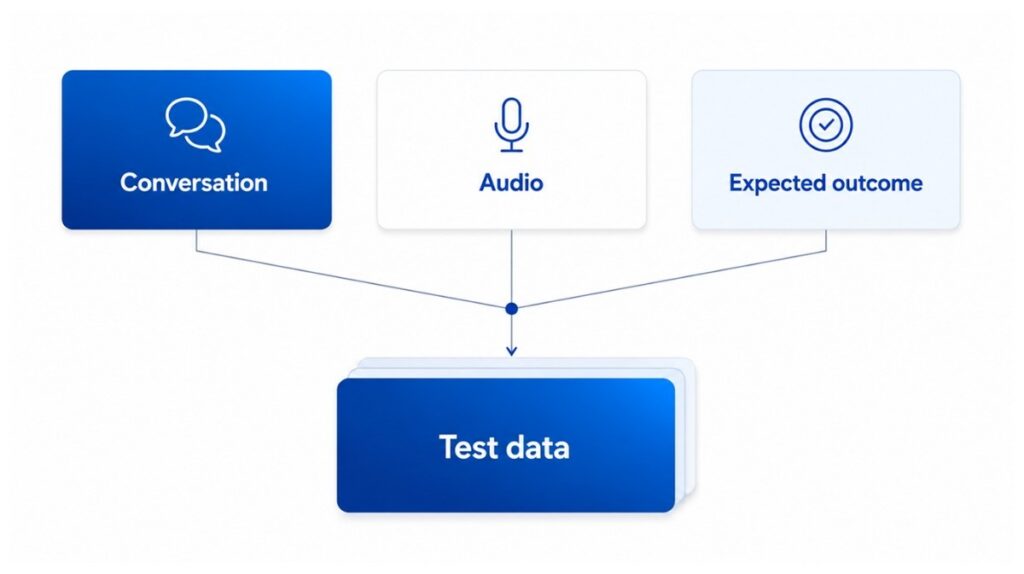
Test data is a conversation, paired with audio and an expected outcome, used to check whether a system transcribes and summarizes a consultation correctly.
It’s not just any recording. Good test data is built to deliberately surface specific weaknesses, such as a detail that should or shouldn’t make it into the notes, a denial that shouldn’t get flipped, or a dosage that gets revised mid conversation, so you can verify the system handles them correctly rather than just sounding right.
How to Automate Test Data Generation for AI Note-Taking Applications
The manual approach fails because every part of the process depends on direct human effort: writing, recording, and reviewing each scenario individually. Automating test data generation removes that dependency by generating both the conversation and the audio programmatically.
At Testiva, AI test data generation for note-taking applications became the foundation of our testing framework. By automating both conversation generation and audio creation, we were able to expand test coverage while keeping scenarios consistent and repeatable.
This generally comes down to two parts working together. First, a language model generates synthetic medical conversations, including any specific behavior you want to test. Second, that script is passed to a text to speech model with a chosen voice profile set for each speaker, which converts the written conversation into a realistic audio file. Once both parts are automated, producing one scenario or a hundred takes roughly the same amount of effort. This is the shift we made after manually testing a medical scribe application for several weeks, and it changed how much we could realistically cover.
Test Data Generation Process for AI Note-Taking Applications
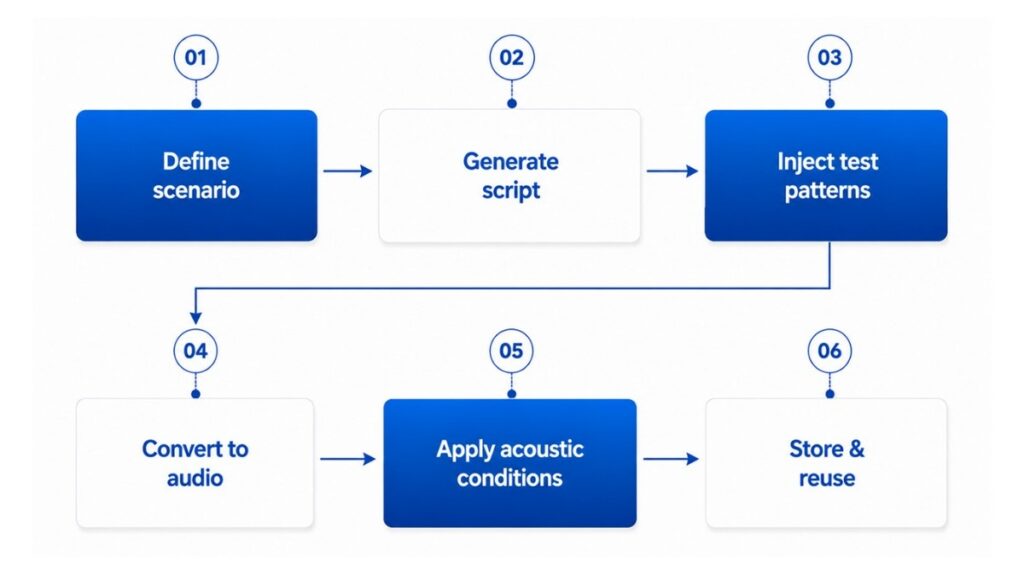
Step 1: Define the scenario. Decide what’s being tested. This includes the medical context, the complexity of the conversation, and which specific behavior you want to check.
Step 2: Generate the conversation script. A language model produces realistic synthetic medical conversations based on the defined scenario, covering the symptoms, history, and outcome appropriate to that context.
Step 3: Inject specific test patterns into the script. This is where targeted behaviors get built directly into the conversation rather than hoped for by chance. Examples include a statement that gets denied and later contradicted, a dosage that gets revised partway through the visit, or a recording that’s structured to end before a plan is confirmed.
Step 4: Convert the script into audio. The generated script is sent to a text to speech model, with a voice profile set for each speaker, such as a chosen voice, accent, or language. The model converts the text into an audio file, so the same script can be tested with different speakers without rewriting anything.
Step 5: Apply real world acoustic conditions. Background noise, room acoustics, microphone distance, and volume can all be layered onto the generated audio, simulating a noisy clinic or a quiet, distant speaker without a second recording session.
Step 6: Store and reuse the generated data. Once a scenario exists, it can be regenerated or rerun later, making it possible to retest the same case after a model update instead of treating it as a one time check. This repeatability is a key part of Testiva’s testing framework, enabling consistent regression testing across successive model and prompt updates.
Generating Positive, Negative, and Edge Case Test Data for AI Note-Taking Applications
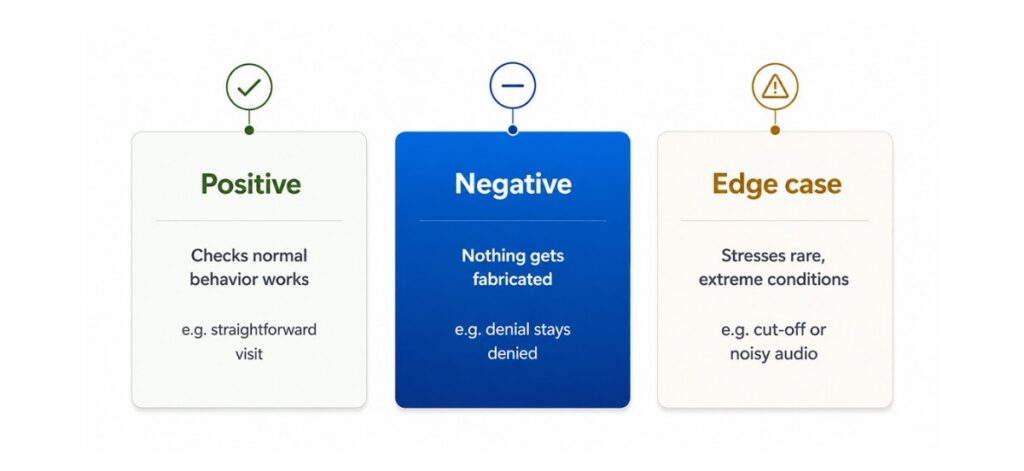
A complete test set needs more than just examples that work. It needs a deliberate mix of three types.
Positive test data confirms the system behaves correctly under normal, expected conditions. This includes clear conversations with a straightforward history, diagnosis, and plan, used to check that the basic transcription and summarization process works as intended.
Negative test data checks that the system doesn’t introduce something that never happened. This includes conversations where a patient denies a symptom that shouldn’t later appear as confirmed, or where a diagnosis is only implied but never actually stated, used to check the system doesn’t fabricate or misrepresent information.
Edge case test data stresses the system under rare or extreme conditions. This includes very short conversations with minimal content, recordings that cut off abruptly, conversations with two unrelated conditions discussed together, and audio recorded at very low volume or with heavy background noise. In our own testing of a medical scribe application, these edge cases consistently revealed more problems than any number of straightforward conversations did.
Benefits of Automated Test Data Generation for AI Note-Taking Applications
Automating this process changes what’s realistically possible to test. Large volumes of synthetic test data can be produced quickly instead of over weeks. Every known failure mode can be represented on purpose instead of by chance. The same scenario can be regenerated and retested after every model update. No real patient data needs to be involved at any point. And testing can scale across conditions, languages, and acoustic environments without a proportional increase in manual effort.
These capabilities form the basis of Testiva’s automated test generation approach, helping teams build repeatable, scalable QA workflows for AI note-taking applications.
Conclusion
A robust AI test data generation for note-taking applications strategy is the foundation of effective AI note-taking QA. Automating test data creation enables broader coverage, repeatable testing, and realistic positive, negative, and edge-case scenarios, helping teams uncover issues that manual testing often misses while reducing time, cost, and compliance risks.
At Testiva, we apply these best practices through an automated test data generation framework that creates realistic conversations, injects targeted failure scenarios, and supports scalable evaluation across different recording conditions. This helps teams build more comprehensive test suites and improve confidence in their AI note-taking applications.
Ready to scale testing for your AI note-taking application? Contact Testiva today for a demo of our automated test data generation framework and learn how structured QA can improve coverage, accuracy, and reliability.