




Latest Insights
How to Measure Accuracy in AI Note-Taking Apps
- Sep 15, 2026
- Sajid M.
- AI Note Taking Accuracy

AI note-taking apps have moved from “nice experiment” to everyday infrastructure. Teams now use them to transcribe meetings, summarize discussions, identify action items, capture decisions, and turn hours of conversation into searchable knowledge. The convenience is obvious. The harder question is whether the notes are actually accurate.
At Testiva, we look at accuracy as a quality problem rather than a single AI metric. Testing an AI note-taking application requires checking the entire journey from captured audio and transcription to summaries, speaker attribution, and extracted actions. That is where structured AI application testing and QA becomes particularly useful: an output can look polished while still containing subtle errors that materially change what happened in the meeting.
Measuring accuracy therefore requires more than asking, “Did the AI get the words right?” A reliable evaluation framework needs to determine whether the application captured the right words, understood their context, preserved the important facts, attributed them correctly, and avoided inventing information.
What Does “Accuracy” Actually Mean for an AI Note-Taking App?
Accuracy is multidimensional. Consider a meeting where someone says, “We shouldn’t deploy on Friday unless the payment bug is fixed.” A transcription system might capture every word correctly, while a summarizer produces, “The team will deploy on Friday.” Technically, the transcript performed well. Practically, the note-taking application failed.
That distinction matters because users rarely consume AI-generated meeting data at only one layer. They may read the transcript, scan a summary, copy action items into project management software, or search previous meetings for a decision. Each feature creates its own accuracy requirements.
A useful QA strategy therefore separates transcription accuracy, semantic accuracy, factual accuracy, speaker accuracy, and extraction accuracy. These measurements can then be combined to provide a much more realistic picture of product quality.
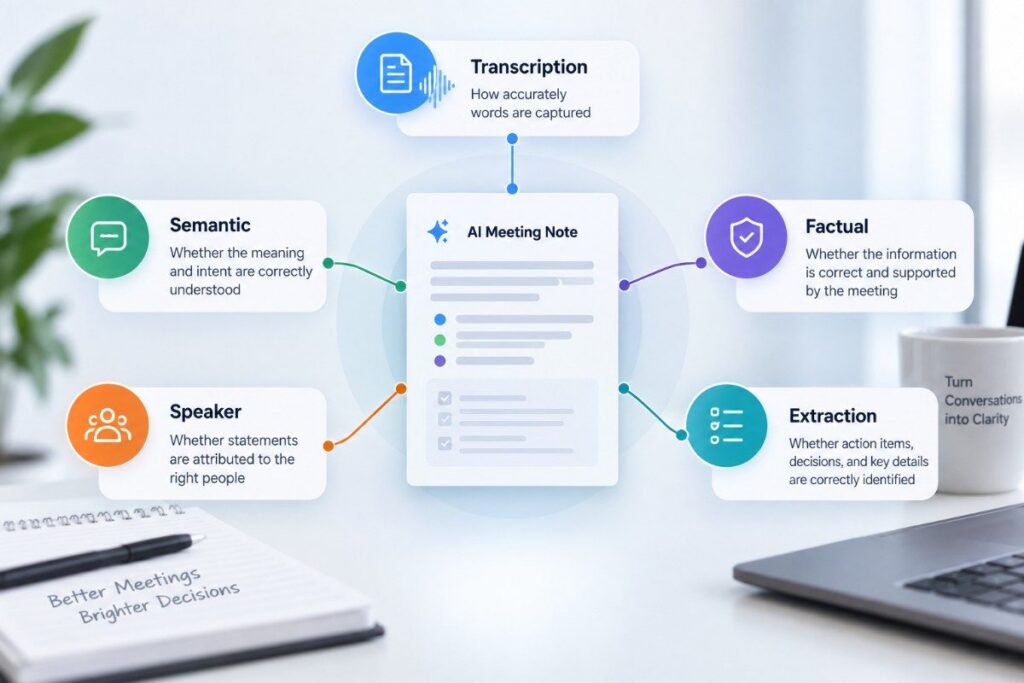
Measure Transcription Accuracy with Word Error Rate
Word Error Rate (WER) remains one of the most useful baseline metrics for evaluating speech-to-text systems. It compares an AI-generated transcript against a carefully prepared reference transcript and measures substitutions, deletions, and insertions.
The basic formula is:
WER = (Substitutions + Deletions + Insertions) / Total Words in the Reference Transcript
Suppose the reference contains 1,000 words and the application makes 20 substitutions, deletes 15 words, and inserts 5 incorrect words. The WER is 4%. Lower values indicate better transcription performance.
But WER should never be interpreted in isolation. Misrecognizing “Tuesday” as “Thursday” is only one word error, yet it could cause someone to miss an important deadline. Replacing a filler word such as “um” has almost no business impact. We therefore recommend pairing WER with tests that measure the significance of individual errors.
Test the Conditions Real Users Actually Create
A pristine recording from one native speaker in a quiet room tells you very little about how an application will behave during a real sales call or engineering stand-up. Accuracy testing needs a representative audio dataset.
That means including different accents, speaking speeds, microphone qualities, background noise levels, overlapping speakers, remote participants, technical terminology, names, abbreviations, and unstable connections. Testing should also cover both short conversations and long meetings, because model behavior can change as context grows.
The objective is not to create artificially difficult tests. It is to reproduce the messy conditions the product will encounter after release.
Evaluate Speaker Attribution Separately
Speaker diarization the system’s ability to determine who said what is another critical accuracy dimension. A transcript can contain perfect wording and still become dangerous if statements are assigned to the wrong people.
Imagine an executive saying, “I don’t approve this budget yet,” while the notes attribute the sentence to the finance lead. The words are correct, but the record of the meeting is not.
QA teams should measure how often speaker boundaries are detected correctly and how frequently statements are assigned to the appropriate participant. Tests should deliberately include interruptions, similar voices, quick exchanges, participants joining late, and people speaking simultaneously. These scenarios reveal failures that straightforward recordings rarely expose.
Measure Summary Accuracy Against Ground Truth
Summary evaluation is harder than transcript evaluation because there may be several valid ways to summarize the same meeting. You cannot simply compare generated text word for word against a reference summary.
Instead, create a human-reviewed ground truth containing the meeting’s essential facts, decisions, unresolved questions, commitments, and outcomes. The generated summary can then be evaluated against that information.
We typically care about two broad questions: Did the AI include the important information, and is everything it included supported by the meeting? The first measures coverage. The second measures faithfulness.
A concise summary that misses a major decision has poor coverage. A detailed summary that introduces a decision nobody made has poor faithfulness. Both are accuracy failures, even if the writing itself sounds excellent.
Track Hallucination and Unsupported Claims
Hallucinations deserve their own measurement because generative systems can produce statements that are grammatically flawless, plausible, and completely unsupported.
A practical metric is the unsupported claim rate: the percentage of factual claims in generated notes or summaries that cannot be verified against the source conversation. Teams can also classify hallucinations by severity.
For example, incorrectly describing a minor discussion point may be low severity. Inventing a deadline, assigning a task to the wrong employee, or claiming that a contract was approved could be high severity.
This severity-based approach prevents a misleading situation where dozens of harmless imperfections outweigh one serious business error. In QA, impact matters just as much as frequency.
Test Action Items, Decisions, and Deadlines
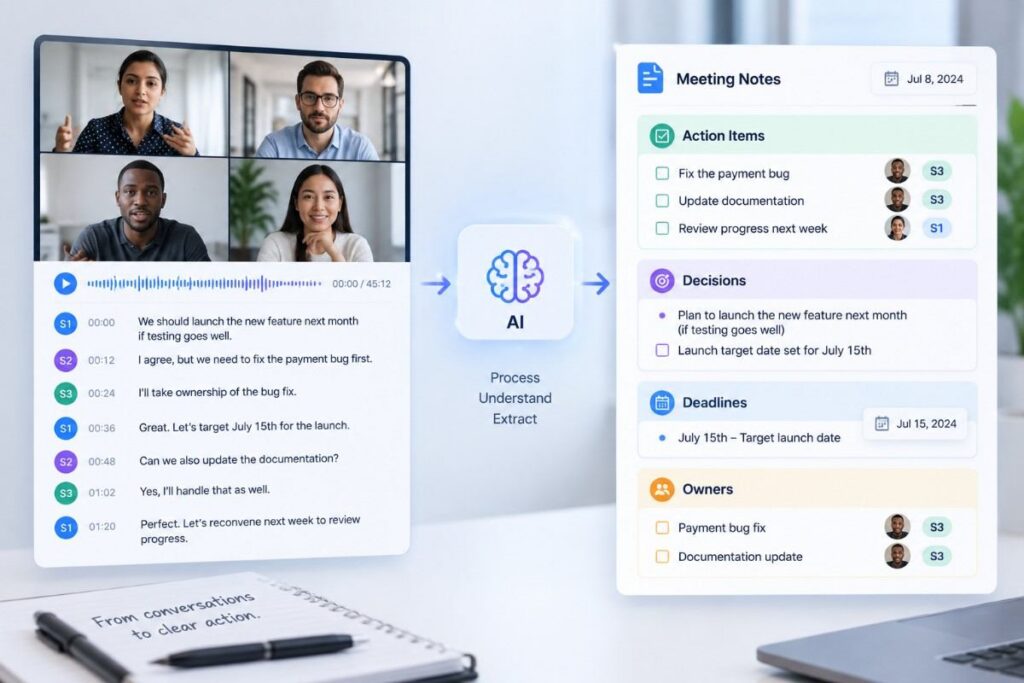
Modern AI note takers increasingly promise structured intelligence rather than plain transcription. They extract tasks, owners, deadlines, decisions, topics, questions, and follow-ups. Every extracted field needs its own accuracy measurement.
Precision and recall are particularly useful here. Precision asks how many extracted action items were genuine action items. Recall asks how many genuine action items the system successfully captured.
Suppose a meeting contains 10 real action items. The AI identifies eight correctly but also generates two tasks that nobody assigned. Recall is 80%, while precision is also 80%. Looking at both metrics prevents teams from improving one behavior at the expense of another.
The same methodology can be applied to decisions, dates, names, follow-up questions, and other structured outputs.
Build an Accuracy Scorecard Instead of One Magic Number
There is a strong temptation to advertise an AI note-taking application as “95% accurate.” Without explaining what that percentage represents, the number is nearly meaningless.
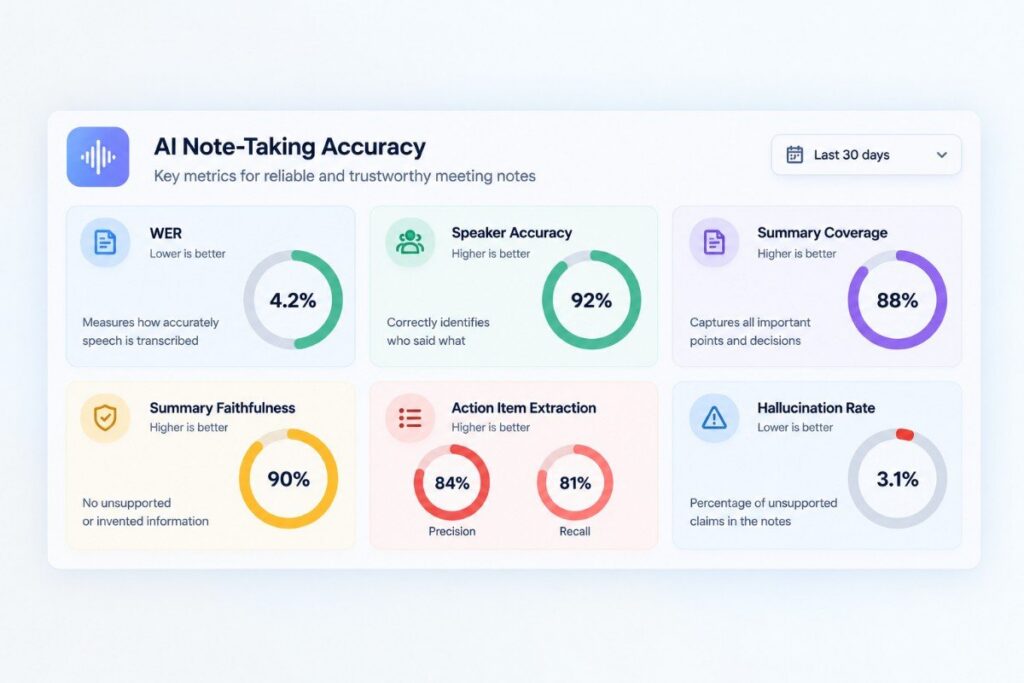
A more mature approach uses an accuracy scorecard containing multiple dimensions. A team might track transcription WER, speaker attribution accuracy, summary coverage, summary faithfulness, action-item precision and recall, deadline extraction accuracy, and hallucination rate.
Weights can then reflect the product’s use case. A note-taking tool designed for lectures may prioritize transcription and topic coverage. A meeting assistant used by enterprise teams may place greater weight on decisions, action owners, deadlines, and speaker attribution.
This also makes regression testing significantly more informative. Instead of discovering that “accuracy dropped by 2%,” engineers can see exactly which capability deteriorated after a model, prompt, preprocessing, or infrastructure change.
Use Human Evaluation Where Automated Metrics Fall Short
Automated evaluation is essential for scale, but human review remains extremely valuable for semantic quality. Language is full of ambiguity, implication, humor, corrections, and context that simple metrics can struggle to judge.
Human evaluators should work from a defined rubric rather than personal impressions. Reviewers can score factual correctness, completeness, relevance, attribution, clarity, and severity of errors against agreed criteria.
Consistency matters here. If one reviewer considers a missing minor detail a serious failure while another ignores it, the evaluation dataset becomes noisy. Calibration exercises and examples of acceptable versus unacceptable outputs help reviewers apply standards consistently.
Human evaluation can also be used strategically rather than manually reviewing every test. Automated metrics can cover large regression suites while human reviewers investigate representative samples, edge cases, and high-risk failures.
Test Accuracy Over Time, Not Just Before Launch
AI systems are not static. Model upgrades, prompt changes, audio preprocessing adjustments, new integrations, and third-party API updates can alter output quality unexpectedly.
That makes accuracy testing a continuous QA activity. A strong benchmark dataset should become part of the regression suite and be rerun whenever meaningful system components change.
Teams should also monitor production signals. User corrections, edited summaries, deleted action items, speaker-name changes, and repeated regeneration attempts can reveal accuracy problems that laboratory datasets missed.
Over time, those real-world failures should feed back into the test dataset. The result is a benchmark that evolves alongside the product instead of remaining frozen around idealized launch conditions.
Segment Results Instead of Trusting Averages
Average accuracy can hide exactly the failures users care about. An application might perform brilliantly on clear English audio but struggle badly with specific accents, noisy rooms, domain terminology, or conversations involving five or more speakers.
Segmenting results exposes these weaknesses. Compare accuracy by language, accent, device, audio quality, meeting length, number of speakers, industry vocabulary, and feature type.
This is especially important when releasing improvements. A new speech model could improve overall WER while making recognition of technical product names worse. Looking only at the global average would label the release a success.
Good QA asks a more demanding question: Who experienced the improvement, and where did performance get worse?
Define Accuracy Thresholds Around User Risk
Not every AI note-taking product requires identical accuracy standards. The acceptable threshold depends heavily on what users do with the output.
A casual personal note assistant can tolerate errors that would be unacceptable in software used to document important client commitments or operational decisions. Teams should therefore define pass/fail thresholds according to user impact and error severity rather than choosing arbitrary industry-wide percentages.
High-risk fields such as dates, monetary values, decisions, names, and assigned responsibilities may require stricter thresholds than general conversational text. This risk-based approach keeps testing focused on failures that can actually damage trust, productivity, or decision-making.
Accurate AI Notes Require More Than Accurate Transcription
The best way to measure an AI note-taking app is to treat it as a complete information system. Start with transcription, but continue through speaker attribution, semantic fidelity, summary coverage, hallucinations, action extraction, deadlines, and real-world edge cases.
Most importantly, build repeatable benchmarks. An accuracy measurement is useful only when the same methodology can be applied to the next model version, product release, integration, and dataset.
At Testiva, we see effective AI QA as the discipline of turning “the output looks right” into measurable evidence that the system behaves reliably under realistic conditions. For AI note-taking products, that means testing not only whether the application heard the conversation, but whether it preserved what the conversation actually meant.
When your users depend on AI-generated notes to remember decisions and take action, that distinction is everything. Start your QA journey today and build accuracy into the product before your users have to discover the gaps themselves.