




Latest Insights
Ambient AI Testing Framework for Healthcare: Building Trust Into Invisible Clinical Intelligence
- Oct 20, 2026
- Sajid M.
- Ambient AI Testing Framework for Healthcare

Healthcare AI is becoming quieter. Instead of asking clinicians to stop, open another application, and interact with an obvious AI interface, ambient systems listen, interpret, summarize, document, and trigger workflows in the background. That invisibility is precisely what makes ambient AI powerful and unusually difficult to test. A system can feel effortless while making subtle mistakes with serious clinical consequences.
For healthcare organizations, conventional software testing is no longer enough. Ambient intelligence demands continuous validation across speech, context, workflows, integrations, privacy, and AI behavior. At Testiva, our AI and software QA testing approach addresses this broader quality surface, helping teams examine not simply whether an application works, but whether intelligent behavior remains dependable when exposed to real healthcare complexity.
What Makes Ambient AI Different From Traditional Healthcare Software?
Traditional healthcare software usually follows explicit interactions. A clinician clicks a button, enters information, submits a form, or requests a specific operation. Testers can map those actions to expected outputs and determine whether the application behaved correctly.
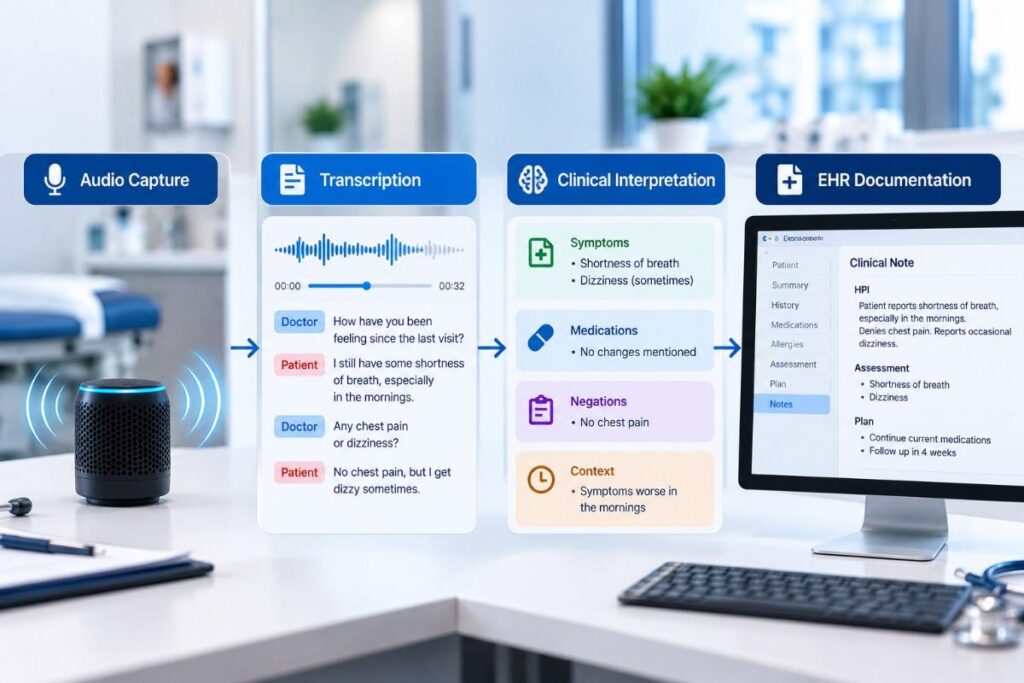
Ambient AI changes that model. It can capture conversations, identify speakers, interpret medical terminology, infer context, create clinical notes, suggest actions, and transfer information into connected systems with minimal direct interaction. One clinical conversation may therefore activate several AI models, APIs, data transformations, and workflow rules.
The testing challenge becomes multidimensional. Did the system hear the conversation correctly? Did it attribute statements to the right speaker? Did it distinguish a confirmed diagnosis from a hypothetical condition? Did it omit irrelevant small talk? Did the generated documentation accurately represent what occurred?
A technically successful API call does not answer those questions. Healthcare teams need a framework that tests the entire chain from ambient input to clinical output.
The Core Architecture of an Ambient AI Testing Framework
A robust framework should treat ambient AI as a connected decision pipeline rather than an isolated model. Every stage introduces its own failure modes, and an error near the beginning can propagate through everything downstream.
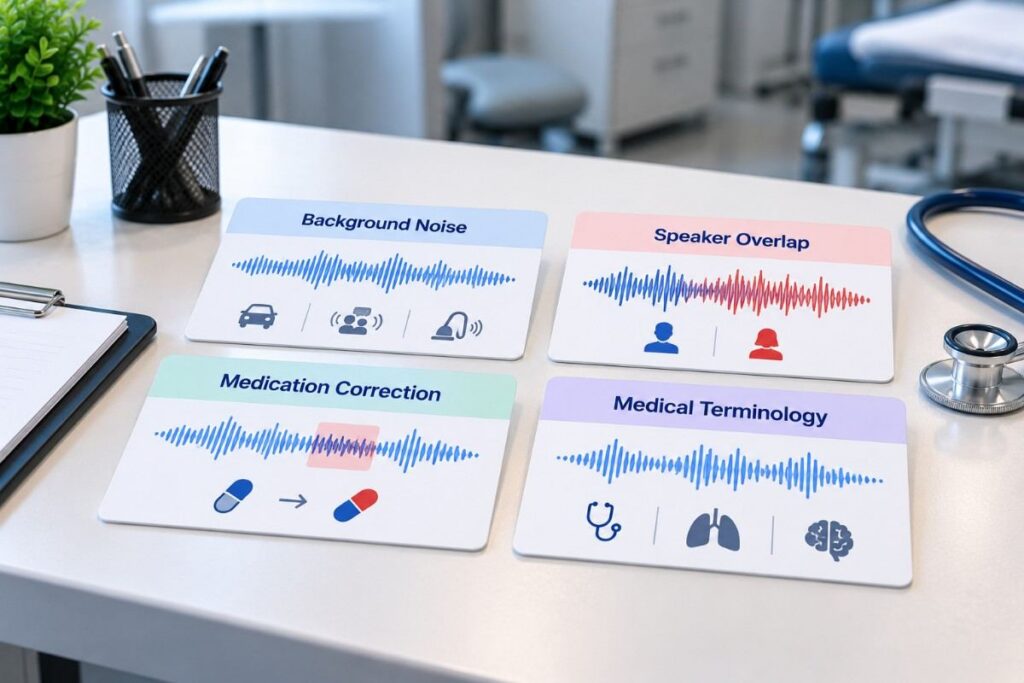
The framework starts with input validation. Audio quality, accents, overlapping speech, background noise, abbreviations, medication names, specialist terminology, and incomplete sentences should all be represented. Testing only pristine recordings produces confidence in laboratory conditions rather than confidence in healthcare environments.
Next comes interpretation testing. The framework evaluates whether the AI preserves clinical meaning, identifies relevant context, distinguishes speakers, understands negation, and avoids introducing unsupported information. “The patient has no history of seizures,” for example, must never become documentation indicating a seizure history.
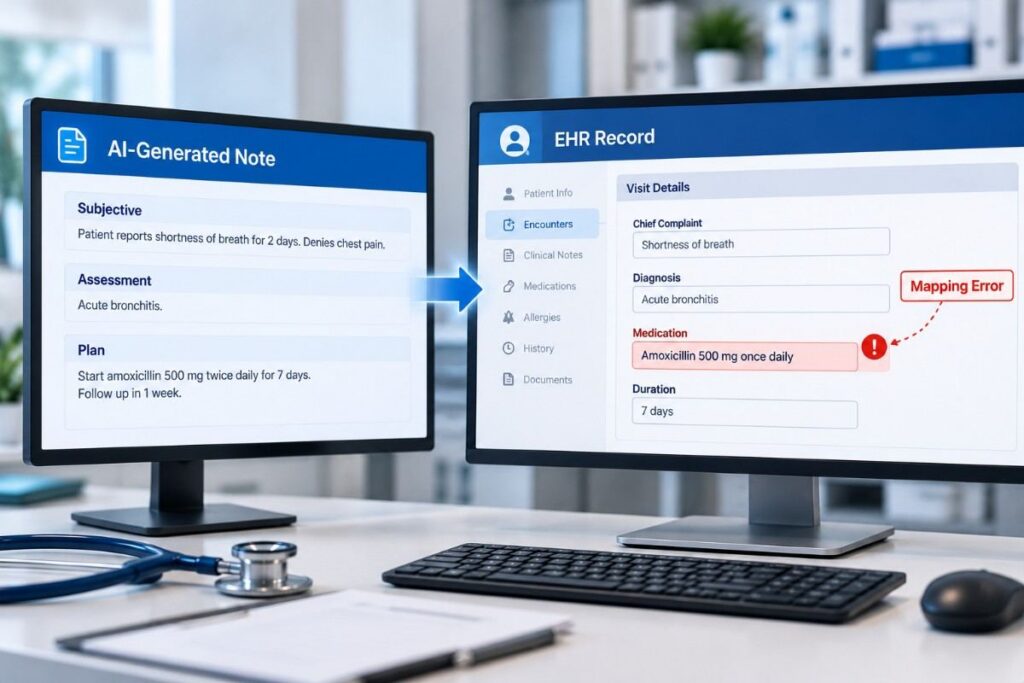
The final layers validate generated outputs, system integrations, and resulting workflows. A clinically accurate summary can still create risk if information is mapped to the wrong field, associated with the wrong patient, duplicated, truncated, or transmitted incorrectly.
Clinical Accuracy Must Be Tested Beyond Word Matching
One of the biggest mistakes in ambient AI QA is treating transcription accuracy as a sufficient quality metric. A transcript can contain nearly every spoken word and still misrepresent the clinical encounter.
Healthcare language is contextual. Statements may refer to family history, previous conditions, suspected diagnoses, ruled-out possibilities, or medications that a patient stopped taking. An AI system must preserve these distinctions when converting conversation into structured documentation.
Testing should therefore measure semantic and clinical fidelity. Expected outputs can be evaluated against carefully constructed reference cases that capture diagnoses, symptoms, medications, dosages, allergies, temporal relationships, negations, and uncertainty.
We also need to test omission and invention separately. Missing a relevant symptom is fundamentally different from fabricating one. Both are quality failures, but they require different detection strategies, severity models, and remediation paths.
Build a Scenario Library That Resembles Actual Healthcare
Ambient AI cannot be validated effectively with a handful of idealized conversations. A mature framework needs a scenario library representing the messy variability found in clinical environments.
Consider a consultation where a patient changes the subject repeatedly, a caregiver answers some questions, alarms sound nearby, and the physician uses shorthand. Now compare that with a telehealth session affected by network instability or a specialist encounter filled with domain-specific terminology. Each environment stresses different parts of the system.
Scenario design should also cover rare but high-impact conditions. Uncommon medication names, contradictory statements, corrections made late in an encounter, ambiguous pronouns, and rapidly spoken dosage instructions can expose weaknesses that average-case testing hides.
Synthetic test data is particularly useful for expanding coverage without unnecessarily exposing real patient information. Carefully designed synthetic encounters allow QA teams to introduce controlled variations and know exactly what the AI should recognize, ignore, or document.
Test the AI for Context, Not Just Correct Answers
Generative and probabilistic systems complicate the familiar idea of an expected result. Two acceptable summaries may use different language while preserving exactly the same clinical meaning.
That means rigid string comparison is insufficient. Ambient AI testing needs evaluation criteria that examine factual consistency, completeness, relevance, structure, and adherence to clinical documentation requirements. Depending on the application, deterministic checks can be combined with semantic evaluation and qualified human review.
Context-window behavior deserves particular attention. Long encounters can cause models to underweight information mentioned earlier. Corrections may also create problems: a patient might initially say “10 milligrams” and later clarify that the dosage is “20 milligrams.” Testing should confirm that the final documentation reflects the corrected information rather than preserving both values indiscriminately.
Multi-turn reasoning should receive similar scrutiny. Ambient AI must maintain context without transforming assumptions into facts as conversations evolve.
Privacy and Security Are Part of Functional Quality
In healthcare, privacy cannot sit in a separate compliance checklist disconnected from QA. Ambient systems continuously handle highly sensitive information, often beginning with raw voice data before generating transcripts, summaries, and structured records.
Testing should examine data capture, transmission, processing, storage, access, and deletion. Teams need confidence that sensitive information appears only where intended and that permissions remain effective across every connected component.
Logging deserves special attention. Development teams need detailed logs to diagnose failures, but careless logging can expose patient information or model inputs. A secure testing strategy verifies both observability and appropriate data minimization.
Failure conditions matter too. What happens when authentication expires during an encounter, a downstream system becomes unavailable, or a request times out after processing has begun? Secure recovery should prevent accidental duplication, leakage, corruption, or cross-patient association.
Integration Testing Is Where Hidden Risks Surface
Ambient AI rarely operates alone. Its value often depends on connections with electronic health records, scheduling platforms, clinical applications, identity services, messaging tools, and other healthcare infrastructure.
Every integration creates assumptions about formats, identifiers, timing, authentication, field limits, and workflow states. Those assumptions need explicit testing. A flawless AI-generated note becomes useless if an integration truncates it or attaches it to an incorrect record.
Contract testing can verify whether APIs continue to exchange data according to agreed schemas. End-to-end testing then determines whether the entire workflow behaves correctly from captured conversation through final destination.
Resilience testing should deliberately introduce delayed responses, malformed data, temporary outages, duplicate events, and partial failures. Healthcare systems cannot assume perfect connectivity, so ambient AI must fail predictably and recover safely.
Performance Testing Must Reflect the Clinical Experience
Speed matters differently in ambient healthcare applications. A delay of several seconds might be harmless in one workflow and disruptive in another. Performance targets should therefore be connected to clinical expectations rather than arbitrary technical benchmarks.
Teams should measure latency across the complete pipeline, including audio processing, model inference, downstream services, integrations, and user-interface updates. Testing each component independently can hide cumulative delays that clinicians experience as one slow system.
Concurrency is equally important. Performance may look excellent during a small pilot and deteriorate when hundreds of encounters occur simultaneously. Load and stress testing can reveal bottlenecks before wider deployment.
The objective is not merely maximum speed. It is predictable responsiveness under realistic conditions, with graceful degradation when infrastructure or external services experience pressure.
Continuous Evaluation Is Essential After Release
Ambient AI testing does not end when production begins. Models, prompts, workflows, integrations, clinical terminology, and usage patterns evolve. A system that performed well during initial validation can regress without an obvious software crash.
Continuous evaluation creates an early-warning system. Teams can maintain benchmark datasets and rerun them whenever models, prompts, configurations, or dependencies change. Results can then be compared against established quality thresholds.
Production monitoring should complement pre-release testing by identifying unusual failure patterns, latency changes, integration errors, and shifts in output quality. Feedback from clinicians can also reveal problems that automated metrics fail to capture.
The critical principle is controlled evolution. AI systems will change, but healthcare organizations should know whether each change improves quality, preserves it, or introduces unacceptable risk before that change reaches patients at scale.
From Test Automation to an Ambient AI Quality System
The strongest testing framework combines automation with deliberate human judgment. Automation provides repeatability, scale, regression coverage, and fast feedback. Human expertise remains valuable for ambiguous clinical meaning, usability, unusual scenarios, and outputs where correctness depends heavily on context.
This combination can be organized into quality gates across development and deployment. Deterministic checks validate schemas, APIs, permissions, and known rules. AI-focused evaluations measure semantic fidelity and hallucination behavior. Performance and resilience suites challenge infrastructure, while expert review examines clinically sensitive edge cases.
The result is more than a collection of test scripts. It becomes a quality system capable of evaluating how ambient intelligence behaves across technology, clinical context, and real-world uncertainty.
Reliable Ambient AI Starts With Testing the Invisible
Ambient AI promises something healthcare technology has pursued for years: software that reduces interaction overhead rather than adding to it. But when technology disappears into the background, its mistakes become harder to notice as well.
That makes comprehensive QA foundational. Healthcare teams need to test what the AI hears, what it understands, what it generates, where the information travels, how quickly workflows respond, and how safely the system behaves when conditions become unpredictable.
At Testiva, we approach ambient AI quality as an end-to-end engineering problem rather than a final pre-release checkpoint. The goal is straightforward but demanding: intelligent healthcare software should remain accurate, secure, resilient, and useful beyond controlled demonstrations.
Building ambient AI is impressive. Building ambient AI that clinicians can depend on is the real engineering achievement. Start your QA journey today and unlock flawless delivery for the intelligent healthcare experiences operating quietly in the background.